Politics

Random entry RSS

  • Posted in:

    How did Republicanism lose its way in the 1960s?

    The IRA in the 1960s, led by Cathal Goulding the IRA Chief and Tomás MacGiolla who chaired Sinn Féin, initiated a reform towards radical democratic politics. This was supported by Seán Cronin, later an Irish Times correspondent, who had led the 1950s armed campaign. I know this because he contacted me in around 1959 after his release from internment, to discuss left-republican ideas which I had been promoting in the Plough, an innovative Left periodical of the time with trade-union links. I had earlier been associated with the Irish Workers League, a Marxist group which I had had a hand in setting up, with student-left support via the Trinity College Dublin Fabian Society. I was however seeking broad-left alternatives, and was supporting the Plough, avoiding the basically Stalinist Irish Worker League which superseded the Communist Party here for a while and was associated with Jim Larkin. In 1960 my TCD/Dublin Institute of Advanced Studies post-graduate research period in physics ended, and I worked in London up to 1963, when I returned to a job in Dublin. In London I had worked politically with the Connolly Association and interacted with Desmond Greaves, a pioneer Marxist focusing on national questions. Greaves had come up with the need to focus, in the Irish context, on the civil rights issue in Northern Ireland, as an escape from religious sectarian politics. After my return to Dublin, I cultivated links with the republican movement, initially via the Wolfe Tone 1963 bi-centenary events, which included broad-based seminars in the Mansion House. These were manifestations of the Goulding/MacGiolla/Cronin influence on IRA reconstructive reform. I interacted with the leadership and we came up with the ‘Wolfe Tone Societies’ concept as a promotional model for democratic reform. From this I went on to cultivate an active role in the leadership of a reforming republican movement, in which the Northern IRA activists set themselves up openly as Republican Clubs and supported the Civil Rights Movement. We now have the problem: how did this evolve in the 60s and how and why did it occasion the militarist ‘Provisional’ split? I will not attempt this here and now, but I did try with my book ‘Century of Endeavour’ published initially in the US in 2003, with a revised edition in Ireland in 2006. This covers the century from my perspective and that of my father, a Tyrone Presbyterian supporter of all-Ireland Home Rule in 1913, who made his subsequent career in the Free State and in 1938 helped to set up the Irish Association to promote an all-Ireland cultural identity in the spirit of the de Valera Constitution. There are 576 pages in ‘Century of Endeavour’ and the period of 1960s activism takes up about 150 pages for the 60s decade. There is much detail in the book about the 1960s politics of republican transformation, and I feel I need help in analysing the record of how it evolved into a ‘near miss’ of what now has, I hope, been achieved by Adams et al but could have happened then. Certainly I believe the split led by O Brádaigh and MacStiofáin who resisted moves to end abstentionism from the British, Irish and Northern Ireland parliaments, to form the ‘Provisional IRA’, was a disaster! Will anyone interested in helping to research how the 1960s politics evolved into decades of mayhem, and the current complex ‘hard border’ problem, please e-mail me with some comments on the above overview; I am contactable via roy@rjtechne.org; please do not phone as my hearing aid is not phone-friendly. You can usually get the ‘Century’ book in libraries; it is also still on the market, but I have some copies here that I can donate to people interested in analysing critically how the 1960s political problems were nearly deals with without the use of the gun! Roy Johnston Dr Roy HW Johnston (born 1929) is an Irish physicist. As a Marxist member of the IRA in the 1960s he argued for a National Liberation Strategy to unite the Catholic and Protestant working classes. He wrote extensively for such newspapers as The United Irishman and the Irish Times, remaining as a member of the Official IRA after the split. Johnston left the stickies in 1972 after the assassination of Northern Ireland Senator John Barnhill and joined the Communist Party of Ireland, which he left in 1977. He was later a member of the Labour Party, serving on their International Affairs Committee, and is currently a member of the Green Party. He wrote a bi-montly science column for the Irish Times in the 1970s.

    Loading

    Read more

  • Posted in:

    Ourland

    The return of the Irish economy is not an accident. The fact there were no riots when in collapsed in 2008 in a sea of imploded vested interests was no happenstance. The fact this country has divided power since its instigation between Fianna Fáil and Fine Gael wasn’t just luck. The repetition of the failures of the national spatial strategy in the National Planning Framework was predestined. The failure of any party to take on the rights of property and make them subject to the common good isn’t a random thing, it’s determined. This country isn’t Germany which went through industrialisation, Nazification and deNazification, and learnt that politics and the common good is a serious business. Nor are we like the US which takes itself so seriously that it can elect a politician on an America First platform, elect someone who’s utterly wrong about everything. Or the UK which tossed a reputation forged over a millennium for empirical pragmatism into the fires of Brexit because it had a serious gripe with Institutional Europe (and Johnny foreigner). Ireland lost half of its people in the famine five generations ago. There is a strong folk memory of apocalypse which imbues a national fear that workaday issues aren’t important, that politics doesn’t really matter, that anything good is transient, that there’s no point planting a tree, a flower. We also suffer from the residual malaise of the colonised. For 700 years decisions were taken not in the common good but in the interest of an alien political entity. Service for the government and its establishment was not service for the common good. This country is sceptical about the motivations of its politicians, and its politicians do not see their roles as ethical or principled. This can generate corruption. We also suffer from the overhang of over a millennium of pious religious adherence though arguably we are overcoming that fast, almost – though not quite – too fast. Ireland is not a serious country like Germany. Yes we’re big on the GDP that every country wants. Certainly, we can do capitalism if you ask us too, but it’s only because that’s a doctrine that depends on an independent competitive detachment. You don’t have to buy in to anything particular to practise capitalism. We’re good at giving international commerce and its IT companies and vulture funds what they want: from planning permissions to an utterly unethical system of corporate taxation. You never hear anyone in public life talk of morality or ethics, you rarely hear mention of the public interest or the common good. Or philosophy: we’re sort of middlebrow. It is taken for granted that the combined private interests of all somehow amounts to the public interest. It is assumed the needs of the present outweigh concerns for the future. We don’t have a language for ugliness even though we forge it everywhere. We don’t care about planning, we couldn’t give a fiddlers for the environment. We’re the worst climate-change offenders in Europe, one of the few EU countries to miss its 2020 emission reduction targets under the EU effort-sharing decision, the worst per person in Europe. We love to litter. We’ve filled the countryside with unsustainable houses, allowed Dublin to leapfrog into much of Leinster. We’re going continue doing it. It would be draconian to tell anyone they can’t actually build somewhere. Climate, the environment and planning are at the sharp edge of our psychological weaknesses. We understand when someone fleeces the public purse – sure we’d do it ourselves. Even the parties of the left can’t bring themselves to support a property tax. For that would impinge on “the family home”. Does Richard Boyd Barrett not realise that that phrase betrays a millennium of weakness? Strangely we never hear that other assets shouldn’t be taxed – that stocks and shares shouldn’t be taxed because they’re “the family portfolio” but mention the family home in Ireland and a ‘Land League’ and a host of people who don’t realise they’re not leftists will come running to your aid, in your home or in the courts, even if you’re looking to remain in a gilded mansion, even if you have three homes. Charlie Haughey, Bertie Ahern, Enda Kenny, have been replaced with shiny new faces – Leo, the Simons, Eoghan. These tyros may have had radical, progressive or interesting ideas before they got into politics but it’s not an accident that they get beaten out of them by the time they stand for election, for the party. They’ll toe the party line, not the thinktank line on everything from housing to the drugs crisis to healthcare. They bought into Fine Gael (it might as well have been Fianna Fáil) atavistically. Sit on a bus in England or the US and the quality of the conversation overheard (‘innit?’, ‘So I’m Like’) shocks and bores. Not here. You’ll never meet a complete moron in Ireland. The left may not yield a property-tax agenda but then again the right hasn’t managed to muster much of an anti-immigration or even privatisation agenda. Most Irish people have lots of common sense, a fairly global outlook, a sense of humour and a cultural hinterland of some sort. Ireland isn’t serious enough to keep its quality of life as high as that in countries where the common good is the transcendent driver. But then again it’s not serious enough to say no to gay marriage – sure everyone likes someone who’s gay. Or serious enough to elect a Fascist or a tub-thumper. Ireland is a peculiar place. It’s not the worst place. But its history holds it back, and will for generations to come.

    Loading

    Read more

  • Posted in:

    Panoramaphosa

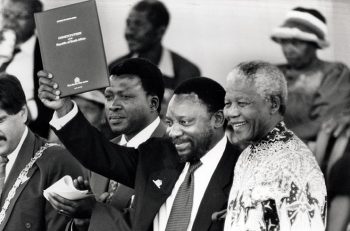
    On a recent drive to Cape Town International airport the ‘Rainbow Nation’ was nowhere to be seen. Instead it was like old times when I was the Irish Times Correspondent there in the 1990s. The scene carried a strong message of the work that faces the country’s new President Cyril Ramaphosa. Along the motorway known as ‘Settlers Way’ there was a clear run out of town to deposit the hired car and catch the early-morning flight to Lanseria north of Johannesburg. The other carriageway, the one carrying traffic into the city centre, told an entirely different story. On that side the traffic was chock-a-block and consisted almost in its entirety of white minibuses carrying black workers from the vast townships of Gugulethu, Langa and elsewhere. They were travelling in their thousands to service the needs of the white population of the city and its wealthy suburbs. Earlier that week in Franschhoek, a tourist and wine-producing town , it was also like old times. The restaurants were full of white folk of retirement age being served by waiters from the Black and Cape Coloured Communities. In Johannesburg restaurants things were different but only slightly. There were tables occupied by white clients and tables occupied by black clients but no tables at which blacks and whites dined together. These casual and anecdotal observations don’t tell the full story but they are an indication of how deeply-ingrained apartheid and its legacy have been in South African society. It will take a very long time and a great deal of patience to make significant changes but there is no doubt that the country’s new President, Cyril Ramaphosa, is a patient man. -Nelson Mandela indicated that Ramaphosa was his preferred successor but the African National Congress (ANC) was, and still is, a very complicated organisation and as in most African countries ethnic loyalties played their part in the succession stakes. Ramaphosa is a member of the small Venda nation. His opponent for the vice- presidency and eventual presidency, Thabo Mbeki, was a Xhosa, a group that produced Mandela himself, his political partners Oliver Tambo and Walter Sisulu as well as the influential churchman Archbishop Desmond Tutu. Nelson Mandela merely indicated a preference for Ramaphosa but his estranged wife Winnie mobilised the ANC Youth League behind Mbeki’s candidacy. Ramaphosa’s time for campaigning had been limited due to his involvement in negotiations on a new Constitution. All these factors: tribes, internal ANC politics and time constraints played their part in his defeat by Mbeki. Ramaphosa had to wait until December of 2017 before he could make his move. Mbeki, a small bookish man with a penchant for the poetry of W B Yeats, fell under the spell of American pseudo-scientists who peddled the theory that HIV did not cause AIDS. The result for South Africa was disastrous but the ANC’s response was predictable. As a former liberation movement, loyalty had been vital to the organisation’s very existence during the struggle against the apartheid regime but it became a hindrance to progress after the party came to power. ANC loyalty kept Mbeki in power amid a catastrophic AIDS epidemic, just as it kept Jacob Zuma in a presidency that smacked of intense corruption and maladministration. After Mbeki had won the nomination to become Mandela’s vice-president, Ramaphosa made a rare rash decision. He refused to attend Nelson Mandela’s presidential inauguration in Pretoria in 1994. From then on, however, he matured and played a political waiting game, concentrating on business opportunities that made him one of South Africa’s wealthiest men with a personal fortune of more than $550 million. During that time Zuma, a member of the Zulu nation, the country’s largest ethnicity, became entangled in a web of deals with the Guptas, a wealthy Indian business family. Corruption allegations abounded and a new glossary of political terms was spawned, the most prominent of which was ‘State Capture’ suggesting much more than personal corruption. The phrase indicates the belief that the entire State and its institutions had been ‘captured’ by the Guptas and their allies in the ANC. And Zuma was not the only ‘captured’ ANC member. In Parliament, as the popular newspaper City Press recently put it, six ministers sat in what it has been tempted to call the “Gupta Corner” of the Government front bench. Ramaphosa has recaptured the cabinet in a quick reshuffle in order to get moving but by doing so has increased tensions and enmity within his own party. The ANC’s traditional loyalty to its leader in this instance could provide a positive counteraction to its negative effects in the past. He has got off to an energetic start, setting out on early-morning exercises in his Ronald McDonald socks in various parts of the country, ranging from the promenade at the prosperous Cape Town suburb of Sea Point, to the beach at East London; and on a long walk at 5.30 am in the Cape from the black Township of Gugulethu to the ‘coloured’ community of Athlone. In each case these were exercises in building up his profile in local communities as a man of the people instead of his image as a wealthy man who loves fast cars and good wine. In parliament his State of the Nation address was delivered without interruption, a very rare happening in a place where raucous heckling is frequent. In that address he touched on the country’s problems which he has vowed to solve. The education system is in a parlous state. Poverty abounds mainly in non-white areas but also amongst Afrikaans-speaking people who have always had a “poor white” section of their community. Health services need reform. Public transport is almost non-existent with Uber taking over its role especially in white areas. There have been a number of murders of white farmers, and Ramaphosa caused raised eyebrows among them by stating in his address that he would pursue the expropriation, without compensation, of land that had been confiscated from blacks. Right-wing commentators saw their chance and

    Loading

    Read more

  • Posted in:

    The cost of costs

    Real justice requires access to justice, which requires effective access to courts, which requires that courts be accessible without the threat of prohibitive costs. Some 90%, or an even higher percentage, of people in Ireland have no realistic access to justice, due to the prohibitiveness of the costs associated with legal actions via the courts. The Irish system of access to justice is permeated with unfair procedures, unconstitutional laws, and conflicts of interests, which means that most court users in Ireland are vulnerable users. BalaNCiNG CONFliCTiNG CONSTiTUTiONal RiGHTS: The English rule (Loser pays rule) on legal costs does not balance two conflicting rights – (1) the property rights of winning litigants, and (2) the right of persons to have access to the courts, without being threatened by unpredictable and prohibitive legal costs. Notionally, proponents of the English rule claim that winners are entitled to be 100% vindicated, and so be in a position to cover all their legal costs. However, this is a very narrow view, which fails to assess the big-picture consequences: (a) winners are also threatened, up to the point of winning, and can be threatened as defendants, in circumstances where they have no chance of recovery of costs from penny-less plaintiffs. (b) the English rule creates all sorts of conflicts of interests and market distortions, which enormously inflate the costs payable. (c) wealthy litigants can threaten persons of lessor wealth, with adverse costs, such that the case is determined more often by issues of fear, rather than justice. (d) the state, and most government actors become unaccountable, as the decision makers are immune from costs (lumped ontaxpayers, often, with little transparency), but can pursue political goals, or engage in abuse of power, with no financial downside, and can still threaten all challengers with financial ruin; this inequality of arms, means that citizens are generally unable to challenge the unconstitutional laws and conduct of government. HeNCe, THe eNGliSH RUle iS NOT COMPaTiBle WiTH a Real CONSTiTUTiONal deMOCRaCy: Costs Allocation Rules incentivise Unfair Adjudication Rules which also incentivise Inefficiencies into the system. Because the government is allowed to intimidate its challengers with unlimited adverse costs, it then wants to maximise those costs, so as to bolster its threat and avoid oversight; High Legal Costs has been the default weapon of choice for all governments since the commencement of the state; the “Big Stick” is maintained to bounce its opponents out of the ring, and this has so far been achieved with little condemnation by international institutions, which have largely failed to recognise the stealth threat that prohibitive costs represents as a threat to the rule of law. The Big Stick undemocratically deters citizens and/or NGOs from challenging the government when it passes unconstitutional laws, or acts unconstitutionally – this allows the government to pander to its own electoral constituency while depriving less well represented persons access to rights protection, leading to violations of minority rights and individual rights. When populist demands call for adjudicative processes which affect specific rights of connected groups, QUANGOs are often created in order to parry off populist demands for accessible justice. The substitute QUANGO justice can rarely be as independent as courts, and the outcomes are often secretised, thus bypassing democratic oversight. Hence, the government passes unfair laws for legal costs adjudication, so as to frighten all challengers – this allows it to exercise power with minimum oversight. THe Need FOR CCOS (COSTS CaPPiNG ORdeRS) In the ex parte application by Dymphna Maher [2012], the applicant effectively sought an assurance from the High Court that any adverse costs would not be prohibitively expensive, if her lawsuit was subsequently deemed not to have fallen under the ambit of the special costs regime (related to some environmental cases). Judge Hedigan insisted that there was no legal authority to permit him to make the order sought by the applicant. However, he observed that: “[It was] very arguable that the absence of some legal provision permitting an applicant to bring such a motion, without exposure to an order for costs, acts in such a way as to nullify the State’s efforts to comply with its obligation to ensure that costs in certain planning matters are not prohibitive. As things stand, I have no power to change this”. This case along with 12 other cases was appealed to the Supreme Court (SC) on an ex parte basis – where only one of the parties is heard. The SC held that it could not provide such an assurance, on an ex parte basis, as the other side (the EPA) needed to be heard first. The SC decision in the Coffey case means, in effect, that any person seeing to access the courts in Ireland is threatened with financial ruin, even if just seeking a CCO. The court failed proportionately to balance the right of access to the courts as a right conflicting with the property rights of government, particularly in the context of the need for real separation of powers. The judicial sphere of power is rendered inaccessible to most citizens, when the loser-pays rule is applied to challenges to executive power, and so the judicial sphere of power is inappropriately diminished; this undermines the checks and balances necessary in a liberal democracy between the legislative, executive an judicial functions. SePaRaTiON OF POWeRS By dividing power between these traditional three spheres, the courts, the government, and the Oireachtas, we help to disperse power and make less probable the accumulation of power to one person, or a small elite, as often happens in what are referred to as illiberal democracies. Diagram 1, above, displays the traditional Montesquieu view of three spheres of power. However the (Montesquieu) tripartite division of power, is a poor reflection of reality. This is largely because it generally fails to engage with the level of real power held by each of the three spheres, in practice. A second flaw, is that there should really be five spheres of power, and not three; the people should be seen

    Loading

    Read more

  • Posted in:

    ‘Reclaiming the State – a Progressive Vision of Sovereignty for a Post-Neoliberal World’

    ‘Reclaiming the State – a Progressive Vision of Sovereignty for a Post-Neoliberal World’ is the title of what will surely come to be seen as one of the more important social science works of our time (Pluto Press, 2017, €23). In it Australian economics professor William Mitchell and Italian political theorist Thomas Fazi reconceptualise the Nation State as a vehicle for progressive change. They issue a highly topical challenge to progressives, leftwingers and genuine liberals to come to the defence of national sovereignty and not cede that issue to the populist right. For the thirty years from the end of World War 2 to the 1970s a left-oriented Keynesian consensus held sway in the developed world. Then, for reasons this book describes, the mainstream Left as represented by the mass Labour and Social Democrat parties in Britain, France, Germany and elsewhere, and by the Democrats in the USA, ideologically disarmed themselves before rampant neoliberalism. Key neoliberal propositions were that national sovereignty had become irrelevant in today’s increasingly complex and interdependent international economy. Globalisation had made individual States increasingly powerless in face of market forces. The growth of multinational companies and the internationalisation of finance had eroded the ability of national States to pursue progressive social and economic policies and deliver prosperity for their peoples. Consequently the only hope of meaningful change was to “pool” State sovereignty and transfer it to supranational institutions such as the European Union, thereby regaining at supranational level the sovereignty that has been lost at the national level. Many who regarded themselves as progressive and on the Left came to share these views, stressing how neoliberalism has involved a retreat or a hollowing-out of the State, which found itself increasingly powerless in face of market forces. To cover their abandonment of criticism of capitalism as a social system, progressives and Left parties generally focused instead on issues such as racism, gender, homophobia, multiculturalism and environmentalism – social marginality being no longer described and opposed in terms of class but rather in terms of identity. This book analyses the political timidity, ideological opportunism and intellectual fallacies involved in this surrender. For example the decades of neoliberalism have seen little or no decline in State spending as a percentage of GDP – a key measure of the strength of the State in society. Even supposedly neoliberal governments such as Reagan’s or Thatcher’s did not reduce overall public spending, although they altered its composition, for example spending more on weaponry and less on welfare. As the authors point out, “even though neoliberalism as an ideology springs from a desire to curtail the State’s role, neoliberalism as political-economic practice has produced increasingly powerful interventionist regimes.” Neoliberalism has entailed extensive and permanent intervention by States and their Governments: for example the liberalization of goods and capital markets, the privatization of resources and public services, deregulation of finance, the reduction of workers’ rights in collective bargaining, cuts to social programmes and the lowering of taxes on wealth and capital at the expense of the middle and working classes. The authors show how neoliberal ideology, in its official anti-State guise, has been little more than a convenient alibi for what has been an essentially political and State-driven project aimed at placing the commanding heights of economic policy in the hands of capital and especially Finance Capital. Far from neoliberal globalisation making the Nation State out of date, all its key elements were the result of choices deliberately and consciously made by national governments as their ruling elites set out to limit State sovereign rights. The authors call this a process of “depoliticisation” of policy. Its principal elements were: the reduction of the power of parliaments via-a-vis the executive; making central banks formally independent of government; adopting constitutional limits on debt-to-GDP ratios and public spending, as with the 2012 Stability treaty, thereby limiting what politicians can do at the behest of their voters; enforcing free movement of goods and capital, and, above, all shifting government powers from the national level to the supranational. Why did national politicians choose to ‘tie their hands’ in this way ? As the EU case epitomises, the creation of these self-imposed ‘external constraints’ allowed national politicians to reduce the political costs to themselves of neoliberal policies that were generally unpopular. It enabled them to ‘scapegoat’ these externally imposed rules and supranational and ‘independent’ institutions. These could be publicly presented as an inevitable outcome of the new harsh realities of globalisation, about which supposedly little or nothing could be done at national level. In this way national government choices and State macroeconomic policies were insulated from popular criticism and protest. Mitchell and Fazi contend that the war on sovereignty has been in essence a war on democracy. This process was brought to its most extreme in Europe where the 1992 Maastricht Treaty that created the euro-currency embedded neoliberalism into the EU’s very fabric, effectively outlawing in supranational EU law the Keynesian policies that had been commonplace in the previous decades. Given neoliberalism’s war against State sovereignty it is only natural that the revolt against neoliberalism should first and foremost take the form of demands for a ‘repoliticisation’ of national decision-making processes – that is, for more democratic control over politics and particularly over the destructive effects of the free movement of capital, goods and labour unleashed by neoliberalism. This necessarily can only be done at the national level by means of the national State in the absence of effective supranational mechanisms of representation. The latter are impossible to bring into being as long as people’s primary political identification is with their own nationality and State. Supranational structures will always lack democratic legitimacy because people do not identify with them as their own. The case of Iceland shows what even a tiny country can do when it used its State sovereignty, an independent currency, capital controls and sequestration of its banks to overcome an extreme economic crisis. The authors argue that progressives and the political Left should not regard Brexit –

    Loading

    Read more

  • Posted in:

    Dumb greens and unions

    One of the things historians may dwell on is how the key December 2017 and February 2018 eu drafts of the Brexit agreement came to take the forms they did. It is all the more important since the inept UK Government of Theresa May failed to produce its own draft, though it might have been expected to do just that. Of course that suggests a lack of seriousness on the UK’s part about the agreement and perhaps that the EU Drafts may not go as far as we, and the EU, think, but that is a separate matter. In particular it is interesting that the drafts – the first a draft political agreement, the second a draft legal agreement with the same substance enshrine the EU’s rules for the customs union and single market but not its rules for multifarious other spheres of eu activity that bind the UK while it remains a member of the EU: most notably on the environment, labour and consumer affairs. The body politic and commentators have missed the following: the UK could become the trading neighbour from hell by ignoring EU environmental, health, labour etc standards – exploiting the competitive advantage over the eu you’d expect from a country saving money by keeping these standards low. It is interesting is that so many dogs have failed to bark. One might have expected the British trade unions to be shocked at the potential dangers to workers’ rights if EU standards are abolished and they become subject to the whims of a hawkish Tory party. But they didn’t because, like the British Labour party of course, they can only think of the superior standards Jeremy Corbyn will bring to the sphere. This is self- absorbedly naïve. Corbyn will not be in power for ever and the Tories won’t be going anywhere. When they return they will not have to observe the comfort blanket that EU standards provide. We know well the frustrations of the Tory party over the years with what used to be known as the EU’s ‘Social Chapter’. Nothing is as certain as that they will not observe its prescripts on issues like maternity and overtime if they return to power in some post-Brexit outturn. There are occasional insights into this thinking but mostly the protagonists remain mute. Surprising too that the Irish unions have made so little noise about it but then the Irish Congress of Trades Unions and SIPTU are both challenged by having members and remits both North and South of the border. You’d think they’d be on the warpath. Environmentalists and Green parties have said little perhaps because typically they languish far from the vehicles of power and tend not to be as forensic or aggressive as the circumstances here demand. Village tried to provoke the establishment media, most of RTÉ’s and the Irish Times’ Europe, Northern Ireland and Environment correspondents etc (by twitter) into recognising their failure to cover this issue but – to a man – they’re too complacent, and probably too immersed in politics and economics, to think about social and environmental rights and rules. The issue is clouded as terms like “a common regulatory area on the island of Ireland” and “a single regulatory space on the island of Ireland…” in themselves don’t do justice to the fact that there are important areas that will no longer be regulated by the EU. It’s also a bit difficult for many people to get their heads around as “regulatory alignment” of Northern Ireland with the EU is only envisaged as a ‘backstop’ if the UK can’t strike a more wide- ranging deal with Ireland and if a technological border solution proves impossible. Of course with only a year left to Brexit it’s looking increasingly like neither of the two contingencies will come to pass. The easiest way to avoid the backstop is for the UK as a whole to remain in the customs union and the single market. But the UK government insists this will not happen. Because the contingencies are uncertain they were left out of the draft Withdrawal Agreement which is a strictly legalistic document, thought they had appeared in the December political draft – and they remain politically possible. It’s complicating too that the Tories and Brexiteers so vociferously think the common regulatory area described in the EU draft goes too far rather than not far enough – though of course they are referring essentially to economic matters, not to environmental and social matters about which they may care little. It is clouded because it may well be that no deal is possible. It is important to note that, despite occasional diplomatic pleasantries, there has been little progress on the central conundrum of the negotiations: if the UK leaves the EU trading bloc, then a customs border is needed either on the island of Ireland or in the Irish Sea. One is ruled out by the EU drafts, the other by the UK. Theresa May asked Brussels if Britain could stay in the bits of the single market that she likes and exit the bits that she does not. The EU doesn’t have to, and won’t, run with that – no matter how self-righteous Brexiteers fume. On this basis it is very possible the EU’s draft terms form no element of the (WTO) arrangement that the UK falls back on. And it is clouded because confusingly the Draft Withdrawal Agreement refers, in its Article 12, to the Environment. Most people (not you dear reader) glaze over a little when contemplating the diktats of a customs union and single market. The customs union is an agreement among members to charge the same import duties as each other and usually to allow free trade between themselves. The single market guarantees the free movement of goods, capital, services, and labour – the “four freedoms” – within the European Union. You couldn’t for example have goods which comprise some material, imported into Britain on the basis of a tariff-free agreement between Britain

    Loading

    Read more

  • Posted in:

    NIhillism

    It is forty three years since the now notorious Glenanne Gang murdered three members of the Miami Showband in July 1975. Two of the band survived -Stephen Travers and Des Lee. The Gang was made up of serving RUC and UDR personnel, plus members of the UVF. The leader on the night, the infamous Robin ‘the Jackal’ Jackson, was at the time in command of the UVF’s mid-Ulster Brigade. He was an ex-British-army soldier. Journalist David McKittrick attributes as many as 50 killings to Jackson, making him one of the most lethal, and most secretive, serial killers of the late 20th century you’ve probably never heard of. The gang is said to have been responsible for 120 murders, including those of the Reavey brothers and the O’Dowd family in January 1976. the next night the IRA murdered ten innocent Protestants at Kingsmill, another sectarian obscenity in Ulster’s murder triangle. Jackson was linked to the Miami Showband killings by the now defunct historical enquiries team in its 2011 report on the 1975 massacre. Jackson’s finger prints were found on the homemade silencer of a Luger gun used in the attack. The report also stated that Jackson claimed he had been “tipped off’” while in custody in May 1976 by an RUC Detective Superintendent, and that he “… should clear as there was a wee job up the country that I would be done for and there was no way out of it for me”. But Jackson didn’t “clear” anywhere; instead he went on to kill many more. Despite widespread rumours about Jackson’s killing career at the time and his virtual impunity from punishment, he remained practically untouched by the forces of law until his death in 1998, apart from a seven-year conviction in January 1981, of which he served only two. That may mean he spent two weeks per killing, in jail. John Weir a former member of the RUC and member of the gang, who was convicted for murder in 1980, called him probably the “best operator” during the troubles. In 1999 Weir made detailed allegations in an affidavit about security-force collusion, making disturbing suggestions about how Jackson and the Glenanne gang’s murderous rampage was not only known of, but also tolerated by, the security forces. Weir’s allegations were regarded by the 2006 Cassel’s report, an independent panel of international lawyers commissioned by the Pat Finucane Centreto look into collusion in the North, as credible. Others found him believable too, including the BBC’s ‘Spotlight’. The fundamental question though is: were Jackson and the Glenanne gang not only tolerated but actively orchestrated by elements of the British intelligence and security apparatus (MI5, Military Intelligence, RUC Special Branch) as a proxy counter-terror gang? For years it has been alleged that Jackson was a protected agent of the RUC’s Special Branch. The 2003 Barron report into the Dublin and Monaghan bombings, quoting British army whistleblower Colin Wallace, said as much. In his affidavit Weir implicated RUC Chief Inspector Harry Breen, who served as a sergeant in Newry and Banbridge in the 1970sas having direct knowledge of the Glenanne gang. More incredibly still, he claimed that Breen was supplying weapons to the gang through a far-right loyalist organisation called Down Orange Welfare. In a 2015 documentary on collusion BBC journalist Daragh McIntyre claimed that, while discussing the Glenanne gang, Jackson was “protected by one of the most senior police men in Northern Ireland”. Breen was later killed by the IRA in 1989. If he was referring to Breen, and given the geography, timing and Weir’s claims, it is very plausible that he was, it is an extraordinary allegation worth stating again – clearly. Was one of the most notorious sectarian killers in the troubles protected as a strategic asset by one of the most senior policemen in Northern Ireland ? Whatever about the alleged protection, Jackson enjoyed practical immunity from prosecution all through his killing years during the 1970s and 1980s. Why that was the case has. But more importantly, the deeper question is who or what was protecting, or directing, or encouraging, the senior policeman ? As early as 1974 Colin Wallace, quoted again in the Barron report, said that Jackson and other leading Mid-Ulster UVF members “…were working closely with SB (Special Branch) and Int. (Military Intelligence) at that time”. Journalist Paul Footand Yorkshire TV’s 1993 documentary ‘The Hidden Hand – The Forgotten Massacre’ both suggested convincingly that Jackson and his gang, with members of the Belfast UVF, perpetrated the Dublin Bombings a year before the Miami massacre from their Glenanne base. The final report into the bombings published in March 2004 signposted obliquely that, “The possibility that the involvement of such army or police officers was covered-up at a higher level cannot be ruled out; but it is unlikely that any such decision would ever have been committed to writing”. As many have also pointed out, it is inconceivable that James Mitchell’s farm in Glenanne, South Armagh, the gang’s well known and notorious epicentre, would not have been under constant surveillance given what was common knowledge about the gang at the time in security and intelligence circles. Mitchell was an RUC reservist. John Weir claimed that the house was constantly watched by both RUC special branch and military intelligence: “basically everybody knew what was going on there…military intelligence was more often in the house than I was” yet to be seriously rebutted. Unfortunately the Barron report was signicantly handicapped from the beginning in its search for the truth. The British government is said to have over 65,000 potentially relevant files about the bombings, of which only a handful were ever handed over to the Inquiry. Writing of the murky, devious and labyrinth world of counter-insurgency in the North, Wallace, in a letter dated August 1975, printed in the Irish Mail on Sunday, on 10 December, 2006, stated that, ”it would appearthat loyalist paramilitaries and Int/SB members have formed some sort of pseudo gangs in an attempt to get paramilitaries on both sides to kill each other, and at the same time, prevent any future

    Loading

    Read more

  • Posted in:

    Labour starts to rebuild

    Is the Irish Labour party finished, is a question that’s been asked for nearly as long as the party has existed. In the last year or so however, or more accurately since a couple of years into the Fine Gael-led coalition, the party’s tail-spinning poll numbers have started to feel symptomatic of a terminal decline. The old question has a new urgency. The regular Irish Times’ poll with Ipsos/MRBI hasn’t placed Labour over 10% since February 2013. The same poll has yet to rise above the benchmark set in February last year, when the party’s support bottomed out at 6.6% in the general election. On some level, the party recognises that the negative association with the last government isn’t going away in a hurry. Asked whether Labour’s problems might stem from increased competition on the left, Councillor Martina Genockey, recently selected as the party’s candidate in Dublin South-West, is quick to retort that no, “our biggest problem is that we were in government for five years”. Abatement of hostility? “People are still seeing things through that lens”, she says. A year on from the nadir of Labour’s worst general election result, policy proposals are still met on the doorstep with shouts of “you didn’t do this when you were in government, you didn’t do that”. That isn’t to say that canvassing is as rough as it once was. The increased amiability on doorsteps is a recurring line in conversations with the new array of candidates. “I wouldn’t say there’s a swing to Labour”, says Andrew Montague, selected to run in Dublin North-West, “but the anger against Labour has dissipated”. Ged Nash, elected to the Seanad and selected in April to run for his old Dáil seat in Louth, says that “there’s been an abatement of the hostility experienced on the doors”. That the polls have, if anything, gone in the wrong direction since the election, misses the point, says Kevin Humphreys, also a Senator. “Don’t necessarily expect movement in the polls”. Labour, he says, are focussing on 15-20 winnable constituencies, such that national opinion polls may not reflect the party’s strength. How credible is this? According to a spokesperson for the parliamentary party, plans are well underway for the next election, whenever it comes. The plan is to contest a minimum of 30 out of 39 constituencies. All selection conventions are intended to be completed by Christmas, with conventions already on the cards to select Brendan Howlin, Alan Kelly, Seán Sherlock, Brendan Ryan and in Meath West, newcomer Tracy McElhenny. A draft manifesto has been prepared, a fundraising drive is underway, while a membership recruitment drive is ongoing, said the spokesperson. The stated aim of party leader Howlin has been to double the party’s Dáil representation at the next election. Achieving that, bringing Labour to around 14 seats, would see it back around its historical average. That’s when the real rebuild could begin, you might think. Labour’s problem lies partially in its vote distribution, says Adrian Kavanagh, a lecturer in political geography at Maynooth University. Until not that long ago, Labour’s real base was in rural Leinster and Munster, and not necessarily in Dublin. That changed after the amalgamation with Democratic Left in 1999. “The change in the last number of years is in the loss of traditional working-class areas”, says Kavanagh. The party’s result last year saw it shrink back to a core of largely personal votes in rural Leinster and Munster – with the likes of Howlin in Wexford, Willie Penrose in Longford- Westmeath, and Alan Kelly in Tipperary clinging on. This leaves the party in a precarious position as regards vote share. Its vote is more thinly spread than that of Solidarity-People Before Profit, who won only one less seat on a lower vote total. If Labour falls a few percentage points below the 6.6% from last year, “they’ll struggle to win any seats” says Kavanagh – his analysis of the most recent Sunday Business Post poll has Labour winning only one, with Brendan Howlin in Wexford perhaps the sole survivor. Such is the geographical distribution of Labour’s vote, this could come about even as Solidarity- People Before Profit leapfrog them to 7 seats, still on a lower vote share. On the other hand, if Labour go up a few percentage points, “then it’d be possible to get back up to the mid-teens in terms of seats, which is quite a respectable result”. Separate, and socialist? Fairly or not, the primary accusation that’s been levelled at Labour in the years since it entered government has been that it turned away from its working-class base, with the consequences being felt at the ballot box. Joan Burton, the then-leader, lost more than 3,000 votes at the 2016 election. Party figures are reluctant to give credence to this viewpoint – Labour stepped up in the national interest, they still say. According to Nash, Labour’s “unique selling point is that we’re prepared to put our money where our mouth is”, minus a harmful obsession with being “philosophically pure”. Humphreys rejects the idea that Labour’s social democratic roots were abandoned, and emphasises the traditional idea that the party has a record of delivery. “Protest, not People: is all those on the hard left are good for”. Labour are in many ways dealing with an old problem, says DCU academic Eoin O’Malley. “They’re not radical enough for lots of people, while at the same time, they’re a bit too radical for a lot of people in centrist Ireland”. Furthermore, says O’Malley, “as pragmatic as the Labour Party is, it damaged them as a brand to go into government”. Better in 2011, would have been to lean on Fianna Fáil to prop up a Fine Gael government, sailing into 2016 as the uncontested leader of the opposition for the first time in its history. Counter-factuals are fine but what should the party be doing? The party has taken the implications of its diminished representation seriously – rewriting the party constitution, re-energising ordinary supporters and, says

    Loading

    Read more