Politics

Random entry RSS

  • Posted in:

    Bud get real

    The Annual ritual surrounding the budget will come to an end on Tuesday 10 october when finance minister, Paschal Donohoe, unveils his first package of tax and spending proposals since his appointment earlier this year. Don’t expect too many surprises though, as most of the expected initiatives have already been well aired through inspired leaks from various government and other sources. Once again, and despite the faux outrage of some Fianna Fáil frontbenchers who are threatening to pull out of its confidence-and-supply agreement unless the USC is cut or pensioners given another ver, the reality is that the deal is already done. It will not take much to cobble what both parties will claim as a victory in relation to cuts to the USC for lower- and middle-income earners while also ensuring that the wealthy are not overburdened and indeed will also gain from fiddling with tax bands and rates. Varadkar has promised to reward those who get up early and those who create wealth and pay for public services in what is clearly a pitch to the middle-class and better off voters he needs to keep on board if Fine Gael is to regain power. Equally, Micheál Martin does not wish to alienate the same constituency which he hopes will return to the Fianna Fáil fold in greater numbers than the party managed in 2016. Ultimately, the differences on tax and spending policies between the two main parties are minuscule and any rows over tax breaks for builders, increases in stamp duty, inheritance tax or whatever other measures are largely manufactured. The real question of the ratio between reducing the tax burden at the expense of improving public services is of course ideological. This makes the contribution of the hardly radical Economic and Social Research Unit all the more interesting. It has warned against tax cuts while the economy is growing by around 5% this year and an expected 4% in 2018. It submits that tax cuts will only overheat the economy. “Given the pace of growth over the past number of years there is certainly no case to stimulate economic activity with the budgetary package”, ESRI economist Kieran McQuinn said. He added that, if anything, the Government might need to raise taxes in order to dampen consumption and in order to raise the funds for essential capital spending on infrastructure in housing, health and education. This is not the narrative that Varadkar needs, to boost his chances of retaining power after the next election which many expect will come some time after the third and final budget to which Fianna Fáil committed in the confidence-and-supply deal. This is subject of course to the upshots of other unexpected events which could prompt a rush to the polls earlier next year or following the abortion referendum. Others on the Left who oppose the tax-cutting agenda and argue that the housing and health crises, not to mind other social needs, demand that all available resources should go into public services. SIPTU president Jack O’Connor spelled this out at the union’s biennial conference in Cork on 2 October. In his final presidential address to the union after more than fourteen years in the job, he argued that there should be no tax cuts whatever between now and the centenary of the foundation of the State in 2022. Arguing that all available resources should be put into the construction of social housing, decent health and education systems and a mandatory second-pillar pension scheme, he condemned the main parties for promoting tax-cutting policies and “a value system that precipitated the crisis in the first place”. “It’s back to be looking the other way, while exponentially growing inequality reasserts itself in our domestic and social affairs. It is absolutely unforgiveable that thousands of our children are homeless, in the aftermath of the collapse of a credit fuelled property bubble”, he told delegates in Cork city hall. “It is appalling to think that this is happening within twelve months of the celebration of the centenary of the insurrection of 1916, which was fought on the basis of a Proclamation which declared the establishment of a Republic which would cherish all the children of the nation equally. And while this is unforgivable in itself, it is absolutely obscene that our major political parties are again promoting a tax-cutting agenda while children are homeless, in this, one of the wealthiest countries in the world”. It is unlikely that Donohoe and Varadkar will heed such advice or that Fianna Fáil will do anything more than pay lip service to such utterances. As O’Connor, who is chairman of the Labour Party, also said, it will require an alliance of all genuinely progressive forces in Ireland to achieve his ambition for the common good by 2022. And that is a big ask. Frank Connolly

    Loading

    Read more

  • Posted in:

    Leo’s paradox

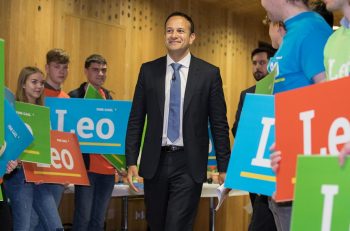
    As a younger, and perhaps wiser, Leo Varadkar once said: there is no messiah who will lead Fine Gael from the desert into the promised land. This did not prevent him from presenting a decidedly messianic image as he posed for the cameras following his decisive victory in the party’s leadership contest on 2 June. Since then politics and the media have obsessed over his choice for cabinet posts with one potential appointee after another scrambling for pole position beside the new leader to confirm their adoration for the man who holds their future in his hands. Soon forgotten was the uncomfortable truth that most of those among the party membership allowed to vote chose Simon Coveney from Carrigaline ahead of the man from Castleknock, and that Varadkar was elected through the over-whelming support of the parliamentary party and local councillors for the sole reason that they believe he is the most likely leader to ensure their re-election. The wider party it seems judged the candidates on policy, rather than geography or dare we suggest because the average blue shirt just is not ready yet for a gay man whose father comes from India as their particular cup of Barry’s tea. This is not to suggest that Fine Gael people are more likely to be homophobic or racist than any other group of political supporters but that they simply have not got their head around the rapid change in attitudes of a population with an average age of 38, which also happens to be Leo’s. For all this, Varadkar is as cautious and conservative as most in his party on both social and economic matters and is more likely to upset the wider LGBT community than endear himself to them. After all, he only came out as gay during the marriage equality referendum which many gay people saw as the culmination of decades of campaigning for their rights from which the young Leo had been silently absent. More importantly however, as Taoiseach, he is unlikely to deliver on a repeal of the eighth amendment which adequately meets the progressive demand for an end to church and State interference with reproductive rights or to tackle the huge range of discriminatory measures the State employs against women, children and minorities in health, education and social provision. There is little question that Varadkar will improve on the future prospects for his party colleagues and that they will go into the next election with greater expectations than if enda Kenny was still in charge. But that does not say much and neither does it take into account the harsh realities facing Fine Gael as it stumbles from one crisis to another while feeding from the life support provided by Fianna Fáil in government. Fianna Fáil is now looking at a general election next year and possibly ahead of the third budget it agreed to allow under the confidence and supply agreement which was negotiated by a less than enthusiastic Varadkar. His tendency to speak first and ask questions later will almost certainly cause some rocky moments over the coming months while his need to satisfy the many competing demands within his own ranks will also hinder any desire he may have to make innovative, not to mind radical, change. Varadkar will be really tested when it comes to the bigger issues facing the country and the first challenge he faces is how to deal with the ongoing and apparently unceasing crisis within the leadership of the Garda. He was among the first to criticise former commissioner, Martin Callinan, for describing the actions of whistleblower, Maurice McCabe as “disgusting”, and almost certainly precipitated the end of his long career in the force. Now he has to decide whether to allow the beleaguered Noirin O’Sullivan to remain in position. Varadkar will be happy to see the public service pay and pensions issue sorted before he takes full hold of the reins but the challenge posed by Brexit and its implications for the border and peace process would have been well outside his previous comfort zone. As to the insuperable health crisis as a medical doctor he might have been expected, when Minister for Health (2014-2016) to have led the delivery of the party’s plan for a universal health service to which he pays lip service, but there is a suspicion he ran out of ideas and little cause to think he will apply swift effective medicine as Taoiseach. Ultimately it will be his willingness to stand up to the vested private interests that sustain and feed the housing crisis, the rise in economic and tax inequality, precarious work and poverty that will test his imputed qualities as a radical young visionary. However, his party promotes the low tax, poor public service model that appeals to the very people he needs to survive in the cruel world of politics. Let’s call it Leo’s paradox. Frank Connolly

    Loading

    Read more

  • Posted in:

    Haughey cleaned up his own mess

    The author is a senior lecturer in the department of Modern History at Liverpool’s hope University. He has carefully mined the available documentary sources to produce a book that covers Haughey’s, much disputed disposition and policy instincts on Northern Ireland. Given the longevity and impact of Haughey’s career this, by definition, involves a painstaking trawl through a variety of sources. His cautious conclusion is that “Northern Ireland, it seems, was only one of a handful of issues to which Haughey left a positive legacy”. However, even this tentative conclusion is set against the view of the haughey critics who saw his actions as opportunistic and maladroit. The Arms Trial is of course the defining event in Haughey’s career. Stephen Kelly goes a great distance to establish that Haughey was, however unwittingly, the person who most facilitated the emergence of the Provisional IRA as a terrorist organisation in the years that followed from the upsurge of violence in Northern Ireland following the events of 1969. He states that Haughey’s “subversive involvement in the distribution of monies, guns and ammunitions” indirectly facilitated the yet to fully emerge Provisional IRA. The only issue I can see with this line of argument is that it suggests that Haughey was in fact subversive when in fact most of the testimony, research and evidence suggests that the arms importation was part of a fully authorised, albeit covert, operation of state. There is little or no doubt, at this remove of time, that Haughey was part of a plot to import arms for nationalists in Northern Ireland and that this operation was initiated at the highest levels of government and was supervised, quite deliberately, by army intelligence as opposed to that other security arm of the state the Special Branch. The lack of co-ordination between the two agencies meant the importation was badly managed. Kelly appears to give credence to the line, pursued by the Jack Lynch faction, in the wake of the Arms Trial, that Blaney and Haughey were in effect usurping their mandate from government and foisting their own policy on Northern Ireland. The problem in sustaining this argument is firstly the actual jury verdict in the trial which concluded that the accused persons did have a government mandate for their action. The second difficult issue is the copious evidence from military intelligence officers that the operation was run with the active involvement of a variety of ministers including the Minister for Defence. Stephen Kelly does well when covering Haughey’s subsequent efforts, when in power as Taoiseach, to develop policy on Northern Ireland and the famous early summit with Mrs Thatcher. His mishandling of Mrs Thatcher over the Falklands war and its consequences for Anglo-Irish relations is well covered. This book also gives a valuable insight into Haughey’s early approval of contact between Fianna Fáil and Sinn Fáin as well as the careful cultivation of Fr Alex Reid, the Redemptorist priest, who became a crucial interlocutor in what has become known as the peace process and the ending, by way of formal ceasefire, of the IRA’s campaign of violence. In may 1987 Haughey, who had become Taoiseach, was presented with a 15-page letter from Fr Reid. The contents of the letter were groundbreaking. Contained within were the terms of a proposed IRA ceasefire, seven years before the end of hostilities in August 1994. Apart from his secret dealings with republicans, it was also Haughey who first won concessions from John Major, Margaret Thatcher’s successor as prime minister, on Northern Ireland. In December 1991, following three years of discussions between Adams and Hume, Haughey presented Major with a draft of a model joint British-Irish government declaration, known as ‘Draft 2’ which would later become the ‘Downing street Declaration’. Stephen Kelly has set himself a hard task. John Bowman produced his definitive De Valera and the Ulster Question, 1917-1973 with the benefit of a PhD thesis and a lifetime of topical interviews with some of the key people through his work as a broadcaster before he produced his book. Kelly has produced something that will be of great value to others who may wish to write full biographies of haughey in the future. A book yet to come from Vincent Browne is much anticipated. My only other quibble with stephen Kelly is his claim in a footnote that my biography ‘Haughey – Prince of Power’ is a hagiographical work. I might humbly suggest he re-read the book. Perhaps the best part of this book is its description of the build up to and the contents of Haughey’s ground breaking summit with Mrs Thatcher in December 1980. Stephen Kelly rightly gives the credit on the British side to two senior Whitehall mandarins namely Sir Robert Armstrong and Sir Kenneth Stowe. Persuaded by Haughey’s persistence in demanding that there be an Irish or Dublin role in relation to the North, and a personal belief on Armstrong’s part that a united Ireland was inevitable, the two civil servants shifted Thatcher on this issue. This is rightly attributed to be the beginning of a series of agreements that brought both Dublin and London closer together. My father was hugely energised by the Dublin Castle meeting and told me afterwards, on the basis of conversations with Armstrong, that the British had given up the ghost on staying on in Ireland. The process begun at Dublin Castle was a move towards a joint British-Irish stewardship of the Northern Ireland issue. ‘A Failed Political entity – Charles Haughey and the Northern Ireland Question 1945-1992’ by Stephen Kelly is available from Merrion Press. Conor Lenihan

    Loading

    Read more

  • Posted in:

    Ross hits judicial soft spot

    There is this extraordinary conjunction of interest between the legal profession and parliament. Lawyers in Ireland play a very active part in the political system. In 2010 there were 16 barristers and solicitors in Dáil Eireann – ten percent of the total. There are strong historical associations between the professions of politics and the law. In Ireland’s case the association has been grandly embedded at least since the time of Daniel O’Connell, arguably the greatest Irish parliamentary figure and agitator a popular and crusading barrister whose campaign for Catholic emancipation earned him the sobriquet ‘the Liberator’, Radical nationalists following in O’Connell’s wake quite often, unfairly, depict his achievement of Catholic emancipation as being only of benefit to the Catholic middle class or the well-heeled lawyerly professionals. Wolfe tone and Padraig Pearse were also members of the legal profession. In more modern times lawyers have in many ways dominated the new state. The story of the first half of the Irish state (1916-1966) was in large part an economic failure – weak domestic industry and continued emigration. The safe and prestigious jobs were in medicine, the professions, banking, the civil service and the law. The meagreness of economic growth and wealth imbued these positions with an enviable mobility for those with social or class aspirations. A great many lawyers also gravitated towards politics. Traditionally the appointment of judges was a rather rarefied activity monopolised by the cabinet. In Ireland judges must have 12 years (10 for the District Court) experience as a barrister or solicitor. Interestingly, the US alone among common law countries has literally no requirements for appointment to its courts, though of course there is stringent scrutiny of supreme Court candidates by the legislature including a senate Judiciary Committee. Historically in Ireland, the whole thing had the feel of an insiders’ game. For example, there was a kind of informal, lawyers’ club within the cabinet when my father, the late Brian Lenihan senior, was in politics. My father, needless to add, was highly active, along with other cabinet-rank lawyers, when it came to the appointment of people as members of the judiciary. Friends and former colleagues of his in the bar library were constantly discussed as possible or actual appointments to the bench. In my father’s time Fianna Fáil and Fine Gael dominated the appointments with an occasional Labour party twist. The two big parties were careful enough to appoint supporters of the opposite political persuasion to create the impression that the process itself was fair and impartial. By the time i had been elected to the Dail in 1997 the appointment of judges had become an extraordinary example of indiscreet lobbying and jockeying for place and position. TDs were frequently canvassed to promote a particular individual. I even became involved myself and managed, along with others to get two or three lawyers appointed who I felt would be good people to be members of the judiciary. In her recent book on ‘the politics of Judicial selection in Ireland’, Jennifer Carroll MacNeill concludes of judicial appointments: “some systems are exclusively based on the preferences of the executive, some systems require approval of nominations by the legislature, some appoint judges according to a quota by different branches of the political system and some restrict the involvement of politicians to selecting among individuals who have been pre-screened by an independent body comprising judges and representatives of the legal profession”. For the last 20 years in Ireland, High Court, Court of appeal and supreme Court judges have been recommended by the Judicial appointments advisory Council and the Cabinet (ie the executive) makes the decision on advice from the minister for Justice and Attorney General and with the consent of the Taoiseach. In reality, of the ‘executive’ only the Taoiseach, minister for Justice and leaders of any coalition partner, are involved in the selection. Unlike in England and Wales (where the Prime minister selects the judge after nomination of one candidate by the Judicial appointments Commission) and unlike Israel (where the Judicial selection Committee selects the judge), the Irish government retains significant discretion to choose any person to fill a judicial vacancy. Reform has certainly been tame but efforts to curtail, control or otherwise reform the legal profession are often the subject of a cacophony of protest by the profession who are very adept at deploying well-orchestrated campaigns against hostile regulation of the profession. This is because unfortunately, according to Carroll MacNeill: “over the 20 years of its operation, the advisory board did not use the range of powers given to it to assess judicial candidates, was not provided with sufficient secretarial or professional supports and suffered from a substantial absence of process and Oireachtas oversight”. Worse, Carroll MacNeill says, the board made a “crippling“ change of strategy when it decided to change its process for recommending judges. Instead of performing a careful selection that would recommend the seven (or fewer) best candidates as provided in law, the board decided it would in the future simply approve all applicants deemed not to be explicitly “unsuitable”. The number of names recommended to government “increased substantially from about seven to roughly 20, 50 or 100 names for a High Court, Circuit Court or District Court vacancy respectively”. In Ireland this means the executive has almost free reign to appoint someone whose – real or perceived – politics they favour or, more pertinently, who favours theirs. Against this domestic background, Shane Ross is either very brave, or very foolish, to take on the task of reforming the country’s judiciary and how it regulates itself. His proposal to create a new body, composed mainly of non-lawyers, to guide the judges in their work, recruit appointees and register their financial interests is a welcome and well overdue piece of work. Ross is often accused by his opponents of coat-trailing a brand of opportunistic populism that is once off and designed to secure him maximum publicity. in the case of the judiciary however Shane Ross has been remarkably consistent.

    Loading

    Read more

  • Posted in:

    Nay to the Mayor Yayers

    In any discussion about Mayoral governance’ in Dublin there are assumptions: firstly, that it is a good thing, that it will solve lots of problems in the city; and second, that the mayor should be directly elected. We usually hear the paraphrased quote – ‘who do I ring if I want to talk to Dublin?’. We want to be able to identify who runs the place. We want someone to be running the place. Directly-elected mayors give us that. The ‘direct’ in direct election, a bit like in direct democracy, is a ‘Yay’-word. It is seen as an unarguable good. Who could not be in favour of giving people a direct say in, a direct link to, who runs the city? These assumptions ignore the relationship between central government and city government and what competencies are appropriate for the mayor, what geographical area the mayor might rule over, and the central issue of funding. They also ignore the fact that we can and do have strong political leaders who are not directly elected. There are broadly three models for city governance. One is the Council-Manager system we currently have – where the mayor has no executive powers. There’s an assumption that it is a bad thing. It certainly isn’t very democratic: it is not responsive to voters’ wishes and there are no clear links between the vote in local elections and local government policy. It’s also not very transparent – though that might be due to the absence of real media reporting of city government. It in turn might be a function of the lack of clarity in decision-making. The second model is the directly-elected mayor or Mayor-Council system. It is used in London, some other European cities, such as Rome, and about half the big US cities, including New York and Chicago. Probably because our nearest neighbour and biggest influencers adopted and use it, we naturally assume it is the one for us. But within this system, things aren’t uniform. They can be strongly mayoral or weakly mayoral – so the Council’s control of the legislative and financial functions can vary considerably. There is a third model. It is a Council system. The elected councillors appoint a mayor, who has executive functions. As with the directly-elected mayor, depending on rules, the mayor’s power can vary quite significantly. The system is quite common, used in many northern European cities, such as Amsterdam, Berlin, Stockholm and Paris. So which works best? Well I’m not an expert in local government, but even the literature doesn’t have a clear conclusion. So the short answer is, we don’t know. But I am interested in the functioning of central government, and we can think of the two models, the directly and indirectly-elected executive mayors as functional equivalents to the presidential and parliamentary systems at the national level. And there is a long debate in political science about the relative success of the two systems at delivering democratic stability, human development, and a range of other indicators of a country’s success. So which should we choose if we are to be guided by the relative performance of presidential or parliamentary systems? The presidential system, which is the system analogous to directly-elected mayor, has some advantages. Candidates are required to present a vision to the public. It puts power in the hands of one person, on the basis of popular election. That means the presidential system is clearer and appears fairer. We all know who we vote for; and the person who gets most votes becomes mayor. Unlike in parliamentary systems, there is no messing about with coalition-building based on backroom deals that aren’t transparent and over which the voters have little control. Much of the debate in parliamentary elections is about who will coalesce with whom, a debate that could be avoided in presidential-style systems. Instead the rival candidates for mayor could debate the issues facing Dubliners. The presidential system also weakens the power of parties. Many people dislike parties, and regard them as gatekeepers of political ambition. With a presidential system new leaders can emerge without having to be sanctioned by a party. This is much less likely in a parliamentary system. And at a time when people complain that government is unresponsive to their needs, and lacks leadership, the mayor could have clear lines of power to deal with the big problems. A suitably empowered mayor might be able to deal with the housing crisis in a way that the local authorities, minister and agencies can’t. The parliamentary system, that is the indirectly-elected mayor, however, has some advantages of its own. One might seem a weak one, but it might be important. We are used to parliamentarianism – it’s in our political culture. Political culture governs how we behave and are expected to behave. It changes slowly and doesn’t always respond to institutional changes – perhaps not at all, or perhaps not in predictable ways. This is important because picking systems that we are used to means we are less likely to get nasty surprises. A stronger argument in favour of parliamentarianism is the way it divides power. Politics is meant to do at least two things. It should solve collective action problems: those that make us collectively better off if we are guided to behave in certain ways than if we were left to act individually. The classic example is fishing. Individually we have an incentive to extract as many fish as we possibly can from the seas. We would over fish, making us collectively worse off when fish stocks are depleted. So we are made better off being forced to restrict our fishing. Politics is therefore also a mechanism for the resolution of conflicts, such as the fishing one. In parliamentary systems the mechanism for the resolution of conflict is negotiation, and parties representing different interests compromise, strike deals and build consensus, embracing a wide range of views in the decision. This manifests itself in coalitions, with a formal opposition offering alternative policies. In presidential systems conflict

    Loading

    Read more

  • Posted in:

    Transfer pattern augurs well for Left

    Transfers matter under proportionate representation though perhaps more for psephologists and party tacticians than in terms of actual electoral difference. Noel Whelan, for example, notes that: “only 12 or 13 of the 158 deputies in the new Dáil will win their seats because of transfers. If we stopped counting after the first counts and declared the results, all but a dozen or so of the seats would have been filled by the same people”. The most dramatic difference transfers made was of Maureen O’Sullivan, a notably gentle and non-partisan independent in Dublin Central. She polled badly on first preferences, getting just 1,990 votes. The quota was 5,922. She was in sixth place. Everyone assumed she was out for the count but in the end she took the last of the three seats. In the same constituency in 2007 Bertie Ahern, then ascendant Taoiseach, brought in his running-mate Cyprian Brady in 2007, though he had polled 939 first preferences. The only other candidate ever to be elected with fewer than 1000 first preferences was Brian O’Higgins (later President of Sinn Féin from 1931–1933) elected in Clare in 1923 on DeValera’s transfers. The Right to Change campaign, which involved around 100 candidates, both party and non-party, helped Sinn Féin to secure transfers that pushed a number of their candidates over the line. As well as a strong transfer pattern (76% as opposed to 58% in 2011) between SF candidates running in the same constituency the party enjoyed a good return of more than 23% from other left candidates who endorsed the campaign. In Dublin Bay North, which had one of the longest counts in the election, Denise Mitchell of Sinn Féin was assisted by significant transfers from John Lyons of People before Profit (PBP) as well as from her party colleague, Micheál MacDonncha who was eliminated at an earlier stage. Similarly, SF candidate and trade unionist, Louise O’Reilly, won a seat following strong transfers from Barry Martin, also of PBP and a running mate of Clare Daly’s in the Fingal constituency. Richard Boyd Barrett who was always likely to take a seat in Dun Laoghaire, was helped by the votes transferred from Sinn Féin candidate Shane O’Brien on his elimination. Across the country, there were other examples of the Right to Change arrangement benefitting successful candidates. AAA-PBP transferred significantly more votes to Sinn Féin than any other party with independents the next block to gain from their transfers. Sinn Féin performed exceptionally in its internal transfers with an unprecedented rate of 76% which augurs well for its future prospects where it stands two candidates. Sinn Féin has historically been quite transfer unfriendly, but in 2016 they have improved significantly on their own transfers as well as taking 28% of the transfers from AAA-PBP. With the exception of Donegal where it overrated its chances of taking three of the five seats, leaving Pádraig MacLochlainn as the party’s most prominent casualty, it came close in several other constituencies to bringing in a running mate. Fine Gael also displayed strong transfer discipline. The transfer rate between Fine Gael candidates was much better than that between Fianna Fáil candidates. In 2016 this discipline brought Fine Gael an even bigger seat bonus than it got in 2011. It benefited from 54% of its own transfers as well as 53% of those of Labour candidates. What is also evident and perhaps a harbinger of the future is the number of transfers between Fine Gael and Fianna Fáil. Where a candidate had no running mate or he or she had been eliminated or elected, Fine Gael was more likely to transfer to its big right-wing rivals than any other party and vice versa. 18% of FF transfers went to FG candidates and 16% of FG transfers nished up with FF. As the two beasts prepare the ground for an historic coalition it would seem that their supporters do not share the view that their differences would make the ending of civil war politics impossible. Frank Connolly

    Loading

    Read more

  • Posted in:

    SF won’t prop up FF, FG or Labour

    The recent General Election was a very good one for Sinn Féin. We increased our number of TDs from 14 to 23. That’s a 65% increase – a success by any standards. Importantly, Sinn Féin also further increased the geographical spread of the party. There are now very few regions in the State in which there isn’t Sinn Féin Dáil representation. There is also in place, another whole raft of Sinn Féin representatives who, although not returned at this election are very likely to be elected next time around if they continue with the valuable work they are doing. So, Sinn Féin returns to the Dáil, not just with a significantly larger team but also with a team of very high-calibre TDs, including more women and more younger representatives. Sinn Féin had two clear objectives going into the election. The first was to get rid of a Fine Gael/Labour government that has brought chaos to housing and health, imposed unfair taxes and promoted mass emigration. We succeeded in that. In the early days of the election campaign we holed the coalition’s strategy below the waterline by proving that their figures were wrong and that they presented €2 billion which they did not have. I think we were also successful in demonstrating that you cannot have US-style taxes and at the same time invest in decent public services.Our other objective was to prove to people that there is a realistic, credible political alternative of which we are a significant part. That is very much a work in progress. We may not have succeeded, at this point, in getting enough seats to form a progressive Government but that will improve as we go on. But the realignment of politics in this State took an important step forward in this election and the next election will see that trend intensify. The political domination of Fine Gael and Fianna Fáil is finished. What we now need to do is increase the cohesion among those who advocate an alternative view of how the economy and society should be organised. Over the past five years, Sinn Féin has been the genuine voice of opposition in Leinster House, offering an alternative to the dreadful austerity policies of Fine Gael, Labour and Fianna Fáil. All of Sinn Féin’s pre-Budget submissions demonstrated a way of ensuring economic growth while also being socially equitable and protecting the vulnerable. We repeatedly warned the Government of the escalating homelessness crisis. The Government refused to listen and it became an emergency. We also consistently raised the issue of all-Ireland integration and the political, economic and social case for a united Ireland. Sinn Féin has now received an enhanced mandate to continue with that work. The post-election sham fight between Fine Gael and Fianna Fáil is nothing to do with the real issues affecting citizens. The people who were homeless last Friday will remain homeless under Fine Gael and Fianna Fáil. Patients will still languish on trolleys in our hospitals under Fine Gael and Fianna Fáil because those parties are not serious about resolving these issues. Going into this election Fianna Fáil picked up on a sense that voters were moving to the left, so they began to steal the phrases Sinn Féin was using about fairness and a recovery for all. That strategy resulted in a partial recovery of the Fianna Fáil vote itself but still left it far, far short, in his-torical terms, of where it once stood. Throughout the election campaign, Sinn Féin made it clear that we would not prop up those parties that created and sustained the economic and social crisis facing our people. That is the mandate we received and we will not break our commitments. Sinn Féin will continue to consult with others, including those aligned to the Right2Change platform, on the way forward. If not in the immediate period ahead, the objective of a genuinely progressive alternative Government in which Sinn Féin plays a lead role is a live possibility. Over 400,000 people voted for candidates aligned to the Right2Change platform to end water charges. The Fine Gael/Labour Government has been defeated and water charges should leave the stage with them. What is now clear from the election is that people voted for real change and a more equal society. Sinn Féin is committed to achieving that and to pursuing and preparing for the peaceful reunification of Ireland and the reconciliation of all our people. Whether in Government or in opposition, Sinn Féin will stick by the mandate we have been given. Gerry Adams Gerry Adams TD is President of Sinn Féin

    Loading

    Read more

  • Posted in:

    Unruly

    What is meant by the Rule of Law and is such a concept honoured in Ireland today? I believe that the rule of law though arguably an unqualified good is not being adhered to in this state save mostly by the judiciary and that the legal system and erratic observance of legality by state officials renders our democracy fragile. In my view Ireland draws close to that amorphous notion, a failed state that cannot in reality uphold the rule of law. This opinion piece will not be a comprehensive pathology but will point out many of the salient practical features which show how the rule of law is breaking down. The Rule of Law: Theoretical Incoherence? We first need to probe the many senses in which the rule of law is described. Joseph Raz, a legal positivist who believes in “perfectionist liberalism” has suggested that the rule of law is merely a kind of shorthand description of the positive aspects of any given political system. From a different vantage point the fundamentalist Christian legal philosopher John Finnis considers that the rule of law is: “[t]he name commonly given to the state of affairs in which a legal system is legally in good shape”. Another philosopher Brian Tamanaha chimes to negative effect that the rule of law is “an exceedingly elusive notion” which leads to “rampant divergence of understandings” and is similar to the amorphous concept of Good in that “everyone is for it, but has contrasting convictions about what it is”. At bottom, there is no consensus: it is elusive at best: a form of smokescreen or professional hypocrisy at worst. But let us endeavour to be constructive. For example Carothers, though sceptical, adds a worthwhile positive definition of the rule of law as: “a system in which the laws are public knowledge, are clear in meaning, and apply equally to everyone. They enshrine and uphold the political and civil liberties that have gained status as universal human rights over the last half-century. In particular, anyone accused of a crime has the right to a fair, prompt hearing and is presumed innocent until proved guilty. The central institutions of the legal system, including courts, prosecutors, and police, are reasonably fair, competent, and efficient. Judges are impartial and independent, not subject to political influence or manipulation. Perhaps most important, the government is embedded in a comprehensive legal framework, its officials accept that the law will be applied to their own conduct, and the government seeks to be law-abiding”. Now let us stress-test certain aspects of this detailed expurgation against the patient – in this context Ireland Inc. Yes of course rights exist in our still fine, if shopworn, constitutional matrix and are enforced by the courts in many instances but there is also an undue deference to the executive that has led to the non-enforcement of social and economic rights particularly the right to housing by the courts. There is an excess of judicial caution on other rights-based claims, particularly where issues of financial iniquity and the countervailing amorphous blob, public policy, are implicated. There is also widespread violation of privacy by the state and its police force, in particular. The overly sanguine way we as a nation have accepted, in effect, what has been police and state criminality with respect to privacy for the last thirty years without widespread outcry is baffling. At least there are signals of an upsurge in civil disobedience, which when peaceful, as Habermas, the German sociologist of critical theory and pragmatist, would contend, leads to a vitalisation of democracy. Not here. Further, the scandal that is our banking structures, the disgrace of the banks varying interest-rate repayments in breach of agreements, the sometimes unconscionable evictions, are not conterminous with the rule of law. NAMA is a mess formulated by the neoliberal club which did its best to avoid a proper new deal for the Irish people. The banking inquiry was a poorly performed French farce. What is desperately needed is a right to housing. Eviction should be rare, require rehousing, and should only follow meaningful intervention by an arbitrator who can determine whether the consumer can repay and whether the bank – with or without the enlistment of a vulture fund – is bundling the mortgage at a bargain-basement rate to private-law profiteers. Further, many of our state institutions have major structural problems. The Garda are not progressive in training and intent: they do not seek justice or the truth, but rather a result. They, at times spin, embellish or at worst, manufacture evidence – and, to be candid, at times act criminally and in violation of the rule of law. Finally, there are limited independent checks and far too close a nexus between politicians and the police. The recent moving of the deckchairs by the Garda Commissioner will not change the culture or training of the force, its group think or, arguably, its competence. It needs a radical ovehaul and a redirection so primarily promotes truth- seeking, investigative process. The impartiality and independence of our judiciary needs at times to be severely questioned because there is far too close a nexus between politics and judicial appointments. Though most are appointed on merit, many of our judges are appointed for their proximity to political parties. Further, some judges have an aggrandised sense of themselves: certainly they are not servants of the state as that is not a judicial function, but rather, they are the servants of the constitution which is a bulwark to protect the people against state excess. Judges also need, in the interest of public confidence as to their impartiality, to declare their share-holdings and indebtedness to the banks. Moreover, parts of the government left itself open to the accusation, during the bugging crisis, that it was also mired in corruption. In the strictest sense it observed the rule of law but, in manner, it laid itself open to the criticism levelled elsewhere by the late great Christopher Hitchens of being crypto-fascist, pursuing a

    Loading

    Read more