Prime Minister

Random entry RSS

  • Posted in:

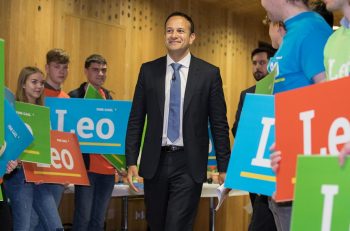
    Leo’s paradox

    As a younger, and perhaps wiser, Leo Varadkar once said: there is no messiah who will lead Fine Gael from the desert into the promised land. This did not prevent him from presenting a decidedly messianic image as he posed for the cameras following his decisive victory in the party’s leadership contest on 2 June. Since then politics and the media have obsessed over his choice for cabinet posts with one potential appointee after another scrambling for pole position beside the new leader to confirm their adoration for the man who holds their future in his hands. Soon forgotten was the uncomfortable truth that most of those among the party membership allowed to vote chose Simon Coveney from Carrigaline ahead of the man from Castleknock, and that Varadkar was elected through the over-whelming support of the parliamentary party and local councillors for the sole reason that they believe he is the most likely leader to ensure their re-election. The wider party it seems judged the candidates on policy, rather than geography or dare we suggest because the average blue shirt just is not ready yet for a gay man whose father comes from India as their particular cup of Barry’s tea. This is not to suggest that Fine Gael people are more likely to be homophobic or racist than any other group of political supporters but that they simply have not got their head around the rapid change in attitudes of a population with an average age of 38, which also happens to be Leo’s. For all this, Varadkar is as cautious and conservative as most in his party on both social and economic matters and is more likely to upset the wider LGBT community than endear himself to them. After all, he only came out as gay during the marriage equality referendum which many gay people saw as the culmination of decades of campaigning for their rights from which the young Leo had been silently absent. More importantly however, as Taoiseach, he is unlikely to deliver on a repeal of the eighth amendment which adequately meets the progressive demand for an end to church and State interference with reproductive rights or to tackle the huge range of discriminatory measures the State employs against women, children and minorities in health, education and social provision. There is little question that Varadkar will improve on the future prospects for his party colleagues and that they will go into the next election with greater expectations than if enda Kenny was still in charge. But that does not say much and neither does it take into account the harsh realities facing Fine Gael as it stumbles from one crisis to another while feeding from the life support provided by Fianna Fáil in government. Fianna Fáil is now looking at a general election next year and possibly ahead of the third budget it agreed to allow under the confidence and supply agreement which was negotiated by a less than enthusiastic Varadkar. His tendency to speak first and ask questions later will almost certainly cause some rocky moments over the coming months while his need to satisfy the many competing demands within his own ranks will also hinder any desire he may have to make innovative, not to mind radical, change. Varadkar will be really tested when it comes to the bigger issues facing the country and the first challenge he faces is how to deal with the ongoing and apparently unceasing crisis within the leadership of the Garda. He was among the first to criticise former commissioner, Martin Callinan, for describing the actions of whistleblower, Maurice McCabe as “disgusting”, and almost certainly precipitated the end of his long career in the force. Now he has to decide whether to allow the beleaguered Noirin O’Sullivan to remain in position. Varadkar will be happy to see the public service pay and pensions issue sorted before he takes full hold of the reins but the challenge posed by Brexit and its implications for the border and peace process would have been well outside his previous comfort zone. As to the insuperable health crisis as a medical doctor he might have been expected, when Minister for Health (2014-2016) to have led the delivery of the party’s plan for a universal health service to which he pays lip service, but there is a suspicion he ran out of ideas and little cause to think he will apply swift effective medicine as Taoiseach. Ultimately it will be his willingness to stand up to the vested private interests that sustain and feed the housing crisis, the rise in economic and tax inequality, precarious work and poverty that will test his imputed qualities as a radical young visionary. However, his party promotes the low tax, poor public service model that appeals to the very people he needs to survive in the cruel world of politics. Let’s call it Leo’s paradox. Frank Connolly

    Loading

    Read more

  • Posted in:

    Haughey cleaned up his own mess

    The author is a senior lecturer in the department of Modern History at Liverpool’s hope University. He has carefully mined the available documentary sources to produce a book that covers Haughey’s, much disputed disposition and policy instincts on Northern Ireland. Given the longevity and impact of Haughey’s career this, by definition, involves a painstaking trawl through a variety of sources. His cautious conclusion is that “Northern Ireland, it seems, was only one of a handful of issues to which Haughey left a positive legacy”. However, even this tentative conclusion is set against the view of the haughey critics who saw his actions as opportunistic and maladroit. The Arms Trial is of course the defining event in Haughey’s career. Stephen Kelly goes a great distance to establish that Haughey was, however unwittingly, the person who most facilitated the emergence of the Provisional IRA as a terrorist organisation in the years that followed from the upsurge of violence in Northern Ireland following the events of 1969. He states that Haughey’s “subversive involvement in the distribution of monies, guns and ammunitions” indirectly facilitated the yet to fully emerge Provisional IRA. The only issue I can see with this line of argument is that it suggests that Haughey was in fact subversive when in fact most of the testimony, research and evidence suggests that the arms importation was part of a fully authorised, albeit covert, operation of state. There is little or no doubt, at this remove of time, that Haughey was part of a plot to import arms for nationalists in Northern Ireland and that this operation was initiated at the highest levels of government and was supervised, quite deliberately, by army intelligence as opposed to that other security arm of the state the Special Branch. The lack of co-ordination between the two agencies meant the importation was badly managed. Kelly appears to give credence to the line, pursued by the Jack Lynch faction, in the wake of the Arms Trial, that Blaney and Haughey were in effect usurping their mandate from government and foisting their own policy on Northern Ireland. The problem in sustaining this argument is firstly the actual jury verdict in the trial which concluded that the accused persons did have a government mandate for their action. The second difficult issue is the copious evidence from military intelligence officers that the operation was run with the active involvement of a variety of ministers including the Minister for Defence. Stephen Kelly does well when covering Haughey’s subsequent efforts, when in power as Taoiseach, to develop policy on Northern Ireland and the famous early summit with Mrs Thatcher. His mishandling of Mrs Thatcher over the Falklands war and its consequences for Anglo-Irish relations is well covered. This book also gives a valuable insight into Haughey’s early approval of contact between Fianna Fáil and Sinn Fáin as well as the careful cultivation of Fr Alex Reid, the Redemptorist priest, who became a crucial interlocutor in what has become known as the peace process and the ending, by way of formal ceasefire, of the IRA’s campaign of violence. In may 1987 Haughey, who had become Taoiseach, was presented with a 15-page letter from Fr Reid. The contents of the letter were groundbreaking. Contained within were the terms of a proposed IRA ceasefire, seven years before the end of hostilities in August 1994. Apart from his secret dealings with republicans, it was also Haughey who first won concessions from John Major, Margaret Thatcher’s successor as prime minister, on Northern Ireland. In December 1991, following three years of discussions between Adams and Hume, Haughey presented Major with a draft of a model joint British-Irish government declaration, known as ‘Draft 2’ which would later become the ‘Downing street Declaration’. Stephen Kelly has set himself a hard task. John Bowman produced his definitive De Valera and the Ulster Question, 1917-1973 with the benefit of a PhD thesis and a lifetime of topical interviews with some of the key people through his work as a broadcaster before he produced his book. Kelly has produced something that will be of great value to others who may wish to write full biographies of haughey in the future. A book yet to come from Vincent Browne is much anticipated. My only other quibble with stephen Kelly is his claim in a footnote that my biography ‘Haughey – Prince of Power’ is a hagiographical work. I might humbly suggest he re-read the book. Perhaps the best part of this book is its description of the build up to and the contents of Haughey’s ground breaking summit with Mrs Thatcher in December 1980. Stephen Kelly rightly gives the credit on the British side to two senior Whitehall mandarins namely Sir Robert Armstrong and Sir Kenneth Stowe. Persuaded by Haughey’s persistence in demanding that there be an Irish or Dublin role in relation to the North, and a personal belief on Armstrong’s part that a united Ireland was inevitable, the two civil servants shifted Thatcher on this issue. This is rightly attributed to be the beginning of a series of agreements that brought both Dublin and London closer together. My father was hugely energised by the Dublin Castle meeting and told me afterwards, on the basis of conversations with Armstrong, that the British had given up the ghost on staying on in Ireland. The process begun at Dublin Castle was a move towards a joint British-Irish stewardship of the Northern Ireland issue. ‘A Failed Political entity – Charles Haughey and the Northern Ireland Question 1945-1992’ by Stephen Kelly is available from Merrion Press. Conor Lenihan

    Loading

    Read more