Protest

Random entry RSS

  • Posted in:

    50 years since 1968

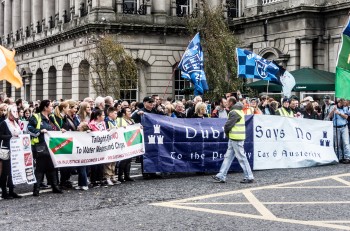
    Not a week has gone by in 2018 Ireland without several street demonstrations, especially about abortion and the housing crisis. In France, protesting is part of the vernacular. Riots are common: just look at 1789 and 1968. Ireland and France share a reputation for feistiness. A comparison between Irish and French demonstrations could be instructive. “What do we want? Public housing! When do we want it? Now!”. More than 10,000 people are currently home- less in Ireland. The demonstration I attended, organised by the National Homeless and Housing Coalition, on 7 April was good-natured: festive and serene. People played and sang music as they marched. The Garda seemed engaged and smiled while overseeing the demonstration: a safe protest. It appeared the crowd was representative of the general population, as perhaps you might want. It started at the Garden of Remembrance and ended in front of the Custom House in Dublin in light rain, as cheerful as the weather allowed. Its effectiveness was its mainstream attendance; there was no danger here. It would, I reflected, be different: more fractious, less representative, angrier – in France. Ireland fights for Human Rights At the moment Ireland is in arms over: abortion, education, sex education, health, animal welfare, drugs. But I have the sense that some of these campaigns are not mainstream, even as protests. Certainly the Water Protests were successful, albeit the underlying political message (no new taxes?) and symbolic value were not too clear. Abortion is a long-standing divisive issue in Ireland, symbolising the hegemony and, later, decline of the Catholic Church. Protests date back to 1983 when an unwise blanket prohibition was approved in a referendum. In May there will be a rerun. There are many events, debates and demonstrations on both sides, with pro-choice as fashionable politically as pro-life must have been a generation ago. The demonstration I attended in April was ‘pro-choice’- for ‘Equality, Freedom and Choice’, organised by Rosa. The rally was jubilant and confident, almost over-confident. The Daddy of all modern Irish marches is the PAYE protests from 1979-1980. Around 700,000 Dubliners marched against the stifling ‘Pay As You Earn’ tax. The BBC called it “the largest peaceful protest in post-war Europe”. But I sense things have changed since then. There is no longer an Ireland the sense that the regime is fundamentally at odds with its electorate. Perhaps it’s because the country now mostly complies with international norms or is fast moving in that direction; perhaps it’s because the country is simply much wealthier and has never been so confident. In 2003, Irish anti-war protesters organised a demonstration for peace in Iraq. The British and Americans had invaded Iraq. 100,000 walked on the streets of Dublin. It was a thoroughly internationalist protest. In 2006, a violent demonstration took place in Dublin’s O’Connell Street. For some reason Northern Unionists wanted to organise a ‘Love Ulster’ Parade to honour the victims of the IRA. A counter demonstration materialised and a riot started. Several Molotov cocktails were thrown and cars were burnt. A total amount of 14 persons were wounded and 41 arrested by Garda. Locals put the intense violence down to the alien influence of recalcitrant Northerners: it didn’t symptomise a new riot mentality. These kinds of demonstrations are pretty rare in Ireland compared to in France, where there are wide-ranging politically-driven strikes and demonstrations every year. Governments can fall as a result of demonstration culture in France. If France had had an international bailout that was forcibly inflicted on the population; if France had had the iniquities of Nama bailing out the richest failed developers there would have been strikes and riots. A country’s protest mentality varies from generation to generation. We’ll put down the Irish monster meetings and boycotts of the nineteenth century as the fruits of a different era. Where a country is colonised and not run for the benefit of the majority – or a significant minority – wideranging subversion is to be expected. In Ireland it culminated in the Easter Rising in 1916 and the War of Independence 1919-21. In the North of course discrimination against Catholics fuelled a later whirlwind. In the Bogside riots of 1969, eight people were killed, a majority Catholic, and over 150 homes destroyed; and the IRA campaign resulted in 1696 deaths. But, though important, this all speaks little to the modern-day Republic of Ireland.   France, protest pioneer French demonstrations have been well-known and lethal since at least the 18th century with a sustained and celebrated (though not of course by Edmund Burke) historic riot: the French Revolution, facilitating a declaration of the rights of man and changing forever the notion of the political establishment. In the twenty-first century, protests are still an important political phenomenon. France has been a global leader in dissent. The rockstar of street opposition was May 1968 when strikes and demonstrations led by students and workers and the occupation of universities and factories across France brought the entire economy of France to its knees and political leaders feared civil war or revolution. The moribund government itself ceased to function for a while after President Charles de Gaulle secretly fled France for a few hours in Germany. ‘68 changed France’s democracy: the super-annuated President De Gaulle resigned, the Assemblée Nationale was dissolved, and government committees were formed to restructure secondary schooling, universities, the film industry, the theatre and the news media. The Grenelle Accord gave better conditions for the unemployed, a 35% increase in the minimum wage and a fourth week of paid leave for those in employment. Mentalities started to change too with a sexual revolution from the young. Mixed schools became more common. 1968 sundered a post-War France of austerity, conservatism and asceticism. Nevertheless the movement succeeded “as a social revolution, not as a political one”. President of the Republic (2007-12) Nicolas Sarkozy famously denounced May 1968 as the source of contemporary France’s problems. The student revolts against bourgeois society introduced a “relativism”, he argued, that undermined national identity, the spirit of

    Loading

    Read more

  • Posted in:

    Cometh the hour

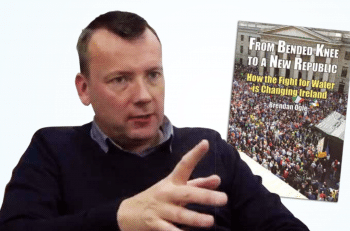
    ‘From Bended knee to a New Republic: How the fight for water is changing Ireland’ by Brendan Ogle, promises in its opening pages to take us on a journey “through the travails of a nation broken, sold and left in penury”. Ogle, unlike the many politicians and political parties he describes, fulfils this promise. The book brings you on a fascinating, inspiring, informative, and thoughtful journey through inequality in Ireland and “a nation’s fightback against it”. It should be clear from this that the book, just like the protest movement itself, is about much more than water. It comprehensively answers the question that many have asked: why was water the “issue that Irish people would take their first and biggest real stand against austerity?”. Ogle is the Education, Politics and Development organiser for the Unite trade union in Ireland and one of the founders of the Right2Water and Right2Change campaigns. The first quarter of the book provides detailed analysis of the political, economic, and social circumstances that gave rise to the Irish water protests which are “the biggest (per capita) and most peaceful protest movement for social change anywhere in the world”. These include the global water privatisation agenda, austerity, poverty and the health and housing crises. Neoliberalism is explored before an analysis of the self-evisceration of social democracy through Tony Blair’s ‘third way’ acceptance and implementation of neoliberalism, and its adoption by the Irish Labour Party. He suggests the Labour Party has become an “obstacle to progress toward a more equal Ireland, and is in fact an enabler of neoliberal inequality”. Ogle spends the rest of the book describing how the Right2Water campaign was organised and the challenges it faced in becoming a mass movement. He recounts how he and Dave Gibney, the other main organiser in Right2Water, withstood difficult negotiations with local communities who had been let down by trade unions in the past but had started this new movement in order to build trust and a strong working partnership with them. He writes about how ‘civil society’ organisations failed to offer much support to the movement. He describes the constant work required to build unity amongst the fractious left-wing parties that make up the ‘political pillar’ of the movement. We can read how he and others in the water movement which “could so easily have been just another failed campaign in a failed Republic”, actually developed the most successful mass-protest movement in modern Irish history. It is, therefore, an essential read for those looking to understand not just how and why the water movement developed in Ireland but for those seeking lessons of how to build successful social movements. A central purpose of the book is to set out the origins and purpose of the water movement, and to tell the story of the water activists, which, as Ogle rightly says, you won’t read about in the media or many other places. The book provides an important contribution to documenting Ireland’s recent socio-political history and geography, particularly the excluded voices and views in society which are too often ignored. The book documents how the movement was built from the grassroots up in working class communities like Edenmore in Coolock in Dublin and by “wonderful people” from all over Ireland “who were determined to make a difference”. It tells the inspiring story of water activists such as Karen Doyle, a “housewife and mother who also works part-time outside the home” from ‘Cobh says No’. She got involved in the water charges movement and formed one of the hundreds of ‘meter watch’ groups, which were the heart of the movement across the country, to obstruct water meters being installed. It is from such actions that a broader social movement was born. Ogle writes: “every week-day morning someone would rise about 4.00 to 5.00 am and find where the meter contractor vans were heading. Text alerts were sent so that by the time the vans arrived people like Karen were at estate entrances to protest. A caravan and trailer were procured and soup, tea and coffee produced every day for sustenance. Margaret Thatcher would have hated it. Society! People came from their homes, their individual isolated bolt holes, to start sharing stories about where it had all gone wrong, how their lives had been impacted by the breaking of a nation, which gave them the strength, the determination, to do something about it”. These groups, according to Ogle, faced problems from “some on the ultra-left” who saw the local groups “as a vehicle for advancing their own agenda, viewing people like Karen as potential recruits”. He describes how “people who got involved in a campaign out of genuine concern for their community and their country”, were hurt as they found themselves “the focal of bitter and personalised attacks”. He notes that in the past “many have walked away from the campaigns, surrendering them to the dogmatic ultra-left and the inevitable failure to deliver on their promise”. But not this time. Karen and many other community activists like her continued on and developed their own spaces and confidence to keep building a broad and inclusive movement. important in this was the support given by the Right2Water trade unions, and Unite in particular through its political economy education. It ran nine free ‘political economy’ courses for 150 ‘non-aligned’ community activists “with the objective of giving activists who were central to the growing water movement access to the type of information that would enable them to understand the political economic agenda behind water privatisation”. This was a very innovative approach which provided an important longer term empowering aspect to the movement. Ogle writes how “through the training we not only helped them connect with each other on a national level but showed how the tax and privatisation agenda are global issues…giving renewed energy as to how to challenge the neoliberal consensus”. Ogle persuasively tackles the critiques of the water movement in relation to water conservation. He highlights how people in the UK, which has

    Loading

    Read more