republicanism

Random entry RSS

  • Posted in:

    Sinn Féin alone

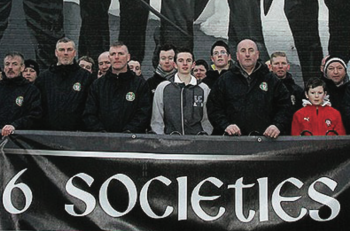
    Republicanism is fragmenting. That was  seen on Easter Sunday, when at least eight Republican groups held commemorations on Belfast’s Falls Road. At protests in the North, it is common for various ‘dissident’ groups to have more presence that mainstream Sinn Féin. That party has a much smaller activist base than a decade ago. Paradoxically, as that base has shrunk, the vote has increased. The exodus of members has not affected the vote. That was seen most starkly in last year’s assembly election for North Antrim. A councillor and 17 other activists resigned in protest when the party forced assembly Member Dáithí McKay to resign. Monica Digney, an able and respected former councillor, and one of those who had resigned, stood as an Independent. Sinn Féin’s vote increased by just under 3%. Digney polled just 435, lagging behind the Green Party. That is a stark version of trends across the north. A few years ago, even Sinn Féin strategists believed the vote had plateaued, and might even fall back. In last year’s Westminster election, Sinn Féin took 29.4% of the vote. That was a 4.8% increase in a year. The terminal decline of the SDlP has been hastened. Sinn Féin took the SDlP’s two perceived strongholds: South Down and, of greater importance, Derry. That is not to deny the importance of the exodus. There is a disillusionment with Sinn Féin. An Easter statement from Óglaigh na hÉireann prisoners sums up the dissidents’ problems: “It’s clear that presently the revolutionary Republican community appear to be facing challenging times and lack strategic direction in response to these events”. The largest single non-Sinn Féin grouping are the 1916 societies. There have spread out of their initial base in East Tyrone across the North, and into the South. They have a sizeable membership, mostly of an older generation, but they also have a small but significant membership from the post-IRA generation. They are an excellent symptom of how widespread the malaise in Republicanism is. They have engaged in some co-ordinated activity, such as calling for an all-Ireland Referendum on unity. However, their main activity is commemorations. This is the only activity on which all non-Sinn Féin Republicans can agree. They certainly cannot on a central debate for Republicans: whether or not there should be an armed campaign. Most are opposed. some, mostly from the anti-armed-campaign cohort, are becoming involved in community issues as individuals or through different organisations. There is no issue about which ‘dissidents’ can coalesce. In 1969-70, the Republican movement split into ‘official’ and ‘Provisional’ wings. (The ‘Provisionals’ became today’s Sinn Féin, while the remnants of the ‘officials’ are the Workers Party). The ‘Provisionals’ derived from the anger of many young Catholics, and a belief that the IRA had spent too much time on left-wing politics rather than preparing to defend catholic areas. This time, there is no single big issue to divide Republicans. There is a generalised unhappiness at Sinn Féin’s acceptance of Stormont and the PSNI. In some cases, unhappiness has spilled over into demoralisation. Some in Sinn Féin dismiss ‘dissidents’ as criminals. That is not to say there are not criminals using dissident groups as a cover; and others who, their war over, have turned to criminality but it is not the central case. The dissident groups are fragmented. The new IRA and the continuity IRA are continuing their campaign, while Óglaigh na hÉireann has called a ceasefire. All armed groups are riddled by infiltration by security-force agents. However, they have found a certain niche in carrying out punishment attacks. These grew by 60% between 2013 and last year. They are popular among a significant layer of the population in Catholic working-class areas. Part of the reason is the traditional hostility between the catholic minority and the police in the Northern state. Part is also that punishment attacks offer ‘quick x’ justice, without the necessity to take the time taken by a formal court system. Police seem willing to let punishment attacks continue, as long as the victims are perceived ‘hoods’. Vigilantism, though, is not a basis for building organisations that will be a serious alternative to Sinn Féin in Catholic areas. Sinn Féin could probably benefit from a bit of coherent opposition from people whose political premises, at least viscerally, it identifies with. Anton McCabe

    Loading

    Read more

  • Posted in:

    How did Republicanism lose its way in the 1960s?

    The IRA in the 1960s, led by Cathal Goulding the IRA Chief and Tomás MacGiolla who chaired Sinn Féin, initiated a reform towards radical democratic politics. This was supported by Seán Cronin, later an Irish Times correspondent, who had led the 1950s armed campaign. I know this because he contacted me in around 1959 after his release from internment, to discuss left-republican ideas which I had been promoting in the Plough, an innovative Left periodical of the time with trade-union links. I had earlier been associated with the Irish Workers League, a Marxist group which I had had a hand in setting up, with student-left support via the Trinity College Dublin Fabian Society. I was however seeking broad-left alternatives, and was supporting the Plough, avoiding the basically Stalinist Irish Worker League which superseded the Communist Party here for a while and was associated with Jim Larkin. In 1960 my TCD/Dublin Institute of Advanced Studies post-graduate research period in physics ended, and I worked in London up to 1963, when I returned to a job in Dublin. In London I had worked politically with the Connolly Association and interacted with Desmond Greaves, a pioneer Marxist focusing on national questions. Greaves had come up with the need to focus, in the Irish context, on the civil rights issue in Northern Ireland, as an escape from religious sectarian politics. After my return to Dublin, I cultivated links with the republican movement, initially via the Wolfe Tone 1963 bi-centenary events, which included broad-based seminars in the Mansion House. These were manifestations of the Goulding/MacGiolla/Cronin influence on IRA reconstructive reform. I interacted with the leadership and we came up with the ‘Wolfe Tone Societies’ concept as a promotional model for democratic reform. From this I went on to cultivate an active role in the leadership of a reforming republican movement, in which the Northern IRA activists set themselves up openly as Republican Clubs and supported the Civil Rights Movement. We now have the problem: how did this evolve in the 60s and how and why did it occasion the militarist ‘Provisional’ split? I will not attempt this here and now, but I did try with my book ‘Century of Endeavour’ published initially in the US in 2003, with a revised edition in Ireland in 2006. This covers the century from my perspective and that of my father, a Tyrone Presbyterian supporter of all-Ireland Home Rule in 1913, who made his subsequent career in the Free State and in 1938 helped to set up the Irish Association to promote an all-Ireland cultural identity in the spirit of the de Valera Constitution. There are 576 pages in ‘Century of Endeavour’ and the period of 1960s activism takes up about 150 pages for the 60s decade. There is much detail in the book about the 1960s politics of republican transformation, and I feel I need help in analysing the record of how it evolved into a ‘near miss’ of what now has, I hope, been achieved by Adams et al but could have happened then. Certainly I believe the split led by O Brádaigh and MacStiofáin who resisted moves to end abstentionism from the British, Irish and Northern Ireland parliaments, to form the ‘Provisional IRA’, was a disaster! Will anyone interested in helping to research how the 1960s politics evolved into decades of mayhem, and the current complex ‘hard border’ problem, please e-mail me with some comments on the above overview; I am contactable via roy@rjtechne.org; please do not phone as my hearing aid is not phone-friendly. You can usually get the ‘Century’ book in libraries; it is also still on the market, but I have some copies here that I can donate to people interested in analysing critically how the 1960s political problems were nearly deals with without the use of the gun! Roy Johnston Dr Roy HW Johnston (born 1929) is an Irish physicist. As a Marxist member of the IRA in the 1960s he argued for a National Liberation Strategy to unite the Catholic and Protestant working classes. He wrote extensively for such newspapers as The United Irishman and the Irish Times, remaining as a member of the Official IRA after the split. Johnston left the stickies in 1972 after the assassination of Northern Ireland Senator John Barnhill and joined the Communist Party of Ireland, which he left in 1977. He was later a member of the Labour Party, serving on their International Affairs Committee, and is currently a member of the Green Party. He wrote a bi-montly science column for the Irish Times in the 1970s.

    Loading

    Read more