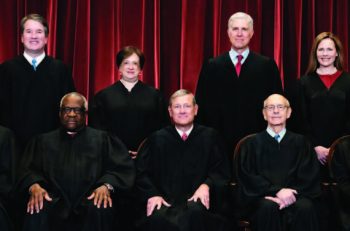
So far, manifestations of difficulty include an insidious marginal judicial interest in historicism and a move away from unenumerated rights, particularly that of a general right to privacy. By David Langwallner This article is about dangerous trends in American jurisprudence driven by problems with the political culture of that country. The trends risk being replicated in Ireland but must be resisted. The recrudescence of neo-conservatism in the American judiciary is a least a 30-year phenomenon with a limited and ever-shrinking liberal counterweight. It has been fuelled by the political nature of judicial appointments, Trumpism and indeed Trump nominees. The difference between neo-liberalism and neo-conservatism is important in the judiciary. A traditional neo-liberal like the UK’s Lord Sumption believes in disallowing state interference and police interference in private lives and the liberty of others — which is at least intellectually cogent. Neo-conservatism on the other hand enforces on others a fundamentalist and dogmatic worldview of religion and the deserving. It is led by Trump and Christian rednecks in America. In the US Supreme Court in the last two years, there have been chilling changes as it veers towards far-right-wing extremism. Intentionalism/historicism/constructivism In New York State Rifle and Pistol Association v Bruen, a case concerning the tragic mass shootings in Uvalde and Buffalo, the Supreme Court recently held a 1911 New York edict that anyone in possession of a handgun in a public place needed proper cause violated the Second Amendment’s right to bear arms So, just as you could use muskets against the British in the Eighteenth century, you can use handguns on the streets of New York in 2023. This ludicrous underpinning doctrine, known as originalism, intentionalism, or historicism is an approach inherited from the recently deceased Supreme Court judge Anthony J Scalia, for whom Trump’s 2020 appointee, Amy Coney Barrett clerked. The idea, if it can be called that, is of an unevolving text that should be interpreted according to the original intent of the founding fathers or those who drafted the text. This all militates against the derivation of new rights particularly that of privacy and its emanations. Apart from the objection that such intent is unknowable, there is also the objection posited by Ronald Dworkin that this is rule by the dead hand of history and that it just creates an unanswerable imperative for the constitution to be overhauled for modern times, and legitimacy. It is a silly method of constitutional interpretation for a progressive society. Privacy Rights The biggest recent outing for the obscurantist doctrine of historicism was the overturning of the abortion case Roe v Wade in Dobbs v Jackson Women’s Health Organization, on 24 June 2022. The trimester analysis in Roe which was overturned was not, it must be conceded, medically sound — allowing, as it did, for termination up to six months which, as medical science advanced, became long post-viability. The subsequent case of Casey established that the abortion right derived not from a right to privacy but from the Fourteenth Amendment’s due process clause and that restrictions could be imposed on abortion unless they were unduly burdensome. This led to a flurry of State retrenchments and subsequent litigation. Notifications, parental consent, and independent advice were all promoted as obstacles to the procedure. It also led to abortion wars, the murder of doctors providing abortion services and, just recently in South Carolina, proposals for the death penalty for abortionists. It culminated in 2022 with Justice Samuel Alito in his majority opinion, overturning Roe, in Dobbs: establishing that Casey was wrong in upholding Roe because a right to abortion was not found in the constitution and could not be inferred from the concept of ordered liberty since it did not historically, as a matter of consensus. feature as an inherent component of liberty. In his recent book, ‘The Supermajority’, Michael Waldman says the judgment preserves “in amber 19th-century social norms”. It is implicit in Alito’s opinion that privacy rights should not ever have been added to the constitution. Waldman implies that conservatives might have been less put out if decisions on contraception, abortion and criminal justice had been couched in less “groovy” and “psychedelic” terms. This augurs badly for homosexuality and contraception. Unwillingness to infer rights from liberty – and other constitutional imperatives — is also arguably evident in recent Irish Constitutional judgments which are shifting away from the idea of “unenumerated rights”, to, as with the Supreme Court in Climate Case Ireland (2020) more limited “derived rights”. Unenumerated rights are anathema to historicists but in fact, flow logically from the fact Bunreacht na hÉireann iterates a list of personal rights “in particular” which necessarily implies there must be others. Abortion has of course been ineradicably secured in Ireland by referendum. In McGee, which recognised a right to marital privacy leading to a right to contraceptives for marital couples, the Supreme Court explicitly rejected historicism and said that it was the public mores of today and not of 1937, which were relevant. As Walsh J, opined referring to the values declared in the Preamble: “It is but natural that from time to time the prevailing ideas of [prudence, justice and charity] may be conditioned by the passage of time”. Of course, Ireland’s Supreme Court’s rightist Titan, the late Adrian Hardiman, endorsed historicism in Ireland. The more recent case of Sinnott v Minister for Education [2001] includes an application of the historical method of interpretation. Hardiman, J stated: “If the term “primary education” is construed on a historic basis it is clear that what was in the mind of the drafters of the Constitution was the ordinary, scholastically oriented primary education represented by the ministerially prescribed National School curriculum. The contrary was not submitted”. The historicist approach is one thing but more generally the Sinnott judgment, according to Professor Colm Ó Cinnéide, is significant for “how the majority of the Supreme Court pushed back against new approaches to protecting rights which had become highly fashionable by the end of the 1990s – favouring instead