Archives

OK

Random entry RSS

Loading

  • Posted in:

    Only vote Green if they show more hard-mindedness and discipline.

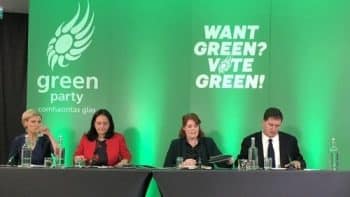
    Even in the climate emergency the Greens are all carrot and no stick.  By Michael Smith. I attended the Greens’ manifesto launch. I did it because, more than for any other party, their agenda – Green – matters. Being well-disposed I wanted to assess their fitness to deliver it. The media were there in force and about a hundred fairly presentable Green activists were on hand.  There would be internal training afterwards.  On the podium were three leaders of the party.  The first two spoke mostly about particular sectoral issues, reading from scripts.  Then Eamon Ryan gave a bit of a framework to it, some vision, an aspiration to ten areas where the Greens wanted more ambition, and an ambition to 15 seats which everyone seemed especially excited about.  He said something, again, about senior hurling.  There didn’t seem to be many hurlers in the crowd.  Nearly half of the candidates in Dublin went to rugby-playing Gonzaga which brings its own biases.  Then there were questions, led by Brian Dobson and the Irish Times‘ Green Party person, Harry Magee.  The questions were mostly what a non-Green would ask, with a fiscal bias.  Harry asked about insulation, and the budget for it. Eamon Ryan said if Ireland was to reach its emissions-reduction goals it will need to spend a total of €50 billion over 20 years to retrofit 750,000 houses to improve energy efficiency. I asked what they’d do about implementation of their agenda bearing in mind the problems with that the last time they were in Government.  Eamon Ryan – an almost pathologically benign optimist – said what he always does, that you can achieve a lot in government (they didn’t) and that half the reduction in carbon in the period after they entered government was due to their efforts – the other half being due to the fact the imploded economy meant fewer people needed to get to work.  He didn’t mention that any incursion on the soaring emission figures was highly temporary, and the energy improvements around that time were forced by the EU.   I asked what they would do about sprawl.  The answer was delegate more decisions to the community level.  That is the right answer to nearly all questions.  But not to this one.   The answer is ensure the already-agreed National Planning Framework is implemented not just referred to.  Indicatively, actually the Greens’ manifesto doesn’t even refer to it…or scandalously, outside of transport and climate, even refer to Planning. Nobody addressed my question on quality of life. It is elementary that environmentalists think quality of life should be measured, across a range of indicators, so it can be advanced instead of pursuit of a simple economic GDP metric. This is one of the biggest features of a green agenda. But there’s no reference to it in the manifesto. They didn’t advance it the last time they were in government, and clearly they won’t do it this time if they’re elected. The Green candidate in Dublin Central, Neasa Hourigan, often an impressive presence, mistook my question about introducing a constitutional referendum to reduce the power of property rights in order to promote a general pro-planning agenda for a question about housing.  They seemed to be improvising on central policy issues. This would not matter if it were not probable the Greens will shortly be in government and if they had not achieved so little last time out.  For it proves they have not learnt their lessons.  When asked about what the Greens had learnt from being in government the last time out, and the question wasn’t particularly directed at the environment, then-aspirant-MEP Ciaran Cuffe stated that it was not to go into government in the worst depression in generations.  That was not the right answer to give.  Remember, this is the party that justified going into government with dodgy Bertie Ahern on the basis that the climate imperative necessitated it, and yet which failed to pass a climate act in three and a half years, leaving only a toothless climate ‘bill’ as their legacy. The Greens needed, indeed still need, to be tougher and more strategic.  They need to plot out want they need to achieve in government, in particular policies;  and to monitor its success.   Just as you can monitor economic growth month to month they should be monitoring: quality of life, air quality, mortality rates and development patterns month to month; and adjusting policy to achieve clear strategic goals.  The Greens’ manifesto is fairly thin – by comparison with Sinn Féin’s magnificently unwieldly one for example – but imaginative and progressive.  It’s great to see a proposal for an 80% tax on windfall rezoning profits and the Green Party is serious about a site value tax. Implementing the Kenny Report on public compulsory acquisition would be exciting. Environmental journalist John Gibbons has applauded its plan to increase the amount of Irish land farmed organically to 20 per cent by 2030.  I would find it difficult to argue with almost any of it as far as it goes.  Though unfortunately it is not always entirely clear that it is a party of the Left, or that it favours radical redistribution.  Though they support the radical measure of a universal basic income, their section on ‘Equality’ illuminatingly doesn’t mention income or wealth equality.  It’s not even that detailed on the environment.  There’s nothing on architecture or design. Or on urbanism; or on curtailing sprawl and one-off housing. There’s a bit on density but nothing on high-rise. Nothing from the Greens on Planning. It just doesn’t figure in the manifesto. Ciarán Cuffe must have been asleep. The Greens aren’t going to stop one-off housing – as that would generate an unholy row.  And their approach to the suckler herd is likely to be as gentle as that of the Polish government to coal-mining.  It’s an exception where we have a competitive advantage after all. And the lobby is frightening.  Anyway, it calls for a 7 per cent per year fall in emissions to reach the EU CO2 reduction target of a minimum 50 per cent by 2030. The current government target

    Loading

    Read more

  • Posted in:

    The subtlety of Ireland’s leftward shift explained.

    Where they vote left, young  voters tend to focus on redistribution and inequality. Only 31% of 18-24 year olds and 32% of 25-34 year olds support Fianna Fáil or Fine Gael. By William Foley. Ireland is on the cusp of a general election which will see an unprecedented transformation of its political divisions. Surprisingly, it will be the first time in generations that questions of economic distribution will have affected the outcome. Evidence from opinion polls and surveys shows that where younger voters (under 29 years of age) reject the dominant right-wing parties they do so because they want greater economic equality. This gives the left a unique chance by focusing on their core issue – redistribution – to galvanise today’s youth to an egalitarian agenda  if, despite the failure of commentators to read the situation, they keep clear heads and take the opportunity. In postwar Europe, political parties in most countries traditionally competed over who got what, and how much. Parties were aligned along an axis – on the right were those who believed that the market should be the primary mechanism for determining the distribution of wealth, and on the left were those who believed that this distribution should be fixed in large part by the government.  Ireland has usually been regarded as an exception. Here, the main political division does not run between the left and the right.  Here it has not been between those who favour greater redistribution by the state and those who are against it, but between descendants of the opposing sides in the civil war. Those lineages may have some importance today – Fianna Fáil would probably not have attempted to rehabilitate the RIC – but what they amount to in practice is a system in which the vast majority of people have always voted for parties which have been economically right-wing, at least since Lemass.  This state of affairs has not prevailed because Irish people are inherently more right-wing than other Europeans. Political views are not the result of a simple transformation of broad values and social attitudes into party support; they are the indirect outcome of a process which filters those values and attitudes through a given ideological frame. These frames function like lenses, capable of magnification and diminution, distortion and concentration. Certain values may be filtered out – considered irrelevant for the determination of political preference. In Ireland, due to a conjuncture of historical reasons, left-wing ideological frames were largely absent.  Other factors were at play which determined political identities: the legacy of a brutal and traumatic civil war, the personalisation and parochialisation of politics, the hobbling of economic development under British imperialism, the passive role played by the Labour party from 1916 onwards, and so on. Questions which concerned the just distribution of resources were simply filtered out by the dominant post-civil war frame. Historically, the left has failed to pry even one finger loose from the FF/FG stranglehold. Parties such as Clann na Poblachta and The Workers’ Party occasionally sparked into life, achieving fleeting electoral success before flickering out like tealights in a children’s nursery. Because one of either Fianna Fáil or Fine Gael was usually in opposition, the see-saw effect of electoral politics meant that when one became somewhat unpopular, the other could take its place in government.  But the confidence and supply arrangement that prevailed in the last Dáil has meant that, while Fianna Fáil were not in the cabinet, they were not entirely in the opposition either. The economic crisis dealt them a blow from which they have not really recovered, nor have Fine Gael truly taken their place.  The result is that the two right-wing parties are more closely associated than ever – and more unpopular. Opinion polling since the general election seems to show them combined  on about fifty percent or less. Most striking is the age gradient: only 31% of 18-24 year olds and 32% of 25-34 year olds support either Fianna Fáil or Fine Gael, according to an Irish Times / Ipsos MRBI poll. If these trends hold true, then what appears to be emerging in Ireland is a more traditional “left-right” divide, characterised by competition between parties who favour more economic redistribution and those who oppose it. Survey evidence seems to support the increasing relevance of attitudes towards redistribution for determining party support. Figure 1 Support for redistribution and combined support (%) for FF / FG over time. Figure 1 makes use of Irish data from nine rounds of the European Social Survey (ESS) to illustrate this dynamic. Each round of the ESS asks respondents to indicate their support for the following statement: “Government should reduce differences in income levels”.  The respondent could say that they strongly agreed, agreed, neither agreed nor disagreed, disagreed, or strongly disagreed. I recoded the question so that everyone who strongly agreed or agreed was categorised as “supportive of redistribution” and everyone else was categorised as “unsupportive”, excluding those who didn’t answer the question (about 2.7% of the sample).  The ESS also asked respondents if they felt close to any party (about 36% did), and which party they felt closest to. I used this question to calculate the combined support for FF / FG over time, among those who are supportive and unsupportive of redistribution, excluding those who didn’t support any party. This relationship is shown in Figure 1. The data are weighted to reflect unequal probabilities of inclusion in the sample (though the unweighted results are the same), and the years given on the horizontal access correspond to the calendar years in which most of the Irish respondents were interviewed for each of the nine rounds of the ESS. These data probably overestimate support for Fianna Fáil and Fine Gael – at least compared to present opinion polls –  but the emerging relationship that they depict is valid.  As can be seen, preferences for redistribution matter a lot more after 2011. In the preceding years, those who are supportive and unsupportive of redistribution

    Loading

    Read more

  • Posted in:

    Left fails properly to address scandal of Direct Provision at election time.

    Loth in their campaigns to address minority issues, the mainstream parties have left all the momentum on immigration to the intolerant right. By Stacy Wrenn. For how long can something be ‘next’ before it’s allowed to become ‘current’? Direct provision has been referred to, in some variation, as ‘our next great shame’ in the mainstream media for years without experiencing this elevation. Working groups have come and gone, minor reforms have been made that benefit some asylum-seekers over others, and little has fundamentally changed.  Although it was established as a temporary measure for housing asylum-seekers awaiting refugee status in 1999, direct provision — or direct provision and dispersal as it is more accurately referred to — has remained constant in contrast to its perceived attention-worthiness. This fleeting public shame appears in bursts, often for months at a time, sparked by major events that essentially serve as reminders that the system still exists. In 2019, there were at least seven co-ordinated anti-asylum seeker protests in response to proposed accommodation centres, not including arson attacks on some of the properties themselves. On the morning of October 28th, the car of Sinn Féin TD for Sligo-Leitrim Martin Kenny was set alight in what was widely accepted to be a response to statements he had made in the Dáil the previous week condemning such protests. For weeks the Irish mainstream media had the direct provision system as their primary topic of conversation, with multiple discussions in the Dáil chamber after months of silence. With powerful addresses from Brendan Ryan, Labour Party TD, and Catherine Martin, Green Party TD, among others, it felt as if a meaningful national conversation had begun. A swathe of documentaries, think pieces, and media exposés followed on the history of direct provision, the experiences of various sub-groups, with the Joint Committee on Justice and Equality report finding it “no longer fit for purpose”. The fifth-anniversary conference of the Movement of Asylum Seekers in Ireland [MASI] saw greater engagement from wider civil society than any outreach event in previous years. Then Christmas came, the election was called, and it was as if none of this had happened. An argument could be made that it was difficult to maintain such momentum over what is traditionally a lull in the political calendar. However, this was also the optimal time to develop a coherent position to make direct provision an election issue, yet no left party sought to do this. Instead, the debate has focused on health and housing with little nuance — such as consideration of the experiences of those granted refugee status who are forced to remain in direct provision because of the shortage of affordable housing. With The National Party and Anti-Corruption Ireland running thirteen candidates between them on explicitly anti-immigration tickets, this is negligence that no progressive party can justify. The momentum on immigration in general and direct provision in particular, at election 2020, has all been with the intolerant right.  There is no doubt that the candidates on the right feel emboldened by the protests of last year:  it’s clear in the openness of their messaging. Standing with two thumbs up and a broad grin, the National Party’s Longford-Westmeath candidate and deputy leader James Reynolds unveiled a large roadside poster with the message: “There are too many immigrants. Enough is enough!”[1]. At the start of the election, one columnist in The Irish Times had the optimistic take that this was not something to be concerned about, explained by some ‘attitudinal trends’ from European Social Surveys between 2002 and 2018. He claimed that the general public has reached the point of being so positive about immigration that any party that advocated for increased controls would be at a disadvantage: “Indeed, political parties both small and large that aim for broad-based support across Irish society would stand to lose more votes from adopting an anti-immigrant platform. While there is possibly some room for Independent political candidates to gain votes from playing the immigrant card this is likely to remain localised and context-bound – at least for the present time”.[2]   This would make sense if we were in a different political climate. Alongside the manufactured struggle for resources that is the housing crisis, the threshold of what is publicly considered racist is consistently raised higher and higher – the increasingly frequent debates about ‘culture wars’ online and ‘snowflakes’ testifies to this. This has enfranchised voters on doorsteps across the country, according to canvassers, to raise the need to ‘house our own first’, apparently generating heterogeneous responses across the political spectrum.  It’s likely that if Fine Gael are to remain in government, they will continue with their cycle of working groups and consultations, and the occasional rehashed press statement about Albanian and Georgian immigrants. And in an interview with JOE.ie the leader of Fianna Fáil, Micheál Martin who knows the importance of care in language when dealing with issues of tolerance, seemed to be taking the side of both the protestors in Oughterard and Rooskey and those who criticised them by saying that while some groups did exploit the “fear of the unknown”, only “some” of it was “completely unfounded”.[3] Although their candidates have been actively organising under the banner of United Against Racism and their track record is good we may take People Before Profit as an exemplar of how even the progressive parties do not have thought-through policies in in their manifestos though they do briefly state that they would “end Direct Provision and give asylum seekers the right to work”. This is a slogan, not a policy. There are no commitments to alternative accommodation or allowances, or indications on how they would implement this in practice.[4] Although election manifestos are predominantly communications exercises, the absence of detailed policies in relation to accommodation, welfare, and education, suggests that implementing their limited policy could leave many asylum-seekers in a worse position than now. One party to directly address the sensitive topic of asylum-seeker accommodation in its manifestos is the Green Party, which in the ‘Migrant Integration’ section aims to end

    Loading

    Read more

  • Posted in:

    Keeler Concealer: the British Establishment’s severe embarrassment at the depth of the Soviet Union’s penetration of MI5 and MI6.

    By David Burke The BBC’s lavish Christine Keeler drama concealed her claim that the Director-General of MI5 was a Soviet mole and ignored what she knew about the infidelities of Prince Philip. The real story is one of treachery, depravity, judicial corruption and the sexual abuse of children by VIPs such as Lord Mountbatten. The six-part BBC drama, ‘The Trial of Christine Keeler’,  has just come to an end. It was meant to be an accurate and comprehenisve portrayal of the notorious Profumo Affair during which a teenager, Christine Keeler, slept with Captain Eugene Ivanov, a Russian naval attaché at the Soviet Embassy in London, while also having a relationship with the much older John Profumo, the high-flying Conservative MP who was Secretary of State for War. Profumo, who met Keeler in July 1961, dramatically denied a relationship with her in the House of Commons but later admitted he had lied and, in June 1963, resigned in disgrace. Stephen Ward, the artist and society osteopath who had introduced Keeler to Profumo, was subsequently put on trial for living off the immoral earnings of prostitutes. He took an overdose of medication before the jury returned a verdict against him and died shortly thereafter. He was found guilty on two charges. 1. THE WIMPOLE MEWS SPY RING. The puzzle that lies at the heart of the BBC’s production is that it ignored the most significant claim Keeler made about the affair: that Sir Roger Hollis was a Soviet mole who was part of a network consisting of Stephen Ward and Sir Anthony Blunt. Hollis served as the Director-General of MI5, 1956 – 1965. Blunt was a KGB mole who penetrated MI5 during WW2. Keeler made the claim in her book, Secrets and Lies (2001). Keeler says she told Lord Denning about D-G Hollis in 1963 while the latter was carrying out his controversial inquiry into the affair and that he made notes of what she said. Hence, there is one straightforward way to resolve the question of D-G Hollis’ loyalty: declassify Denning’s files. Clearly, Keeler could not have known that D-G Hollis was a suspected Soviet mole until the 1980s when this allegation emerged into the public domain, except from her observation of him at Ward’s residence at Wimpole Mews where she had lived with Ward for a while. She said she was witness to a string of meetings between D-G Hollis and Ward at the address. There is a way to resolve the question of D-G Hollis’ loyalty: declassify Denning’s files. 2. THE TRUE DEPTH OF THE KGB’S PENETRATION OF MI5 AND MI6 MAY BE UNFATHOMABLE. Anthony Blunt joined MI5 at the start of WW2 and supplied the Soviets with classified and sensitive secrets throughout the conflict. The perceived wisdom is that he cut all links with Moscow after he retired from MI5 after the war ended and became the Surveyor of the King’s Pictures at Buckingham Palace. Keeler’s revelations, however, indicate that he was still an active Soviet agent as late as the early 1960s. Blunt eventually confessed his role as a Soviet agent and hence there is no doubt about his duplicity. If D-G Hollis was yet another traitor, it means that he had over a decade to plant and promote fellow conspirators up the ranks and turn a blind eye to Soviet operations directed against Britain and her colonies. (MI5 is responsible for the security of UK and her colonies; MI6 spies on foreign soil.) The British media has been obsessed with the hunt for the so-called ‘Fifth Man’ inside the Cambridge Spy Ring for decades. For many years D-G Hollis was viewed as a serious candidate for that perch. The Cambridge Ring consisted of Kim Philby, Guy Burgess, Blunt and Donald Maclean. British commentators now generally agree that a man called John Cairncross was the Fifth Man. Yet, there is no logical reason to believe there were only five high level traitors inside the Establishment or that Cambridge was the only campus visited by Soviet talent scouts. If Keeler’s revelations about D-G Hollis are reliable, there is a strong possibility that MI5 was nothing less than a burgeoning nest of traitors. Indeed, D-G Hollis was only one of an array of suspects. A slew of books have been published which make out cases against a variety of suspects including the man D-G Hollis appointed as his deputy, Graham Mitchell. Another senior MI5 officer, Guy Liddell, was also put under the microscope as was Lord Victor Rothschild who served in MI5 during WW2. There is no logical reason to believe there were only five high level traitors inside the Establishment or that Cambridge was the only campus visited by Soviet talent scouts. 3. AND THEN THERE WERE THE BLACKMAIL TARGETS Aside from ideologically motivated traitors, the KGB used blackmail to recruit reluctant informants. Incredible as it may seem, the FBI suspected Lord Mountbatten – who held a senior position in the Admiralty and had access to NATO secrets – was a traitor and monitored his private life. They learnt that he was a paedophile with a ‘lust for boys’. The Provisional IRA, who monitored and attempted to assassinate Sir Maurice Oldfield of MI6 in the mid-1970s, learnt he was a homosexual. If they knew, is it likely the KGB did not? In 2016 MI6 told the Hart Inquiry in Northern Ireland that Oldfield had a ‘relationship’ with the man who ran the notorious Kincora Boys’ Home in Belfast where sex abuse was rampant. If the Soviets knew even a fraction of this, why did they not destroy his career by exposing him? Instead, did they coerce him into spilling MI6 secrets? MI5 carried out an investigation into the possibility he had been blackmailed in 1980 and concluded he had not. Was Oldfield’s reputed successor as Deputy Chief of MI6, Sir Peter Hayman, another of their blackmail targets? Hayman was a notorious paedophile with a conviction for gross indecency in a public lavatory. One of his victims was

    Loading

    Read more

  • Posted in:

    Still accelerating

    But it’s time to stop living for consumption by John Gibbons One of the innate limitations of living in any given era is the innate assumption that the way things are is how they have always been, and will continue, more or less, into the foreseeable future. In a time of rapid shift, such assumptions can be fatal. Over the last seven decades or so since 1950, the world has embarked on an era known as the Great Acceleration. In this era, the solution to every problem and the very goal of human endeavour all seemed to be the pursuit of growth and with it, ever-increasing standards of material comfort. At the dawn of this new age, in 1955, economist Victor Lebow wrote a stunningly prescient article for the US Journal of Retailing. His key insight was to realise that, for the first time in human history, industrial output exceeded public demand for products. “Our enormously productive economy demands that we make consumption our way of life, that we convert the buying and use of goods into rituals, that we seek our spiritual satisfactions, our ego satisfactions, in consumption”. He added: “we need things consumed, burned up, worn out, replaced and discarded at an ever increasing pace. We need to have people eat, drink, dress, ride, live, with ever more complicated and, therefore, constantly more expensive consumption”. While presented as though it were human nature itself, consumerism is simply a clever ruse dreamed up by marketing Mad Men charged with persuading the public to buy ever more stuff. Not in their wildest fantasies could Lebow and his colleagues have truly understood what forces they were unleashing on the world, and how, decades later, this spiralling global orgy of consumption would have trashed the planet to the point where it teeters on the brink of the ecological abyss. It was never just about consumption. To justify this spree, “we erected new politics, new ideologies and new institutions predicated on continuous growth”, according to author JR McNeill. Writing in 2000, he warned: “Should this age of exuberance end, or even taper off, we will face another set of wrenching adjustments”. Now, some twenty years later, instead of heeding the ever more insistent warnings from the scientific community that critical planetary thresholds were being breached, humanity has instead doubled down, further accelerating growth, consumption, resource depletion and pollution throughout our already stressed biosphere. The recent report from the UN’s Environment Programme (UNEP) on the parlous state of carbon emissions didn’t pull any punches. “The summary findings are bleak”, it noted. ‘Countries collectively failed to stop the growth in global greenhouse gas emissions, meaning that deeper and faster cuts are now required”. The report says that emissions have gone up by 1.5% every year for the last decade. In 2018, the total reached 55 thousand million tonnes of CO2 equivalent. The UNEP report noted that this rate of emissions will deliver a catastrophic rise in global average surface temperature of some 3.2ºC by the end of the century, if not sooner. The Intergovernmental Panel on Climate Change (IPCC) late last year set out in the starkest terms the dangers of allowing global temperatures to rise by more than 1.5ºC this century (they have already risen by just over 1ºC). To have any chance of meeting these targets, emissions need to be cut across every country, every economy and every sector by an average of 7.6% per annum, every year for at least the next decade. This would have to mean sharp declines in living standards across the entire developed world. Largely non-essential sectors, from aviation to tourism would need to dramatically contract over the next decade, as would the use of private cars and the consumption of all meats, including of virtually all red meat. The reality is of course that no government on Earth is planning anything of the kind, and even if some brave politician or party were to come forward with such an extreme austerity programme, they would face sure and certain obliteration at the ballot box. The science says that countries like Ireland need to drastically decarbonise every aspect of their economies, food systems and societies as a whole, or face ruin. Yet the response of our Taoiseach has been to talk up the merits of re-usable keep cups while half-heartedly rolling out a Climate Action Plan that was designed to fail. Meanwhile, Ireland’s Chief Scientific Advisor thinks some carbon-sucking technology is going to magically appear and somehow scale up to solve the greatest crisis in human history. Magical thinking used to be something we associated with hippies, dropouts and dreamers. Now, it’s what passes for policy among the ‘serious’ people like economists, politicians and senior public officials and advisors. We may not be lions, but we are assuredly led by donkeys. John Gibbons is an environmental writer and commentator @think_or_swim

    Loading

    Read more

  • Posted in:

    Co-house, co-op but only sometimes co-live

    We should look to Co-operative and Cohousing solutions to the Housing Crisis caused by dependence on developers and prejudice against social housing by Caroline Hurley and Kim O’Shea THE RUMBLING by the Criminal Assets Bureau (CAB) of a dangerous gang engaged in prolonged extortion of building companies for protection, leading to High Court drama in October 2019, was the culmination of various inquiries involving Dublin City Council into accusations of illegal practices since 2016. CAB claimed well-rewarded criminals carried out anti-social acts at building sites to pressurise developers to decamp. In Drogheda, after seventy shootings and bombings in one year between feuding families, national emergency and armed response Garda have been deployed but a lack of intelligence hampers efforts. Some believe only the type of multi-agency taskforce assembled to combat similar mayhem in Limerick in the early 2000s would work now. Feuding Ennis families repeatedly fight it out with machetes, chainsaws and slash hooks. Casualties mount as the Hutch-Kinahan war extends internationally from Dublin. Parcel bombs are being tossed through letterboxes in a Killarney housing estate. With aggression escalating, bus and rail workers voted unanimously last August to strike if nothing was done about daily assaults, threats, robberies and racist insults encountered by them. 2018 saw a 7% rise in crimes categorised as anti-social, and a 50% risein anti-social behaviour orders issued, with only about 200 served nationwide Beyond those headline-grabbing examples, noise, verbal abuse, trespassing, property damage, stalking and other intrusive and disruptive behaviour frequently forces trapped, targeted householders to uproot as complaints fall on deaf ears. Violations range from vicious random attacks to insidious sinister predation. Effective legal remedies seem to exist in theory only. It’s as if afflicted residents are suddenly conscripted by faceless officialdom into an isolated full-time social-work role, with no consultation or preparation. According to the Central Statistics Office (CSO) and Garda figures, 2018 saw a 7% rise in crimes categorised as anti-social, and a 50% rise in anti-social behaviour orders issued, with only about two hundred served nationwide. Communities live in fear of fearless malfeasants. Where the nuisance is eliminated there is a syndrome of counter-threats. None of this suggests we should condone vengefulness but it does point to the futility of pursuing approved avenues of redress, given beleaguered gardaí, disempowered Councils, conflicted Courts, and meek providers of Citizens Advice, Crime Victims Helpline, and similar bodies. The most pertinent laws are: the Housing Acts 1966 to 2014, governing local authority housing; the Planning and Development Act 2000; the Residential Tenancies Acts 2004 to 2016; the Criminal Justice (Public Order) Acts 2004 to 2016; the Non-fatal Offences against the Person Act 1997; the Children’s Acts 2001 to 2017; the Control of Dogs Act 1986; the Environmental Protection Agency Act 1992 and the Courts Act 1986. An analysis of training for local authority staff dealing with anti-social behaviour, cited in a Community Mediation Works 2010 report, ‘The State Of “Anti-Social Behaviour” In Working Class Communities’, found that “training focused on ensuring that the correct legal procedures were followed”. Equipping staff with skills conducive to impartial investigations, community mediation and tenancy support were peripheral considerations. Bureaucratic rigidity seems still to prevail, though there is a greater emphasis on rights. The report criticised “housing management policies that make enabling tenant purchase the priority”, to the detriment of quality, amenities and relationships. It blamed the 1997 Housing Act for splitting anti-social behaviour into two categories: first, drug dealing, and then, serious intimidation and threatening behaviour, suggesting the latter was less important. The 2003 Norris report faulted the Act for pushing eviction without due process as the solution of choice to anti-social behaviour. While eviction is very rare now, anti-social behaviour is not. Providing only the draconian measure of summary eviction as redress for the widespread torture of peace-loving citizens is uncivic. While not dealing directly with community conflict, management could arrange “cost effective programmes proven to help families in difficulty live peaceably with their neighbours”. These measures could include mediation, family support, monitoring, liaison and above all, real tenant participation through their own organising initiatives. However, such resources are rarely made available. The Free Legal Aid Centre (FLAC)’s 2018 Annual Report drew attention to “the vague and imprecise nature of the legislation dealing with Garda vetting prior to the allocation of local authority housing and the huge disparity between local authorities in relation to the assessment of disclosures made by Gardaí and more worryingly the nature of certain disclosures being made by An Garda Síochána itself”. The lack of standards is causing social collapse. Tenants of housing associations or Approved Housing Bodies (AHBs) report much higher levels of satisfaction than those living in either the council or private sector Residents’ suggestions for beneficial amenities are routinely refused, leaving many with nothing to do but reconcile themselves to their own containment. As anger spills over, the risk of harsh measures like fines and curfews goes up, even though research by bodies like ‘Preparing for Life’ shows that humane steps including early intervention and education are what really work. A wideranging 2017 survey by the Irish Council for Social Housing discovered that tenants of housing associations or Approved Housing Bodies (AHB) report much higher levels of satisfaction than those living in either the council or private sector. Regular property maintenance, reasonable hands-on management, tenant focus and a sense of community were advantages cited. AHBs tend to have strict anti-social policies facilitating fast, effective action. An internal audit of local authorities conducted by the National Oversight and Audit Commission (NOAC) in 2017 referenced policies and procedures meant to be followed for similar challenging situations, but they are mere aspirations. The responsibility of local authorities to co-ordinate services for citizens of varying needs, in such a way as to balance the rights of all, appears diminished. The Housing Agency, whose remit is to facilitate national housing policy, has published papers by the Centre for Housing Research shedding light on approaches taken internationally to ameliorate friction between neighbours. While taken for granted

    Loading

    Read more

  • Posted in:

    Taking Liberties

    An Bord Pleanála is anachronistically heedless to the heritage of Dublin’s most famous and vibrant working-class suburb by Kevin Duff THE LIBERTIES area is a special part of Dublin with a rich social and architectural history. Dating to the twelfth century, the area preserved its own jurisdiction although it was otherwise part of the city. Considered to maintain an authentic sense of historic and working-class Dublin to a greater extent than other parts of the city, the feeling is that great care needs to be taken in its development so as not to erase or further diminish these particular qualities. Following years of underinvestment, the area has seen an explosion of recent construction activity. While on the one hand repair of the area’s fabric is welcome, there is significant disquiet over the avalanche of new hotels, aparthotels and – in particular – student accommodation constructed in the past five years, and the parallel absence of construction and delivery of much-needed affordable housing in the area for locals or for those who wish to live in the area. As has happened in other parts of the city, the smaller artisan houses and terraces of the area have been attractive to young professionals for the past couple of decades, pushing prices up and contributing to housing shortage and unaffordability. Successful new additions to the area include the Hyatt Centric hotel on the Coombe, and the Maldron hotel, Upper Kevin Street, both of which are well-mannered and reinstate historic streetscapes in the vicinity of Saint Patrick’s Cathedral. The redevelopment currently underway of the Tivoli Theatre and adjoining carpark, on Francis Street, will provide a mixed-use scheme to include a cultural and performance space. There are plans to regenerate a 12-acre site at the Guinness Brewery as a new mixed, commercial and residential district. At Newmarket, where the market was closed and the Teeling Distillery opened, the restoration of the early-eighteenth-century house at No. 10 Mill Street as part of an adjacent new development provided a public gain in the rehabilitation of an historic building that had fallen into dereliction over two decades in Eircom’s ownership, and redevelopment of the square itself at Newmarket has commenced. Successful new additions to the area include the Hyatt Centric hotel on the Coombe, and the Maldron hotel, Upper Kevin Street, both of which are well-mannered and reinstate historic streetscapes in the vicinity of Saint Patrick’s Cathedral. The main streets of the Liberties are medieval in origin and the area is richly endowed with architecturally outstanding buildings, including Saint Catherine’s church, the former Fire Station on Thomas Street (now part of NCAD), John’s Lane church, and the Iveagh Market, Francis Street. Built in a neo-Palladian style in 1907, the regeneration of the latter is long-awaited and much concern has been expressed over the unnecessary deterioration of its fabric through a gross lack of maintenance. Owned by Dublin City Council and leased to Temple Bar publican Martin Keane, a sensitive redevelopment proposal for the complex was expected to include retention and rehabilitation of the adjacent nineteenth-century brick buildings of the former Mother Redcap’s pub and Winstanley factory on Back Lane, close to An Taisce’s headquarters where the tailors had their hall. Unfortunately a recent application provided for an eight-storey lump with facade retention only. Apart from its well known historic architectural landmarks, the Liberties, as a former industrial quarter, has an abundance of smaller-scaled buildings of interest – mills, pubs, malthouses and stores. However, poor planning decisions are routinely being made by the State appeals board, An Bord Pleanála, resulting in the needless destruction of this vital and understated component of the area’s built heritage. A recent case concerned an unlisted stone industrial building on Warrenmount Lane, off Mill Street, formerly part of a malthouse complex adjacent to the River Poddle. The building had sat for some years within a development site known as ‘the Tenters Site’ and had been identified by the conservation architects Shaffrey Associates as being of value and interest and worthy of repair and retention within the new development. An example of ‘urban vernacular’ architecture, it was envisaged that the building would form a marker or ‘gatepost’ at the western entrance to the new development. The building (or a previous building on the same footprint) is seen on the 1756 John Rocque map of Dublin forming part of a stepped street-line leading towards the early-eighteenth-century mansion Warrenmount House, a protected structure, which was later converted to a convent. The Tenters Site had been the subject of numerous planning applications for development stretching back to 2005, all of them providing for retention and integration of the stone industrial building within the new scheme. Building work finally got underway in 2016 and was largely complete when, out of the blue in March 2017, an application was made by the developer, BAM Property Ltd (of Children’s Hospital fame), to demolish the historic stone building. Demolition would extend to part of the adjacent, roofless, cement-rendered building, also visible on the Rocque map and forming part of the boundary wall with Warrenmount House. Objections were lodged by An Taisce and a local resident, citing the heritage value of the existing building and the planning precedents for its retention, but permission was nevertheless given by Dublin City Council. As a vital ‘safety valve’ within the system, An Bord Pleanála could generally be relied upon in cases like this where vulnerable built heritage was endangered, and so an appeal against the City Council’s decision was lodged by An Taisce with the aim of saving the building. The appeal arguments were straightforward: The building was characteristic of the Liberties and an example of historic stone construction and craftsmanship It provided a valuable link to and reminder of the area’s rich industrial past, and its retention would add value to the new development Its footprint was evident on maps going back to the mid-18th century It formed part of the historic laneway approach to and setting of the early-Georgian mansion, Warrenmount House, and

    Loading

    Read more