Archives

OK

Random entry RSS

Loading

  • Posted in:

    French Toast

    By Bryan Wall. In a development that shocked very few people Ian Bailey was found guilty of the murder of Sophie Toscan du Plantier in a French court in May. After a four-day trial and deliberating for five hours a panel of three judges sentenced Bailey to 25 years in prison. He was also ordered to pay a total of 1225,000 in compensation, 1110,000 of which is to go to Toscan du Plantier’s family. Bailey, who has always denied his involvement in the murder of the French woman, was tried in absentia. A peculiar aspect of French law allows the authorities there to prosecute people suspected of crimes against French citizens that were carried out abroad. The French had therefore tried twice before to have him extradited to stand trial. In both cases the Irish courts ruled against his extradition, with the High Court ruling in 2017 that the demand for extradition was an “abuse of process”. Nonetheless, the French went ahead and held a trial with Bailey’s absence noted. But Bailey was not the only person absent from the trial. Irish witnesses received a letter asking them to appear at the trial only two weeks before it began. In some cases they were given as little as one week’s notice. As a result only three witnesses gave evidence, one of whom, Helan Callanan, had a statement read out on her behalf. Callanan, one-time editor of the Sunday Tribune, wrote in her statement that Bailey had confessed to her that he murdered Toscan du Plantier in order to “to resurrect my career”. At the time he was freelancing for the paper and wrote about the case for the paper. Of the two other witnesses, Amanda Reed gave evidence on behalf of her son Malachi. As a 14-year-old he had received a lift home from Bailey on 4 February 1997, less thantwo months after Toscan du Plantier’s death. He claimed that Bailey said to him “I bashed her f**king brains in”. His mother. related this to the French court. Back on the evening of 4 February 1997 Malachi arrived home, with no apparent concerns, having being dropped off by Bailey. The next day gardaí visited Malachi in school. There they questioned him about his journey with the journalist. And it was after he arrived home from school in an “agitated” state that he informed his mother what Bailey allegedly told him. Bill Fuller, the third witness, told the court that Bailey had confessed to him. Fuller stated that Bailey, speaking in the second person, said “It’s you who killed her”. Bailey denied this conversation ever took place. But these evidential issues with the trial pale in comparison to the French prosecution’s dismissal of the Irish Director of Public Prosecutions (DPP) and its opinion of the murder. The DPP file about the case was leaked a number of years ago and makes for astounding reading. It contains a litany of concerns with how the murder was investigated. These embrace wide-ranging issues such as witnesses who lacked both credibility and consistency being taken at face value and members of the gardaí stonewalling the DPP itself. It’s pointed out at the start of the report that there is “No forensic evidence linking Ian Bailey to the scene”. He had volunteered blood, hair, and fingerprint samples to the gardaí. This was in spite of the fact that, as the DPP highlights, in his former profession as a crime reporter in the UK Bailey “was aware of the nature of forensic evidence” and that it could comprehensively incriminate the guilty. The trial in France introduced no new forensic evidence to link him to the scene and the murder. The evidence of Marie Farrell, the witness who initially claimed she saw Bailey walking late from the direction of Toscan du Plantier’s home on the night of her murder, was described by the DPP as being unreliable. Yet these initial statements by Farrell, which she retracted years later, were accepted by the French. As for Bailey’s apparent admissions of guilt, the DPP found that they “appear to be sarcastic responses to questions”. This includes his comments to Callanan about trying to “resurrect” his career. And it includes the apparent conversation between Bailey and Fuller. The DPP noted that Fuller’s statement came at a time when the Garda’s actions were “bound to create a climate in which witnesses became suggestible”. The DPP report also discusses the statement made by Malachi Reed. It noted that it was “abundantly clear that Malachi Reed was not upset by Ian Bailey” after the latter had dropped him home. In fact, the DPP pointed out that it was after a conversation with a garda the following day that “he became upset and turned a conversation which had not apparently up until then alarmed him into something sinister”. And then there’s the Garda’s arrest of Bailey’s partner, Jules Thomas. She was arrested for the Toscan du Plantier murder on 10 February 1997. But the arrest appeared to the DPP to be illegal. This was because it discovered she was asked no questions about her involvement in the murder. The DPP wrote that her “questioning indicates that she was arrested to obtain information which could be used against Bailey”. And given this, “her arrest and detention was unlawful”. The French ignoring of the report means that none of this was taken into consideration. It means that a trial was held using evidence that was roundly dismissed by the DPP; evidence which resulted in the DPP clearly stating in unequivocal terms that “A prosecution against Bailey is not warranted by the evidence”. Frank Buttimer, Bailey’s solicitor, is explicit in his condemnation of the French trial, or “so-called trial” as he refers to it. Although not present in France, based on the information he’s seen he says what took place there “was not in any way a trial that we in a common law jurisdiction would understand a trial to be”. He said that what actually happened

    Loading

    Read more

  • Posted in:

    Weather forecasts are horribly inaccurate.

    WEATHER FORECASTS were always things for older people, like manners and leaf tea. And indeed for olden days: D-Day was only possible because of some superhuman advance-weather-divining from a sage in Blacksod. Many of the ‘War’ generation seemed obsessed with the weather forecast, well beyond the point of refusing to acknowledge its shocking deviance. The weather forecast was the most tedious thing on television. Of course, in Ireland, you couldn’t make plans. Outside of sustained heat waves, no one in Ireland should plan a picnic or barbecue in advance. So you never did. I never cared. I just got on with it. Operationally, you just had to look at the sky when you got up out of your bed and assume it would last. Equally, in Ireland, there was always a good chance of grey. Like today only greyer. Beyond that it seemed pointless, and unyouthful, to speculate. But there are other decisions – a snap weekend away, a walk, dependant others to be born in mind, that may depend on an accurate weather forecast – and so with age you find yourself seeking comfort in experts. And when you pay attention you find they nearly always seem to get it wrong. It’s not that they get it wrong with hurricanes, snowstorms and heatwaves, it’s that they get it wrong – all the time – saying it’s going to shine, or rain, where you’re going to be. The first thing to notice, even before they get it wrong, is that they smother you with ambiguity, those beguiling, soothing-tongued prognosticators: ‘Sunshine and scattered showers, in the West’. ‘Partly clear becoming cloudy, with a risk of rainspells, in the afternoon’. ‘Fine becoming fair’ It means nothing. Words like ‘should’, ‘possibly’, ‘probably’, ‘may’, ‘likely’, ‘some’ and of course ‘occasional’ compound the cloudiness. Getting it wrong is the weather forecaster’s speciality. One study found that when television meteorologists in Kansas predicted that there was a 100 percent chance of rain, it didn’t rain at all a third of the time. On the evening before the worst storm to hit the UK for almost 300 years, the BBC’s well-liked Michael Fish proclaimed on the night of October 15, 1987: “Earlier on today, apparently, a woman rang the BBC and said she heard there was a hurricane on the way. Well, if you’re watching, don’t worry, there isn’t”. There was; and gales at 115mph caused utter devastation across the southern half of the country, leaving 18 people dead, 15 million trees flattened, and damage of £2bn. Though his boss, Bill Giles – the lead forecaster for the station – took the blame for the mistake in 2011, the term “Michael Fish moment” is applied to public forecasts, on any topic, which turn out to be embarrassingly wrong. On September 29, 2016 the National Hurricane Center in Miami announced that Hurricane Matthew was nothing to worry about just before it exploded into a Category 5 monster that slammed Haiti, killing over 1,000 people before moving on to wreaking 30 mortalities in the US. In Ireland, during the big freeze of January 2010, Batt O’Keeffe, as minister for education, directed all schools to close for three days, based on a Met Éireann forecast of snow and ice. A thaw immediately kicked in, and he ignominiously rescinded his decision. Documents released under freedom of information to thejournal.ie a few years ago revealed widespread anger at this carry on in Ireland. Typical letters to the Met service were: “How can Met Eireann get away with wrong forecasts so much, I am baffled? If another service provider got it wrong so much, that service provider would be long gone… Met Eireann says one thing and the sky above our heads says another”. “What a joke. From forecasting that today would be mostly sunny yesterday to now saying it will be dull and cloudy. This is not forecasting, it’s nowcasting”. Some years ago Donegal County Council decided to start up its own weather-forecast website because RTÉ was reporting the north-west as a constant wash-out when Donegal had in fact had a scorcher of a summer. However, let’s be clear: the issue of regional bias is a different problem which I don’t want to get into (because it’s ludicrous). I’m talking here just about inaccuracy. Last year dodgy councillor and hotel mogul, Donegal’s Sean McEniff, threatened to sue Met Éireann for money lost by cancelled business. He instructed his solicitors to investigate the possibility of legal action against Met Éireann over what he claimed as an inaccurate weather forecast. Sadly he died shortly after the instruction. The main problem, it seems to me, is that the weather in Ireland is made over the seas, particularly the vast Atlantic ocean but also the Irish sea, and so varies over very small distances. If you live in Germany or Colorado there’s simply less sea to go around and you can see the weather coming. We’re also precariously positioned in a zone of complex transition between warm, moist air (sometimes of tropical origin) moving northwards and colder, denser, drier air (usually of polar origin) which is moving southwards. This is the devious and manipulative ‘polar front’ that ruins so many weekends. Nevertheless it is claimed, by those concerned only with the facts, that one-day forecasts have an average accuracy within 2 degrees, and that they predict rain (or a lack thereof) correctly 82 percent of the time. That drops to 70 per cent at three days, but even the seven-day forecast has a 50 per cent chance of being accurate. The UK Met Office does a 10-day forecast but – wisely, given its reputation – has ditched its seasonal forecasting which really never amounted to much more than hubris. In April 2009 the Met Office had unwisely issued a press release about the oncoming summer – “barbecue weather”. But it was a washout. A project at the 2018 Young Scientists Exhibition tended to absolve Met Éireann: two boys from Avondale Community School concluded that: “The

    Loading

    Read more

  • Posted in:

    First impressions of the new European Parliament

    By Mick Wallace OF COURSE I understood that the European Parliament represents a different way of working to that of the Dáil, but to say just how the European Parliament compares with what I had expected is difficult, mainly because I didn’t really know what to expect. I knew that it could be even more frustrating, if that’s possible, than the Dáil, that it was a structure which had neoliberalism built into its very essence, and that it was likely to present us with the political challenge of addressing the difficulty of making a real difference. Deciding to run for the European elections was not an easy decision. I’m still not certain that it was the right one; only time will tell. I’ve spent the best part of six weeks in Brussels and Strasbourg and the early experience has been head-melting. So far it’s been a mix of negative and positive. On the negative side the bureaucracy does my head in! Both Clare Daly and I got elected as Independents under the Independents 4 Change banner, with every intention of remaining Independent. One of our first challenges was to join a group of some sort: we soon discovered that there’s no perfect group, they all seem to be a bit of a mixed bag, and all challenging our natural allergy to political parties. We ended up with GUE/NGL (the Confederal Group of the European United Left/Nordic Green Left which brings together left-wing MEPs) – by no means perfect, but it was the grouping that allowed us the most freedom as Independents and they were the only grouping that didn’t apply a whip system – God knows, I was never very fond of being told what I should think. The battle for committees was next, and I eventually got what I wanted – Environment and Food Safety, which is a huge area, and is sure to be central to much of the parliamentary proceedings for the next five years. I also got Foreign Affairs, along with Security and Defence – the battle to prioritise peace over war, and to stop the ‘not so gradual’ militarisation of Europe has begun. A cursory glance suggests that I might regularly find myself in a minority – but nothing new there. The real work in the European Parliament takes place at committee level, and there are many strands to it. As an individual member of a committee you can look for a file on a particular issue, or for a directive, or for another piece of legislation that you are interested in. You can also look to be a co-ordinator where you would be the rep for your group on a particular file or piece of legislation, or you could look to be a rapporteur where you would be spokesperson for the file for all the co-ordinators of the different groups. There are also good opportunities to speak at committees. On the last pre-vacation sitting week, I managed to speak twice at the Environmental Committee. I spoke first on the Mercosur trade deal which I strongly believe should be opposed – it is bad for the environment, bad for food-safety standards and bad for the future of smaller family farms across Europe. I also spoke on the need to stop the use of glyphosate, better known in Ireland as ‘Roundup’. Its connection to any form of food production should not be tolerated. It is extremely bad for our health despite what the best science, that Monsanto’s money could buy, may have said. I also got to speak twice at the Foreign Affairs committee, and aside from having the opportunity to have my say, it was also good to be allowed to challenge two big hitters. I got to question the impressive Helga Schmid, Secretary General of the European Union’s diplomatic service, the EEAS, on Iran, and I also got to challenge the less impressive Gilles Bertrand, Head of the EU Delegation to Syria, about his outrageous support for regime-change in Syria. The previous week, I got to speak four times at the Parliament’s Plenary session in Strasbourg. I had fought like a bear for speaking time through the GUE/NGL group and failed, but by sitting through long debates from start to finish, managed to grind out speaking time on issues ranging from the Mercosur trade deal to challenging Federica Mogherini, EU Commission Head of Foreign Affairs, on how the EU is prepared to ignore International laws when it comes to Venezuela and Iran, conceding to the will of the US regime. It is early days yet but we do realise that we will have to work harder in Europe than at home, to make a difference, but that’s a challenge we relish. The numbers of MEPs are big out here but already we see a lot of people who we don’t believe will put the work in. We are also conscious of the fact that there’s a serious lack of democracy in how Europe works – but we didn’t stand for election to the European Parliament to just go with the flow. We believe in the European project but Europe must change, and we will do our damndest to change it. Right now it is undemocratic, it is wedded to neoliberalism, and if it continues to prioritise the interest of large corporations and big business over those of the people of Europe, the European project as we know it will perish. If it doesn’t change direction, the likely departure of the British could be the beginning of the end – but we didn’t come to Brussels to put an end to the European project, we’ve come to try to save it from itself.

    Loading

    Read more

  • Posted in:

    The Prince, the pauper and the paedophile peer: the dangerous questions the BBC failed to ask.

    SOME REALLY DANGEROUS QUESTIONS WERE NOT ASKED The BBC’s Emily Maitlis has broadcast the interview she conducted with Prince Andrew about his relationship with the convicted paedophile Jeffrey Epstein. It was billed as a ‘no holds barred’ interview. Unfortunately, Maitlis did not ask a single question about his relationship with the notorious child molester, Lord Greville Janner. Yet the Prince’s relationship with Janner raises as many questions as that of his friendship with Epstein. The British media has turned a blind eye to the Janner-Duke of York relationship. The Independent Inquiry into Child Sex (IISCA) in London chaired by Professor Alexis Jay may soon abandon its inquiry into Janner completely. If it does, the Prince will get to heave yet another deep sigh of relief for he will not have to face questions about his friendship with Janner from that quarter either. Alan Kerr, an Irish victim of sex abuse from Belfast, has provided the IICSA with details about the Prince’s friendship with Janner. Kerr’s story was revealed exclusively by this magazine. Readers who are not familiar with it are invited to read ‘The Boy on the Meat Rack’  and  ‘Out of the Frying Pan and into the Fire’ on this website. (Click on the ‘Alan Kerr’ tab at the end of this story.) A  PRINCE WHO IS ABOVE THE LAW The possibility that the IICSA will not investigate Janner comes in the wake of an announcement last August that the Metropolitian Police were not going to investigate the Prince for having had sex  in London with Virginia Roberts when she was 17. A spokesperson for the Met announced that it investigated allegations he had “had sex with Virginia Roberts Giuffre aged 17 in Ghislaine Maxwell’s bathroom” in London and confirmed that while they had received “an allegation of non-recent trafficking for sexual exploitation’ that ‘no further action is being taken”. Last August Channel 4 News discovered that the Met had “reviewed the available evidence” and decided that the matter “would not progress to a full investigation”. The Met’s purported inquiry had begun with a review of the “available evidence” in 2015 after receiving a complaint over claims in US court papers that a girl was “forced to have sex with Prince Andrew”. Independently, Roberts’ lawyers contacted the Met in 2016. A further complaint concerning the sexual trafficking of Roberts to the UK was received by the Met in 2015 from an unconnected third party. As Channel 4 disclosed, ‘The Met Police has refused to answer detailed questions about the allegations and whether they ever spoke to Epstein, his friend Ghislaine Maxwell, Prince Andrew or anyone from the Royal Household. Channel 4 News asked the Metropolitan Police a series of questions about Virginia Roberts’account of what she says happened to her at Maxwell’s London residence in early 2001. The Met told Channel 4 News: “[We] can confirm that the Metropolitan Police Service [MPS] received an allegation of non-recent trafficking for sexual exploitation. The MPS reviewed the available evidence and the decision was made that this would not progress to a full investigation. As such, the matter was closed”. It will come as no surprise that the Prince chose the BBC, not Channel 4 for his interview about Epstein. THE PRINCE IS CLAIMING THIS WOMAN IS A LIAR AND A FORGER. Ghislaine Maxwell procured and trained underage girls to have sex with adult males, as part of Jeffrey Epstein’s now infamous international paedophile ring.  Roberts has spoken about how she was taken to London in 2001 by Epstein. During her trip, she was awoken from her sleep by Ghislane Maxwell who told her ‘you’re gonna meet a prince today’. That night she went out dancing with Prince Andrew in a club where he gave her alcohol and she was later ‘forced’ to have sex with him. She claims had sex on two other occasions with the Prince. Although the Prince had precise dates, times and places at the tip of his fingers, he affected genuine surprise at the suggestion he had participated in an orgy in America with her. This demonstrates that he was putting on a performance for the cameras. His facial expression was tantamount to a lie:  how could he have been so surprised at an accusation – acting as if it was the first time he had heard it – if he was long since familiar with it?   HAS TIME RUN OUT FOR THE JANNER STRAND OF THE IICSA’S INQUIRY INTO CHILD RAPE? On 9 March 2016 Ben Emmerson QC for the IICSA said the Janner investigation “has been identified for an early hearing, partly in recognition of the length of time the complainants in this matter have had to wait before their allegations could be heard. The Janner investigation is one of four investigations in which preliminary hearings are being heard this month and in which early public hearing of the evidence are expected”. The Janner strand was intended to have opened in September 2016 but was moved to March 2017. It was adjourned again in the expectation it would be heard in 2018 but was then moved to a three-week slot in February 2020. It may now not proceed at all. Overall, the Inquiry proposes to conclude its hearing by November 2020 and publish a final report by March 2022. The threat of discontinuance of the Janner strand arises from the fact the Crown Prosecution Service (CPS) is considering whether or not to prosecute an unnamed individual on a referral from the Independent Office for Police Conduct (IOPC).  The Janner strand may not proceed while the CPS decides whether or not it will prosecute the individual. If the CPS decides to prosecute,  the IICSA will have to wait until after the prosecution has been completed. By then IICSA may have completed its hearings. If there are further delays and or appeals, the IICSA may even be wound up by the time all issues are determined. Unfortunately, the CPS was not in a position to tell the

    Loading

    Read more

  • Posted in:

    Jeremy Corbyn's record shows he would end the cover-up of MI5's exploitation of the rape of Irish children.

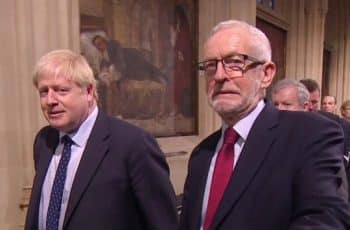
    While the UK’s 2019 general election will focus on Brexit, the outcome will have far-reaching implications for Buckingham Palace and Her Majesty’s intelligence services. Boris Johnson is unlikely to order a new inquiry into MI5 and MI6’s role in the abhorrent Kincora scandal, nor the role played by Lord Louis Mountbatten in it. Jeremy Corbyn has no such inhibitions. The survival of the Royal Family’s reputation and that of the UK’s intelligence services may very well depend on keeping Corbyn out of 10 Downing Street. Meanwhile, Johnson’s government has finally voted to set up a compensation scheme to aid the victims of child sex abuse in Northern Ireland and hopes the scandals they are associated with will go away. The establishment of the new scheme must not be exploited as an opportunity to consign the horrors the abuse victims suffered to history. The torture meted out to children at institutions such as Kincora Boy’s Home, Williamson House, Bawnmore and elsewhere, must not be forgotten. The abuse they suffered should not be described as ‘historic’. On the contrary, they are livid wounds on the British body politic. Some victims committed suicide. Many of the survivors  lead precarious, lonely and impoverished lives as a result of their traumatic experiences. The British Government needs to tell them the truth about what happened to them as children for the sake of their mental well-being. They need closure in the form of apology, acknowledgement and the truth, not lies, insults and defamation. Judge Anthony Hart, who produced a lamentable report in 2017 about the so-called ‘historical’ abuse that took place in institutions run by the State in Northern Ireland, understood none of this. On the contrary, he was condescending and disdainful towards victims such as Richard Kerr. The ongoing Independent Inquiry into Child Sexual Abuse (IICSA) in London looks like it will result in an even bigger car crash, especially as it may not proceed with its probe of Lord Greville Janner. This is incredible as Janner is beginning to look like he acted as a pimp for the British Establishment, the very issue the IICSA was set up to inquire into. There are many substantial reasons to condemn Hart’s 2017 Report and many reasons to abandon all hope that the IICSA wil unravel the seedy Anglo-Irish Vice Ring that preyd on children for decades. A fresh inquiry should be ordered into (a) the role MI5, MI6, the Northern Ireland Office (NIO) played in the original Kincora scandal and (b) the VIPs who abused Irish and British children and (c) the mammoth cover-up which persists to this day. Most particularly, Margaret Thatcher’s Cabinet Secretary, Sir Robert Armstrong, should be invited to tell such an inquiry all that he knows about the cover-up. General election candidates in Northern Ireland should be asked where they stand on the issue. Naomi Long, Leader of the Alliance Party, has already displayed outstanding leadership on the issue. The DUP has multiple connections to the scandal through its former leader Ian Paisley. He was surrounded by a relay of paedophiles and pederasts who raped children in the 1960s and 1970s. Foremost among them is a notorious wife beater who raped at least one boy Village  has spoken to at the Park Avenue hotel in Belfast. The Ulster Unionists have questions to answer too about a number of former Westminster MPs who served in their ranks such as their former leader, James Molyneaux. Sinn Fein and the Provisional IRA can hang their heads in shame too. They have had their own own sex abuse scandals which they mishandled badly (not to mention the incalculable number of children whose lives were destroyed by the acts of IRA bombers and gunmen). Compared to Boris Johnson, Jeremy Corbyn loathes, hates and despises MI5 and the other UK intelligence services. He has no love for the Royal Family either. Moreover, his key aide, Seumas Milne, a former journalist, has written extensively about MI5 dirty tricks. His book, ‘The Enemy Within’, first published in 1994,  has now reached its fourth edition. It is an indictment of MI5’s dirty tricks campaign during the Miners’ Strike. MI5 should be afraid, very afraid that Corbyn and Milne may yet reach Downing Street. There is nothing they would rather do than grind MI5 into dust. Kincora, the Patrick Finucane assassination, collusion with Loyalist paramilitaries and the type of dirty tricks Milne has written about, will more than provide them with the ammunition they need to shut it down and replace it with an organisation that has respect for law and order. The report Judge Hart issued – insofar as Kincora and its links to the UK’s intelligence services was concerned – was riddled with mistakes and pitiful speculation. Hart was not a cunning and deceitful fraud in the tradition of Lord Widgery (who produced the first Bloody Sunday report). Instead, Hart was a basically honest yet severely naive plodder. He failed to persuade a string of crucial witnesses such as Colin Wallace and Richard Kerr to talk to him. With the benefit of hindsight, they undoubtedly took the right decision in boycotting him. Hart did not merely fail at persuading high-profile people like Wallace and Kerr to co-operate with him, he was lazy and badly informed. He skill set did not include the ability to  seek out and ask  key figures such as Eric Witchell and Alan Campbell – two former member of the vice ring that swirled around Kincora – to tell him the truth about what had happened. Witchell is still alive and living in London. Campbell died in June of 2017. Like Hart, it appears the London inquiry will ignore Witchell too. Hart also ignored Albert ‘Ginger’ Baker, a former member of the UDA, despite the fact he had spoken about what the UDA had known about Kincora to Ken Livingstone in the 1980s. Baker is also still alive. Livingstone wrote about what Baker told him in one of his books. Baker knows about Westminster MPs from the

    Loading

    Read more

  • Posted in:

    Did Thatcher sanction the Finucane murder? It is now up to PM Boris Johnson and his Home Secretary, Priti Patel, to order a full judicial inquiry into the murder of Patrick Finucane to establish whether or not Margaret Thatcher gave Sir Patrick Walker, Director-General of MI5, the green light to murder him.

    Update: this article was published in October 2019. One year later the British government has refused to carry out a judicial inquiry. One of the stated reasons is that the PSNI and Police Ombudsman are reviewing the case. However, no  review is about to take place. Patrick Finucane’s widow has responded by saying that “as long as there is breath” in her body she will continue to seek answers about her husband’s murder and that the decision by the British government was “quite a shock” and showed “startling arrogance at ignoring the highest court in the land”,  i.e. the UK Supreme Court which has ruled that an inquiry should take place. Mrs Finucane has also pointed out that Brandon Lewis, the Northern Ireland Secretary of State, did not go into any detail about why the decision to refuse the inquiry was made. It  “does seem rather bizarre” she added  “that he [Lewis] is insisting the police [will investigate]” as the PSNI later issued a statement saying there is nothing new to investigate. The Police Ombudsman has no funding for a review. In any event such a review would be pointless and it is a judicial inquiry that is required. Clearly, there are other reasons Lewis and his boss Boris Johnson are blocking an inquiry. Village’s 2019 investigation addressed some of the issues the Tories, MI5 and other elements of the British Establishment are trying to suppress. That article starts here: Introduction: Margaret Thatcher and the cold-blooded murder of an Irish lawyer On 12 February, 1989, the UDA assassinated Patrick Finucane, a highly-regarded Belfast solicitor, at his North Belfast home. Finucane, who was 38-years-old, was shot 14 times by two masked UDA gunmen who sledgehammered their way into his house. His wife Geraldine was also injured during the attack which took place while the couple was enjoying a meal with their young family. In 2019 the Supreme Court in London ruled that the British Government had failed to investigate the murder properly. The only tenable reason for this is because the murder was organised by MI5, the intelligence service attached to the Home Office. A retired Canadian judge, Peter Cory, investigated the murder on behalf of the British State. During his inquiry MI5 officers broke into his office and stole some of the evidence he had accumulated. Cory also told Geraldine Finucane that he had seen a document relevant to her husband’s case which was marked  “for Cabinet eyes only”. Mrs Finucane knows no more. This raises the distinct possibility that her husband’s case was discussed in Whitehall in sinister circumstances before the murder. These revelations formed part of BBC NI’s compelling seven part Spotlight  series,  ‘The Secret History of the Troubles’. They have been ignored by the mainstream British media. Put simply, the finger of blame is now pointing at Margaret Thatcher. It now looks like she gave MI5 the green light to murder a perfectly respectable, law abiding lawyer. If Thatcher  and her circle did not order the murder, why are the Tory top brass so terrified of an inquiry? MI5 was led by Sir Patrick Walker at the time the assassination was planned and executed. If MI5 was involved, it is inconceivable he did not call  the shots – literally. When David Cameron was in 10 Downing Street he told the Finucane family that he could not order a public inquiry into the scandal. When Finucane’s brother Martin asked him why, he turned to Mrs Finucane and said: “Look, the last administration couldn’t deliver an inquiry in your husband’s case and neither can we”. According to Cameron this was because “there are people all around this place, [10 Downing Street], who won’t let it happen”. As he was saying this, he raised a finger and made a circular motion in the air. Theresa May, who was Cameron’s Home Secretary between 2010 and 2016, did not order a proper inquiry either when she took over at 10 Downing Street. The opportunity and duty to do the right thing and call one has passed to Theresa May’s successor, Boris Johnson, and his Home Secretary, Priti Patel. Yet, will they prove every bit as disdainful and corrupt as Blair, Cameron and May and continue the cover-up? Time is fast running out to hear what potentially key living  witnesses have to offer about the Finucane case. The list includes  Thatcher’s then Home Secretary, Douglas Hurd. Born in March 1930, he published a 524 page autobiography in 2003.  Unfortunately, there is no entry under the word “Finucane” in its index. Village  offers him the freedom of this website to inform our readers about what he know about the case, most particularly anything about “cabinet eyes only” documents. The evidence that continues to accumulate points to the probability that Finucane, a skilful lawyer, was targeted by the British State because he had mastered the intricacies of the Diplock Court system in NI and was representing his clients to the best of his very considerable abilities. A lot of Provos were walking free from court. In the mind of Thatcher and others in London, he had to have been a Provo and his death warrant was approved. In these circumstances, the task of assassinating him was passed to Walker and his gang of cutthroats at MI5. However, Finucane was not a Provo. On the contrary, he represented both Republicans and Loyalists. Who ever heard of a Provo securing the freedom of the Loyalist enemy? Moreover, he was married to a Protestant. Finucane was perfectly innocent of any involvement with the IRA although he was vilified as a member after his death. Insofar as the UDA was concerned, the kill-order was issued by Tommy ‘Tucker’ Lyttle, the UDA’s ‘brigadier’ or commander in West Belfast. Ian Hurst, who served with the then top secret Force Reconnaissance Unit (FRU) of the British Army, has stated “with cast iron certainty” that Lyttle was a British agent who was “handled” by the RUC’s Special Branch (RUCSB) using the codename “Rodney Stewart”. Lyttle himself

    Loading

    Read more

  • Posted in:

    Maurice The Mole? The Provisional IRA knew Sir Maurice Oldfield, Chief of MI6, was a homosexual. Did the Soviets know too?

    Forty years ago this month Margaret Thatcher sent Sir Maurice Oldfield, the former Chief of MI6, to Belfast to co-ordinate the activities of the various branches of British Intelligence in Ireland. Within a few weeks MI5 was reporting to Downing Street that he was a homosexual and an inquiry was launched to see if he had been blackmailed by the Soviets or any of Britain’s other enemies. He was soon given a clean bill of health. Kieran Conway, the former Provisional IRA Director of Intelligence in the 1970s, has confirmed to Village   that the Provos knew Oldfield was gay. What, if anything, did the Soviet intelligence apparatus, the KGB, know about Oldfield’s homosexuality? More significantly, if the KGB found out, what did they do with the information? The answer is nothing despite the fact it could have destroyed him.  Such inaction makes no sense as Oldfield was reputed to have been a highly effective opponent of the KGB. The notorious MI6 traitor Kim Philby described him as an officer of “high quality” and “formidable” in his memoirs.  In 2017 the Hart Report into child sex abuse published details of an MI6 document which revealed a “small collection of papers in file three which relate to the relationship [Oldfield] had with the Head of the Kincora Boys’ Home (KBH) in Belfast”. The “Head” of Kincora was “Warden” Joseph Mains who abused teenage boys at Kincora and elsewhere. Joseph Mains, according to MI6 records he had a “relationship” and  a “friendship” with Oldfield. PART 1: OLDFIELD AS A SECURITY RISK A DANGEROUS ATTRACTION TO YOUNG MALES Oldfield was in fact attracted to young males. The KGB could have ascertained this through routine surveillance or from its spies inside MI6 such as Kim Philby and George Blake who would have been on the lookout for blackmail material on their colleagues. There is, of course, a world of difference between being a homosexual and being attracted to underage males. However, back in the unenlightened 1970s and 1980s, few in politics would have  acknowledged this important distinction.  Incredible as it now seems, the mainstream print media routinely referred to the Kincora scandal as a “homosexual” one when it was nothing of the sort. In the dark days of the 1970s and 1980s those who ran British Intelligence definitely viewed a homosexual in the ranks as a security risk. Hence, when Margaret Thatcher was told about Oldfield’s sexuality, his security clearance was withdrawn while an inquiry was carried out to see if he had been compromised by the Soviets. It determined that he hadn’t. However, inquiries into the loyalty of Kim Philby, another senior MI6 officer,  had failed to expose evidence of his true allegiance to the Soviet Union. Furthermore, MI5 and MI6 had let at least Anthony Blunt, Guy Burgess, Donald MacClean, John Cairncross, George Blake – all Soviet agents – run amok inside Britain’s intelligence community for decades. HER MAJESTY’S SPYMASTER  Who was Maurice Oldfield and what was he capable of? When ‘The Troubles’ erupted, Oldfield was Deputy Chief of MI6. He assumed control of Irish affairs because his Chief, Sir John Rennie, did not share the same experience as he in the dark arts of the secret world. Rennie, who had been a surprise appointment as Chief of MI6, had a diplomatic and propaganda background whereas Oldfield had participated in deception campaigns during WW2; fought terrorism in Palestine after it; monitored the flow of weapons and money to the communist guerrillas fighting the British in Malaya in the 1950s. And, if all this wasn’t enough to square up to the IRA, he had a good idea of what it took to run a paramilitary campaign due to his knowledge of MI6’s guerrilla campaign against Albania, something that happened in the 1950s during his stint as deputy chief of MI6’s counter espionage directorate, R5. The Albanian campaign was a disaster. Most observers believe it was betrayed from the inside. Oldfield was a tubby little man who waddled when he walked, often dressed badly and was allegedly afflicted with occasional psoriasis. He has become more famous than most of his contemporaries, probably because Alec Guinness drew on his bespectacled appearance for his celebrated portrayal of George Smiley for the BBC’s production of John Le Carre’s Tinker Tailor Soldier Spy. The glamour of the association with Le Carrie has eclipsed the true nature of Oldfield’s character When Rennie retired prematurely in 1973 after a drug smuggling scandal in Hong Kong involving his son, Oldfield finally secured the top spot he had coveted for so long. Once in the driving seat, he steered MI6 until his retirement in early 1978 under an appropriately misleading title, ‘Head of the Foreign and Commonwealth Office, Research Department’. Under Oldfield, MI6 HQ continued to be what it had always been: a haven for criminals and the sort of place where a visitor would have been well advised to wipe his or her shoes on the way out of the building. Oldfield’s retirement as MI6 Chief was not to prove the death of his career: he re-emerged from his crypt to become Ulster Security Co-ordinator at the behest of Margaret Thatcher in 1979. By then too many intelligence cooks had congregated in NI and were spoiling the spy broth. Oldfield was asked to knock heads and streamline their work. While he was in Northern Ireland MI5 discovered he was gay. An MI5 report submitted to Cabinet Secretary, Sir Robert Armstrong, on 31 March 1980 revealed that on 28 March Oldfield had after “some preliminaries” admitted he “had first been introduced to homosexuality at university and he admitted having engaged in homosexual practices, intermittently, up till the time of his acceptance of his Northern Ireland appointment. His relationships were, for the most part, with restaurant waiters and the like: he had none, he said, with (MI6) staff or agents”. In other words, Oldfield admitted that he had engaged in homosexual activity throughout his career as an MI6 officer with random individuals. A copy of

    Loading

    Read more

  • Posted in:

    Report on NoWar2019 Pathways to Peace Conference, Limerick, 5-6 October 2019.

    By Caroline Hurley. An anti-war conference called ‘NoWar2019 Pathways to Peace’ took place last weekend at Limerick’s South Court Hotel, organised by WorldBeyondWar.Irish and international concerned parties met to consider the extent of militarism in Ireland and elsewhere, and to work towards preventing the war response everywhere with all its inhumane impacts. Speakers included seasoned Irish and American activists, contributors from Germany, Spain, Afghanistan, journalists and others. A video link enabled MEP Clare Daly to join from Brussels. Presenter and producer of RTÉ Global Affairs series What in the World, Peadar King attended a screening and post-discussion of his 2019 documentary, Palestinian Refugees in The Lebanon: No Direction Home, which features extracts of King’s previous discussion with Robert Fisk on the issues. Panel discussions covered topics such as awareness of army bases, nonviolent protest, the arms trade, Irish neutrality, sanctions, divestment, space militarisation, and refugees. Most of the presentations are now online at WorldBeyondWar.org YouTube channel, while #NoWar2019was the Twitter hashtag used. A highlight was the presence of Nobel Peace Laureate Mairead (Corrigan) Maguire from Belfast, co-founder of The Peace People, who movingly participated on Saturday but delivered the impassioned and erudite speech of the weekend on Sunday, as published by the International Press Agency, Presenza. The conference doubled as the annual gathering of World BEYOND War members. Co-founded by acclaimed journalist, author, activist, Nobel peace prize multi-nominee and radio host, David Swanson in 2014, World Beyond War ‘is a global nonviolent movement to end war and establish a just and sustainable peace’. Under the ‘how’ section of the international organisation’s professional website, instruction is given about taking practical actions. Their award-winning book, A Global Security System: An Alternative to War offers a wealth of innovative and viable material showing means to proceed. The event wrapped up on Sunday afternoon with a rally near Shannon Airport, in objection to the airport’s use by US military in violation of Irish neutrality. Shannon’s exclusive civilian function ended in 2002 with the Irish government’s decision to support US vengeance missions after the 9/11 bombings, as elucidated at the gathering by academic and activist John Lannon. Chairperson and founder of Veterans For Peace Ireland, Edward Horgan,added that in permitting this traffic, the Irish government is facilitating wars in the Middle East. Horgan estimated that since the First Gulf War in 1991, up to a million children have died in the region as a result: “roughly the same number of children who died in the Holocaust”. 100,000 Irish people marched in 2003 against the country’s proposed complicity. Even though America then wavered, protesting citizens were over-ruled and the new military-friendly regimeinstalled at Shannon. Shannonwatchdescribes itself as a group of peace and human rights activists based in the mid-West of Ireland. In the tradition of the Irish anti-war protest that began almost a decade ago, they continue to hold monthly protest vigils at Shannon on the second Sunday of every month. They also do continuous monitoring of all military flights and rendition-linked flights in and out of Shannon and through Irish airspace, details of which are logged online. They dislike what ‘killing in the name of’ is doing to Ireland’s reputation. The Peace and Neutrality Alliance, PANA, promotes neutrality and reform of UN security policy, and is critical of the European Defence Agency’s PESCO programme for a coordinated European military force, to which Ireland is subscribed through the controversial Lisbon Treaty – “PESCO allows thus willing and able member states to jointly plan, develop and invest in shared capability projects, and enhance the operational readiness and contribution of their armed forces. The aim is to jointly develop a coherent full spectrum force package and make the capabilities available to Member States for national and multinational (EU CSDP, NATO, UN, etc.) missions and operations”. Two special guests at the Limerick conference were the American Veterans For Peace Tarak Kauff and Ken Mayers who were not only recently arrested but were also banned from leaving the country. Mr Kauff is 77 years of age, Mr Mayers 82. They were imprisoned for thirteen days and held on remand at Limerick Prison for entering Shannon Airport and causing a ‘security breach’ on St. Patrick’s Day 2019. They were freed on bail paid by Edward Horgan but the revocation of their visas is currently being contested in the Irish courts. They shared experiences and ideas with those present. Such treatment of those caring about vulnerable people by Ireland of the welcomes, with our history of colonial oppression, seems egregiously shameful. Pat Elder addressed the US military’s use of fire-extinguishing foam, which contains long-lived carcinogens, PFAS, dubbed ‘forever’ chemicals. No longer can one source of pollution be isolated for clean-up, however, when the earth is being poisoned by plastics, pesticides, industrial and nuclear waste, and more. And when it comes to war, all these come into play on a massive scale as preparations for war weaken and destroy the ecosystems on which civilization rests. World Beyond War’s manual makes the following claims: Military aircraft consume about one quarter of the world’s jet fuel. The US Department of Defense uses more fuel per day than the country of Sweden. An F-16 fighter bomber consumes almost twice as much fuel in one hour as a high-consuming US motorist burns in a year. The US military uses enough fuel in one year to run the entire mass transit system of the nation for 22 years. One military estimate in 2003 was that two-thirds of the US Army’s fuel consumption occurred in vehicles that were delivering fuel to the battlefield. The US Department of Defense generates more chemical waste than the five largest chemical companies combined. During the 1991 aerial campaign over Iraq, the US.  utilised approximately 340 tons of missiles containing depleted uranium (DU) – there were significantly higher rates of cancer, birth defects and infant mortality in Fallujah, Iraq in early 2010. And so on. Given war’s significant contribution to the degradation of nature and to climate change, peace groups are increasingly linking up with environmental organisations such as Extinction Rebellion (XR) which is running a global fortnight of activities from Monday 7 October

    Loading

    Read more