Archives

OK

Random entry RSS

Loading

  • Posted in:

    Fidelma Healy-Memes

    By Gerard Cunningham If one story last month illustrated how far Irish media have to go in adapting to the speed at which stories develop online, it was the latest gaffe by Galway-based Fine Gael senator Fidelma Healy-Eames. Healy-Eames does not have a good record when it comes to the internet. So error prone has the she become, she is known online as Healy-Memes for her ability to reliably generate regular snafus. The senator, who has a doctorate and looks like a politician, joined the Reform Alliance though not its ultimate incarnation, Renua. She infamously was fined for allegedly being obstreperous  with a ticket collector on the Galway-Dublin train when she  was found without a ticket in July 2012, 10 days after her Merc was seized for failure to display a tax disc; and for refusing to pay €12,000 to a plumber for renovations to her home – something “implausible” about the jacuzzi being too big. Anyway… in January, she reacted to Leo Varadkar’s coming out interview with Miriam O’Callaghan by wishing him well, ending her tweet with a bizarre #sexualorientation hashtag. The choice was mocked for the rest of the day, with tweets such as “Just taking the bins out #sexualorientation”. On Mothers Day, Healy-Eames took to twitter to wish a “Happy Mother’s Day to all”, before continuing by noting: “Hope we can continue to celebrate it after #SSM (same-sex marriage) passed. In some US states Mothers and Fathers day banned. #pcgonemad”. Online, the tweet was quickly mocked and fact-checked, and “some US states” soon turned out to be isolated incidents in two schools, one in New York, the other in Nova Scotia, a decade apart and, in both cases, pre-dating any same-sex marriage laws. The Senator didn’t help her case during her climb-down several hours later by posting a link to one of the stories at a website with a noted anti-Semitic bent which also sells, among other things, magic pills which claim to offer protection against ocean-borne Fukushima radiation. Following the Mother’s Day faux-pas, the Journal fact-checked the claim, even as several twitter accounts did the same thing. The first fact-checked rebuttal came in their Daily Edge section, 65 minutes after Healy-Eames took to twitter. Later that afternoon, the Journal got an interview with the senator. In other words, by the time the Monday papers were being laid to bed, the story had run its course. A politician had made a wild claim, been challenged on it (and not just by “ordinary” twitter users but also by several TDs, senators, journalists and activists), and clarified her position or backed down, depending on your point of view. The tweet from the senator, on a Sunday morning, was the kind of thing an enterprising producer on one of the Sunday morning radio shows might have run with, either offering it to the roundtable panel to chew over, or even trying to get Healy-Eames on the phone to expand on her position. Granted, ‘The Marian Finucane Show’, which usually reports on Twitter and internet items with the tone of a medieval scribe confronted with a Gutenberg press, was unlikely to make that call, but neither did Newstalk or Today FM. The first Irish Times report on the story isn’t on their website until 9PM that night, compiled by Michael O’Regan. Only the first three paragraphs of the story concern the tweet-storm, and they are followed by two more on the senator’s relations with Renua, before segueing to an Atheist Ireland statement on the referendum campaign. The Healy-Eames tweet bears all the hallmarks of being shoehorned into an existing story. The Irish Examiner didn’t even bother with an update during the day. The website simply uploaded the report, with all their stories, at 1am the next morning. The first newspaper to speak to Healy-Eames, the Irish Independent, quoted her at length on her voting intentions but, while the report did state that there were two school cases, it oddly underplayed the senator’s claim that “some US states” had banned the holiday. The blatant untruth is simply skipped over. The senator was not challenged about it, or offered an opportunity to explain if, for example, it was the result of poor research or  a misunderstanding. To the Indo’s credit, however, its story was posted two hours after the event, and a full nine hours before the Irish Times’. Stories don’t happen in a vacuum. When the most engaged audience watches a story unfold online, actively investigates and debunks it, and then watches as the “mainstream” media downplays even as it plays catch-up, then old-media credibility suffers. It probably didn’t help that the Senator took to her twitter on a sleepy Sunday morning, but when statements  are treated less seriously because they were not made in the august chambers of Leinster House or on the busy plinth outside, the audience may wonder whether it’s worth bothering with the mainstream. If newspapers really want to be ‘digital first’, then they have to adapt to be ‘digital serious’ about ‘digital events’, and report them in something close to real time. •

    Loading

    Read more

  • Posted in:

    Julien Mercille

    By Gerard Cunningham Dr Julien Mercille is a  lecturer in geography with the School of Geography, Planning and Environmental Policy in UCD, working on US foreign policy, political economy and the economic crisis. He appeared before the Oireachtas committee of inquiry into the banking crisis inquiry during its module on media coverage of the property bubble. Mercille’s critique of Irish property coverage is summed up best in the following two paragraphs from his Oireachtas appearance: “There are two main measures to determine whether property prices are in bubble territory: the price-to-earnings ratio and the price-to-income ratio. The Economist magazine used those indicators to warn about property bubbles around the world early on. In 2002, it stated that the Irish housing market had been ‘displaying bubble-like symptoms in recent years’, and, in 2003, it calculated that Ireland’s property market was overvalued by 42% relative to the average of the previous three decades. In Ireland, the economists David McWilliams and Morgan Kelly identified the problem and warned about it early on. However, overwhelmingly, the Irish analysts and institutions, including the media, maintained that there was no bubble and that the boom would eventually end in a soft landing. Indeed, there is a clear discrepancy between coverage of the housing bubble before and after it burst. Before 2008, the media tended to largely ignore it, and it was only months after it started deflating that reality had to be faced. Once the housing market collapsed, the media simply could not ignore its downwards trajectory, hence the increased coverage. I have included two figures showing the number of articles on the housing bubble that appeared in newspapers by year. On average, the Irish Times had 5.5 times more articles on the bubble per year in 2008–11 than in 1996–2007. Similarly, the Irish Independent and the Sunday Independent had on average 12.5 times more such articles in 2008–11 than in 1999–2007. Moreover, the few articles published during the earlier period often denied that there was a bubble. For example, there were articles in the Irish Times entitled ‘Study refutes any house price ‘bubble’’ and ‘House prices ‘set for soft landing’,’ while the Irish Independent and Sunday Independent had headlines such as ‘NCB rejects house value threat from burst bubble,’ ‘House prices not about to fall soon, insist auctioneers,’ ‘Price of houses ‘not over-valued’ says new report,’ and ‘There is no property bubble to burst, despite doomsayers.’ In particular, between 2000 and 2007, the Irish Times published more than 40,000 articles about the economy, but only 78 of these were about the property bubble, or 0.2%. This is small coverage for what was the most important economic story in those years”. Q: Were you expecting the Spanish Inquisition? A: Probably, yes, maybe not as much as happened, but because the topic at the inquiry was the media I thought the media would cover it. I’d say I was surprised more by how they criticised my work, but [the Committee] used my studies, my work, for their questions on the following people who came, the newspaper editors, so in that way it was useful. Q Were you surprised at the media reaction? A: A little bit, yes. I’m not surprised that they criticised it, but I suppose I was expecting a bit less. Every newspaper, every national title, wrote something directly against me, against my work. I didn’t think they would be that aggressive, if I can use that word. Q: You were the subject of columns by writers from Dan O’Brien in the Independent to Michael Clifford in the Irish Examiner. What reasons would you put forward for that? A: Yeah, officially I never even included the Irish Examiner in my work. I think it’s that the media is not often held accountable and they had to be, to come to the parliament for that, so I think that’s the main thing, they don’t like to have to explain themselves. I think it is also the case that if you  are a top journalist and you’re accepted as such in the media industry, when someone challenges the media you have to show that you’re defending the media, to show that you’re on the side of your employer. Mick Clifford is not one of the worst, he is one of the better ones in the mainstream. I had been on Vincent Browne with him before, and we had the same kind of debate there. So in that way, I wasn’t surprised. Maybe they asked someone who knows me – maybe he had his thoughts ready to respond. Q: How does someone who starts off as a geographer become someone who ends up working in media analysis, media criticism? A: Well, I did my PhD in US foreign policy, on geopolitics, and my main interest is current affairs, social sciences at large, so geography is good for that. It’s a pretty broad field, and that’s why I did the media. There is an economic crisis now, and I thought, it is essential to understand it if you are an academic in social sciences, so I jumped on it, and it’s more because of an interest in social science and current affairs generally. Q: At the Cleraun conference last year, Dan O’Brien said that he had asked you for the raw data from your research and you were unable to provide it, a statement he made again in a column after your appearance before the Oireachtas. A: Yeah, Dan O’Brien, he asked me for my data and I told him I don’t have the data he is referring to, the study he is interested in is the media in the property bubble. I watched the ‘Prime Time’ shows on RTÉ, and he says that, and I said he remained vague, he didn’t give any clear warning about the housing bubble, and then he says that he did in fact, but then again after that he says again that he never saw the housing bubble. I don’t know how

    Loading

    Read more

  • Posted in:

    Her-nalism

    By Lorraine Courtney At least one Sunday newspaper always adorns its male-dominated business section with an attractive, often skimpily dressed woman. The weekend lifestyle supplements of several Irish newspapers lean on their female correspondents to reveal their personal lives and ideally to remove as much clothing as possible for personal features. Stephanie Roche’s appearance at the ‘Puskas’ attracted as much attention to the gawpings of Ronaldo and Messi, as for the skill manifest. Her goal-scoring prowess somehow required that she appear in her underwear in a photoshoot for another Sunday. For bright young women leaving university, journalism must seem a tantalisingly desirable career. After all everyone knows our newspapers and magazines are full of female bylines. Women can make their name early, so that they are established in their work before having children. And talent is so transparent that the world of media must of course be a true meritocracy. On April 18 female journalists will meet in Ballybunion for the annual ‘Women in Media’ event. Some might survey this bright and confident gathering and wonder why on earth they need it. Some men, particularly, will watch in horror or amusement, though more confident men might approve. But if you look at women journalists as members of yet another profession where few get the top jobs or have a say in the culture and tone of their work, you will understand why female journalists must do it. Joan O’Connor is one of the organisers and when asked why she first set the event up she says: “Put simply, as the mother of two young girls I look forward to reminiscing with them in time to come about how and more importantly why we felt the need to set up Women in Media way way back in 2013”. The Global Media Monitoring Project (GMMP) maps the representation of women and men in news media worldwide and its research has been carried out in five-year cycles since 1995. The 1995, 2000 and 2005 studies revealed that women are grossly underrepresented in news coverage and the depressing result of this under-representation is an imbalanced picture of the world, in which women are often absent, resulting in news that presents a male-centred view of the world. On 10 November 2009, 1,281 newspapers, and television and radio stations were monitored in 108 countries for the fourth GMMP. The research covered 16,734 news items, 20,769 news personnel (announcers, presenters and reporters), and 35,543 total news subjects. Only 24% of the people heard or read about in print, radio and television news are female. In contrast  that’s more than three out of four of the people in the news are male. However, this is a significant improvement from back in 1995 when only 17pc of the people in the news were women. But despite a slow but overall steady increase in women’s presence in the news over the past 10 years, the world described in the news remains mostly male. Where they do figure in the news, women remain embedded in the ‘ordinary’ people categories, in contrast to men who continue to predominate in the “expert” categories. They made up 44pc of persons interviewed in the news in this kind of role compared to just 34pc in 2005. Despite the gains, only 19pc of spokespersons and 20pc of experts are women.  In contrast, 81pc of spokespersons and 80pc of experts in the news are male. Since 2000 the percentage of stories reported by women compared to those reported by men has increased in all major topics except for science and health stories. Nonetheless, stories by male reporters continue to exceed those by female reporters in all topics. The changes range from three to eleven percentage points, the highest increase being in fluffier stories on celebrities and the arts. Men report 67 percent of stories on politics/government, 65 percent of stories on crime/violence and 60pc of stories on the economy. The percentage of stories on science/health reported by women declined sharply between 2000 and 2005 from 46 percent to 38 percent. So how do we compare? The first Missing Voices survey, monitoring female expertise on radio panels here, was carried out in 2010 and has been followed by similar surveys in 2012, 2013 and October 2014. Researchers Lucy Keaveney and Dolores Gibbons found that RTÉ Radio 1 made definite progress. ‘Today with Sean O’Rourke’, ‘News at One’, ‘Drivetime’, ‘Late Debate’ and ‘The Marian Finucane Show’ all increased their representation of women during the four-year period. However, they have included two new programmes in the latest survey and both had disappointing figures. Sunday’s ‘This Week’ had just 12 percent female participation and on Sunday 12 October it actually had an all-male line up, with two male presenters and six male guests. ‘Saturday with Brian Dowling’ had a female representation of a very low 17 percent. Today FM also registered improved inclusivity with ‘The Last Word’ increasing from 14pc female representation in 2010 to 28pc in 2014. Keaveney and Gibbons found little evidence of progress in addressing gender balance at Newstalk. ‘The Pat Kenny Show’ fell from 35pc to 17pc while ‘The Right Hook’ dropped by 15pc to only 5pc. The only show to improve was their breakfast one. Sports coverage proved a big issue. It was almost always dealt with from a male perspective and ignored female successes in sport. TG4 was an exception to this and does have significant coverage of women’s sporting events. A notable syndrome was that female voices are frequently heard reading scripted items (such as the weather and traffic reports) and women were also far more likely to be heard discussing topics like health, education, caring, cooking etc, perpetuating redundant stereotypes of the female as carer or victim. Another issue was the current affairs programmes surveyed often allowed men to talk over and interrupt women as they gave their opinions, undermining the female panellist’s input. There’s a gaping hole when it comes to research on the numbers of women working in print here

    Loading

    Read more

  • Posted in:

    Values

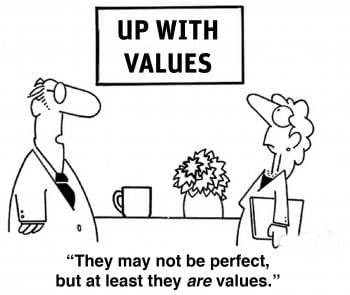
    By Rachel Mullen Public-sector services are different: they are supposed to serve the public good and its values. The citizen should have a sense of ownership of, and entitlement to, them. Cutbacks and public-sector reform have, however, crowded out any sense of difference. The clamour for aggressive reorientation, led by certain quarters of the press and their pundits, has been cacophonous. In 2008, just before the crisis took hold, an Institute of Public Administration paper by Muiris MacCarthaigh identified a range of values associated with public service. These were “efficiency, impartiality, honesty, loyalty, risk-aversion, equity, hierarchy, integrity, accountability and fairness”. He found that new non-traditional values were occasionally identified by public-sector officials, including flexibility, value for money and effectiveness. Some values, such as innovation, that he expected in the context of modernisation did not emerge. The ‘pecking order’ of values was seen to have changed as part of the modernisation of the public services. Many public servants reported that accountability was now the dominant value in their work. Efficiency, in the sense of speedy service delivery, had grown in importance. Public-sector reform has never been too explicit about what new values it offers. Yet it is, more than anything else, an exercise in changing public sector’s values. Modernisation has involved the incorporation of private-sector values and the pursuit of a market-led public sector. As the new values associated with this modernisation take hold other more traditional public-sector values inevitably give way and disappear. Public-sector reform and its private-sector value-base predate austerity. The 1996 ‘Delivering Better Government’ strategy identified ‘equity’ and ‘integrity’ as core values of the public service; and at the apex. However, it noted that values of professionalism, openness, flexibility, impartiality and customer orientation are integral to the public service. Austerity has provided the cover for a further reinforcement of such values. The Public Sector Reform Plan 2011-2014 emphasises efficiency, productivity and cost-reduction. Value-for-money has been established as the dominant public-sector value. This shifting ethic makes a difference. Every decision that an organisation makes and every action taken by its employees will reflect the value system of that organisation. Values are central to the development of the culture of an organisation, what it stands for, how it operates, and what it might prioritise. New and old values can end up in conflict with each other. Value for money, for example, that is concerned with productivity, can diminish values of equity and fairness. The voguish move to recognising its public as ‘customers’ can be to the detriment to seeing them as the holders of rights. MacCarthaigh concluded that “whatever values are deemed to be appropriate for the public service, the evidence suggests that performance will be enhanced through their meaningful integration into all aspects of the work of the service”. He captures the importance of values, however, he is mistaken to be so agnostic about what those values might be. We need to move away from market-based values for public service if we are to secure public services that better match and meet the needs of our diverse citizenry. Public sector reform has addressed values head-on. Now we need public-sector renewal to address the damage that the reform has done. The renewal too must be value-driven. The recent introduction of obligations of equality and human rights  for the public bodies should be central to this renewal. Section 42 of the Irish Human Rights and Equality Commission Act 2014 requires public bodies, including government departments, to pro-actively consider and address equality and human rights issues that are relevant to their functions. The values of dignity, inclusion, autonomy, social justice and democracy underpin equality and human rights. A strategic and and funded drive is now required to centralise and implement this public-sector duty. This would refresh and bolster a public service that could stand central to a more equal Ireland. •

    Loading

    Read more

  • Posted in:

    Leveraging State largesse for human rights

    By Shane Darcy There is an important sub-plot to Minister James Reilly’s efforts to enact legislation for the plain packaging of tobacco products. It concerns the incongruent relationship that the Irish State has with the tobacco industry, and with legal firms that advocate on its behalf. Recent reports have shown that the Ireland Strategic Investment Fund has invested over €9m in tobacco companies, while Arthur Cox, the firm representing Japan Tobacco Ireland in its threatened plain-packaging litigation against the State, has also received around €1m in legal fees from advising various health-oriented State agencies and bodies, including the Health Service Executive. We have heard much pontification about the need to ensure that the right to a lawyer is respected, with an obscure UN charter even being cited, but that need not mean that State agencies that promote one agenda should employ lawyers or anyone else who currently promote a contradictory agenda. As it finalises a National Action Plan on business and human rights, the Irish Government has a prime opportunity to set out an ethically coherent approach to State investment and procurement. As an investor and consumer of goods and services itself, the Irish State has a significant capacity to promote responsible behaviour by the private sector and to insist on respect for human rights by those companies with which it does business. The Minister for Foreign Affairs and Trade, Charlie Flanagan, considers that “placing human rights firmly on the business agenda” is necessary for enhancing the reputation of Ireland and of Irish companies. The National Action Plan on business and human rights is being prepared by his Department, following a broad consultation with civil society and business. It is aimed at implementing the United Nations Guiding Principles on Business and Human Rights, a framework document unanimously endorsed by the Human Rights Council in 2011. Ireland is currently the proud holder of a seat on the Council. These Guiding Principles emphasise a State’s duty to protect human rights, corporate responsibility to respect human rights, and the need to ensure access to remedies in the event of breaches. They expressly state that: “States should promote respect for human rights by business enterprises with which they conduct commercial transactions”. The State duty is grounded in existing international human rights law, which requires a State to ensure that third parties, including business enterprises, do not violate human rights. A national business and human rights plan is very timely for Ireland, as concerns have been raised by the recent activities of Irish-based companies, both at home and abroad. These include the inadequate protection of data and the right to privacy by social media companies, the supply of software used for censorship to Syria’s repressive regime, and the operation of construction firms in Qatar where forced labour and irregular working conditions prevail. The State must make clear in its national action plan that it expects Irish companies to respect human rights throughout their operations. To embed respect for human rights from business, countries can insist on compliance with human rights as an eligibility requirement for State support or for availing of, or providing, government services, investment, procurement or listing on the Stock Exchange. The UN Guiding Principles consider that the various commercial transactions undertaken with companies by States provide a unique opportunity to promote awareness of and respect for human rights by business. In 2014 the European Union called upon Member States to bring about the “appropriate integration of environmental, social and labour requirements into public procurement procedures”. The Dutch national plan on business and human rights notes that in the Netherlands, “companies supplying the government with goods and services are required to respect human rights”. Ireland needs to move beyond merely encouraging Irish business to be socially responsible. The business and human rights agenda differs from corporate social responsibility as it is based on what is required and expected of companies, rather than on what a company may choose to do voluntarily  to ‘give something back’ to society. No amount of charity or philanthropic work can offset a negative impact on human rights. Legislating to reduce tobacco consumption by introducing plain packaging can be seen as a legitimate attempt to meet the State’s human rights obligation to fulfil the right of every person to the highest attainable standard of health. A consistent approach to human rights here would mandate that the State does not invest in the tobacco industry and that it reconsiders doing business with companies that support, represent or promote it. • Dr Shane Darcy is a lecturer at the Irish Centre for Human Rights, NUI Galway.

    Loading

    Read more

  • Posted in:

    Fuel poverty is two-pronged

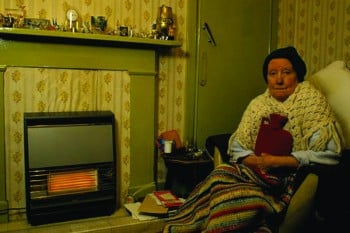
    By Brendan Hennessy Around 20% of all households in Ireland are considered to be in energy poverty, as they spend more than 10% of their income on energy. The latest EU Survey on Income and Living Conditions (SILC) data identify a continuing upward trend in households, both above and below the poverty line, struggling to afford energy. This is also reflected in the work of the Society of St Vincent de Paul (SVP). The overall demand for our assistance rose by 100% between 2008 and 2012. However, our expenditure for assisting households with energy costs rose by 200%, from €3.8m in 2008 to a high of €11.3m in 2012. This assistance is for all fuel types and covers both the Republic of Ireland and Northern Ireland. The issues are illustrated in the words of one person we assisted: “I sit out in the kitchen but during the cold spell…I couldn’t light my fire because it was getting a back draft down the chimney, full of smoke… [my son] has bronchitis and [my daughter] has asthma so I’d to get the heaters out and thank God only for the St Vincent de Paul helped me out to get the heaters, and during the very cold spell…that’s all we had was those heaters…Oh my God the doors we had…there was a big gap. You could see out on the street. I went around the house doing my own little thing… put masking tape around the draft on the window…the snake thing for the door, hot water bottles for the kids to heat upstairs and the bedrooms”. The point is this is not untypical. Energy affordability is not only about being able to buy energy. It is also about housing conditions, the price of fuel and knowing ‘the little things’ that reduce costs. These are the issues that SVP brought to the Department of Communications, Energy and Natural Resource consultation document ‘Towards a New Affordable Energy Strategy for Ireland’ Survey on Income and Living Conditions’. This document pointed to the importance of retrofitting homes in addressing energy poverty. Improving the energy efficiency of the national housing stock, both owner-occupied and private-rented, makes financial, economic and social sense.  Investing in energy-efficiency measures is good for household income, jobs, the environment, and human health and welfare. As to the efficacy of subsidies for retrofitting, we can look to the large Department of Social Protection expenditure on the fuel-allowance and household-benefits package. The €400m spent annually on these allowances dwarfs that of the retrofit budgets of the Sustainable Energy Authority of Ireland (SEAI) yet retrofitting would clearly help reduce the need for the allowances. Retrofitting homes plays an important part in addressing energy poverty, but it should not fall to those already in energy poverty to foot the bill. If Government wants to fund a significant national retrofitting campaign it behoves all stakeholder Departments to contribute to the cost. SVP’s recent briefing paper ‘Policy Links on Energy Poverty’ contends that the debate must take account of the multi-layered benefits of energy efficiency measures. The positive health contributions are suggested by the quote above. SVP volunteers speak of their fears for children’s education when they visit homes where students have to do their homework in busy family rooms due to the absence of heated quiet rooms. Any resultant reduction in bills takes financial pressure off households, reduces dependence on credit and gives more financial autonomy. Reducing energy use benefits the environment and wider society. Research, undertaken by the Vincentian Partnership for Social Justice and commissioned by the SVP, shows the positive contribution of energy retrofitting. However, it also points toward continued income inadequacy for households dependent on social welfare. This research, entitled ‘Minimum Household Energy Need’ found that, for certain household types in different accommodation and using different fuel types, improving the BER rating of a home from an E to a B halved the household’s energy costs. Despite this however, such households remained in or close to energy poverty as they still paid more than 10% of their income on energy. The report warns that: “even at the highest efficiency levels examined, social-welfare-dependent households tended to remain in energy poverty and all faced inadequate income. Consequently policy must address both overall income adequacy and dwelling efficiency”. • Brendan Hennessy is Membership Liaison Officer, Social Justice and Policy Team, Society of St Vincent de Paul.

    Loading

    Read more

  • Posted in:

    Doctors rob York Street

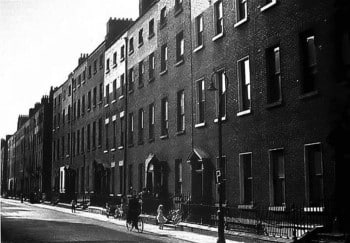
    By Mannix Flynn In 2009 the then Lord Mayor of Dublin, Eibhlin Byrne, officially opened the new apartment blocks at York Street, Dublin. It was hailed, by some, as a flagship of social housing and regeneration. Before this, York Street housing had magnificent spaces outdoor and indoor – substantial back gardens, ample space in bedrooms and good-floor-to-ceiling heights. Residents had been housed in a dilapidated, though distinguished, Georgian former tenement block with fire-safety issues. Had that block been refurbished and made safe it would have safeguarded the aspirations of an entire community. Instead, what happened was the perpetration of the architecture of containment and an ‘othering off’ – the erasure of the spirit of York Street apartments. The very concept of these blocks was constrained: by the necessity to sell more than half of York Street at its east end to the plutocratic St Stephen’s Green-anchored Royal College of Surgeons in Ireland (RCSI) for swanky new college facilities. During the negotiations between the residents and tenants of York Street which began around 2007 Sinn Féin’s Daithi Doolan was the representative in the area. There were other Sinn Féin supporters on the ground, and the community felt confident that they were going to get a good deal, though they might have been suspicious about a college of doctors that had built a car park at York Street some years previously against the wishes of the local people purely for financial reasons, generating large-scale vehicle emissions to the detriment of community health. The sweetener for the deal was the use of the RCSI sports and community facilities. The rooftop of the RCSI extension was to be in the form of an all-weather pitch and its facilities were to be shared with the entire community in compensation for the lost green space and amenities. However, in fact these amenities were eliminated by stealth as the community interest was subordinated to that of the well-got RCSI. The all-weather pitch was removed through a variation of the plan. And the use of the facilities as a right was eliminated – becoming instead part of an elusive ‘outreach program’ whereby the community got access to the facility only when it was not in use. In partial return the RCSI gave Dublin City Council around €400,000 of community-gain money, whose destination is uncertain, and there will be no messiness of integration with the locals for the men in suits and stethoscopes. All this has eradicated the possibility that the RCSI might ever integrate with the community of York St and Mercer St. It was tragically clear in 2009 when the new apartments opened that the residents had had no idea that there was to be no all-weather pitch or sports facility for them. Moreover, as to the new apartments, from the outside all looked well but from the inside there were many concerns: safety of windows, tap-water overheating, much-vaunted roof gardens quickly closed down by Dublin City Council (DCC) as unsafe. Six years on and the RCSI has another grandiose plan. It is going to build another much bulkier building at York Street with – again – no rooftop facility, this time abetted by newish local Sinn Féin Councillor, Chris Andrews. A recent offer of around €3,000 each in compensation to the residents at York Street has been dwarfed by offers of more than twice that amount made to residents in Cuffe Lane at the rear of York Street who own their own homes and therefore seem to be treated more seriously by all concerned. The always stuffy but greedy, morally and aesthetically bereft, hawkish and cynical RCSI and the dead hand of Dublin City Council with the naïve support of deal-making local Sinn Féin councillors in 2009 and again in 2015 underpinned the dynamic of the  take-out. The property-playing RCSI, which has over several generations colonised much of the St Stephen’s Green area with characteristic mediocrity is now insisting that all the deals it did with the DCC tenants are confidential. While some of the residents in the area seem to be content, a number are not, as they face in to two years of dawn-to-dusk pile-driving, dust and heavy-machinery movements, and are seeking legal advice. Sinn Féin’s Chris Andrew’s has been rather coy on the matter in keeping with the ethos of his new party. None of the other local councillors was aware that negotiations were taking place. Many residents now feel they were stampeded into signing the RCSI secret documents, especially when their private neighbours have been paid substantially more than they have and Chris Andrews hadn’t informed them of this. When I raised the matter at the DCC in a motion that called for a guideline protocol for major compensation for DCC tenants, Andrews came over oddly uncomfortable. He should have been wholeheartedly in support of this motion, but the truth is that Mr Andrews is busy being in support of the RCSI, illustrating the journey the Shinners have travelled. They have aided and abetted the rape of a vulnerable community and its assets. •

    Loading

    Read more

  • Posted in:

    Sinn Féin v Fine Gael

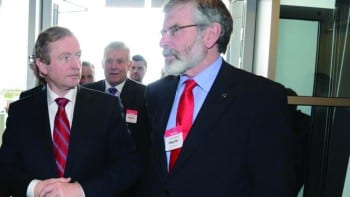
    By Eoin O’ Malley At most a year out from the general election, we are beginning to see some shape to what will be the most formative election in recent memory. The 2011 election was called an ‘earthquake election’ by some political scientists because on many metrics we saw remarkable changes. It was one of the most volatile election campaigns in post-war Europe. But it was as remarkable that such a volatile campaign produced such a familiar government. The Irish did what they were used to doing, kicking out a long-lasting Fianna Fáil government and replacing it with a Fine Gael-Labour coalition. The current government enjoyed a honeymoon of about 18 months, followed by two years of bad news and poor management. However the last six months have seen good news on most fronts: unemployment is down, employment up, emigration has fallen, tax receipts are up, and there are tentative signs that Fine Gael and Labour are benefiting from this in the polls (see Chart 1). Given that governments usually suffer a mid-term slump, a recovery a year out from an election, accompanied by economic growth, suggests that the government could be returned, perhaps needing the support of independents to secures a majority. But the government is not loved, and its improved polling might say as much about the qualities of the opposition as it does about Fine Gael and Labour. To secure re-election the two parties need to do a better job selling their successes, and refuting their failures. The biggest and most obvious failure relates to water charges. Quite how the government managed to make this a touchstones issue is depressing. With the problems of water quality and supply that we’ve seen ubiquitously, most obviously in Galway, nearly everyone agreed that the Victorian water infrastructure needed investment. EU rules meant that its operating costs needed to be funded by consumers. A majority also agreed that people should pay in proportion to use. But the government regarded water supply as a technical issue that could be delegated to an outside agency. It failed to understand that it was more than a technical issue; it was a new tax and that required a political approach. The tax had to be sold to the public, but Irish Water was designed to supply water not sell a policy. A less obvious failure, but one that will limit the government’s resurgence, is its lack of support for the group of people who bought houses at the height of the boom and the ones who are trying to buy them now. There has been no attempt to curtail banks from increasing interest rates. Nor is there any concerted attempt massively to increase the supply of housing. The government, as one the largest property owners in the country seems to view increased property prices as a good thing. But it’s damaging Ireland’s recovery because a new generation of people is being asked to pay excessive amounts for a place to live. These costs will increase pressure for pay hikes. It’s not for nothing that the groups that are least likely to vote for the government are aged between 25 and 45. This is the generation that is least secure about its future, and all parties hoping to make electoral gains will have to make them here. Fine Gael looks in pretty good shape for the next election. Its message will be simple: recovery and stability. It will frame the choice as between the progress it has made and the risk of a Sinn Féin-led government. It will warn voters that they shouldn’t throw it all away to  populist promises of miracle recoveries. Rather, it can suggest, recoveries are delicate flowers that need to be nurtured. Since Fine Gael has shown itself to be inept at selling its message in the past one would wonder whether it could throw it all away by succumbing to its own populist tendencies. Sinn Féin will frame the election as a choice between it and austerity. It obviously suits the party that the election will be seen as a choice between it and Fine Gael. Converting opinion poll support into seats may be its biggest challenge. It has two obstacles.  Its supporters, predominantly young, working-class men, don’t vote and it will take its entire formidable machine to mobilise them on the day. It’s also not clear to what extent the party is repulsive to transfers. Certainly by-election results show that in fights between it and anyone else for a last seat you’d have to be on anyone else. Another danger for Sinn Féin is its choice to tie itself closely to Syriza. If the Greek experiment ends badly, with Syriza making significant concessions to Europe, or worse leaving the Euro, it might come to regret not modelling itself instead on the Scottish Nationalists. In fact we might prepare ourselves for that comparison being made by the party. Of course, unlike the SNP, Sinn Féin doesn’t want to govern yet. It will stay out, hoping to build on successes to solidify its position as a top-two party in the state, hoping that it can lead a government following the election in 2020 or 2021. Labour’s big mistake was entering government, when it could have been by far the biggest opposition party. Having chosen government, it will depend on personalities and transfers, but it needs to be less apologetic. Apologies indicate that you made a mistake. Labour promised too much in 2011 when it didn’t need to. It must have known that such promises wold leave hostages to fortune on the electoral battlefield, but having failed to protect university fees and child benefit it now thinks that apologising will somehow make it better. It won’t. It just reminds voters. Instead the party should be more aggressive in reminding voters of where Ireland was in 2011 and where it is now. As the smaller party in government it has a tough job. The larger party usually gets to claim the victories, the

    Loading

    Read more