Archives

OK

Random entry RSS

Loading

  • Posted in:

    Things to do in fields.

    By Shirley Clerkin. There is something innately satisfying about a good field. Maybe it is the sense of enclosure, or a golden ratio of open pasture to hedge or stone wall.  Perhaps it is the clatter of the gate as you climb up and over and the decent feeling of arrival as you land with a distancing thud on the ground. It’s the freedom too, freedom to walk and think and observe. I think my very essence or molecules like it. The name “Shirley”, from the shire, means productive or white meadow. Maybe I was destined for fields, always. There is an actual heritage to being in a field. The Céide fields in Mayo are fields of the first farmers in Ireland; hidden by blanket bog during a climatic cooling but now a heritage site and visitor attraction. Fields are the essence of farming. The enclosures domesticated animals, stopped them roaming; and the cultivation of grasses allowed grazing animals to dominate. We changed from hunting to pastoralism as Neolithic people started to clear woodlands and practice agriculture. Now, over 60% of Ireland is covered by grassland, not including the swathes of sterile golf courses, arable crops (which are of course grasses too) or groomed domestic lawns. We get a lot of our nutrition from grasses too: wheat, barley, corn and rice. Grasses are angiosperms or flowering plants. Their flowers are the little spikelets on top and they rely on wind not insects for pollination. Fond of rhizomes, grass species can spread under the soil to cover large areas.  They grow from the base not the tip, which is why they can be grazed, munched and mowed successfully. The improved grassland on which agriculture predominantly relies, is usually a monoculture of rye-grass and white clover; not the semi-natural grassland of your ‘little house on the prairie’ childhood imaginings. Predominantly grassy, these fields do away with the need for those little buzzing batteries of production, the bees and butterflies. Running downhill through a proper meadow of sweet smelling grasses and flowers with butterflies lifting up as you go is energising, and childish. I can hear the damned theme tune and see Laura Ingalls Wilder. Or you can try something less energetic. The late gardener and writer Christoper Lloyd summed it up to a tee: “Perhaps the best way of discovering the living nature of grass is to lie on it, in quite early Spring when the ground has dried.  You need nothing but the grass underneath you to discover that it has a very strong and agreeable smell, all its own”. A fox fable Torrential rain spilled unmitigated into my anorak as I walked through a field searching for access to get to a bog. It was one of those ‘adverse weather’ days with round raindrops, Old Testament in proportion and force. Out of the grey, a magnificent dog fox strolled straight across my path just two feet away, completely un-fazed by the downpour and me. He approached a stone wall, climbed up and over, and vanished through a gap. Thrilled to bits, I made off after him, less gracefully. I clambered down from the wall, eyes fixed down towards my feet to control the incessant drops running down my nose, and as time stood still beheld a field aflush with orchids, thousands and thousands of them. Fantastic Mr Fox had led me.  And was gone. The orchids were not in the field by chance. Special conditions allowed them to flourish amongst the fine grasses, black knapweed and yellow rattle. Species-rich or flower-rich meadows like these need low-nutrient conditions and the old-fashioned cutting of hay late in the season after the flowers seeds have set. Orchids are an old symbol of fertility; they have double tubers under the ground, which mature over a number of years before they flower and whose appearance explains their greek name orchis, which memorably means testicle. Known as dogs’ stones in some places, they were used to make love potions before the advent of tinder. Even Shakespeare had a go at them in Hamlet when he referred to the Early Purple Orchid as Long Purples. “Long Purples, That liberal shepherds give a grosser name, but our cold maids do dead men’s fingers call them”. The poor cold maids hoped that the love potions might result in a bit of warmth.  In Irish too, the name for Early Purple Orchid, Magairlín means testicle. The grassland Mr Fox steered me to what ecologists call a semi-natural habitat. This means that although the plant communities are natural, they need some sort of activity, like low-intensity farming or late hay-cutting to maintain them. Improved grassland is the habitat in most agricultural fields: all the same colour and strength dominated usually by one species of rye-grass boosted by high nitrogen fertilisers. These are productive agriculturally, but not for nature.  High nature value farming promotes species-rich grasslands with all the attendant productive bonuses of bees, butterflies and other insects. A real shire. The relationship between the yellow rattle and the orchids is very important. Yellow rattle is a semi-parasitic plant, and it reduces the vigour of meadow grasses by essentially sucking the life out of them. It has haustoria, minuscule root-like appendages that can absorb water and minerals from nearby grasses by locking onto their roots. All this, and it looks so innocent and sweet, with its little yellow poddy heads nodding in the breeze, named because it rattles when its seed pods dry out. Yellow rattle is a great mixer, and deals with grassy bullies effectively allowing space for other plants like the orchids. Orchids also rely on a symbiotic fungus for their early germination and development. Their tiny seeds spread on the wind but they will not germinate without this fungus, and this fungus is very susceptible to fertiliser and fungicide. So, if the species-rich grassland is fertilised it won’t take long before all these relationships wane and its tapestry composition is changed to something less interesting. The thirty native

    Loading

    Read more

  • Posted in:

    The Twitter Power 100

    By Gerard Cunningham Imagine you wanted to open a bookshop, but you knew nothing about books. You could research the book market professionally, find out who the best-selling authors are, or which genres do well. But maybe you’re lucky enough to know a lot of authors. So instead of extensive research, you ask your ten favourite writers which books they like, because you know they read a lot. And if anyone shows up on more than three separate lists, you could add those people to the list of authors you stock in your new bookshop. But unless you’re very lucky, your new bookshop isn’t going to do very well. Your circle of friends look like you, and there will be a sameness in their taste in books, so you end up with a narrow selection on the shelves. Wilson Hartnell Public Relations (WHPR) agency tried something similar with Twitter at the start of October. Attempting to measure who had influence on Twitter, they began by assuming political power translated into online influence. They compiled a list of politicians online, and looked at who they followed and were followed by. Any politician followed by lots of other politicians got a high ranking. And anyone followed by lots of politicians got a ranking too. So was born the concept of “power followers”. Having lots of followers helped in the rankings too, but not as much as being followed by “power followers”. Thus, WHPR claimed, they had identified the #Power100 of Irish Twitter. The #Power100 contains some oddities, not least the fact that it actually consists of 200 names. TDs, senators, a smattering of academics, and a sizeable number of political journalists make up the bulk of the list. Politicians follow each other on Twitter (or not; more than one commentator enjoyed pointing out Leo Varadkar doesn’t follow Enda Kenny), and they follow political correspondents. And the journalists follow the TDs in turn, for much the same reason they subscribe to press-office mailing-lists. The list is less about who has influence on Twitter than a reflection of “life inside the bubble”, as political correspondent Harry McGee [#5] described it in an unhumorous Irish Times podcast. WHPR fell prey to a classic fallacy, begging the question. In assuming that politicial actors were influential on Twitter, they created a list of political actors and their followers. In truth, most politicians avoid Twitter outside election campaigns, and even then, most use it as a broadcast medium, linking to party press releases, or posting bland updates about the enthusiastic reception they get on canvass. The neglect of Twitter once the votes are cast is exemplified by former Fine Gael junior minister Dinny McGinley (#198). On the day WHPR released their #Power100 list, his Twitter biography read “Looking for a change of Gov!” and his last tweet was in June 2009. Communications consultant Damien Mulley is scathing about the design of the WHPR list, describing it as “a list on a topic compiled by people who have no insight into said topic and probably done to suck up toperceived ‘influencers’ in that area”. “If the objective was to get a few people to tweet about them because of being on the list, objective achieved. I’m embarrassed for them but I’m sure their Mom thinks they’re cool. I’d love to see the metrics that were used to justify this. The Project Maths of political Twitter lists”.   Twitter is decentralised. And that causes a lot of problems. Politicians struggle to respond to online movements which don’t conform to their traditional lobbying models. Instead of institutions or pressure groups they can engage with (or ignore and discredit) they find themselves faced with an amorphous many-headed hydra. Journalists do a bit better, but they too find themselves trying to sort the signal from the noise, and it is often easier to simply play follow-the-leader and report what politicians (or actors, sports stars, and other celebrities) are saying. A second social-media professional, who preferred not to be named, was equally sceptical. “Influence is a very interesting word”, he told Village. “To my mind someone is actually influential if they have influenced you to actually do something – to click on a link, sign a petition, attend a rally, join a party, cause a revolution – it’s about the action taken because of the message published. Also, the message itself – how many people read, favourite, retweet, click, discuss. Twitter is one of those mediums where there are more factors than just number of followers. While the industry has never cracked, or continually obfuscates, the true social capital “klout” of tweeters, we’re still drawn to the idea that, well, if there’s loads of people talking about them, good or bad, they must be “important” or attention-worthy. But what do they actually do? What actions do they get people to take? What have they changed or improved? Is it for a cause, rather than applause and are they trying to impress rather than express?. We’re also in the wonderful world of clickbait and listicles. Want attention online? Do a top 10, a top 30, a top 100. Or run an awardceremony. They’ll flock. In short, it’s just another list designed to make people click and to get some attention. It hasn’t changed anything. There are people on the list who put a lot of time, energy and good work into what they do. They’re the ones who benefit their audience and hopefully vice versa”. Perhaps one of the most telling absences from the #Power100 is @WomenOnAirIE. Started in December 2011 by Margaret E Ward, a journalist concerned at the lack of women’s voices on Irish television and radio. The Twitter account led to the foundation of a group which created a list of over 1000 women available for interview on numerous topics, and which runs seminars and media-training events, and lobbies for equal representation. Radio and television may still be male-dominated, but broadcasters have found themselves on the defensive as a result, having

    Loading

    Read more

  • Posted in:

    Artists should seek change, but not collaborate.

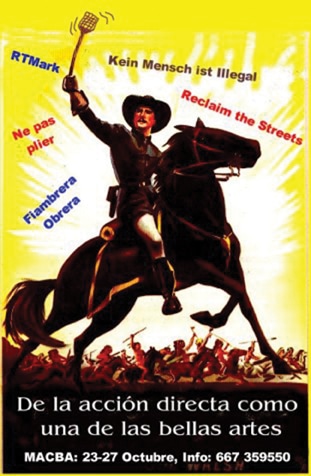
    By Nicola Carroll. ‘My definition of art has always been the same. It is about freedom of expression, a new way of communication. It is never about exhibiting in museums or about hanging it on the wall. Art should live in the heart of the people. Ordinary people should have the same ability to understand art as anybody else. I don’t think art is elite or mysterious. I don’t think anyone can separate art from politics. The intention to separate art from politics is itself a very political intention’       –        Ai Weiwei (2011) So does art have the capacity to offer an alternative way of thinking to the dominant western social, political and economic order that is neoliberal democracy? The answer to this question I believe is to be found somewhere between the fields of art and politics. There are many terms used which encompass the genre of Art activism such as Critical Art, Socially Engaged Art, Social Practice Art, Artivism, Political Art and forms of both Participatory and Collaborative Art. Art activism is a form of art that overtly aspires to effect change in the prevailing social and political order. For change to happen it must take place outside of the existing established order and institutions otherwise any attempt to change will in itself be appropriated by the establishment. It takes the form of collective acts with the public as its medium. Contemporary art has moved away from the formalism of the twentieth century where real innovative success lay in the development of a new genre that displaced conventions of tradition. Contemporary art now looks to displace instead the structures and system of the society in which it exists, the rules that determine what is appropriate in the way that we relate to each other. Contemporary art activism is according to Allan Sekula characterised by the following features: 1. There is a connection between real communities and cyber-communities; 2. It is anti-capitalist /anti-neo liberalism and their intangibilities; 3. It is carnivalesque in nature and aesthetic. The Zapatista movement has strongly influenced contemporary art activism since the 1990s. In 1994 the Zapatista Army of National Liberation movement of the Mexican Chiapas province emerged demanding autonomy. They broadcast their message in a media savvy way that was fresh and interesting, and drew unprecedented international support. They approached their objective through the use of the internet and social networking culture with a poetic and exciting carnivalesque flavour to their activities. The Zapatista movement is characterised by the organising of dances, rock concerts, poetry sessions and sports tournaments. The movement ritualises ‘alegria’ (joy) through celebrations which inspires participation. Zapatista communications captured the imaginations of many, internationally. Lieven De Cauter in Art and Activism in the Age of Globalisation talks about ‘subversion’ and distinguishing ‘subversivity’ from political subversion. Rather than overthrowing the system as political subversion aims to do subversivity is a ‘disruptive attitude that tries to create openings, possibilities in the ‘closedness’ of a system’. Subversivity questions rigid belief systems. Subversivity is eccentricity, a desire to break away from conformity and convention disrupting the tradition. Subversivity does not necessarily want to overthrow the system but it has an aversion to consensus. It is not revolutionary thinking but seeks temporary disruptions. De Cauter maintains that we seem to have lost any desire to negate or criticise and that we are witnessing the end of a tradition of dissent. That even the youth and subcultures have not surfaced since punk. Chantal Mouffe, a Belgian political theorist, advocates the collaborative approach of artists’ ‘engagement with’ the art institution. Her argument is that change must come from within the existing hegemonic order of the art institution. She sees critical art as a way that artistic practices can “contribute to the unsettling of the existing hegemony”. She is also sceptical about demonstration without structures, pointing to the success of the Indignado protests in Spain and how they undermined the Socialist Party only to let in the right wing. She would have preferred collaboration with appropriate political parties. Mouffe uses the Museu D’Art Contemporani De Barcelona (MACBA) in Spain as an example of how engagement with the art institution by art activists can successfully change the hegemonic order of the art institution. But close research suggests even here the experience was negative and the depressing denouement covered up. MACBA opened in November 1995 in the Raval district of Barcelona. In order to build the institution, an area of the Raval district was cleared and a number of residents were relocated. The Raval, once a traditional working class area of the city has since gone through a process of gentrification The civil demonstrations and protests in Seattle in 1999 sought to confront neo-liberalism and much of this happened through performance and activist art. The impact of the ‘Battle for Seattle’ spread across the world. MACBA wanted to create a network of social groups that would become a part of the anti-globalisation movement. In the spring of 1999 MACBA made contact with the art activist collective Fiambrera Obrera, which had been active in Seville and Madrid throughout the 1990s, proposing that they organise a workshop at MACBA to which they would invite various well known and respected art activists groups, such as ‘Reclaim the Streets’, from around Europe to collaborate in a project called ‘’Direct Action as one of the Fine Arts’’. MACBA’s original idea was, according to the Fiambreras, to hold a ‘classic museum-workshop’ where small groups of up to thirty people would be charged an entrance fee and would then sit around and discuss particular subjects around art and activism. The Fiambreras declined MACBA’s invitation initially responding that this was not ‘their model’. In fact they didn’t have a ‘model’ at all but they saw an opportunity to create one in the MACBA invitation. The Fiambreras told MACBA that they were not in favour of inviting a handful of famous art activists from around Europe to spend a few days in Barcelona – the Fiambreras’

    Loading

    Read more

  • Posted in:

    Competition confounding community confusion.

    By Ann Irwin. New legislation and changes to  funding arrangements, community development programmes and institutional structures are all sowing confusion and frustration among community organisations. The rhetoric behind these changes has been about bringing coherence to the community sector, avoiding duplication and ensuring value for money. So far the opposite has happened. Bringing about so many changes that are ill-thought-out and insufficiently planned is damaging the work of these community organisations. A key moment was the signing into law of the Local Government Reform Act 2014 early this year. The subsequent reforms to local government are the source of many of the changes for local community organisations. There are not only too many change processes going on at the same time, but there is also too little information or engagement with the community sector on the issues involved. Local Community Development Committees, established under the new legislation in each local authority area, will now assume responsibility for co-ordinating community development and local development. This will include managing the funding process for programmes in this field. Advice from the Attorney General has identified a requirement that these Local Community Development Committees be subjected to EU procurement legislation. The reforms will therefore include changes to the funding arrangements for the successor programme to the current Local Community Development Programme, which is the biggest social-inclusion programme in the country. The funding will no longer be based on  a grant-giving arrangement between the Department of Environment, Community and Local Government and implementing organisations such as the Local Development Companies. Local Development Companies and other interested organisations must now tender to deliver the successor programme, the Social Inclusion Community Activation Programme, in their area. While the response to this successor programmes has so far been quite positive, the concern for  local communities is at the prospect of privatisation of the implementation of this and other similar programmes. This potentially introduces a profit motivation into this work. Local authority areas have also been divided up as ‘lots’ for this procurement purpose. As a result competition has been created in a number of areas between organisations that are implementing the current programme. This has led to tensions and fear of redundancies amongst their workers in some areas. Implementation of the new Social Inclusion Community Activation Programme, with its local focus, fails to take account of the work of national community sector organisations in enabling the current programme to be effective. These include the National Traveller Partnership and the National Collective of Community-Based Women’s Networks, for example, which have worked with local organisations to support them in implementing the current programme. The Department has, so far, failed to develop an alternative model to include the necessary work of these organisations. It is, however, widely accepted that the proposed model for the progreamme, which would see the work come under the auspices of the local authority, is inappropriate. Alongside this, new institutional structures to facilitate the participation of the community organisations and the voluntary groups in the work of the local authorities are being established. Community and Voluntary Fora that have operated in each local authority area for over a decade are being replaced by Public Participation Networks in each local authority area with little or no consultation with community organisations in many areas. The new Local Community Development Committees are required to develop a Local Economic and Community Plan. This will require a significant consultation process with communities and representative organisations in their area. At the same time, those engaged in the tendering process for the new Social Inclusion Community Activation Programme are also required to carry out a consultation process. In areas where the LEADER programme is operating there could even be a third set of similar questions being asked. Recent workshops in Donegal, Mayo and Longford organised by the Community Workers Cooperative confirm that confusion reigns at local level and frustration is growing. It has been suggested by some that these processes are being influenced by a markets-fixated drive to privatise and to control civil society and they are clearly damaging and undermining the capacity of community organisations to focus on issues and to seek equality and inclusion. •

    Loading

    Read more

  • Posted in:

    Letters – November 2014

    On Irish Water Dear Editor: I wonder if anyone is considering the implications for this proposed referendum that is being sought to protect us from the privatisation of Irish Water. Consider the following if you will: Insidious, Transatlantic Trade and Investment Partnerships (TTIPs) have been under secret negotiation since summer 2013. The biggest bilateral trade deal in history between the EU and the US. The primary focus of these negotiations, which are on-going, is on curbing regulation, including through further expanding the role of extrajudicial tribunals which are being designed to allow corporations and potential investors bypass national courts and to challenge governments who pass regulations that harm their corporate interests. Such tribunals have already been set up under the Canada/US NAFTA agreements, and could be set up here – these tribunals are causing problems in areas like the protection of water quality which is being threatened by fracking. The questions I pose are these: What if these secret TTIP negotiations are concluded in Europe, unelected officials will decide and there is no democratic vote taken over finalisation of these proposals. What then if the protections that have been taken to keep Irish Water a public utility company are challenged by some corporation that feels it is being disadvantaged? What if the existing EU competition authority laws (Directives) conclude that Ireland cannot/ should not prevent Corporatisation of our water utility? What then will we do? No Irish politician, government or opposition, is monitoring this as far as I am aware. However, the new EU Ombudsman, Emily O’Reilly, was so concerned about the lack of information coming into the public arena – that she commenced a public consultation on this matter. Derrick Hambleton Kingston, Galway On the Irish Times and Abortion Dear Editor: How charming of a spokesperson for the Pro Life Campaign, the very moniker of which is a masterstroke of question-begging sophistry, to begin an article by quoting CP Scott on the sacredness of facts (Village, October 2014)! The ostensible (hypo)thesis of Dr Ruth Cullen’s piece centres on a tired fundamentalist shibboleth: the media’s (the Irish Times’ in this case) pushing of the Liberal Agenda. However, this contention merely serves as the vehicle for a fairly predictable whistle-stop tour of all the stock PLC myth-mongering Newspeak catchphrases, each one debunked so many times as not to warrant the oxygen of further critical engagement. (It’s laughable, for instance, that the best-little-country-in-the-world-without-abortion-to-be-a-mammy fib is still getting an outing.) Indeed there are too many red herrings to gut here, so I’d like to volunteer just three unsolicited answers to three of Dr Cullen’s gratingly chin-strokey rhetorical questions, not to defend the increasingly rubbish IT, but merely to illustrate the PLC’s wilful disregard for the facts they always claim to cherish. Dr Cullen ponders why the IT did not report on the progress of the newborn in the Ms Y case. It did. Repeatedly. The IT duly reported in pretty much every article about the case that the infant was in care and progressing quite well. Save attempting to interview a 26-week-old newborn, what else was it to do? “Why did [the case of the woman from Ireland who died in a London taxi after an abortion] merit only a fleeting mention in the Irish Times”? It didn’t. It merited front-page headlines (plural) over the days it broke (22 and 23 July 2013), then further prominent coverage in subsequent days. I’m not sure from what distorted vantage this constitutes “a fleeting mention”, unless Dr Cullen starts her morning read of the paper at the obituaries and works her way backwards. The case made (international) headlines precisely because legal abortion in appropriate medical environments has an enviable safety record. Claiming or implying that a medical procedure that is 14 times safer than childbirth (Raymond and Grimes (2012)) is a danger to women’s lives by appealing to one tragic anomaly is anecdotal cherry-picking at its most transparently disingenuous. Furthermore, Dr Cullen naturally neglects to mention that the woman in question had a medical condition that predisposed her to a high risk of miscarriage, and she had the abortion at 20 weeks’ gestation because, according to her partner, Ireland’s NIMBY abortion laws, which the PLC obviously supports, forced the couple to scrimp and save for the costs of abortion tourism. Perhaps, had she received an earlier-term abortion and the unbroken continuum of care she desired and deserved in her own country, well… The case is, if it’s to be used as an argument at all, more an argument against the dangerous hypocrisy of Ireland’s unceremoniously dumping its abortion-seekers on Blighty’s shores, as well as the false dichotomy between risk to health and risk to life in Irish abortion law. “The onesidedness must leave the neutral observer wondering is the Irish Times so patronising as to think the public cannot be trusted to hear both sides of the story and make up their own minds”. Answer: Breda O’Brien, John Waters (until his petulant defection), numerous anti-choice op-eds, many from spokespersons from the PLC, countless Letters to the Editor from Catholic priests and bishops and other extreme natalists, etc. It could be argued that this in fact constitutes a disproportionately thorough airing of anti-choice sentiment, given its ever-dwindling currency among the population of 21st-century Ireland. Perhaps, given all the above, a more apt and august opening gambit to the good doctor’s piece might have been found in the wisdom of Homer J Simpson: “You can use facts to prove anything that’s even remotely true. Facts schmacts”. E Bates Oxford, UK

    Loading

    Read more

  • Posted in:

    Social welfare privatisation kicks in, quietly and unquestioned.

    By Mary Murphy. The Department of Social Protection has contracted two private companies to deliver JobPath, a new activation programme for Ireland’s 178,000 long-term unemployed. This follows a tendering process supported by the Centre for Economic and Social Inclusion in London. A British recruitment firm, Seetec, has been contracted to deliver these activation services in the north of the country and Dublin. An Turas Nua, a consortium of Irish-based recruitment company FRS and the UK company Working Links, will run the programme in the south of the country. It is understood that each contractor must service 25,000 long-term unemployed people a year in their search for employment. They will do this through a supply chain of sub-contracted local, private and not-for-profit, specialist organisations. We need more scrutiny on the motivations behind this decision and its possible consequences. The explicit driver for this partial privatisation of Irish public employment services is the inability of existing public services to support large numbers of long-term unemployed people back into the labour market.  Certainly, in a context of wide-ranging institutional and policy reform in labour-market activation, there are significant capacity issues such that the long-term unemployed and working-age social-welfare claimants outside the live register have not yet been targeted by activation programmes.  However, we need to be mindful that, elsewhere, such privatisation has been at least partially motivated by the desire to implement sanctions-driven ‘pay by result’ regimes which many public-sector and not-for-profit organisations have been reluctant or unable to deliver. Activation policy now appears to be moving towards a ‘work first’ model that stresses job-search assistance with less emphasis on education and training. In many similar ‘work first’ and ‘pay by result’ régimes the most vulnerable of welfare claimants (people experiencing literacy, homelessness, addiction, domestic-violence, and mental health issues) are the most likely to experience sanctions. This raises questions about the ethics of such activation regimes, reinforces the necessity of monitoring the new regime, and underscores the need  to advocate to support those vulnerable to sanctions. Irish society needs to publicly debate issues of sanctions, when they are reasonable and who should determine their application. There is international evidence that ‘pay by results’ contracts can push claimants into low-paid, low-quality and temporary employment. This leads to recycling claimants into patterns of ‘low pay, no pay’,  as they move between poor-quality employment and welfare. ‘Pay by results’ contracts can of course require quality, ‘sustainable’ outcomes but the JobPath contracts appear ambiguous on this. Payment to the contractors is conditional on sustainable employment outcomes but a series of temporary job contracts qualifies as a ‘sustainable employment outcome’. Again, this needs to be monitored. The design of JobPath, based on a ‘work first’ model, means the private-sector company or the individual claimant involved will directly pay for the option of training or education. This will likely mean fewer people being supported in education and training and a re-orientation to short-term and more vocational training. There will be less investment in options with potential to realise better long term sustainable  individual, societal and even economic outcomes. There remains a significant challenge to facilitate access to activation supports (including childcare) to lone parents, people with disabilities and those who have been without employment for three years or more. The role of the Local Employment Service needs to be clarified on this, as does the future capacity of the statutory activation service Intreo to meet the needs of the long-term unemployed. JobPath is just another instance of a wider trend towards privatisation of what were previously public services. From refuse services to community development to home care,  many public services are now to be delivered by private for-profit actors. These changes have ostensibly happened as discrete individual decisions, sometimes for pragmatic reasons. However, collectively, this pattern has a deep impact on what we understand as citizenship. It has practical effects that are often felt most by the vulnerable and powerless. This level of privatisation needs careful public monitoring and debate. We need to be vigilant to the intended and unintended cumulative consequences of this creeping privatisation. • Dr Mary P Murphy lectures in the Department of Sociology,  Maynooth University

    Loading

    Read more

  • Posted in:

    A Happy Christmas

    By Laurence Speight Patrick Kavanagh wrote ambivalently of Christmas in his distinctly anti-modern poem ‘Advent’: “We have tested and tasted too much, lover/Through a chink too wide there comes in no wonder.
But here in the Advent-darkened room
/Where the dry black bread and the sugarless tea
/Of penance will charm back the luxury/
Of a child’s soul, we’ll return to Doom
/The knowledge we stole but could not use”. Christmas marks the birth of Jesus, but the strengths of the icons in contemporary Ireland are an extraordinary contrast; the man himself a force of diminishing dynamism in this society, his birthday is a worshipped commercial commonplace. At its best Christmas is a celebration of all that is good about the human experience including family and community, joy, sociability, generosity, forgiveness, and desire for peace between warring parties. It is a time of hope and new beginnings. In spite of this Christmas is celebrated in a contradictory manner. Ask the innocents: the hundreds of millions of turkeys, chickens and pigs that will be unwitting centrepieces of the traditional Christmas dinner around the world. It is estimated that 22 million turkeys in the United States, 10 million in the UK and 700,000 in the Republic of Ireland will take one for the human team this yule. And it is not a happy time for industrially planted conifers. Christmas elevates consumption of all kinds with a corresponding increase in toxic waste, greenhouse gasses, loss of biodiversity and the suffering of those in low-wage economies. If we took account of the negative impact of Christmas on the biosphere we would no more celebrate it than we would a riot in which vital amenities were torched. Christmas particularly conduces to the exchange of ephemeral dross: a plastic-destined-for-landfill squandermania – Terry-the-Swearing-Turtle in your stocking.  If there were not an increase in unthinking consumption, shopkeepers, economists and politicians would consider it a bad Christmas. Christmas, since the time of Charles Dickens, has been mass make-believe sustained by the retail, advertisement and entertainment sectors (which George Monbiot calls “the global bullshit industries”), rooted in an unspoken agreement between producers and consumers to turn a blind eye to consequences and contradictions. As Eric Fromm, who spent his academic life analysing and criticising the modern mind, wrote in ‘To Have Or To Be?’ (1976): “most people are half-awake, half-dreaming, and unaware that most of what they hold to be true and self-evident is illusion produced by the suggestive influence of the social world in which they live”. As in a grotesques fable, Christmas is a prescribed happy time in which bonhomie and wellbeing can only be realised through material consumption, gluttony and glitter, excess and inoculating inebriation, contrived festive partying, and tantrums – childish and adult. Banal but cheery Christmas-themed television, schlocky ads for mobile phones and department stores, forced attendance at corny reprises of ‘A Christmas Carol’, and threadbare pantos. This all  speaks of the failure of our education system, religious bodies and civic culture to nurture critical, creative and imaginative thinking that allows for the collective seasonal desire for renewal, the expression of appreciation and goodwill to be celebrated in ways that are wholesome, constructive and elevating. Christmas encapsulates our society’s dominant values and cultural norms. It enfranchises the herd instinct – the desire, not to be thought an ‘odd-ball’, or Scrooge. The desire to feel part of the great social mass is achieved at the sacrifice of ‘knowing’ in Eric Fromm’s use of the term, which is “to penetrate through the surface, in order to arrive at the roots, and hence the causes … to ‘see’ reality in its nakedness”. Compassion too must be selectively suppressed to avert isolation from what is considered normal. While austerity has its place in political circles, frugality is certainly not cool. At 1965 per head, according to PWC, Ireland spends twice what even the US throws at Christmas morning. To little advantage. George Monbiot has written: “Bake them a cake, write them a poem, give them a kiss, tell them a joke, but for god’s sake stop trashing the planet to tell someone you care. All it shows is that you don’t”. It is up to progressive individuals to break the mindless mould and celebrate yuletide consumer minimalism. Life-affirming ideas can take root in the collective mind. It is not just Humbug. As Owen Jones wrote recently in the Guardian, “if we can build a society that encourages greed and sentiments which justify inequality, then we can also build a society nurturing solidarity, compassion and equality”. Science casts some credibility on this theory on the premise that if the selfish gene had prevailed during the course of our evolution humankind would be extinct. It’s truly time to “see reality in its nakedness”. Kavanagh’s poem finishes with hope not from Christmas but from its absence. Time to discard the knowledge we never use, to cherish wonder. The hope is in the poem’s final line that “Christ comes with a January flower”. •

    Loading

    Read more

  • Posted in:

    Wind.

    By Richard Callanan. Some hundred people gathered in October in a Portlaoise Hotel for a private meeting to plan joint action against what they perceive to be the government’s “flawed energy policy”. Reports from those in attendance variously concluded that these hundred people represented forty or possibly eighty-five different groups from across sixteen or seventeen Irish counties. These groups have found common cause in their opposition to wind turbines and pylons. Some describe themselves as action, awareness or information groups while others identify themselves more overtly as being opposed to energy infrastructure by being ‘Against Turbines’ or ‘Against Spin.’ Not a few have adopted titles which come with snappy acronyms such as TWIG (Tubber Wind Information Group) or POW (People Over Wind). This week a very different gathering took place in New York where the UN Climate Summit once again called on the world to step back from the brink of irreversible and catastrophic climate change by reducing our carbon fuel consumption. Enda Kenny’s address  to the summit was rich in unprepossessing climate-change cliché: “stark reality…fair and achievable…the clock is ticking” but mostly it avoided any suggestion that Ireland might set an example for small nations by unilaterally instigating local change, even though for historical reasons is a country which can provide global leadership on certain social issues. With the line ‘Leading nations have to step forward. Others will follow’ our Taoiseach firmly placed Ireland among the followers on the subject of climate change and gave succour to those in this country who have foresworn any responsibility for addressing our own disproportionate carbon fuel use. It is in the nature of wind farms that remote sparsely populated areas tend to be chosen for their location so opposition to their construction invariably relies on a relatively small pool of local inhabitants. The sense of isolation and powerlessness felt in many of these remote communities becomes heightened in the face of the perceived financial and political muscle of wind farm developers. Accustomed as they are to generally both ignoring and being ignored by the tentacles of state and corporate Ireland, the residents of such out of the way towns and villages as Ballycommon, Garbally and Luggacurran are invariably distracted and somewhat overwhelmed to suddenly find themselves – with the prospect of wind turbines being erected in their locality – in the spotlight. Indeed more substantively it is arguable that the scale of climate change requires solutions of a dramatic size – such as vast solar farms in the Sahara or southern Spain, geo-thermal from Iceland and wind from Ireland, linked by an enhanced continent-wide renewables grid. Not one-off solutions designed to fuel rhetoric not substance, of the sort that have always had particular appeal in this country of ad hoc rationalisations. All of which makes it entirely understandable that a small number of these disparate and isolated groups should seek to find greater strength and influence through solidarity in coalitions of the like-minded. But apart from their being formed in response to the prospect of the arrival of some bit of energy infrastructure in their previously unencumbered neighbourhoods what is it that these groups have in common? The arguments to be made either in support of or in opposition to the particular wind turbine location proposals are most valid when they are made in reference to the particular environmental, topographical and the other local factors. These factors are unique to each proposed site and rarely lend themselves to credible extrapolation to refer to all wind-farm proposals. So in the context of a gathering of a multiplicity of disparate local action groups such as that held at Portlaoise the unique arguments which apply to particular wind farm proposals become largely irrelevant or at least not generally applicable. In this situation generic as opposed to particular arguments come to the fore such as the pseudo scientific writings of paediatrician and long-time opponent of wind energy, Nina Pierpont. In 2009 Pierpont authored a book in which she coined the term ‘Wind Turbine Syndrome.’ The premise, methodology and conclusions of the research on which Pierpont based her findings for the existence of a range of deleterious health symptoms all attributable to the proximity of wind turbines have all been entirely discredited by subsequent peer reviewed scientific papers. Despite this, such is the scarcity of credible scientific witnesses that Pierpont has since made something of a career  for herself as an ‘expert witness’ for hire to the opponents of wind energy around the world and has testified or been cited at hearings in the US, Canada, Australia and Slovenia which has become a case study in wind power opposition for the Irish group Wind Aware Ireland (WAI). Pierpont is a darling of one of the most radical and effective anti-wind groups in the US. They are the Wisconsin Independent Citizens Opposing Wind Turbine Sites who go by the contorted almost-acronymous label, WINDCOWS who in a further branding twist have adopted a logo depicting some very angry looking cows in front of a wind turbine. WINDCOWS has become much more than a campaign group against the erection of wind turbines in the state of Wisconsin and is now an international resource for those arguing against wind power in all its forms. A merry-go-round of conflated and inflated articles recently saw WINDCOWS cite an article by a Donegal group arguing – in a considerable exaggeration of even Pierpont’s writings – that the deleterious health effects of her ‘Wind Turbine Syndrome’ could now be felt up to 10 km from a turbine. Their rhetorical flourishes – ‘Big Wind Is Today’s Big Tobacco’ – have much in common with the language adopted by the Tea Party and are similarly peppered with conspiracy theory, xenophobia and invective against the evils of ‘Big Government’. Examples of mission-creep from initially simply giving voice to concerns over local environmental and amenity degradation into the realms of the catch-all protest movement are evident in the postings and publications of many of the groups represented at

    Loading

    Read more