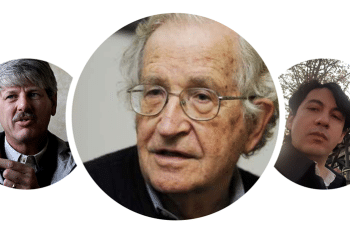
Climate Catastrophe, Collapse, Democracy, and Socialism” between linguist and political critic Noam Chomsky, Chilean exponent of the Marxist-Collapsist theoretical current Miguel Fuentes, and American ecologist and evolutionary biologist Guy McPherson.
On the article about Aosdána in issue 36 of Village (See Mannix Flynn’s reply on page 32) Dear Editor, In his article in your publication, dated 14th April 2015, Mannix Flynn is wrong when he states, regarding election to the position of Saoi of Aosdána, “Currently, if a position is vacant for one of the Saoi (Saoithe) all it needs is for certain insiders in Aosdána to get together 15 members to put a name forward to guarantee the elevation”. The procedures for nominating a member of Aosdána to the honour of Saoi are laid down in the rules of Aosdána, clearly and unambiguously. They state that at any time, fifteen members may propose in writing another member for election as Saoi. There is no such thing as “guaranteed elevation”. When a nomination has been correctly put forward, it then goes to the entire membership for ratification by secret ballot. A successful nomination must gain the positive votes of 50% of the entire membership plus one. Mannix Flynn’s contention that this process can be hijacked in secret by what he calls “certain insiders” is therefore factually wrong. Having been a member of the Toscaireacht (Steering Committee), from 2007 to 2011 Mannix Flynn is, or should be, familiar with the rules of the body. The current Saoithe were nominated by a very wide range of members. At a conservative estimate, more than half of the members have been involved in these nominations. Mannix Flynn’s definition of “certain insiders” is, therefore a most peculiar one. Mannix Flynn’s motion before the last General Assembly proposed that, on a vacancy arising, the Toscaireacht should advise all members that a vacancy exists. The fact is that both the Registrar of Aosdána and the Arts Council/An Chomhairle Ealaíon issue condolence notices to all members when a Saoi dies. Given the status of the Saoithe as artists, there is invariably extensive media coverage of the death. Mannix Flynn is extremely economical with the facts when he refers to the contribution of our member Theo Dorgan to the debate on Mannix Flynn’s motion at the 2015 General Assembly. Theo Dorgan, as the minutes show, made the larger point that the honour of Saoi is conferred to acknowledge the work of the most gifted of our artists. Theo Dorgan’s view was that, as an honour freely conferred by the membership, it would be inappropriate to make the position of Saoi the subject of a competitive election with multiple candidates, which was the thrust of Mannix Flynn’s motion. It would be equally inappropriate, for example, to institute competitive elections for the honour of Freedom of Cities of Dublin, Belfast, Cork etc. Honours are properly, freely given – neither sought nor competed for. Mannix Flynn put his motion before the General Assembly and, following a full and open debate, his motion was put to the meeting; it was overwhelmingly rejected. Yours faithfully, Mary FitzGerald, Chair of the Toscaireacht, Aosdána, 70 Merrion Square, Dublin 2
On the provenance of Kevin Kiely Dear Editor: Some of your contributors merit a brief – and very useful – biographical note. Others do not. For this reader at least, the most glaring omission in the November issue was the lack of any provenance of the writer of the bilious article ‘The I.T. Gang’. While I have read and enjoyed the output of many of the award-winning authors mentioned in the piece, John Banville, Colm Tóibín, Roy Foster, Roddy Doyle et al, the name Kevin Kiely is unknown to me. Perhaps he too has been garlanded with literary honours, an Impac or Man Booker, an American National Book Award? Sadly word of these literary distinctions has yet to reach here. Yours faithfully Terry Kelleher St Remy de Provence, France Ed’s note: Dr Kevin Kiely is a former literary editor of Books Ireland; Fulbright scholar; Professor of Irish Literature, University of Idaho (2008-2009); biographer of Francis Stuart; poet, novelist, critic and playwright. He was awarded the Patrick Kavanagh poetry fellowship in 2006. Village generally takes a dismissively egalitarian stance on garlands. On Village’s Parks Special Dear Editor: Reading your Parks Special (Nov Village), I agreed with the section relating to staff: most Local Authorities have a core of professional staff – architects, engineers and planners, but only a limited number employ professional parks staff. However, in respect of Dublin its still amazing to think that a small number of highly motivated professional staff achieve so much with so little and in the process have left a legacy of immense recreational value for the present and the future in outstanding parks, including Marlay, Corkagh, Tymon North, Malahide Castle, Newbridge Demesne and Ardgillan. As to Ciaran Cuffe’s suggested steps for better parks, I think the author of the article and I see elements of the landscape in a different way. You need to know what you are looking for to be able to find it. For example, many years ago while walking for the first time through Alpine meadows in the Spanish Pyrenees, I asked what do Gentians look like. Our guide, a famous British horticulturist, said look under your feet, you have been walking on them for the past hour but not knowing, did not see them. Suddenly my eyes were opened and I saw them everywhere. I see wild flower meadows in the Tolka Valley, at Robswall Park in Malahide, at Malahide Castle, and have enjoyed participating in the Bio-blitz at St Anne’s park. One of my favourite urban parks for viewing nature in all its forms be it wild flowers, majestic native trees, birds, animals, bats and an amazing variety of habitats must be the Phoenix Park . Others use the Park for active recreation be it formal sports, play facilities at the Visitor Centre, or just to run or walk. Long may it survive in this form and be known as one of the premier world parks, a rare jewel to be treasured. Rare breeds of cattle are used to graze vegetation at Robswalls, and in St Catherine’s. In fact it has been my experience that innovative land-management techniques are part of every day life in Irish parks. Extensive usage is made of native tree species in planting schemes. However, diversity is important as you never know what aggressive pathogen is about to pounce – look at the demise of the elm. What grows in the hostile environment of a roadside margin rather than survives is often a difficult choice. From my experience play – be it formal or informal – is encouraged, the problem being in the Irish context that we seem all to ready to make claims. Perhaps a bit more parental responsibility might be desirable. The role of trees and woodland in terms of biodiversity, carbon sequestration and enjoyment needs to be reinforced. Hopefully the legislation in relation to tree preservation will be updated, and possibly the right of appeal to An Bord Pleanála reintroduced. Yours faithfully Peter W Cuthbert Landscape consultant and former senior executive parks superintendent for Fingal County Council On our kind direct provision system Dear Editor: Frank Connolly’s use of a case-history to illustrate the “inhumane” direct provision system (Village, Nov 2014) was quite extraordinary. “Ramesh”, he told us, came to Ireland in January 2010, applied for asylum and got refugee status that same year. Refugee status gives you the same entitlements as any Irish citizen. On getting it, you leave direct provision. You are not thrown out overnight, but given some time to make new arrangements. But Connolly tells us that “Ramesh” has “recently”, i.e. four years later, left direct provision. Given his fragile mental state, after torture in Sri Lanka, we must assume that he was allowed to stay for four years out of kindness and consideration for his vulnerability. Yet Connolly uses this kindness and consideration as a stick with which to beat the direct provision system. How very logical. Yours faithfully Áine Ní Chonaill, PRO Immigration Control Platform PO Box 6469 Dublin 2
On Irish Water Dear Editor: I wonder if anyone is considering the implications for this proposed referendum that is being sought to protect us from the privatisation of Irish Water. Consider the following if you will: Insidious, Transatlantic Trade and Investment Partnerships (TTIPs) have been under secret negotiation since summer 2013. The biggest bilateral trade deal in history between the EU and the US. The primary focus of these negotiations, which are on-going, is on curbing regulation, including through further expanding the role of extrajudicial tribunals which are being designed to allow corporations and potential investors bypass national courts and to challenge governments who pass regulations that harm their corporate interests. Such tribunals have already been set up under the Canada/US NAFTA agreements, and could be set up here – these tribunals are causing problems in areas like the protection of water quality which is being threatened by fracking. The questions I pose are these: What if these secret TTIP negotiations are concluded in Europe, unelected officials will decide and there is no democratic vote taken over finalisation of these proposals. What then if the protections that have been taken to keep Irish Water a public utility company are challenged by some corporation that feels it is being disadvantaged? What if the existing EU competition authority laws (Directives) conclude that Ireland cannot/ should not prevent Corporatisation of our water utility? What then will we do? No Irish politician, government or opposition, is monitoring this as far as I am aware. However, the new EU Ombudsman, Emily O’Reilly, was so concerned about the lack of information coming into the public arena – that she commenced a public consultation on this matter. Derrick Hambleton Kingston, Galway On the Irish Times and Abortion Dear Editor: How charming of a spokesperson for the Pro Life Campaign, the very moniker of which is a masterstroke of question-begging sophistry, to begin an article by quoting CP Scott on the sacredness of facts (Village, October 2014)! The ostensible (hypo)thesis of Dr Ruth Cullen’s piece centres on a tired fundamentalist shibboleth: the media’s (the Irish Times’ in this case) pushing of the Liberal Agenda. However, this contention merely serves as the vehicle for a fairly predictable whistle-stop tour of all the stock PLC myth-mongering Newspeak catchphrases, each one debunked so many times as not to warrant the oxygen of further critical engagement. (It’s laughable, for instance, that the best-little-country-in-the-world-without-abortion-to-be-a-mammy fib is still getting an outing.) Indeed there are too many red herrings to gut here, so I’d like to volunteer just three unsolicited answers to three of Dr Cullen’s gratingly chin-strokey rhetorical questions, not to defend the increasingly rubbish IT, but merely to illustrate the PLC’s wilful disregard for the facts they always claim to cherish. Dr Cullen ponders why the IT did not report on the progress of the newborn in the Ms Y case. It did. Repeatedly. The IT duly reported in pretty much every article about the case that the infant was in care and progressing quite well. Save attempting to interview a 26-week-old newborn, what else was it to do? “Why did [the case of the woman from Ireland who died in a London taxi after an abortion] merit only a fleeting mention in the Irish Times”? It didn’t. It merited front-page headlines (plural) over the days it broke (22 and 23 July 2013), then further prominent coverage in subsequent days. I’m not sure from what distorted vantage this constitutes “a fleeting mention”, unless Dr Cullen starts her morning read of the paper at the obituaries and works her way backwards. The case made (international) headlines precisely because legal abortion in appropriate medical environments has an enviable safety record. Claiming or implying that a medical procedure that is 14 times safer than childbirth (Raymond and Grimes (2012)) is a danger to women’s lives by appealing to one tragic anomaly is anecdotal cherry-picking at its most transparently disingenuous. Furthermore, Dr Cullen naturally neglects to mention that the woman in question had a medical condition that predisposed her to a high risk of miscarriage, and she had the abortion at 20 weeks’ gestation because, according to her partner, Ireland’s NIMBY abortion laws, which the PLC obviously supports, forced the couple to scrimp and save for the costs of abortion tourism. Perhaps, had she received an earlier-term abortion and the unbroken continuum of care she desired and deserved in her own country, well… The case is, if it’s to be used as an argument at all, more an argument against the dangerous hypocrisy of Ireland’s unceremoniously dumping its abortion-seekers on Blighty’s shores, as well as the false dichotomy between risk to health and risk to life in Irish abortion law. “The onesidedness must leave the neutral observer wondering is the Irish Times so patronising as to think the public cannot be trusted to hear both sides of the story and make up their own minds”. Answer: Breda O’Brien, John Waters (until his petulant defection), numerous anti-choice op-eds, many from spokespersons from the PLC, countless Letters to the Editor from Catholic priests and bishops and other extreme natalists, etc. It could be argued that this in fact constitutes a disproportionately thorough airing of anti-choice sentiment, given its ever-dwindling currency among the population of 21st-century Ireland. Perhaps, given all the above, a more apt and august opening gambit to the good doctor’s piece might have been found in the wisdom of Homer J Simpson: “You can use facts to prove anything that’s even remotely true. Facts schmacts”. E Bates Oxford, UK
Dear Editor, I want to draw your attention to a blatant breach of a decision made by An Bord Pleanála regarding the new Dublin Institute of Technology Campus at Grangegorman. (Ref: 29Z. ZD. 2005) on 10th May 2012. Pages 2 and 3 of the Board’s Direction (SZD2005.pdf) state: “High quality, prominent accesses are required on the eastern and western boundaries of the new Quarter, at Constitution Hill and Prussia Street. These accesses are necessary to ensure that the new Quarter integrates successfully into the existing community, to waymark the campus, to provide permeability through the site and to ease undue pressure on the existing circulation network in the area. These accesses are considered essential to the successful implementation of the planning scheme. The opening up of these accesses prior to the occupation of the facilities by the DIT students is a prerequisite of the planning scheme. Reason for modification: It is considered that the provision of a high quality access to the SDZ lands from the west is essential to the integration of the SDZ lands with the local community, as expressed in the Masterplan …” Despite the clear direction by An Bord Pleanála, the Grangegorman Development Agency (GDA) have informed us that they intend to have the first 1,000 students relocate to Grangegorman in September 2014 without the access routes from Broadstone or Prussia Street in place. They have also claimed at various stages that this decision was with the consent of Dublin City Council (DCC) and An Bord Pleanala. Although, they have retracted the claim with respect to An Bord Pleanala subsequently. Yours faithfully Pirooz Daneshmandi, Grangegorman Residents Alliance, Rathdown Road, Dublin 7