Archives

OK

Random entry RSS

Loading

  • Posted in:

    99% gone, and still going.

      By Tony Lowes. 99% of the actively growing raised bog in Ireland has gone, with one third of the remaining 1% lost in the last 10 years     “I would like to draw your attention to the outright carnage bestowed on hundreds of acres of our historical raised bog lands in County Westmeath.”   So began an anonymous letter to a variety of environmental NGOs and Government officials in February of 2009. Site visits to Westmeath confirmed the concern and revealed that in fact the extraction was intensifying, with multiple unmarked container lorries heading from the back bogs of Coole and Castlepollard directly to the docks in Dublin.   Five years later, a questionnaire to Local Authorities from the Department of the Environment about 126 extraction sites of over 30 hectares across 20 local authorities confirmed that the industrial extraction from Ireland’s bogs remains the biggest unregulated land use in Ireland, if not in Europe. The questionnaire was based on a satellite survey undertaken by an Irish environmental NGO.     Damage The statistics are in fact well known. The original pristine raised bog area of 311,000 hectares has been reduced to 18,000 hectares. As of the last Report to the EU, 99% of the actively growing raised bog in Ireland has gone, with one third of the remaining 1% lost in the last 10 years.   The damage is also well researched.   Drainage of peat causes not only the degradation of the peat, but a reduction of water-storage capacity and a release of nutrients, heavy metals, sediments, and dissolved organic carbon.   The dissolved organic carbons when treated with chlorine in our water-treatment plants creates carcinogenic disinfectant by products – trihalomethanes. Trihalomethanes exceeding the WHO and EU recommended levels in drinking water currently affect 600,000 Irish consumers, some 200,000 of them on the EPA’s ‘Remedial Action List’. The fact that consumers are not informed and so able to take precautionary measures, as required by the legislation, is a not-unrelated scandal.   Then there is the loss of carbon sink from turf-cutting and related activities (e.g. combustion and horticulture). According to recent UCD studies, these emissions are twice that from waste processing and the equivalent of half of the emissions from our national housing stock.   As a Southern Regional Fisheries Board Report in 2008 concluded:   “The companies involved in the hacking of the boglands have no appreciation for the habitat or the surrounding watercourses and do not work to any specified environmental work procedures. The extraction schemes are financially lucrative due to consumer demand in Ireland, the UK and further afield. The overall result is that the loss of available bog sites greatly exceeds the area of bog being conserved, and this further demonstrates the urgent requirement for control”.     Satellite Survey The Department of the Environment’s ‘2013 Peatlands Survey’ was based on a 2010 satellite survey of exposed peatlands commission from University College Cork by Friends of the Irish Environment [FIE].   The survey was pieced together from free Landsat imagery and cloud-cover meant that the only clear pictures were from 2003 – 2007. These revealed more than 74,000 hectares of exposed peatlands in unknown ownership (excluding Bord na Mona). Vast areas of devastation stretched across the raised bogs of the midlands with more than 21,000 hectares in Offaly alone.   The result were catalogued by county and size and presented by FIE to the EU Petitions Committee with dramatic results. The Commission wrote to Ireland suggesting that “extraction is of a scale that exceeds the threshold for mandatory EIA without the competent authorities having required any peat extractrion operator to undertake an EIA”.   Subsequent pressure from the Commission led to the Department of the Environment agreeing to investigate 126 sites of over 30 hectares identified in the NGO satellite survey. Accordingly, they wrote to the 20 local authorities involved, providing maps and coordinates, requesting site surveys of each location.   While some sites were abandoned or in fact were young forestry on exposed peat soils, more than 80 of the 126 sites were found to have required planning permission. No local authority had to date even a record of peat extraction, as it was considered exempt from planning. Consequently, none were on the Register of Extractive Industries and not one had undergone any assessment.     The Planning System FIE also pursued the unauthorised extraction at a national level. A series of test cases in County Westmeatrh was subject to Section 5 Reference, where the local authority is required to determine if an activity requires planning permission.   In its first decision the Planning Appeals Board (An Bord Pleanála) dismissed the reference as it claimed it could not identify the location or boundaries. FIE took a judicial review, having supplied GIS coordinates in the centre of a 100-hectare site. The Board’s decision was quashed by the High Court in 2011 and costs were awarded against the Board and Westmeath County Council with a requirement for new References to be submitted.   The new References led, after a further two years, to a ruling confirming that planning permission was required. The Bord Pleanála Inspector concluded dryly:   “The continued extraction of peat and other ancillary works on each of the sites raised in the referred request would therefore be likely to have significant effects on the environment and require environmental impact assessment. Indeed, after inspection of the sites I cannot imagine any reasonable basis to conclude otherwise”.   This decision was appealed to the High Court by the two operators concerned – Westlands and Bullrush – who were also given leave to continue operations whilst the matter was being adjudicated (see Box: ‘To Bronze age roads’) on the grounds of unfair commercial disadvantage if they were singled out to halt work when so many others continued apace. The case is scheduled for hearing in June 2015.   And so the destruction of Ireland’s raised bog continues.   Tony Lowes is a

    Loading

    Read more

  • Posted in:

    Fuck you, Mattie McGrath.

    In the bath with Minister for the Environment, Heritage and Local Government, Alan Kelly. Alan Kelly contemplated his navel over the water, Irish Water, in his dirty bath. Thank Jaysus it was only thirty thousand.  Thanks the lord. And the  Garda tallymen. I fully accept the dirty bath, he practised, ministerially.  Errors were made in how it was run at the beginning.  But they were not my errors.  We will now take clean steps out of the dirty water. We or, should I say, they have not communicated why I am in this dirty bath. Fuck you, Mattie McGrath he murmured, and then forgot he’d said it. A drop of the valuable resource plashed into the foam.  But he didn’t cut it off. The water supply  will not be reduced or cut off, he mouthed. Did I say timelines yet?  Confusion.  Other people’s confusion. My hyper-confidence.  Fianna Fail in the  bath. I have my ear in the  bath, listening to the people. The bath will not cost what people think.  Better communication.  Less confusion. Leader Burton, in the way, those funny ideas about iquity, she said.  Equetty. Ek-wetty.  It sounded good.  That was what he was for.  While the timelines may have been dictated by the Troika, we all accept at this stage that they were simply too ambitious. I fully accept this. While I was not a member of cabinet at the time, it is important that as a Government we acknowledge that errors were made – the timelines, the complex nature of the charging structure and poor communications by Irish Water. We must now take steps to address them and we will.The timelines have led to confusion, uncertainty and huge frustration for the public. Again, I fully accept this. As a Government, it is time for us to listen and we are doing that. We are working on a package to bring the necessary certainty and clarity to the charging structure so that the public do face water charges which are modest and affordable. Many people are preparing for bills in the region of €500, €600 or €800. Based on the package we are bringing in, nobody will be paying these levels for their water. Let me repeat that, nobody will be paying these levels for their water services. I fully acknowledge there have been failures in communication.  Irish Water have correctly and appropriately apologised to its customers and elected members for this and are taking steps to remedy it. I apologise myself even though I have nothing to apologise for. Sorry for telling Mattie to fuck off if he’d said it. Sorry.  Sorry.  Apology. Eqwetty. There is nothing I will not accept, or remember. He couldn’t remember a thing about what was good or bad about water, baths or taxes. It was all about avoiding reaching for the towel. The bath was nice if dirty. Emissions. And getting hotter.  Like the country’s climate. He kept telling himself he should care, just short of the point where he actually did. Climate legislation that didn’t have any of the qualities of legislation. He let the hot tap run some more. Some of it splashed over the side down onto his jocks. I am on record as stating that the 2020 targets were unrealistic and unachievable and that did not take into account Ireland’s dependence on agriculture or the fact that we have one of the most climate-friendly agricultural systems in the world. This deal recognises that we have secured recognition across the EU of the importance of a sustainable agriculture  as a key consideration in ensuring coherence between the EU’s food security and climate change objectives. I made it clear that Ireland would not be signing up to any future targets that would be unachievable. Ye can’t eat the environment.  Couldn’t give a rat’s arse he confided to himself and moved his head forward on its plane, like he used to do before he’d become an important man. He’d the lip under control since he’d become the big fella up in Dublin. Fuck the  climate.  Doesn’t vote.  Beef.  Beef,  belching Beef forever he couldn’t get enough of it. 500 votes that was worth.   And he emitted again. He caught a glimpse of the biggest bullox in the cabinet, through the soup below. And a night out on Macra, Christmas week. Minister for Local Government, he mused. He loved Government.  But he if anything preferred Local. Local Funding he thought and fisted one out of the water. €1.1m New Ambulance Base, €350,000 Jimmy Doyle Road, €140,170 Thurles Leisure Centre, €95,000 Thurles Town Council for Pre-Approved schemes, €200 million investment in Limerick Institute of Technology’s Limerick and Tipperary campuses, €71,000 extra for road maintenance & major funding for Thurles bridge rehabilitation, €66,000 MUGA Monakeeba, €50,000 Thurles Walkway, €25,000 Thurles Boxing Club, Substantial funding for the CBS and the Presentation Secondary school and the Thurles international festival of hurling. Huzz-fuckin-Ah. And jobs. I am delighted to announce that a Tipperary company is among the preferred bidders to deliver the Government’s Jobpath programme. FRS Recruitment, who are based in Roscrea form part of the Consortium who have been selected to deliver the Jobpath programme in the Southern half of the country for the Department of Social Protection. 500 employees with their head office expected to be located in North Tipperary.  Fuckin A.  I haven’t even realised it’s privatisation of essential services. Better Tipp and private than the pale and public, he thought then threw himself back under the water confused. Jayz but amn’t I against privatisation? The bloody referendum.All that thinking they were expecting of him now in the senior hurling. Nobody seemed to care he’d the MPhil from Boston, founding chair Kemmy Branch Labour UCC,  former Chair Labour Youth. TD.  Minister for the Environment and especially local government.  And the other thing.  MEP, BA, MPhil, Dip (Leadership) Bost, MBS. Deputy leader  Labour Party. And still under thirty. Had anyone so unknown been gifted such a role (the brother, maybe)? Youngest ever

    Loading

    Read more

  • Posted in:

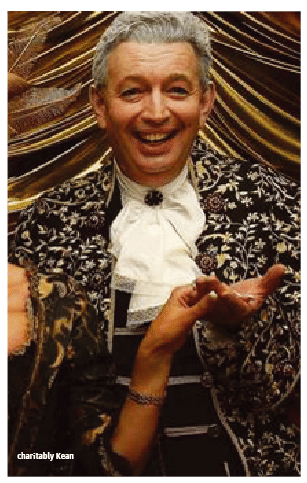
    In the soup: Gerald Kean.

    By Frank Connolly. Fresh from his latest, and unfortunate, altercation with the Law Society celebrity solicitor, Gerald Kean, has landed himself in the thick of it again. No doubt motivated by the best of intentions, Kean has joined the trustees of soup kitchen, the Cork ‘Penny Dinners’, where his friend Caitriona Twomey has ruled the roost over many years. Kean of course has been associated with many charities over the years and, when he is not promoting himself, his bejewelled partner, and his lavish Wicklow mansion on the pages of the Sindo, he has managed to maintain a lucrative practice from his offices on Upper Pembroke Street in Dublin. In September, the High Court dismissed an appeal against a finding of professional misconduct arising out of Kean’s handling of a former client’s case. Justice Nicholas Kearns upheld a finding of professional misconduct made by a Solicitors Disciplinary Tribunal (SDT) against the solicitor over his handling of a case brought by Christopher O’Neill. Fortunately for Kean, the court said it would not impose a fine of €20,000 for misconduct which had been recommended by the SDT. Kean was also for some years during the lengthy and brutal Pinochet regime the honorary consul for Chile in Ireland even though, according to himself, he never once visited the Latin American dictatorship.  When the reviled general was arrested in England in 1998 in connection with a Spanish-led investigation into human rights abuses, some of his advisors called on Kean to help. Sure enough, the solicitor kindly introduced a delegation of Chileans to the then foreign minister, David Andrews, who did not look kindly on their request for assistance for the embattled Pinochet, or his possible refuge in Ireland. The dictator remains subject to a global investigation into his vast hidden assets, led by the Spanish judge Baltasar Garzon which has apparently failed to uncover any significant riches. After a heated emergency general meeting on 6th November of the volunteers who run the Cork Penny Dinners, a charity set up by concerned Catholic, Church of Ireland and Quaker religionists in the late 19th Century, the absent Kean was among a new board of trustees appointed “as part of a major restructuring of the charity” according to a report in the Irish Examiner. He is joined by new chairman and businessman, Jim Urquhart, who defended the exclusion of a number of people from the EGM at the charity’s somewhat dilapidated premises and kitchen at Little Hanover Street in the city. There has been an angry and vocal reaction from some former volunteers who claim that those who managed to get in were not allowed by Urquhart to ask questions or to query the credentials of many of those present and permitted to vote for the new board. Among those who was permitted to attend and the only one allowed to make a speech was solicitor Martin Archer who castigated efforts by a group of people who, he claimed, had made an attempt to establish a new governing board without notifying members as required under the code of governance of the charity. He also cited other alleged breaches of the code before promptly resigning his position as legal advisor to the Penny Dinners. What is at stake here is not just the reputation of one of Cork’s most popular charities which feeds the needy, down and out and impoverished of the city with the help of generous retailers and volunteers but the estimated €1.5 million held in its various accounts. According to Urquhart, the finances of the charity are “absolutely sound” and a Garda investigation had found “nothing wrong” with their administration. This inquiry followed complaints by volunteers some time ago over the handling of the Christmas collection, among other matters, leading to a number of recommendations as to appropriate business practice. Following the departure of Archer, and those of other long-standing trustees, the incoming board appointed South Mall solicitor, David Donegan, (who is listed with Urquhart on the board of Cork -based company, Family Business Ireland) to keep a legal eye on the affairs of the charity. No doubt he can call on Gerald Kean to help him if the financial waters prove too choppy in the future. •

    Loading

    Read more

  • Posted in:

    The Irish weekend. Candles and Cake at Avoca.

    By Michael Smith. Avoca: I hate it.  The dead river which has run marinated in copper for a century, the town which spawned the  devil’s tv series, Ballykissangel, and now Avoca – the “store”, the café, the nursery, “the shopping and leisure destination”. In recent months I have discovered the  joys of dedicated walking in the Wicklow Mountains.  That’s organised trips, not the type where you decant from the car at a random gate and head overland between the  barbed wire and slatted sheds before being stopped in your tracks round the first bend by a plastic ranch and a belching four  by four.  It’s walks where you study a map – or a Google Map, wear  gear and get remote.  For this grimy city dweller, Wicklow’s become the best thing about detestable Dublin.  One thing you notice if you bump into anyone else on these treks is that they’re not Irish.  That’s because all the Irish are in Avoca. Or should I say Avocas.  Because Avoca now IS Wicklow.  Its stores are everywhere, not just Avoca Village itself but Powerscourt, Mount Usher and Kilmacanogue which is the one that detained me recently. And it has begotten emulators: Brooklodge/Macreddin Village and Fisher’s of Newtownmountkennedy are every bit as soul-crunching; the  Ritz Carlton much worse still. Moreover, like a virus of good cheer Avoca itself has colonised Suffolk St in Dublin, Malahide Castle, Letterfrack and even Belfast. It shunts me to distraction that there is nothing to do in Ireland at weekends if you tire of Man City on Sky down the boozer.  Dublin is the most scandalous.  I’m not looking for mardi gras: a general market sprawling with artesan food and craftwork, books, antiques, bric a brac, mad clothing and African masks, all challenged by street artists, cascading down Smithfield, in Dublin’s North  Inner City, would be enough – drawing people from all over the  country with its indigenous, organic vibrancy.  But the city architect killed that idea years ago with a revamp of Dublin’s defunct market square that was driven by architecture – an attempt to eradicate the historic,  the gritty and the horizontal – rather than a new attractive USE, such as A MARKET. Every other city of a million people has a market. The model can be Camden Lock in London, the souk in Rabat, the  Chatuchak in Bankok, Union Square in New York or  the St Ouen flea market in Paris. Even the  English Market, in Cork.  Just make it big not like the piddling overdone organic market in Temple Bar. Every other.  Not us. So the weekend comes and no one has anywhere to go in the  city.  Grimly simulating cheer through the  hangover the natives concentrate on avoiding hassle, exertion, the rain.  But they can’t admit it to the kids, to the prickly partner who stayed home last night, or even of course to themselves. So when somebody says “let’s go somewhere”, a reflex rejoinder is “I know – let’s spend the  afternoon in Wicklow”.  And then the  reality comes to mind, and torpor, and no  shoes, and the comfort fetish suffuses the perspiring obescent corpus.  Somewhere in the process going for a walk in Wicklow gets replaced by going to Avoca.  The opposite. Forged out of the billet-like remains of the old handweavers’ mill there, Avoca Kilmacanogue is the shed of the  garden of Ireland. It is a prefab  Dundrum Town Centre plonked in Wicklow and sprinkled with faux rustications and Victorian ‘fern rooms’. This is as much  the countryside as Dundrum is the Town.  Or indeed Kildare Village is a Village. Or Powerscourt any more a country house. They are all SUBURBIA, with all its characteristic mediocre anonymity for people who find cities, villages and the country too spontaneous. Avoca’s blurb proclaims the Kilmacanogue outlet is “set in the grounds of the old Jameson (of whiskey fame) estate, surrounded by ancient trees and rolling gardens”.  Well it was before they crammed in  a parking lot big enough  to fill paradise. I visited at a weekend and I can’t believe anyone goes there during the week.  I visualise dozens of earth-moving machines working Monday to Friday shifting trees and knolls to create a couple of spaces here, a bus reservation there; and of course  shifting remedial diesel all Friday to prepare it so the ladies and occasional gentlemen who lunch  on a Saturday will think the latest addition of asphalt has been there since the time of old John Jameson. Back  to  the  brochure again: “the Avoca store”, it states, “at Kilmacanogue is simply Ireland’s best retail & food experience. (It’s pronounced Kill-ma-cano-guh by the way)”. The fare is twee and predictable, as you’d expect from a corporation  that gives pronunciation guides, though well enough executed that there’s always someone on hand to coo or champ at the fare (you have to call it fare), much of which  is produced in Ireland, to exalt the ethics of the place even if the good is undone in the end by its consumption by motorway-addicts. “From knits to glassware, ceramics to jewellery, toys, books, homewares, aromatics – much of which is exclusive to Avoca – we can go on…”. To me it all looks like jam and blankets. I can go on…this is the place the people who exchange scented candles at Christmas actually bump into each other. It is laid out with all the personality  of an  airport duty free or a Christmas shop.  It’s pushchair central too, evenly dispelling the perfumes of one-year-olds. The  families who flock to Avoca love the ubiquitous  queuing.  It gives them  a chance to savour the texture and weight of their  trays.  They like standing in line for the  same reasons they will like sitting in traffic on the  journey  home. And the prices are pure Brown Thomas:  €2.99 for a yoghurt, I noticed before I persuaded myself just  to  eat and stop thinking. But it’s an icon for people who seek one.  A writer in Dubliner

    Loading

    Read more

  • Posted in:

    One had a Nanny and went to Eton.

    By Michael Smith. The differences between David Cameron and Nick Clegg (2010). No-one has ever contemplated the relative poshnesses of Ireland’s  Enda Kenny and Brian Cowen.  Both are classless (and  only incidentally unclassy).  Britain is different.  In a society where people wear their class on their shirts or forearms (sleeved or tattooed), they are obsessed with it. Even our comrades in the Guardian published an article about who was posher – (Prime Minister)  Cameron or (Deputy Prime Minister) Clegg. Both of them are sons of financiers, attended major public schools and then went to Oxbridge. Both have the comportment, manners and what has been described as ‘pointless handsomeness’ of a certain sort of well-bred Englishman. Both have aristocratic connections. ► Clegg Clegg’s father, Nicholas Clegg CBE (no less), is chairman of United Trust Bank.  His paternal grandmother was a Baroness from  Imperial Russia whose aristocratic family fled after the 1917 Russian Revolution. His paternal grandfather was the editor of the British Medical Journal for 35 years. Clegg’s great-great-grandfather, was attorney general of the imperial Russian senate. Louis Theroux, the Gonzo-style tv jourmalist, was his fag at Westminster Public School and he spent a gap year (that irritating staple of the white-shoe Englishperson) as a skiing instructor in Austria. Clegg, who worked for years in Brussels, speaks English, Dutch, French, German and Spanish, and his family owns a chateau in France. But this isn’t enough. Instead they sniff he was born in Chalfont St Giles (a sort of English Kinnegad), and more ambivalently, that he’s an  unrecognisable hybrid Eurofop, not the well-known English incarnation. His accent is not easily defined (just a hint of Sheffield, where his constituency is, and a mortifying ease with the glottal stop). And the name Clegg…even his wife insisted on calling all the children exotic Spanish first names to counter it. A Clegg sounds like a jobbie’s nail. ► Cameron Cameron is a direct descendant of King William IV (and so fifth cousin, twice removed of Queen Elizabeth II). Cameron’s maternal grandfather was High Sheriff of Berkshire, and his maternal great-grandfather was Sir William Mount, First Baronet, Conservative MP for Newbury 1918-1922. His wife, Samantha, is the eldest daughter of Sir Reginald Sheffield (and a descendant in three different ways of King Charles II). Her mother is Viscountess Astor. We assume – though he will hardly admit it – that Cameron, like many of his forebears, regarded it as preferable in a wife to be a baronet’s daughter. Samantha grew up on the 300-acre Normanby Hall estate in Lincolnshire. Her family also owns a large Yorkshire estate called Sutton Park. “Cor blimey, guv” Sam Cam – a later incarnation – allegedly took reverse elocution lessons to make her sound a little less £30 million, went to all the wrong colleges and has a tattoo – but it was all too late and makes no difference to her class. Cameron grew up in Peasemore, Berkshire, under the tutelage of Nanny Hoare –  the Cameron family loyal retainer who not surprisingly doesn’t figure in official dispatches. The experience of Jacob Rees Mogg, another toff – the son of a former editor of the Times, [right] shows what can happen if you allow others to play the Nanny card. Do not expect to see Nanny Hoare’s Master David albums in Hello Magazine, any time soon. On Desert Island Discs,  Cameron described how – while poor old Nick Clegg was presumably wasting his time on yet another academic bauble – he spent the inevitable gap year in Hong Kong working for Jardine Matherson – a sort of shipping agent – which one assumes is the last outpost of unreconstructed colonialist buffery, where he will have been updated on how to rule places. While wending his way back to blighty he visited a beach at Yalta in the Soviet Union, where he was approached by two Russian men, speaking fluent English. Cameron was later told by an  omniscient professor that it was “definitely an attempt” by the KGB to recruit him.  This is the ultimate accolade for any Nob. Clegg would not have worked for anything containing the name Jardine, would not have been in Yalta and, if he had, would have reasoned with the spooks in flawless Russian. Of course Cameron, presumably uncompromised, went to Oxford and took a first in Politics, Philosophy and Economics. Along with London Mayor, Boris Johnson, he was a member of the élitist Oxford Bullingdon dining club, whose members major in getting drunk and smashing restaurants. A famous photo, over which he sued, depicts this comprehensively. The Guardian has accused Cameron of relying on “the most prestigious of old-boy networks in his attempt to return the Tories to power”, pointing out that three members of his shadow cabinet and 15 members of his front-bench team were “Old Etonians”. While this might be just quaintly irritating to a disinterested Irishperson, it’s infuriating to many English people: the Milburn report, published last year, shows that 45% of top civil servants, 53% of top journalists, 32% of MPs, 70% of finance directors and 75% of judges come from the 7% of the population who went to private schools. So why is the Conservative (note: Cameron never uses the term Tory) Leader seen as upper class while the Liberal Democrat Deputy passes for an ordinary bloke?  Firstly, Metropolitan Westminster School, where Clegg went, is just not as grand as Cameron’s alma mater, Eton. Equally, Cameron’s Oxford college, Brasenose, was founded in 1509: Clegg’s college, Robinson, was founded in 1977. Of course the policies are different too – or at least they were for a while before the Clemeron/Conserveral coalition.  Clegg wanted to dump Trident and join the Euro – though no longer.  Cameron would never dump ‘our Trident’ but famously cut the Conservatives’ link with the European People’s Party in favour of one with a bunch of nationalist loons; and wanted to limit capital gains tax to estates over £1m. He’s much keener on re-legalising bloodsports than his foreignish friend.

    Loading

    Read more

  • Posted in:

    Planetary death by extractivism.

    ________________________ This Changes Everything Naomi Klein Simon & Schuster 2014 _______________________ Review by John Gibbons. I finished reading Naomi Klein’s ‘This Changes Everything’ just as a major study by the WWF confirmed that, in a mere four decades, more than half of the wild animals on Earth had been wiped out. From the time I was in primary school to today, life on Earth has been impoverished more rapidly than at any time in the last 65 million years. The calculus used to measure this is known as the Living Planet Index. It might be more accurately called the Dying Planet Index. Humanity’s relationship with almost all life on Earth can be defined as extractivist – a phrase used repeatedly by Klein, in her sweeping, angry polemic against the rapidly unfolding madness of one species run amok in the world, destroying everything in its ever-expanding path. Klein made her name in 1999 with ‘No Logo’, a withering assault on the hidden underbelly of the global brand business – the sweatshops, the crooked trade deals and the structural violence of the rich against the poor. This time, however, it’s personal. A neophyte to climate change, Klein admits to only having really tuned into it as an issue as recently as 2009. She is, however, a quick learner and in the last five years, it has gone from being fodder for her next book to occasioning her the awful realisation contained in the book’s title: climate change does indeed change everything – and truly understanding this issue inevitably changes you. “I denied climate change for longer than I care to admit. I knew it was happening, sure…but I stayed pretty hazy on the details and only skimmed most of the news stories, especially the really scary ones. I told myself the science was too complicated and that the environmentalists were dealing with it”. Having, like Klein, come from an entirely non-environmental background, and slowly, reluctantly, coming to realise the true import of climate change, I could personally relate to her initial desire to look the other way, and simply tune out this avalanche of ecological bad news, in ways that are analogous to how we humans are psychologically programmed to largely tune out the reality of human death. “Remember and then forget again. Climate change is like that; it’s hard to keep it in your head for very long. We engage in this odd form of on-again-off-again ecological amnesia for perfectly rational reasons. We deny because we fear that letting in the full reality of this crisis will change everything. And we are right”. As a society, as a civilisation, our response thus far has been about as nuanced as curling, puppy-like, into a ball and hoping it will just go away. “All we have to do is keep on denying how frightened we actually are. And then, bit by bit, we will have arrived at the place we most fear, the thing from which we have been averting our eyes”. We’ve become truly accomplished at both understanding and ignoring climate change. In the 24 years since international climate negotiations began in earnest, global CO2 emissions have risen by 61%. Crisis, what crisis? I vividly remember watching on in horror as the 2009 Copenhagen climate summit ended in bitter failure. The Irish Times was one of 55 major newspapers that, in December 2009, ran a joint editorial urging – demanding – that world leaders grasp this last ditch opportunity to avert calamity. One month later, the same paper ran an editorial complaining about the severe cold snap and wondering aloud if global warming wasn’t all just a big ol’ hoax after all. From the ashes of disaster, sprang clarity. “I have come to think of that night (in Copenhagen) as the climate movement’s coming of age: it was the moment the realisation truly sank in that no one was coming to save us”, writes Klein. After all the guff and rhetoric, this emerged from the ruins of Copenhagen: “our economic system and our planetary system are now at war. Or, more accurately, our economy is at war with many forms of life on Earth, including human life”. Klein spares some of her harshest critique for Big Green, namely those multi-million dollar US environmental organisations, specifically the Environmental Defence Fund (EDF) and the Nature Conservancy. Hilariously, it turns out that the latter actually operates its own oil wells, while the EDF regularly partners with Big Energy and helps it sell the myth that shale gas can be a ‘bridge’ to a mythological renewables-powered future. (Klein’s own rejection of nuclear energy as proven low-carbon technology is argued with little conviction and sounds more like a sop to her readership than a considered analysis.) Klein lambastes the various ingenious schemes, from emissions trading to carbon offsets, many backed by Big Green, that have given the illusion of action while achieving precisely nothing. In its early days, the unofficial slogan of the EDF was “sue the bastards”, and it and other groups enjoyed dramatic successes on a range of environmental issues. Latterly, the joke goes, the new EDF slogan is “creating markets for the bastards”. Under the leadership of business-friendly Fred Krupp, the EDF ballooned 40-fold from an annual budget of $3 million to $120 million. With the cash rolling, the emphasis for Big Green was developing industry-friendly “solutions” to the obliteration of the planet and the wrecking of our climate system (‘green growth’ is a particular favourite). Anything, in other words, as long as it didn’t fundamentally challenge the neoliberal narrative. “The refusal of so many environmentalists to consider responses to the climate crisis that would upend the economic status quo forces them to place their hopes in solutions… that are either so weak or so high-risk that entrusting them with our collective safety constitutes what can only be described as magical thinking”, Klein opines. There should be a special place in hell reserved for cuddly, lovable Virgin chief Richard Branson, who, to huge

    Loading

    Read more

  • Posted in:

    Villager – November 2014

       Roy Keane, Bono, Michael Fitzmaurice, the Le Pens, Morgan Kelly etc  Meaningful surnames So Jared Payne’s an injury doubt for upcoming rugby internationals, while Ireland’s second try-scorer against South Africa is pretty-boy Tommy Bowe. Keane to defend himself Roy in Portmarnock book fracas…zzzzzzzzz. Globalism and tax breaks Bono and the IDA want to change the World. Villager wonders what people who want to keep it the same look like. The People’s Peter Mathews Michael Fitzmaurice is beginning to make quite an impression in the Dáil.   Multinational Back The French Front National’s Marine and her dad Jean-Marie Le Pen seem to have fallen out, after his dog ate her cat on the family compound outside Paris over the summer. A few months ago she said his suggestion that Patrick Bruel, a Jewish singer, should be “put in an oven” was a “serious political mistake”. Villager certainly would not demur. Now she wants to change the national front’s name but he says “only bankrupt parties change their names”. Ok then, how about just change the policies?       Trust not Front The Chairman of the English National Trust, Sir Simon Jenkins, a former editor of The Times, has attacked David Cameron, who once said he’d no more put the countryside at risk than his own family,  for abandoning Tory election pledges including by calling for a £15bn “100-roads revolution” by the end of the decade. Jenkins accused former Tory planning minister, Nic Boles – whose father, Jack, counter-intuitively was head of the National Trust 1975-1983, of being effectively a recruiting officer for UKIP which apparently is understanding about the countryside.  Such language would never be heard in Ireland’s National Trust, not since the never-knighted editor here – then An Taisce chairman – called Eamon O’Cuív a gobshite, in 2001.         Morgangst Villager doesn’t really do heroes. Gandhi maybe or Mandela. In Ireland we’ve em Adi Roche and Morgan Kelly. Anyway, the ECB has gently done the bank tests and only PTSB is in trouble. Where does this leave Professor Morgan Kelly? As recently as March he specifically reckoned the ECB was “gonna do” a “trial run” on Ireland.. It didn’t and won’t.  Stress tests would do for a large swathe of our SMEs which were surviving on “bank forbearance”: a “ticking time bomb”. “The ECB has basically kept pumping that sweet, sweet credit into our veins and we haven’t had the real crisis yet” but “we are going to see a big  chunk of the Irish economy wiped out in one go”, he predicted. As with Karl Marx you shouldn’t get in the business of predictions if you’re not prepared to take responsibility if they prove false. Morgan’s prediction is simply inaccurate. Village checked out the video of his subterranean lecture to a bunch of spotty UCD economists, and it’s all there. Never mind that he says Ok a lot, presumptuously, and does an irritating reverse praying gesture with waving hands. Villager has therefore downgraded him to McWilliams. It’s the clock/recession comes around once every 24 hours/business cycle syndrome. When that happens Kelly and McWilliams will be right. Better than most economists, but not great; and not heroic. Gurdgangst Still, like McWilliams, Kelly’s always been floppily cuddlable. On the other hand, Villager’s frankly always been a little scared of Constantin Gurdgiev.  Is there no end to the misery, Constantin? He seems to claim property prices are not rising when everyone else claims the opposite. Yet a cursory look at myhome.ie shows the prices of most properties does seem to be falling.  Is there something we’re not being told? Note to editor: ditch desperate, ill-thought-out plan for Village Property supplement. Statler and Waldorf In a blur of redundant silver-fox smoothness Frank Flannery and Bill O’Herlihy, two compromised former public Fine Gael elders, are to front a weekly iTunes podcast, paid for by Heatley Tector, cricket and rugger-buggering instore music and advertising mogul. Flannery, who was once president of the Union of Students in Ireland and shared rooms with Pat Rabbitte (just imagine the fights over who finished off  the sliced pan) received payments of €351,000 from Rehab over six years.  He was forced to resign from its board and as a Fine Gael trustee earlier this year after it was revealed that the charity paid him to lobby the Government, and that he was hanging around foxily in the portals of the Dáil to do so. He also used invoices from a dissolved company, Laragh Consulting Ltd, when being paid by Rehab for such services. O’Herlihy is a former investigative reporter turned sports broadcaster and Fine Gael handler, and is now chairman of the Irish Film Board. O’Herlihy has marshalled his reputation as a soccer sweet heart to lobby for some dodgy clients over the years. He worked on behalf of the tobacco industry in opposition to plain cigarette packaging, on the grounds that plain packages would make smugglers’ lives easier. In 2004, the Sunday Independent reported that O’Herlihy had lobbied on behalf of an Irish company, Bula Resources, to lift sanctions on Iraq. He also lobbied disingenuously in the early 1990s on behalf of Monarch Properties, subsequently found to have made corrupt payments after he’d moved on, for the rezoning of Cherrywood in South County Dublin. O’Herlihy told the Mahon tribunal that Richard Lynn, the project manager for the rezoning, explained to him that the way the system worked was that one picked a lead councillor in each of the political parties and then discussed the matter with them. An estimate of the amount of money needed to buy votes was made and the money was then provided to the lead councillor who did everything after that. O’Herlihy wouldn’t do that so Monarch replaced him with Frank (Dunlop not Flannery). So Villager waited up and podcast it, these exciting ‘Flannery Files’. Cue sub-Pat-Kenny-Show Mahler’s portentous Symphony No 6 in A minor, then it’s O’Herlihy, drole honest broker, introducing the great man who promises to be

    Loading

    Read more

  • Posted in:

    Parklife.

    By Aidan J ffrench. Parks are vital contributors to urban life. But, with notable exceptions (eg Dublin County Council’s acquisitions of demesne landscapes: Marlay, Malahide, Ardgillan etc.), provision and management of parks in Ireland is haphazard, due to inadequate policy, law and resources, and political inertia. In 2006 Minister Roche’s responses to Dáil questions from John Gormley TD [opposite page] revealed clear indifference to parks. A 2007 international congress in Dublin saw Taoiseach Ahern plámás parks managers with platitudes while his government failed to rectify legal problems raised by the 2005 fiasco in Dartmouth Square, Ranelagh. This year’s Irish Planning Institute conference heard its president announce “.. the lessons [of the boom] have been learnt”. What lessons, learnt by whom: what evidence? None was forthcoming. There’s no evidence of lessons learnt in planning for parks. International practice Experience abroad demonstrates that successful parks require innovative and progressive State support, vision and dedicated human resources. Meeting these requirements is critical if urban dwellers and tourists are to fully enjoy the proven socio-economic, health and environmental benefits of parks. But Ireland lags significantly behind progressive states (Germany, Malaysia, Scotland, USA) and cities (Berlin, Melbourne). There, parks are political priorities – Chicago’s Mayor Daly spent $500 million on Millennium Park! New York and Greenspace Scotland are exemplary in promoting parks as generators of green-collar jobs, quality of life, optimum health and social solidarity. Investing in parks – policies, law, research, guidance, projects and resources – is a national priority. Key impediments Sadly, Ireland still largely relies on an outdated 1980s model of park provision. Key impediments preventing progression to best international practice include: • a 1987 policy unfit for 21st. century needs (quality, climate change, sustainable drainage, biodiversity); • a seemingly disengaged Department of Environment (DoE); • no professional landscape expertise in DoE to champion parks. Parks are landscapes. Government, after inexcusable delays, published a Draft Landscape Policy in July – flawed and unambitious (nothing about parks) – to meet European Landscape Convention obligations. With no single government department employing any Landscape Architects or parks professionals – not Environment, Arts/Heritage or Tourism/Sport – it’s likely to flounder in civil service inertia. In Malaysia – a poorer state – national policy embraces parks: with a large, landscape department (established 1996), devoted to landscapes and parks. In the Netherlands there’s a state landscape architect! There’s increasing demand for council services, driven by expectations raised by the property tax. Former minister Hogan promised a range of services: top of the list were parks and amenities. Very few councils employ qualified staff to deliver these services and they are currently prohibited from recruiting. Resources – some facts and figures Apart from these impediments – significant in themselves – official statistics on parks are unavailable. With rare exceptions, we don’t know the locations, usefulness, quality, quantity or accessibility of urban parks. Fundamentally, the crux is that parks provision is only a discretionary service (Local Government Act 2001), not mandatory, unlike other services which are a legal imperative. Also ….. • no national laws for urban parks; • only 8 of 31 local authorities employ qualified staff; • recruitment embargo severely impacting on capacity to provide / manage parks; • few training programmes for staff; • lack of regulation impeding quality delivery: anyone can claim to be a landscape architect or park manger, so there’s no assurance of quality provision. For years, the Irish Landscape Institute has called on successive governments to regulate the profession, notably in its ‘Manifesto for Irish Landscapes’ (General Election 2007). These impediments have practical consequences: poor quality of life/public health, diminishing property values, compromised tourism benefits and a harsh environment. The Future? Dublin’s local authorities and OPW, with An Taisce, will implement a pilot Green Flags Awards Quality Assurance scheme for parks in 2015. Enlightened and demanding communities are taking independent action (eg community gardens, popup parks). And Open Space Strategies (mandatory in the UK) are being adopted . In the short term, pending more systemic advances, DoE Minister Alan Kelly could immediately introduce two practical reforms: mandatory preparation of OS Strategies and inclusion of parks standards in performance indicators for local authorities. He should also commission design competitions for new parks in regeneration areas (eg Limerick city). Relaxation of the recruitment embargo too would help.   MINISTER ROCHE’S 2006 REPLIES TO DáIL QUESTIONS FROM JOHN GORMLEY TD, ON PARKS QUESTION John Gormley,TD 201. Please indicate: • the number of local authority parks or parks and landscape services departments that are staffed with professionally qualified landscape horticulturists, landscape architects or landscape managers; • the local authorities which run such departments; and if he will make a statement on the matter. [34988/06] REPLY Dick Roche, Minister for Environment, Heritage and Local Government: The information requested on the number of local authority parks or park departments in local authorities is not available in my Department, and staffing returns received from local authorities do not contain the classification of employees referred to in the Question. It is a matter for the manager of each local authority, under section 159 of the Local Government Act 2001, to make such staffing and organizational arrangements as may be necessary for the purposes of carrying out the functions of the local authorities for which he or she is responsible. FURTHER QUESTIONS John Gormley, TD 202. Mr Gormley asked the Minister the Ministerial directives, strategies or policies, his Department has issued in relation to the planning, design and management of green spaces and parks during the current Government’s term of office; if guidelines or directives to county managers in respect of parks or open spaces matters have been issued; and if he will make a statement on the matter. [34989/06] 203. Mr Gormley asked the Minister for the Environment, Heritage and Local Government if there is a unit or permanent staff in his Department responsible for policy development for parks and green spaces. [34990/06] 204. Mr Gormley asked the Minister for the Environment, Heritage and Local Government if his Department provides specific,

    Loading

    Read more