Covers

Random entry RSS

  • Posted in:

    Loving that property tax (Oct 9)

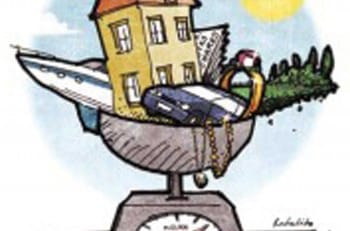
    Taxes can serve all sorts of positive policy goals including redistribution through a tax on property, which constitutes three quarters of private wealth. by Michael Smith   Learning to love property tax requires a perspective on the purposes and types, of taxation. The purposes of taxation include financing government spending; and promotion of greater equality, reduction in the use of harmful goods and the protection of local enterprise. There are three main types of tax: on incomes, on consumption and on wealth. Particular taxes include income taxes, PRSI, consumption taxes like VAT, capital gains taxes, capital acquisition taxes, wealth taxes, property taxes, water taxes, corporation taxes, transaction taxes like stamp duty, excise duties like tobacco taxes, and pollution taxes. In Ireland there has for long been an unimaginative over-emphasis on income and consumption taxes. For example, despite the on-going high levels of unemployment, income tax in 2012 made up 42% of the total tax yield compared with 27% in 2006 at the height of the boom. This creates a problem since high rates of income tax tend to impede job creation. As a result, Budget 2013 introduced base-broadening measures which are considered to be less damaging to economic recovery and job creation than income-tax increases. This magazine believes in government spending to promote high quality of life, in the promotion of radically greater equality and in the reduction of pollution, especially greenhouse gas emissions. Taxes to those ends must be supported and we should all have a vision of where the tax burden should fall. There should be a balance of all the forms of taxes cited above, with no tax overwhelmingly pre-eminent. Capital gains and acquisition taxes, wealth taxes and pollution taxes should be far more widely deployed in a society where equality and sustainability are driving goals. All the other taxes should play strengthened roles, perhaps especially – since the abolition of domestic rates, wealth taxes. Wealth is as sure, indeed surer, an indicator of riches, as income.  As such it should be taxed scrupulously. Perhaps the primary reason for not so doing has been the ease of collection of income tax – at least from PAYE taxpayers. A property tax is an, admittedly somewhat imperfect, surrogate for a wealth tax. The main strategy to reduce the pressure on income tax in Budget 2013 was the introduction of the Local Property Tax which is expected to yield €250 million in 2013 and €500 million from 2014 onwards. €250 million is the equivalent of just a 1% increase in the standard rate of income tax. There is clearly therefore scope for increase. So when people talk about taxing wealth in this country, they are talking principally about taxing the homes that we live in. According to economist, Ronan Lyons, “In Ireland, as of 2006, deposits made up 10% of Irish wealth, equities a further 8%. Pension and investment funds – wealth holdings of unknown type but likely to be a mix of mainly equities and bonds – made up a further 11% of wealth. But it was property that was the overwhelming type of wealth in Ireland, making up 72% of all wealth. The vast bulk of this was residential property. And that picture is not likely to have changed substantially with so much of Irish equity wealth being invested in the banks, which are now all next to worthless. So when people talk about taxing wealth in this country, they are talking principally about taxing the homes that we live in. In second place comes taxing the deposits we have in the bank. Make sure to mention this to the next person who says ‘We don’t need a property tax, we need a wealth tax’”. Lyons himself argues that a property tax should take the form of a ‘land value tax’ on the unimproved component of land – encouraging owners of land to optimise its use, since they are paying tax as if they have already done so. If such a tax is linked to proper zoning and planning it can be used to steer high-quality, well-planned development, so improving quality of life. Economists note too that such a tax does not deter production, distort market mechanisms or otherwise create deadweight losses the way other taxes do. This is presumably why a commitment to such a version of the property tax was in the coalition’s programme for government. Difficulty in explaining the concept ie feeble-mindedness led to its supersession. Property taxes, such as the one now being imposed, that include the value of buildings on land are less efficient, since they are, in effect, a tax on the (desirable) investment in that property. Even so, they are less likely to affect people’s behaviour than income or employment taxes.  Almost any tax is better than income tax since that taxes the ‘good’ of work, not some ‘bad’ like underuse of land or pollution. Economists like property taxes since, in an efficient capital market the burden of property taxes is borne by owners of capital across the economy; and since capital owners tend to be richer, the tax is likely to be progressive. Furthermore property taxes are a stable source of revenue in a globalised world where firms and skilled people can easily move. They are also less prone to cyclical swings. US state and local governments have seen smaller recent declines in property taxes than in other forms of revenue, largely because the valuations on which tax assessments are based were adjusted more slowly and less dramatically than actual prices. Property taxes may even restrain housing booms by rendering it more expensive to buy homes for speculative purposes. According to publicpolicy.ie’s Jessica Worth, the following are some of the advantages of the  Local Property Tax being imposed in Ireland: *    The economic impact is expected to be relatively small since a recurrent tax on residential property is deemed much less distortionary than a tax on income or capital. *    It is a reliable, sustainable source of revenue. Revenue

    Loading

    Read more