General

Random entry RSS

  • Posted in:

    The shooting of Marian Brown. A near 50-year cover-up is blown apart.

    By David Burke. Marian Brown, a 17-year old teenager, was shot dead in Belfast in June of 1972. For nearly half a century the British Government has denied that she was killed by British soldiers. Her family campaigned for the truth for five decades with the aid of researchers and lawyers. Armed with new information from the Historical Enquiries Team report into the case, Ó Muirigh Solicitors, who acted for the Brown family, petitioned the Attorney General for a new inquest in 2018. The petition was successful. After the inquest, Ó Muirigh Solicitors initiated civil proceedings against the British Ministry of Defence (MoD). Back in 2017, the Coroner’s Office had asked Ciaran MacAirt of Paper Trail to help target archival evidence. This he did and concluded that same year that Ms. Brown had been shot by British soldiers. Paper Trail did not publish its conclusions until this morning lest it interfere with the legal action against the MoD. The MoD has now settled the action with the victim’s family. The settlement vindicates the effort of all of those involved in this pursuit of justice. Significantly, the case highlights the injustice of Boris Johnson’s attempts to thwart similar cases through legislation. If Johnson succeeds, relatives of other victims will be denied justice and closure. MacAirt’s foray into Britain’s archives allowed him to conclude in 2017 “that British Army soldiers poured fire into the area” where Ms. Brown and three other teenagers had been shot. MacAirt’s also concluded that “either the British Army believed it was firing at gunmen … and the teenagers were in the line of fire; or the British Army patrols and sanger [fortification] were responding to each other’s firing and either shot the teenagers by mistake or targeted them deliberately”. Paper Trail also felt that the “British Army did not follow its own so-called Yellow Card Rules as the soldier(s) who fired the fatal shots had no clear target, no clear line of sight, and called no warnings”. A detailed article on the shooting can now be found on the Paper Trail website  at: https://www.papertrail.pro/the-killing-of-marian-brown/ The report brings to light one particularly distressing aspect of the tragedy: What makes the killing of Marian Brown more poignant is not only that the British armed forces covered up the circumstances of her death and that her family have fought for two generations for the truth, but also because Marian’s family did not know that she was pregnant at the time. Her family only discovered that she was carrying a baby when they were both killed when the Historical Enquiries Team (HET) reviewed her post-mortem files 40 years later. In a heart-breaking interview with Maurice Fitzmaurice in the Mirror, Marian’s brother, Richard, said: “It’s two people I lost that day… Our mother passed away and she never knew about the grandchild she never had.”  

    Loading

    Read more

  • Posted in:

    Come out of there, Katherine Zappone.

    Freedom of Expression had a lucky escape. By Vanessa Foran. Katherine Zappone, once upon a time, was packaged as a hero to liberals, a wrapper she was very eager to envelop herself in as she set out to make such a name for herself that she hoovered in a Taoiseach’s pick for the Seanad.  There she railed and railed against cronyism. That is what we all saw and heard. It is extraordinary how this one-time beacon of transparency has run to ground after a scandal. Yet this piece is not about her own hypocritical and absenteeist cronyism but about her more general competence, and fitness for office. As a professional politician her electoral record was poor to start with.  Her first attempt in 2016 managed 6.6% and benefited enormously from transfers, yet it took a full recount to get her into the final Dáil seat in Dublin South West.  By 2020, her first preference dropped to 5.5% and transfers were not so generous, and she was out. While she was appointed a Minister on her first Dáil term on her first attempt, within barely three years of her Constituency office opening its doors, the voters of Dublin South West did not re-elect its only Minister.  Shortly after her election in 2016, the now Minister for Children and Youth Affairs, was enmired  in controversy when she claimed excessive expenses for mileage.   The Sunday Times reported that she stood to earn €80,000 over the following five years from these expenses as she stated she lived more than 25 km from Leinster House. The paper, however, reported that AA’s Route Planner put the distance at less than 22 km. During her time in the Seanad, Zappone was paid expenses on that same basis; that she lived farther than 25 km from Leinster House  No matter where a voter is on the political spectrum, politicians overstepping on expenses is a spot all voters share agreement on.   Katherine Zappone’s performance as Minister for Children and Youth Affairs was abysmal, and the Fine Gael leadership had the best view of it. So why were Fine Gael’s elite in the vanguard of her over-promotion to a position as Special Envoy with an emphasis on Freedom of Expression and LGBTQ+ rights? Katherine Zappone’s performance as Minister for Children and Youth Affairs was abysmal, and the Fine Gael leadership had the best view of it. So why were Fine Gael’s elite in the vanguard of her over-promotion to a position as Special Envoy with an emphasis on Freedom of Expression and LGBTQ+ rights? From the moment she accepted the seal of office, she routinely delayed the Commission Report into the Mother and Baby Homes, and tormented the survivors every step of the way; and she did it as if it was a condition of the appointment to office.   Even as an Independent TD and Minister she carried on with the agreed protocol developed by the Department of the Taoiseach from Enda Kenny’s era, with assistance from the Religious Orders of course.  A policy that still exists with Minister Roderic O’Gorman.  But that is not the story we are writing about; for now. While Katherine Zappone was their Minister, she patronised the Mother and Baby Home survivors with insincere compassion – the very worst kind of politicking – with her opportunistic photobombing and staged nodding at the horrors being unearthed at each burial, or dump-site if you like, that unfolded during her short term.  She portrayed herself as the Survivors’ Champion, a woman of compassion, decency and integrity to the many survivor groups, their families and supporters, yet she was everything but.   Just on this element of her Ministerial portfolio alone, we should be allowed say this without contradiction; Irish Liberals should choose their Heroes more carefully. She also got into hot water for meeting Garda whistleblower Maurice McCabe privately in 2017  when Tusla – the child protection agency which functioned under her Departmental aegis – had kept a false allegation of sexual impropriety against McCabe on file for nearly two years after it had been debunked. This prevented other Cabinet members, such as the Minister for Justice, following up on the scandal. ‘Enda the Road: Nine Days that Toppled a Taoiseach’ by journalist and broadcaster Gavan Reilly, reveals how behind the scenes, Taoiseach Enda Kenny’s Department sought to stop a statement being issued by Zappone’s Department on what was known about a Tusla file relating to McCabe: “Kenny’s team were profoundly displeased that Zappone’s handlers issued the statement without their full agreement”. Reilly claimed that after a car-crash  interview where he falsely recalled with specific detail how he had spoken to Zappone before her meeting with the McCabes, Kenny’s trustworthiness took a hit from which he never recovered”.  Even on a day-to-day, operational level, the Minister for Children and Youth Affairs Katherine Zappone was publicly criticised in a report card derived directedly from the Dáil Public Accounts Committee, making it absolutely fair to say the current Cabinet also has a good idea of Katherine Zappone’s work ethic and performance as a Minister with a specifically prescribed and well-funded portfolio. In the closing season as her only term as a TD and Minister, her use or lack of, the resources in her hands were officially declared “unacceptable”.  Year 2019 ended with Katherine Zappone leaving €58.7 million that taxpayers gave her for vulnerable children and young adults, unspent.   She returned €58.7 million to the Exchequer to fund other stuff, like the ‘disappointment money’ suddenly required by Paschal Donohue and Michael McGrath, Ministers for Finance and Public Expenditure respectively, for the many TDs who weren’t returned to the Dáil just a month later.  In fact, she was one of them herself. Not putting her Department’s full allocation from Budget 2019 to work, conduced to around 6,000 children still being without a Social Worker by the time Katherine Zappone put herself in front of the voters of Dublin South West a second time.   The Cabinet  knew what they were doing since her handling of creches and childcare services during the first lockdown as an acting Minister was inept, and nothing else. Late March and

    Loading

    Read more

  • Posted in:

    THE LEGACY OF THE CONFLICT: MR LEWIS’S MODEST PROPOSAL

    Christopher Stanley, Litigation Consultant, KRW LAW LLP, Belfast[1] In 1729, Jonathan Swift published his Juvenalian satirical essay “A Modest Proposal For preventing the Children of Poor People From being a Burthen to Their Parents or Country, and for making them Beneficial to the Publick”. As readers of Village know Swift’s essay suggests that the impoverished Irish might ease their economic troubles by selling their children as food to rich gentlemen and ladies.  Swift’s essay created a backlash within the community after its publication. [i] On 14 July 2021 Her Majesty’s Secretary of State for Northern Ireland, the Right Honourable Brandon Lewis MP (a lawyer by trade), made a statement in the House of Commons and his office published a Modest Proposal: “Addressing the Legacy of Northern Ireland’s Past” (CP498). It  is fair to say that Mr Lewis’s Modest Proposal created a backlash within the community after its publication. [ii] This most recent British government proposal to address the out-workings of the Legacy of the Conflict in Northern Ireland (Dealing with the Past) adds only a little flesh to the bones of Mr Lewis’s plans published at the start of pandemic lockdown in 2020. This was by way of a Press Release “UK Government sets out way forward on the legacy of the past in Northern Ireland” (18 March 2020). That statement marked a dramatic change of tack from the “New Decade, New Approach” (January 2020) of the Right Honourable Julian Smith CBE MP, Secretary of State for Northern Ireland, and Simon Coveney TD, Tánaiste and Minister for Foreign Affairs and Trade, published to restore devolved government in Northern Ireland. The British government agreed that: “16. As part of the Government’s wider legislative agenda, the Government will, within 100 days, publish and introduce legislation in the UK Parliament to implement the Stormont House Agreement, to address Northern Ireland legacy issues. The Government will now start an intensive process with the Northern Ireland parties, and the Irish Government as appropriate, to maintain a broad-based consensus on these issues, recognising that any such UK Parliament legislation should have the consent of the NI Assembly” (page 49) The Irish government made the following commitment: “The Government affirms its commitment to working with the UK Government to support the establishment of the Stormont House Agreement legacy institutions as a matter of urgency, including by introducing necessary implementing legislation in the Oireachtas, to deal with the legacy of the Troubles and support reconciliation, meeting the legitimate needs and expectations of victims and survivors” In under one hundred days Mr Lewis, on behalf of his government, had torn up the “New Decade, New Approach” joint cross-border agreement and in the process abandoned the hard fought for Stormont House Agreement 2014. The Right Honourable Julian Smith CBE MP became, like Syme, in George Orwell’s 1984, an unperson. His fate to be shared, if the Modest Proposal comes to pass, by all relatives of victims and survivors of the Conflict in Northern Ireland [iii] The 18 March 2020 Press Release stated that the UK Government “will now begin an intensive period of engagement with the Northern Ireland political parties, and the Irish government, to discuss these proposals in detail.” It did not. What it did do were behind closed-door briefings, no public consultation, and controversial secret meetings at Lambeth Palace with a select few specially chosen to attend. There is no public record. The restrictions of the lockdown provided perfect cover to ferment policy in private within the deserted village of Whitehall and Westminster. The 18 March 2020  Press Release was both blunt and absent in detail and clearly had an audience in mind: the Tory backbench and those Shire and Red Wall Conservatives who would probably have agreed with Tom Denning’s own Modest proposal in his assessment of The Birmingham Six. “We shouldn’t have had all these campaigns to get them released if they’d been hanged. They’d have been forgotten and the whole community would have been satisfied.” Mr Lewis proposed: A new independent body focused on providing information to families and swift examinations of all unresolved deaths from the Troubles End to the cycle of reinvestigations that has failed victims and veterans for too long Ensuring that Northern Ireland veterans receive equal treatment to their counterparts who served overseas. The focus on veterans signalled a dismantling of the ‘no hierarchy of victims’ as both a political, moral and legal principle (as defined in statute by way of the Victims and Survivors (Northern Ireland) Order 2006 section 3). The focus on veterans  also  opened the way to the contentious issue of a statute of limitation and an amnesty. “We owe a huge debt of gratitude to our Armed Forces for their service in Northern Ireland. That’s why these proposals also put an end to repeated reinvestigations where there is no new compelling evidence and deliver on our promise to protect veterans from vexatious claims.” As was asked at the time of the Press Release: An amnesty for who? Soldiers and ‘Terrorists’ Who are the veterans? Soldiers and other members of the British security forces – spies, agents and informers (from all paramilitary groups). (What vexatious claims?) [iv] The publication of Modest Proposal adds, as I noted, only a little flesh to the bones of the press release but is in the spirit of Swift’s Juvenalian satire in its draconian intent to offer a complete, or final, solution, to the Legacy of the Conflict. “Addressing the Legacy of Northern Ireland’s Past” is an apparently impressive 32-page document. But there is a lot of white space (listen to the void of the white noise) and the type face is large. Of the 32-pages the modest proposal is modestly set out in 24 pages, which is one page longer that the 23 years since the Belfast-Good Friday Agreement 1998. On page two of his Foreword, Mr Lewis calms the Tory back bench and his Cabinet colleagues: “The current system for addressing the events of that dark and difficult period of our national

    Loading

    Read more

  • Posted in:

    Fianna Failing

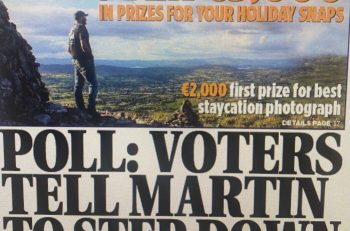
    Only 25% think the Fianna Fáil Taoiseach, Mr Martin, is the most influential politician in government. By Conor Lenihan. The latest opinion poll, this time from the Irish Mail on Sunday, posits more bad news for Fianna Fáil and its somewhat beleaguered leader Micheál Martin. Fianna Fáil’s opinion-poll rating continues to languish around the 15% level while their colleagues in government, Fine Gael, remain in robust polling health at 24% support. In contrast to Fianna Fáil, Sinn Féin are reaping a rich harvest of support placing them well on course to be the largest party in Ireland after the next general election. In political circles it is now taken as inevitable that Sinn Féin will be in government soon. The fate awaiting Fianna Fáil, as distinct from Fine Gael, is an inevitable further drubbing at the polls and possible total extinction. The strength of a party’s leader’s ratings tends to bid up the overall party rating in an election. Equally if the leader is lagging the party level of support this tends to bring the overall support for the party down on polling day. In its latest poll the Mail on Sunday threw in two extra questions that are not usually asked. One on whom those polled felt was most influencing the direction of government policy: Leo Varadkar emerged as the winner with a score of 54%. This is remarkable because the Taoiseach Micheál Martin only chalked up 25% –  embarrassingly adrift of Varadkar. This will only add to the perception that Varadkar and Fine Gael are running  rings around Fianna Fáil in government. The fact that Martin and his ministers rushed to defend Varadkar over Fine Gael blunders with the Zappone appointment has added to the unease in Fianna Fáil. To add to Martin’s woes the same poll showed a majority favoured him stepping down as Fianna Fáil leader when he ceased to be Taoiseach. The challenge for Martin’s parliamentary colleagues is whether they should seek to remove  Martin now or wait until Leo Varadkar comes back in as Taouseach. There are at least 14 of his parliamentary party whio who are prepared to move on Martin. Only five more TDs would be enough to shift him. Others within his ministerial ranks must be getting nervous; or now reckon that they might secure promotion if there was a quick change of leadership. The same thinking must surely apply to those who feel aggrieved at being excluded from the Martin ministerial line-up. Fianna Fáil party inquests into both the 2020 general election and the disastrous showing in the Dublin Bay South by-election are due soon. The discussions around these should crystallise sentiment on the leadership issue. Potential contenders for Martin’s position within the current cabinet must be considering whether their chances are endangered if they continue with him in charge as they may become damaged by association. For the supporters of non-cabinet contender Jim O’Callaghan there must now be an imperative to stage a contest even if it is only to make a point. O’Callaghan has been urging caution on his supporters in a bid not to alienate support from as yet “undecided” or wavering deputies. This is fast becoming a perilous balancing act on his part. Efforts  to sign a leadership-heave letter, led by Marc MacSharry, seem to have foundered in the run into the summer. There is such a disparity now between the views of members of the parliamentary party and those who hold appointed government office that it has become volatile. There is a new and fractious energy as we emerge from the worst of Covid into a likely autumn and winter of discontent. The prize for some of those who wish to replace Martin is the possibility of holding the office of Taoiseach before it is handed back to Varadkar at the end of next year. Conor Lenihan is a former Minister for Science, Technology & Innovation. He served as Fianna Fáil deputy for Dublin South West for 14 years.   

    Loading

    Read more

  • Posted in:

    Another bloody mess. Frank Kitson’s contribution to the wars in Afghanistan and Iraq. 300,000 have died in Afghanistan since 1979.

    By David Burke. 1. The counter-insurgency gurus. During the period 1970-72 Brigadier (later General Sir) Frank Kitson served as Brigadier of 39 Brigade in Belfast. It is arguable that he caused more damage to relations between the British government and the Nationalist community than any other individual in the British Army. There are many stories about Kitson on this website, and readers are invited to visit them. Despite the hornets’ nest he kicked over in Ireland, Kitson rose up the ranks of the British Army and was hailed as a counterinsurgency expert around the globe. He even served as Queen Elizabeth’s aide de camp. Unfortunately, Kitson did not learn much from his mistakes in Ireland. Nor did the American counterinsurgency specialist, General David Petraeus. The latter served as commander of the United States Central Command and Coalition Forces in Iraq and Afghanistan. Petraeus viewed Kitson as some sort of guru. In 2006 when Petraeus was planning the so-called military  ‘surge’ in Iraq, he visited Kitson for guidance and advice. Kitson was in retirement at the time but was happy to share his views with the American. The ‘surge’ involved an increase in the number of American troops to provide security to Baghdad and Al Anbar Governorate. It served as the template for the 2009 ‘surge’ of 30,000 troops in Afghanistan which was meant to stabilise the country and defeat the Taliban. 2. Petraeus supports Kitson in his defence of Mary Heenan’s action against him. On 27 April 2015, Kitson was cited as a co-defendant along with the British Ministry of Defence in an action taken by Mary Heenan. She is the widow of Eugene ‘Paddy’ Heenan. Her husband was murdered by Albert ‘Ginger’ Baker’s UDA gang. Baker was commanded by Tommy Herron, a senior UDA figure. Herron oversaw UDA assassination teams in the early 1970s. Herron and Baker were allies of British military intelligence. Herron entered into his alliance with British army counter-insurgents during Kitson’s tour of duty in Belfast. It is to be hoped that more details will emerge during the forthcoming trial. Baker did not join the UDA until sometime in the second half of 1972, by which time Kitson had left Northern Ireland. What is crucial, however, is that Baker was put in contact with British military intelligence by Herron. Baker is still alive. Although Baker has said little in recent decades, back in the 1980s he spoke at length about his connections to British military intelligence and explained how the UDA conducted operations with guns supplied by the RUC. Petraeus undoubtedly kept in contact with his hero during the rest of his military career. He was appointed as Director of the CIA by President Barack Obama and served in that role between 2011 and 2012. At the very least, Petraeus monitored how his British hero was faring. In November 2019, he came out in defence of Kitson by attacking the type of legal action Heenan had initiated. Petraeus did so in the forward to a paper he wrote, ‘Lawfare – the Judicialisation of War’. He argued that this development was “as much of a threat to Britain’s fighting capacity as would be a failure to meet NATO budgetary targets, and it risks putting the special relationship under increasing strain … The extent to which those who served decades ago in Northern Ireland, including the highly distinguished soldier-scholar General Sir Frank Kitson, remain exposed to legal risk is striking and appalling”. Mary Heenan’s action against Kitson and the Ministry of Defence has not yet received a trial date. No doubt every trick will be used to delay it as long as possible. Kitson is participating in the defence of the action. It is important to note that it is a civil action, not a state prosecution and Mary Heenan is in control of whether or not it will proceed. If it is not derailed by Northern Ireland Office and MoD dirty tricks, the Heenan prosecution could prove to be one of the most important legal actions to arise out of the Troubles. If it is not derailed by Northern Ireland Office and MoD dirty tricks, the Heenan prosecution could prove one of the most important legal actions to arise out of the Troubles. One person who will await the trial with concern for the ‘highly distinguished soldier-scholar’ Frank Kitson is his great admirer, David Petraeus. 3.The Man who boasted about starting the war against the Soviets in Afghanistan in July of 1978. 300,000 have died since then.   The tragedy in Afghanistan was started in July of 1978 by American intelligence dirty tricks. Zbigniew Brzezinski, the US National Security adviser to President Jimmy Carter, admitted during an interview that he instigated the turmoil. He confessed this to a French reporter – on the record. The Americans, he boasted, were plotting against Afghanistan even before the country was invaded by the Soviets. See Obit(ch)uary: Zbigniew Brzezinski It is inconceivable that Brzezinski and his subordinates did not consult the British about their intentions in 1978. The Americans held their British partners in very high esteem in those days. The role of MI6 (Britain’s overseas intelligence service) and the British Army’s special forces in the plotting against Afghanistan before the Soviet invasion in 1979, has yet to emerge. All told about 212,000 people died during the Afghanistan war waged by the US, UK and their allies. At least 70,000 died during the earlier conflict involving the Soviets. The real overall figure probably exceeds 300,000. Many more were maimed and injured.

    Loading

    Read more

  • Posted in:

    EXCLUSIVE. 22 years of lies and cover-ups by Ireland’s leaders.

    Taoiseach, Tánaiste, multiple Ministers, civil service, Garda, official inquiries and EU complicit in wrecking the life of one of Ireland’s leading business representatives. How a former CEO of ISME has been shafted by the State because of two key sensitivities in Irish politics: the relationship between the Social Partners (unions and employers) and government, of which he was critical; and the relationship between the EU and the government. In July’s Village magazine Frank Mulcahy detailed the malevolent and spurious accusations of criminal fraud levelled against him in 1999, about which he has now lodged a criminal complaint. This is an updated online account of his experiences over the last two decades including his response to the Tánaiste’s latest reply of 29 July 2021 in which Micheál Martin passed the buck to his civil servants. By Frank Mulcahy How I got dragged into this mess During the currency crisis in 1993 Bertie Ahern broke protocol. To my utter amazement, he instructed me as the then Director of the Small Firms Association (SFA), to reveal to the waiting press that he was making available £50 million for troubled businesses. Perhaps he had his own reasons. Nevertheless, overnight I became a mini celebrity in the small business community. I used that status to criticise various powerful sectoral institutions, most notably the associated banks. When two years later IBEC acted on these sectoral written demands that I be silenced – under threat by the four associated banks that they would stop funding the big business organisation, I had gained sufficient authority and support to successfully launch the Irish Small and Medium Enterprise Association (ISME). As the Executive Director of ISME I expressed the growing frustration among our members with the direction of social partnership and the failure, as the members perceived it, of big business-representative bodies to articulate the damage that the was doing to small businesses. ISME developed a distinctive media profile focusing on a critical approach that was distinctly at odds with the then-prevailing consensus. We were, I thought, the Robin Hood of lobby groups – principled, provocative and persistent. Unique Status That gave ISME a unique status among business groups, and a disproportionate media profile greatly envied by others clamouring for column inches. I became a thorn in the side of the civil service, big business, the banks and the unions. Contrary to all predictions, within a short period ISME had established itself as a financial and political success. Within a short few years we had purchased and paid for a four-storey office building on Kildare St on the back of funding that eluded most equivalent representative bodies. I had part-funded that purchase by not drawing any salary in the first year. In the subsequent years I had accepted a salary, half what I had enjoyed in IBEC, on the basis that my losses would eventually be made good. I was somewhat surprised when in 1997, after a mere four years, both Michael McDowell and Liz O’Donnell, protagonists in the pro-market Progressive Democrats, informed me that they regarded ISME as the genuine voice of business, an opinion that Tánaiste Mary Harney had, they said, mirrored to the CEO of IBEC. Many years later, several retired civil servants confirmed that that was the political stance, adding that they had vigorously disagreed with the Tánaiste’s position. It was an unusual fracture between government and civil service, that was to play out as tragedy, for me. The following year, at the ISME AGM in March 1998, Geraldine Harney, the then-Tánaiste’s sister, a well-known business journalist, took me to one side; she then cautioned that I was going to be removed by the three of my fellow directors with whom I had established ISME – close drinking friends! Naturally I dismissed the suggestion as preposterous. It made no sense. ISME was to be given co-equal status with IBEC in the partnership process. ISME was to be given co-equal status with IBEC in the partnership process. However, as my role in that offer was unacceptable to my former employers IBEC, to the banks and the civil servants, all of whom had been the focused target of my trenchant criticisms, I was to be sacrificed. I had no idea of these behind the scene developments when suddenly in September 1998 the ISME Chairman Seamus Butler offered £100,000 to have me voluntarily depart. His inducement was accompanied by several faxed threats from ISME directors Hynes and Faulkner, including of a “hatchet job” and the faxed reminders that “nobody has implied anything Yet, other than poor controls…” and “you know how I like to win”. The sinister threat, Hynes’ fax “No one has implied anything Yet….“ “I am answerable to nobody” – Seamus Butler. The ISME Chairman who offered the £100,000 inducement. As we shall see in Part 3, many years later he sought to deny the inducement, emailing: “what part of fuck off dont you understand“. When I spurned his financial inducement, the campaign of vilification in private and in the national media kicked off, leading to my eventual dismissal in May 1999. That dismissal came on foot of a complaint to the Garda in which Seamus Butler complained that I had defrauded the EU in 1997 in the drawing down of grants from the Department of Enterprise, Trade and Employment. The allegation was based solely on the claim that ISME had infringed the EU’s administrative rules by submitting invoices to claim reimbursement in advance of the invoices being paid. Note, I was not accused of having benefited in any way from the alleged infringement of EU rules. Twelve years later it would emerge that the Department perpetrated the infringement and I was the fall guy! However, what was not known to those outside the privileged bureaucratic bubble was that the grant rules had been significantly changed two months after ISME’s application for payment had been submitted in September 1997. Those new audit rules were set out in EU Regulation 2064/97. Proof that the State lied from the outset. In Part 2 of this article I will outline in some detail how and why the highest officials in the land got personally ensnared in a dog fight with the EU Commission. How, from self interest, I was collateral damage, easily surrendered along with the integrity of the Dáil, several ministers for Enterprise including Micheál Martin and the former Taoiseach Bertie Ahern, among other prominent politicians Complaint made by Butler to fraud squad Some history is here warranted. At 3 pm on 5 March 1999 I was informed by the prominent journalist, David Murphy, of  Butler’s complaint to the Fraud Squad. I was temporarily stunned, since I had no prior knowledge and had neither been advised nor questioned by the ISME chairman or indeed anybody before he complained to the Garda that I had defrauded the EU. Given that Butler had been party to the earlier faxed threats of a hatchet job and of using poor controls to allege fraud, I assumed that the Garda would see the complaint for what it was. In addition, since the Department had effectively prepared ISME’s payment application, I expected that the truth would out itself in due course. How could it not? Yet, to my utter consternation and continuing disbelief a file was somehow sent by the Garda to the DPP. As a consequence of that report, before the DPP had adjudicated, I was dismissed, rendered unemployable and have now been deprived of my good name for more than two decades. As I write, it remains the public position of the Department of Enterprise and the Garda authorities that Butler’s original complaint to the Garda was justified. Exhausted and befuddled after two years of public hostilities, in 2000 I set about establishing the facts. It took me several years before I began to suspect that the State might be engaged in subterfuge and several more years before I knew that the State was so involved, but the question always remained – why? Between 1999 and 2004, my 50 or so Freedom of Information (FOI) requests served only to support the State’s ostensible complete good faith when it maintained that the allegation

    Loading

    Read more

  • Posted in:

    Bridal Shower

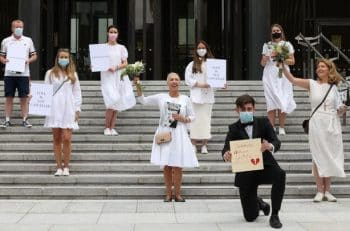
    A recent protest, perhaps the world’s smallest that was improperly touted by the media as spontaneous, featured more wedding organisers than brides By Jed Lonstein Recently a story appeared in all the major media outlets in Ireland. It was a protest without precedent. There were no marker-scrawled placards or grim-faced anoraks, no barriers or batons. Five beauteous brides, a joy in white, one clutching a bouquet, assembled like a troupe of ballet dancers smiling and simpering for the assembled photographers and press corps which vastly outnumbered the betrothed belligerents who in the end added two lads to make up the numbers. They demanded to be heard. Their demands were simple and atavistic: the right to a big wedding with all their friends and family. Within hours news reached the government and – fearful of the rising public, emerging from its collective cabin-fever – the government relented and granted their agenda of innocence. It was a story of triumph over tyranny, five strong women who weren’t going to take it any more. But, like so many Irish marriages, it had a dark side. For it was also a tale of innocence exploited. Although most of the articles pointed out who the ‘protest’ was organised by –  WIPA The Wedding International Professionals Association, they all referred to the lobbyists as brides-to-be and even – amusingly perhaps – bridezillas. However, with chapters from Atlanta, to New York, from Chicago via Las Vegas to Seattle; and in Ireland, the protest was the opposite of a grassroots eruption.  None of this is new. In late December 2019, The Business Post’s Aaron Rogan ran a story on attempts to reform Ireland’s gambling laws. People were terrified that their winnings would be cut by up to 50%.  However little was made of the fact that winnings of €5000 or less would remain untouched. Cue busloads of senior citizens marching on Leinster House with placards declaring, ‘Hands Off Our Balls’. Led by Jack Potts, a seven-foot cat-in-a-hat and mascot for his company which operates four bingo halls in Dublin alone, they were joined by Michael Healy Rae and, within days, the government had backed down. What appeared to be an organic response was in fact organised by the PR guru, Paul Allen. The  wedding ‘protest’, possibly the smallest demo ever staged in Ireland (picture, say, the intensity of a Renua rally), included Brianna Cullen, Orla O’Huadaigh, Orla Hogan, Ali O’Mara  and Anna Killen. Brianna Cullen is a wedding planner working for Tara Fay who organised the event and is the founding member and president of WIPA Ireland. Fay features in Harpers’ Bazaar USA as one of the top wedding planners in the world. Orla O’Huadhaigh lists herself as a ‘Talent Acquisition Partner’ at ActiveCampaign, a corporate marketing company.  Orla Hogan is a wedding planner – her Linkedin describes her as a final-year student seeking experience in event management. In her own words she has shadowed a wedding planner over the past year. Ali O’Mara may be an actual protestor and for that reason I will not expound on her further. The story originally appeared on evoke.ie, which has featured some of the participants before and would be well aware of their identities, though it found no reason to point this out. Pictured in the Irish Examiner is a photo-shoot of Tony Barry – down on one knee before Anna Killen. Tony is a self-professed out-of-work waiter, but as The Times points out, he is the son of Claire Henley who used to cater for high-end weddings, pre-pandemic. Elsewhere, in the Mirror, a Paudie Herlihy is quoted as showing his support for the cause as his keenly bridal daughter is currently still thwarted due to the restrictions. As a father myself, I felt for him, but was also uneasy about his wedding DVD production which he less endearingly chose not to disclose. Perhaps this simply does not matter. These are mostly people whose livelihoods have been affected by the lockdown and why shouldn’t they protest?  To me, it’s a case of marketing and self-promotion masquerading as genuine and valid protest. Had they been clear about who they were and what their motives were it would have represented a certain tawdry integrity. But no.  This event was utterly fake. What makes it infuriating is that every national publication along with thejournal.ie and  joe.ie either didn’t care who the organisations involved were or were simply complicit.  It’s the silly season and, on a sunny day in Dublin five women photographed by  the glossiest of photographers, in snow-white regalia, bouquets in hand and accompanied by tuxedoed gentlemen of endless cheer was just too good to ignore.  However, in the era of fake news where people take their vaccine advice from random strangers who shout the loudest, I feel this is precisely the time for real journalism to differentiate itself  in stark contrast – by boosting verifiable sources and diligent background investigation.   After all scruple  is the only advantage they have over thirty-character tweets, tin-foil facebook pages and blind, tribal charlatanism.  Mainstream media is brawling for its life right now and when its credibility comes into question it loses a perceived unique selling point of long standing, and – worse – opens the door to the manipulations of the cynics and liars without.

    Loading

    Read more