Latest

Random entry RSS

  • Posted in:

    International juristry meets Nespresso ads.

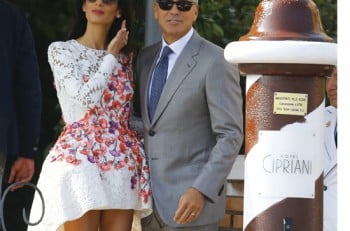
    By Ken Phelan. Amal Alamuddin-Clooney: by night wife of heartthrob espresso addict George Clooney, by day eminent barrister specialising in international law and human rights, is finding that with the tinsel comes an edge. She has experienced several descents from the rarefied elevation of the international bar, as not just her wardrobe but her politics and that of her debonair husband – whose mother famously acknowledged that he had found in her “an intellectual  equal” (for the first time), are scrutinised, and even ridiculed. At the Oscars Tina Fey in sub-Ricky Gervais mode declared as the camera bore down on the perfect couple: “Amal is a human rights lawyer who worked on the Enron case, was an adviser to Kofi Annan regarding Syria, and was selected for a three-person commission investigating rules of war violations in the Gaza Strip”. She went on: “So tonight, her husband is getting a lifetime achievement award”. Cue laughter and applause on the night. Less edifying was a follow-up article in the New York Post by Andrea Peyser, a conservative columnist who once described Christiane Amanpour as “CNN’s war slut”, in a column headed, ‘George Clooney has a Problem – and it’s Amal’. After barbs about her “bovine-insemination gloves”, Peyser got serious: “Fey’s assertion that the woman who married George Clooney, 53, in September had been selected to serve on a commission investigating war crimes in Gaza, allegedly committed by Israeli forces, caused me to gasp. Didn’t she refuse the assignment?”. Peyser determined to make life difficult for the delightful jurist: “Fey’s publicist told me that the comedian was just making a joke at George Clooney’s expense, but would not say why Fey chose to go there. A rep for Poehler did not respond to my email, and George Clooney’s publicist said he passed my questions on to the missus, who did not get back to me. Here is the story: the UN Human Rights Council announced in August that the then-Ms. Alamuddin, engaged to Clooney at the time, would serve on a panel, one that Israeli leaders have likened to a ‘witch hunt’ whose members are bent on penalizing Israel for acting in self-defense against Palestinian rocket attacks”. Peyser noted that Alamuddin tellingly declared she would skip serving on the panel because she was too busy with eight legal cases. But snorted that “she released a statement that revealed her antipathy toward the Jewish state: ‘I am horrified by the situation in the occupied Gaza Strip, particularly the civilian casualties that have been caused, and strongly believe that there should be an independent investigation and accountability for crimes that have been committed’, it read”. Peyser concluded: “I believe that her refusal to join the anti-Israel commission was an effort not to antagonize her then-fiancé’s Hollywood colleagues, many of whom are pro-Israel and/or Jewish”. Alamuddin-Clooney’s roving brief to get the Elgin marbles back from avaricious colonialists in the British Museum for Greece has also attracted derision. Writing in the Daily Telegraph last year under the headline ‘Amal Clooney should back off. Lord Elgin was a hero who saved the marbles for the world’, Dominic Selwood linked Clooney’s “kooky PR stunt” to his love interest and was unimpressed. Clooney had claimed “they came from the Pantheon in Rome rather than the Parthenon in Athens (and also that they had been taken by Lord ‘Eljin’)”. Never before has anyone laughed at George Clooney, except Brad Pitt, and maybe the couple in the Nespresso ad – and that was just joshing. Alamuddin-Clooney – who has represented clients at the International Criminal Court (ICC) and has had clients including Julian Assange and former prime minister of Ukraine, Yulia Tymoshenko, recently endured another controversy over an interview she gave the Guardian about her client, jailed Al-Jazeera journalist Mohamad Fahmy. During the course of this interview, and following an appeal hearing in January at which the three journalists were told they faced a retrial, Alamuddin-Clooney spoke of a report she had submitted in February 2014 to the Egyptian government on behalf of the International Bar Association’s Human Rights Institute (IBA). It detailed a litany of abuses and inadequacies of the Egyptian judicial system which she believed contributed to the imprisonment of her client and the two other al-Jazeera journalists. Fahmy, a Canadian national and fellow Al-Jazeera journalists Baher Mohamed and Peter Greste have been imprisoned since December 2013 on charges of abetting terrorists, spreading false news and endangering national security. They were also charged with involvement with the recently organisation the Muslim Brotherhood, now proscribed as terrorist. The three were initially sentenced to between seven and ten years in prison last June by controversial Egyptian judge Mohamed Nagy Shehata who subsequently notoriously sentenced 188 people to death in one mass trial. The IBA report chronicled the failings of the Egyptian courts under the three regimes following the overthrow of President Hosni Mubarak in February 2011, and claimed that the judiciary was not quite as independent as it should be. The report also detailed how the judiciary had been used for “arbitrary political ends”, had jailed people on “vague charges of conspiracy” and for “insulting the military”, “insulting the president”, or “insulting Islam”. Speaking of the continuing practice of Egyptian officials hand-picking judges, Alamuddin-Clooney said: “That recommendation wasn’t followed, and we’ve seen the results of that in this particular case where you had a hand-picked panel led by a judge who is known for dispensing brutal verdicts”. The current government, under General-turned-President Abdel Fattah al Sisi, failed to act on any of the 2014 report’s recommendations; under Sisi’s rule, persecution of the ‘politically suspect’ has in fact dramatically increased. Speaking to the Guardian on January 1, Alamuddin-Clooney said she was unable to publish the report in Cairo last year as: “first of all they stopped us from doing it in Cairo. They said: ‘Does the report criticise the army, the judiciary, or the government?’ We said: ‘Well, yes.’ They said: ‘Well then, you’re risking arrest’”. Following this interview, a story headlined:

    Loading

    Read more

  • Posted in:

    Agri-culture

    By John Gibbons and Paul Price. It is difficult to get a man to understand something when his salary depends upon his not understanding it”. Novelist Upton Sinclair’s famous observation could well have been describing Agriculture Minister, Simon Coveney, a rare ambitious and ascending star on an otherwise jaded Fine Gael front bench. Coveney’s understanding of the most basic of scientific facts will clearly not encumber his possible trajectory towards the goal of being Cork’s first Taoiseach since Jack Lynch. So, when Coveney appeared on a recent edition of RTÉ’s ‘PrimeTime’, only the thinnest of smiles betrayed the fact that he was selling a series of fat porkies on national television. Coveney’s claim that the Irish dairy herd could be expanded by over 300,000 cows in the next five years “while maintaining the existing carbon footprint of the agriculture sector” is, he must well know, nonsensical. To defend it, he engaged in some unconvincing waffle about higher yields per animal somehow magically offsetting the massive increase in our national herd. This manifest nonsense is blown out of the water by data from the Environmental Protection Agency, which show that methane (CH4) emissions from ‘enteric fermentation’ in Irish dairy cows actually increased, from 101kg per head per annum in 1990 to almost 113kg per head in 2012. Methane is a potent greenhouse gas, at least 28 times more powerful as a heat-trapping gas per molecule than CO2. The reason for the large increase in as few as 20 years? Almost certainly, it’s greater dairy intensification. So much for Coveney’s blarney about higher yields lowering emissions. This sleight of hand also conceals a much wider truth about the nature of greenhouse gas emissions. And that is, what goes up, for all intents and purposes, stays up. Each year’s emissions are yet another warming addition to the human-caused accumulation in Earth’s atmosphere. So, even levelling annual emissions adds to total emissions and climate risk. It is the sum of accumulated emissions to date, and the future emissions we choose to add to that absolute total that counts, not any efficiency measure such as emissions per animal or per kilogramme of milk or beef. The atmosphere does not care about ‘efficiency’ or ‘yield’ it just traps more heat as humans add to the sum total amount of resident greenhouse gases. This is important because anyone who tries to argue that improving efficiency somehow reduces emissions does not understand reality, or does not want us to. Simply put, any given global warming policy limit, such as the 2ºC Ireland has signed up to, has a related amount of remaining emissions that can ever be emitted. Taking from Ireland’s share of the global carbon budget is a zero-sum game: more, used now by us, simply means less for others, elsewhere or in the future. In opposition, Coveney had a clear grasp of the reality of climate change. Indeed, he spoke publicly that what he knew about the science of climate change “sent shivers down my spine”. But of course, Coveney was merely the Environment Spokesperson then, and free to speak truthfully since he had no actual political power. That was then. Since becoming Agriculture Minister, Coveney has quickly embraced the first rule of his office: keep the IFA off your back. And the IFA has applied its formidable muscle to vehemently opposing even the most modest steps towards addressing climate change. This is deeply ironic given that agriculture is, by definition, highly weather-dependent, and therefore uniquely exposed to the impacts of the very same climate change that farmers’ leaders are busy convincing themselves and us is ‘not our problem’. The IFA is following the same mad, tragic logic as the global fishing lobby which has stymied every effort at imposing science-based fisheries quotas and which, in its thirst for short-term gain, is systematically wiping out the very basis of their livelihood for the future. While Coveney is snared by his ambitions, and the IFA blindsided by its inability to think strategically, where are the expert advisors in all this? Teagasc is the semi-state body, 75% paid for by Irish and EU taxpayers, that supports science-based innovation in the agri-food sector. Is Teagasc’s definition of ‘carbon footprint’ the same as climate science’s ‘sum total’? No, it is not. Instead Teagasc repeatedly redefines carbon footprint as ‘production efficiency’ based on emissions per unit product. Nowhere is this clearer than in the 2011 publication ‘Irish Agriculture, Greenhouse Gas Emissions and Climate Change: Opportunities, Obstacles & Proposed Solutions’, in which Section 3.4   “From absolute emissions to emission intensities” spells out the codology: “Under Section 5(9) of the Climate Change Response Bill, sectoral plans must account for the need to (a) promote sustainable development, (b) safeguard economic development, (c) take advantage of economic opportunities within and outside the State and d) be based on scientific research. Under these criteria, Teagasc contends that an ‘absolute emissions’ metric is inappropriate for the agricultural sector”. The Earth’s climate system is entirely indifferent to economic imperatives. All that matters is physics. X amount of additional emissions begets Y increase in average surface temperatures. And known increases mean measurable, extremely dangerous and largely irreversible impacts on all life on Earth, be it human, dairy-cow or polar-bear. All that matters to the climate system is absolute emissions. For Teagasc, a body claiming to be science-driven, to describe this metric as “inappropriate for the agricultural sector” strongly suggests the organisation has undergone ‘agency capture’. Instead of being the arbiter of the best available scientific evidence, it sees itself as ‘pulling on the jersey’ for its many friends and colleagues in the agriculture sector, the people it works with every day, the people who it identifies with. If the facts about the impacts of climate change are inconvenient or likely to create tensions between Teagasc, the Minister and the IFA, well, let’s find some other, less unpalatable facts, dress them up with some scientific-looking charts (while burying the uglier realities deep in the bowels of their reports) and,

    Loading

    Read more

  • Posted in:

    Treating immigrants as we’d have our emigrants treated.

    By Edel McGinley. Enda Kenny wrote to President Obama in November to commend him on the “humanity and leadership” he had shown in his efforts to regularise undocumented migrants in the United States. The Taoiseach’s words demonstrate great empathy for the many undocumented Irish in the US and an understanding of the need for decisive, pragmatic and comprehensive action on this issue. His sincerity was so patently heartfelt it was almost as if he’d thought it through. The following day, Migrant Rights Centre Ireland (MRCI) released the results of a small survey, of 540 undocumented migrants in Ireland. Like the undocumented in the US, they are unable to travel back home for a father’s funeral or a daughter’s wedding. Like the undocumented in the US, they live in fear of contact with the authorities, afraid to report assaults or burglaries. Like the undocumented in the US, they work hard and provide essential services. The Taoiseach, who has such empathy for the undocumented, could change their lives in the morning. We estimate that there are up to 26,000 undocumented people in Ireland, including thousands of children. During the ‘boom’ years, people from all over the world responded to Ireland’s urgent need for labour. Our immigration system, constructed in a hurry and a mess of ad hoc and piecemeal policies, failed to keep up with the demand. According to our survey, 86.5% of undocumented migrants entered the State legally and subsequently became undocumented, falling through gaps in the system. Of the 540 people surveyed, 81% have lived in Ireland for over five years. One in five has been here for over 10 years. For these people, workers, children, families, Ireland is home. Abdullah is a statistical engineer, undocumented in Ireland since 2006. He runs a restaurant in Dublin, and pays tax. He speaks of feeling stuck, unable to move forward, and of the grief of missing his father’s funeral. The painful experience of watching a family funeral on Skype is now familiar to many undocumented migrants both in Ireland and the US. Contrary to the popular myth, undocumented migrants cannot claim social welfare in Ireland, or any benefits whatsoever. The survey revealed that 87% of the migrants are in paid employment. Over half of the remainder, which includes stay-at-home parents, have been out of work for less than six months. A third are current taxpayers. Over half have paid tax in Ireland at some stage, despite serious obstacles to doing so. The survey found that undocumented migrants in Ireland are concentrated in low-paid work. Undocumented workers cook and serve your meals, they mind your children, they care for older people. They clean homes, restaurants and offices across Ireland. This is a significant contribution in labour alone, but there is also consumer expenditure to consider. We estimate that undocumented migrants currently contribute €255 million a year in consumer spending. In return, Ireland’s politicians lobby for immigration reform in the US and celebrate Obama’s plans to regularise the undocumented, while essentially ignoring the thousands of undocumented men, women and children living here in Ireland. MRCI have worked with undocumented migrants since 2001. The findings of our survey are supported by an analysis of over 2,600 MRCI case files from the past five years. This is not a new problem, and it won’t go away on its own. However, there is a straightforward and sensible solution: a regularisation scheme. Such a scheme is far from unprecedented. Regularisation schemes have already been introduced in at least 17 other EU countries. Irish politicians have lobbied for a US scheme for years. Regularisations do not ‘reward illegality’, they are a common-sense response to an inescapable reality. If this issue is not addressed now, in ten years’ time we could be saying that one in five undocumented migrants has spent over twenty years in Ireland. The Government has a choice: it can act now, showing the humanity and leadership for which the Taoiseach praised President Obama, or it can wait, and knowingly allow thousands to live in fear, afraid to go to hospital, afraid to speak to a Garda, afraid to stand up to an exploitative employer, and afraid, in the case of undocumented children, to hope for any future in the only country they have ever called home. In the spirit of Christmas, let’s imagine a system where we treat our immigrants as we want to have our emigrants treated. • Edel McGinley is director of the Migrant Rights Centre Ireland

    Loading

    Read more

  • Posted in:

    Stereotypes underpin abuse.

    By Ivana Bacik. A poignant vigil was held outside Leinster House to mark the start of Women’s Aid’s ‘16 days of action against domestic violence’. The empty shoes of the 78 women murdered in Ireland by their partners or ex-partners since 1996, and the ten children murdered alongside their mothers, were lined up along Kildare Street. We stood silently alongside, to remember and commemorate the tragedies of those lost lives. The seriousness, frequency and pervasiveness of the violence labelled ‘domestic’ is often played down or denied. It is all too often explained away by external factors such as alcoholism or unemployment. It is often wrongly regarded as being particular to disadvantaged communities. It is sometimes portrayed as a reaction to provocation from the victim. Even where victims are not directly blamed for provoking the violence, they are often regarded as complicit in it because they stay with their abusers. Research has contradicted these problematic myths and shown that domestic violence is not a rare or isolated event within otherwise happy families. It has found that apparently ‘passive partners’, who stay with their abuser and endure violence against themselves and their children, may have undergone serious personality changes as a result of the abuse. Many may have nowhere else to go. An increasingly vocal group of activists has in recent years challenged the evidence that most domestic violence is carried out by men against women. Research has established that women make up the vast majority of victims of domestic abuse. The 2005 National Crime Council report, for instance, found that about one in seven women, compared to about one in 16 men, have experienced severely abusive behaviour of a physical, sexual or emotional nature from a partner at some point in their lives. The study found that women were nearly twice as likely as men to require medical treatment for their injuries and ten times more likely to require a hospital stay. The inadequacies of legal responses to domestic violence were highlighted by interviewees in this report and have been emphasised in other research. High attrition levels and low conviction rates back up these perceptions of legal inadequacy. A core problem with the criminal law is that few acts of domestic violence are isolated events. The criminal law is generally designed to deal with once-off incidents, and to attribute liability for those isolated events to particular offenders. It can be difficult to apply it in the context of an ongoing abusive relationship. It is actually difficult to ascertain how effective the criminal law is, given the well-established evidence that most domestic violence goes unreported. This year, during hearings into domestic and sexual violence conducted by the Oireachtas Justice and Equality Committee, we heard extensive evidence about these issues. In October, we published our report, recommending significant legal change, for example to provide for a specific criminal offence of ‘domestic violence’ or ‘domestic abuse’. Currently, abusers are prosecuted under assault laws, or for breaches of barring orders. We recommended the need for emergency barring orders, so that the abuser and not the injured party should be required to leave the family home. We called for the establishment of a ‘domestic violence register’ to catalogue details of convicted abusers. Comprehensive review of the law on domestic violence is long promised. We are hopeful that our recommendations will feed into codifying legislation that we anticipate will be brought forward in 2015. Susan Edwards, a leading researcher in domestic violence law in Britain, wrote nearly 20 years ago that: “Domestic violence until the 1970s was regarded as a rare phenomenon. Criminal law was rarely, if ever, invoked to prosecute aggressors. A far wider range of remedies is now available. But stereotypical attitudes and expectations of woman and men persist, these inform the law and militate against the justice and protection victims receive. The law, whilst it makes claims to offer remedies and protection to victims, is replete with obstacles and difficulties for the applicant or complainant seeking safety and protection”. These words still have resonance in Ireland today for victims and survivors of so-called ‘domestic’ and other forms of gender-based violence. •

    Loading

    Read more

  • Posted in:

    The IT Gang.

    By Kevin Kiely. Here is another cliché for upwardly mobile Irish writers: struggling, but not to the point of discomfort, in your career as civil servant, journalist or whatever, you get a foothold through publication in a second-rate Irish journal or newspaper, make a few literary friends, and eventually get a publisher for your book about homosexuality in Wexford, the 1798 rebellion, family breakdown or whatever. You embrace a right-on, left-liberal, anti-Church/Civil-War-Party attitude in politics.  You get favourably reviewed in the Irish press for your shiny modern politics and  avoid analysis of your plot or especially your prose; somehow an Ireland-friendly writer picks you up for favourable review in the Ireland-friendly Guardian; marhalling all this your agent gets you reviewed by a usual-suspect Irish author in the New York press or academic journals. And suddenly you’ve won the Man Booker/Impac or American National Book award. France has made you a Chevalier des Arts et Lettres. Although you write in English at least you’re not American or English, they think, and actually that’s the only reason you’re there. But back in Ireland they’re speaking of you in the same sentences as Yeats. Joyce and Beckett. Though really you’re more Maeve Binchy. And you’ve never had to stop off to realise just how contrived the  conveyor belt that took you to a forgettable international celebrity was. With the baubly imprimaturs over your desk, in your free time you can work on your jowls, a literary residency and churning out over-generous reviews of the works of those who got you where you are, and their predictable successors. Fintan O’Toole, Colm Tóibín, Roy Foster, Diarmaid Ferriter,  Joseph O’Connor are princes at Ireland’s tentacular literary court. Elevated, mostly peripatetic eminences, they reach to the national consciousness, the  national conscience, and beyond. The Irish Times is the arch facilitator of an unsavoury epochal orgy of niceness and respect for  and among these personages. O’Toole as Literary Editor at the Irish Times is the brain of the great revisionist octopus– in succession to John Banville whose role was indistinguishable. Outliers good for some fraternal (funny that) laudation are Roddy Doyle, Colum McCann, Frank McCourt, Joe Lee and Terry Eagleton. The last four  are gratifyingly offshore and open easy ‘entrées’ for international pick-up. The Irish Times will adulate as marvellous, wonderful and masterful (masterful, ideally) the literary fruits of these historico-literal buddies, even if they turn out books on travel, cookery or gardening. The prose in the reviews rarely scintillates or elevates. The jalopy for the boosterism is ‘review-as-blurb’. Superlative-dripping blurbs are product placements for intellectuals, with quiescent publishing houses the more mercenary beneficiaries. There is of course an ideological underpinning to the brotherhood.  You must have adopted the idea that (per Ferriter in 2012, O’Connor when on the radio, and O’Toole passim) the state is not just economically but…morally bankrupt. You must invest the sentiment every time you lead it out with a sense that this is an original epiphany. You will like Europe and be sceptical though certainly au fait with the United States. Antipathy to England (or indeed the English) is out. You, dear reader, if you want to rise to a new literary station can play the game at home, on your typewriter. Roy Foster is perhaps the most coruscatingly tribal (or more properly anti-tribal) of the cabal. Professor Foster effects a repressive historical revisionism in particular. So Brendan Bradshaw, Director of History Studies at Cambridge, for example  accuses him of a “natural anti-Irish bias”. Amplifying suspicions that Foster elevates ‘the Ascendancy mind’ over that of the common or garden Celt, in ‘Modern Ireland 1600-1972’, the Young Ireland Movement as defined by him had “an insurrectionary ethic founded in an almost psychotic Anglophobia”. And for Foster the revolutionaries of 1916 are rebels with “atavistic Anglophobia” (as opposed to the “atavistic Anglophilia” of others). Ramming it home, he castigates the Irish as part of  “a competitive victimhood in the history of colonised nations”. This is wilfully cruel. Foster’s history is best digested in Oxford with tea and cake as the punts flow past with their enviable youthful cargos. None of the gang looks into the unreconstructed Irish soul with much sympathy. Tóibín has written sympathetically of Banville’s 1973 novel ‘Birchwood’: “Here, Irish history was an enormous joke, a baroque narrative full of crack-pot landlords and roaming peasants and an abiding sense of menace and decay”. Tóibín (who co-wrote ‘The Irish Famine’ with Ferriter) shares Foster’s magnificently patronising revisionism on  the Famine and the 1916 revolutionary tradition. For example, as Foster sees it, during the Famine, landlordism was “seen as to blame for the catastrophe by many – illogically, but understandably”. If you ever subvert anyone else in the fraternity you risk banishment (the Weekend Review in the Irish Independent?) and there is also as with any gang a need to keep other boys out. John Waters is of course not in; nor is Tim Pat Coogan. Desmond Fennell: out. A particular antipathy envelops Seamus Deane (famous Seamus was of course the revered preference). Poor Fiach MacConghail, Director of the Abbey Theatre was outmanoeuvred by a lethal axis of Foster who took part in a review of the oeuvre of the theatre teeing up a sniffy O’Toole to report it and castigate the vacuous standards there, in the Irish Times. Sinn Féin and Fianna Fáil are nasties. The Catholic Church monstrous. Protestantism is OK, Labour is better, the Irish Times ideal. Whether history will be kind to this exclusionary perspective is another matter. Though largely genteel, they are not beyond occasional deterrent salvos of street-fighting. So Diarmaid Ferriter lashed out at fellow De Valera biographers Tim Pat Coogan and Anthony Jordan when his own pictorial book, ‘Judging Dev’, was questioned by them: “Mr Coogan wrote two critical reviews of the ‘Judging Dev’ book which, in my view, were fuelled by his personal antipathy to de Valera and because my book dared to challenge the conclusions of his own biography of de Valera. Mr Jordan, as

    Loading

    Read more

  • Posted in:

    Dissent and Democracy.

    By Tom Hanahoe, Terence Conway and John Monaghan. On September 17 2011, hundreds of Americans gathered in New York’s Wall Street district, the very hub of American and global capitalism.  Calling themselves the Occupy Wall Street movement, they set up a protest encampment, which soon spawned similarly themed protests in over 100 US cities around the world. Within months, most Occupy camps around the world – including camps in Ireland – had been forcibly closed by police.  In the US, over 6,000 protestors were arrested.  Some were batoned or pepper-sprayed. A movement that encompassed around fifty countries was being suppressed. State power – using police power – was crushing People Power. A few weeks ago, on the day the Dáil reconvened after its lengthy summer recess, a few protest groups gathered outside the gates.  The following day’s Irish Times carried a front-page photograph of a woman being carried from the scene by five members of the Garda Public Order Unit (POU) – its riot squad. Why? Did she pose a physical threat to gardaí, to members of the public or to members of the Dáil? The use of riot-squad members to police a group of peaceful protestors was extraordinarily intimidatory – intended to overawe them with fear, and dissuade others. The Water Tax protests have resulted in a certain casualisation of aggressive police force. In 1996, residents of Kilcommon Parish in north-west Mayo learned of a natural gas discovery in the sea off their coastline. The proposed gas pipeline’s land route passed through Rossport village, close to a local road and outlying houses. Assurances that the pipeline posed no risks did not assuage local fears.  Ultimately, consultants hired by the Shell-led consortium admitted that residences within 230 metres of the pipe could ignite spontaneously if an explosion occurred while pipeline gas was at the maximum pressure. Occupants would have just 30 seconds to flee the scene. Residents chose to oppose the project, peacefully but in October 2006, around 200 gardaí – including POU members – arrived in Kilcommon, whose population numbered no more than 2,000 men, women and children,  What followed was a startling erosion of civil liberties and human rights. Democracy was suspended in the area. Allegedly, police tapped phones, correspondence was intercepted and read – and sometimes stolen. People’s movements were monitored and their protests filmed.  Around 24 people spent time in jail – the Rossport Five for 94 days, and Pat ‘The Chief’ O’Donnell for around five and a half months. “There is a sense the law is being used to kick people into submission”, according to local parish priest Fr Michael Nallen. Indeed a 2007 human rights hearing in Glenamoy, conducted by the US-based Global Community Monitor, was told by Ed Collins, an American-born Kilcommon resident of how he had “been beaten, assaulted, kicked, choked, punched… kicked and battered since day one”. One alleged Garda assault left him with a knee so badly damaged that for a considerable period he was confined to a wheelchair, unable to walk. Betty Noone told of seeing gardaí drag a woman to the side of a road – “she tried to get up, and as a third garda left her… he kicked her”. Noone – a 63 year old grandmother – outlined how she herself was lifted up by a garda and thrown towards a water-filled drain, perhaps eight feet below the road. John Monaghan, a former Irish Press journalist and co-author of this  article, told of how a garda had threatened to rape his wife. He has an audio recording – that he says is of this incident. Another recording shows how sergeant James Gill joked about raping two female protesters who had been arrested. But the Garda Ombudsman found that no action could be taken against him as he had retired,  He had also exercised his right to silence throughout his questioning and “largely gave a ‘no-comment’ interview” to them. What is remarkable about the testimony of witnesses is the number of alleged Garda assailants who were identified by name or number. None of the identified gardaí were ever disciplined. Few were even questioned. There is a symbiosis between dissent and democracy.  Polemicist Tony Judt argued that “the disposition to disagree, to reject and to dissent… is the very lifeblood of an open society.  We need people who make a virtue of opposing mainstream opinion. A democracy of permanent consensus will not long remain a democracy”. “What happened to the people in Rossport beggars belief”, Deputy Mick Wallace told the Dáil in May of this year. Front Line – an organisation founded to protect human rights defenders – argued in a 2001 report that it would be appropriate to characterise the situation in Kilcommon “as one where groups of individuals are clearly seeking to defend human rights”. It is imperative that an independent inquiry be held into Garda behaviour there.  It is time that the actions of the people of Kilcommon are, finally, vindicated and that their reputations – besmirched by their oppressors – are restored; and that Garda reform becomes an imperative not a clichéd oxymoron. •

    Loading

    Read more

  • Posted in:

    Out comes equality.

    By Niall Crowley. Inequality is in vogue – from a recent editorial in Village calling for equality of outcome, to Thomas Piketty – extensively covered in this magazine – to academics such as Piketty and Wilkinson and Pickett, and – surprisingly – to conservative institutions such as the International Monetary Fund and the Standards & Poor ratings agency. Even Janet Yellen, US Federal Reserve Chair, professes concern about income inequality. “The past few decades of widening inequality can be summed up as significant income and wealth gains for those at the very top and stagnant living standards for the majority”, she said last month. She went on: “It is appropriate to ask whether this trend is compatible with values rooted in our nation’s history”. She set out no strategy for advancing equality and identified no goals for equality. While recognising that inequality is a problem many of the commentators may not actually want equality. And if they do it may be equality of opportunity rather than anything more disruptive to their established comfort zones. Equality of opportunity is about fairness not equality. It seeks to ensure that everyone has access to some minimum standard – social-welfare safety nets for example. It aims to ensure that, after this, the competition for advantage is fair and without discrimination. The problem with equality of opportunity is that it sits easily with persistent inequality, as long as it is the product of fair competition. It takes no account of differing capacities to compete (to get the opportunity in the first place!) due to legacies of inequality and discrimination. Village went with Janet Yellen in moving away from an economic case for equality to base the case on values. It usefully identified equality as an ‘ethical not an economic imperative’. This is in contrast to all the commentators cited above whose concerns are for  economic equality and who focus exclusively on the manner in which resources are distributed. Historically, in times of economic crisis we focus on poverty and economic inequality. In boom times we tend to focus on identity and the inequalities constructed around it such as gender, disability, sexual orientation, ethnicity, religion and age. Why must it be one or the other? Both are equally important and you don’t get to solve one form of inequality without solving the other. We could start with an acknowledgement of diversity as a predictor of economic inequality. The pay gap between women and men stands at a striking 13.9%, for example. Unemployment too is a function of diversity. Travellers experience an 84.3% unemployment rate. And wealth. People with disabilities experience a 17.6% rate of consistent poverty. Equality of outcome depends on breaking down generic figures to address the particular experience and situation of specific groups. Beyond this we need to recognise the different interconnected FORMS of inequality. Village’s mission statement, dutifully framing the contents page of every edition refers to “resources, welfare, respect and opportunities”. Inequality of power and influence transects most of these. Women for example only make up 15% of Dail representatives, for example. Inequality of status and standing tends to stereotype and sideline young people, women, Black and minority ethnic people and older people. Inequality of respect drives high levels of homophobic bullying in schools. Equality of outcome needs to embrace power and influence, status and standing and respect as well as resources. Reflecting this, the former Equality Authority set out four interlinked objectives for equality in its strategic plan: “Redistribution, involving access to resources and economic activity; Representation, involving access to decision making and capacity to organize; Recognition, involving an acknowledgement and a valuing of different identities, experiences and situations of the groups experiencing inequality; Respect, involving an underpinning of the interdependence and mutual support aspects of human welfare”. We need to go further and also establish a vision for a society that encompasses all these dimensions. In other words we need to define the  scope of equality of outcome, and then promote it. Amartya Sen valuably promoted the vision of a “flourishing” society. This is a society where people and communities have the capabilities to achieve their full potential and to live lives they have reason to value. Equality of outcome is not about some mathematical sameness but about real choices between real options, for people. •

    Loading

    Read more