Opinion

Random entry RSS

  • Posted in:

    Not just noises

    Women’s Council wants action and urgency from government on gender quotas, abortion, violence and childcare-equality

    Loading

    Read more

  • Posted in:

    Laws of unintended coherence

    The case revolved around the circumstance of the unmarried father, with otherwise no rights to remain in Ireland, seeking to avail of his fatherhood of an Irish unborn child in order to remain here – and the extent of the child’s rights

    Loading

    Read more

  • Posted in:

    Make Ireland ethical, equal and beatiful; and put economics in its proper place

    EDITORIAL Make Ireland ethical, equal and beautiful; and put economics in its proper place M argrethe Vestager, the European Union’s competition commis – sioner, serves as an inspiration for the main character in 'Borgen', a Danish prime minister who tries to juggle family life. She will know how economic concerns do not drive all agendas, that quality of life is more important than GDP. Apparently she also like to knit elephants in her spare time, because, she says, “they bear no grudge, but they remember well”. The tech world won’t soon forget August 30th 2016: that is when Ms Vestager ordered the Irish government to recover up to €13bn, plus interest of up to another €6bn, in unpaid taxes from Apple. The decision was expected, vested interests had cynically played down the figure and the purposes for which the back taxes – and they are rightfully due, not some windfall – can be put. The Commission concluded that Irish rul- ings in 1991 and 2007 artificially lowered the tax Apple was due to pay, and that although the firm did not break any law, this arrangement was in breach of EU state-aid rules preventing member states from offering preferential treat- ment to particular firms. The spat centres on two Irish-registered sub- sidiaries that hold rights to use Apple’s intellectual property to make and sell its prod- ucts outside the Americas. The commission argues that a dubious profit- allocation deal allowed most of their profits to be moved to a “head office” that existed only on paper and was tax-resident in no country — allowing Apple to shrink its tax rate in Europe to well below 1%. The ruling is the most important—and contro- versial—moment so far in the war on corporate tax avoidance. It is one that has liquidised the moral armature of Ireland’s laissez-faire Fine Gael party. Michael Noonan would rather “defend the integrity of our tax system” than accept a windfall that could transform the coun- try. Something about seeds. It is all part of an impoverished lack of vision. Enda Kenny’s principal vision is to make Ire- land the best little country in the world in which to do business. Our leading politicians have made it clear that the only “absolute red line” in Ireland’s internationals affairs is retaining Ireland’s Corporation Tax Rate of 12.5%. New thinking is required. Ireland is an imagi- native, youthful and dynamic country. It has nothing to fear from pursuing ethical impera- tives and imaginative politics. We do not need to be the slave of the tax-evasive multinational sector. €19bn could change the country, belea- guered after nearly a decade of austerity. It would take a chunk off the national debt, which now stands at €200bn. It could pay for a few years of the Universal Social Charge, which brings in around €4bn a year annually, or the school building programme between 2016 and 2021 currently capitalised at €2.8bn. It would pay for the health system for a year, or perhaps enable a shift to a free National Health System. It could rebalance a society where at the moment the top 1% owns 15% of wealth. There could be no stronger message that Ireland intends to pursue a mature and equitable poli- tics than that it recognises that one of the major beneficiaries of globalism, should pay its debts to the people on whom it depends, and in par- ticular to the beleaguered populus that in important ways has been hung out to dry by global capital. It could be used to address some big goals. To reduce inequality, improve the quality of life, plan a green and efficacious new Ireland with sustainable employment for all and high-qual- ity well-planned housing, revitalising and rebeautifying all the cities and towns of the country. The money should be used to address social, environmental, cultural and governance issues. To make us the best country in the world to live in. We owe nothing to the transient multinational sector. It should pay corporate at taxes at a full and reasonable rate. Ministerial deference to multinationals cannot be justified by any scientific assessment of the consequences of alternative actions. As with burning bondholders, taking our just deserts from Apple would lose us no significant friends but gain us some pride and even respect. Observers would see that expecting justice from our past dealings bespeaks a country that can be relied upon, a mature partner and not a deferential slave to the ungrateful global finan- cial system The judgment is the EU operating at its best. We should grasp it, and sideline any dinosaur who seeks to appeal it. We should take Apple for every dollar it owes us. It will stay in Ireland for the quality of our workforce anyway. Then let’s look to forge a great little country, not a deferential little econ- omy; and move to pursue serious policies in fields other than economics. We may even even- tually start to grow comfortable with the enhanced political and ethical standing that doing the right thing would afford us. Shove your best little country for business obsession 4 September 2016 EDITORIAL    NEWS        Ken Foxe     Frank Connolly     Frank Connolly 12 COVER STORY    Michael Smith     Michael Smith     Anton McCabe     Constantin Gurdgiev    Eoin O’Malley POLITICS     Ronnie Fay     review by Niall Crowley    George Monbiot     Sarah Lennon     Niall Crowley OPINION     Conor Lenihan IDEOLOGY DEBATE     Desmond Fennell     Michael Smith       John Waters MEDIA     Gerard Cunningham CULTURE    Frank Armstrong     Ed Carroll    review by Cormac Deane 

    Loading

    Read more

  • Posted in:

    Fixers and floaters

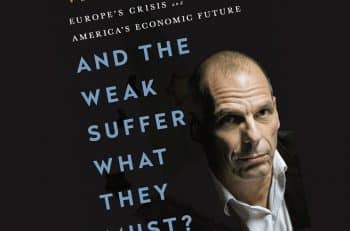
    The colourful former Greek Finance Minister Yanis Varoufakis’s new book, ‘And the Weak Suffer What they Must?’, provides insightful reading for those who want to understand how the EU and the euro-currency have reached their present pass. Varoufakis shows in his book how the EU ‘project’ is now held together more by fear of the effects of the possible disintegration of the Eurozone, which could bring down the entire EU with it, than by positive values of solidarity and international feeling, regardless of the result of the UK’s referendum. His book is also a highly readable treatise on international economics. Economists can be divided into ‘floaters’ or ‘fixers’. Floaters believe that currency exchange rates should be allowed to float up and down vis-a-vis one another in response to the fluctuations of trade and movements of people and capital into and out of countries. Fixers believe that a country’s currency exchange rate should be fixed in relation to another currency, or a basket of other currencies, or a precious metal like gold. If exchange rates are fixed, the real economy of people making and exchanging real goods and services must adapt to suit the fixed exchange rate – and not necessarily at a full-employment level. The policy priority must be maintaining the fixed exchange rate. The price of money, that is the rate of interest, must be geared to upholding that rate. By contrast, if the policy priority aims at maximising output and employment in the real economy, the exchange rate must be allowed to float in order to balance the continually fluctuating payments in and out. Exchange rates can then be more or less let look after themselves. As to floating exchange rates: the only period in the 95-year history of the Irish State when it effectively floated its currency as against tying it to the pound sterling, the Deutschmark or the euro, was 1994 to 1999, before the euro was instituted. Those were the years when Ireland had average economic growth rates of 8% a year; and the resulting highly competitive exchange rate underpinned the ‘Celtic Tiger’. A currency exchange rate after all is just one of millions of prices – the price of a country’s currency in terms of other currencies. It is folly to make a fetish of it. As with all prices, the rational course is to let them move up or down in line with supply and demand for the goods and services they relate to. Exchange rates are always fixed for political reasons. They can never be more fixed than in a monetary union such as the Eurozone, for which the common currency was meant to provide one of the bases of an EU superstate under Franco-German hegemony, and which was established, notionally at least, to last for ever. Varoufakis’ book shows that when 19 countries with different growth rates, levels of development and resource endowments, and therefore with different balance-of-payments requirements, are locked together with one currency, the euro exchange rate at any moment of time will suit some but not suit others. It will encourage export booms, high growth-rates, and payment surpluses in the stronger economies – pre-eminently Germany and the countries of Northern Europe. These are counterbalanced by import surges, low growth-rates and balance-of-payments deficits in the Eurozone “PIIGS” countries – Portugal, Italy, Ireland, Greece and Spain. The deficit countries cannot restore their competitiveness by devaluing their national currencies, for they no longer have them to devalue. They can only compete economically by cutting pay, profits and pensions, perhaps for years on end. This must happen and is happening in the absence of a fiscal and political union alongside the monetary union, that is, a cross-Eurozone tax and spending union that would recycle the economic surpluses of the richer countries to the poorer, just as happens between richer and poorer areas of a single State through its national taxation- and income-transfer systems. There is no such transfer mechanism in the Eurozone because it is not, or is not yet, a political union, a proper State. There clearly cannot be an EU fiscal union when total EU spending in any one year is just 1% of overall EU Gross Product, and when any proposal to raise this by even a fraction would cause a big row between the contributory and putative beneficiary Member States. By contrast national State spending by Eurozone members is, depending on the country, between one-third and one-half of national GDPs – and typically allocates 12% or so of GDP in each country to social security transfers, 8% to health care and 7% to education. What social or historical forces exist or can be imagined that would establish a surplus recycling mechanism between the richer EU countries and the poorer that is in any way comparable to that which exists inside each national State? Germany’s voter-taxpayers will not wear even the slightest move in that direction. Neither would citizens in any of the other EU surplus economies – Austria, Holland, Finland or Sweden – however loud the calls for sacrifice for the sake of a common “Europeanness”. Varoufakis draws on his experience as Greek finance minister interacting with the other finance ministers of the Eurogroup to describe these design flaws of the euro. While he accepts that it would have been better if the euro had never been set up, he fears that if the Eurozone were to break up now, and possibly with it the whole EU, it would have disastrous economic consequences and benefit Europe’s ultra-Right politically. In my opinion this economic-disaster scenario is implausible. History is full of abandoned currency unions. Some sixty disappeared during the 20th century. The USSR broke up relatively amicably in 1991, with one State being replaced by fifteen new ones and fifteen new currencies replacing the old rouble. Moreover, the USSR was not just a currency union but had been a tightly-knit fiscal and political union for 70 years. I remember landing in Prague Airport in 1993 on the day

    Loading

    Read more