Reviews

Random entry RSS

  • Posted in:

    Review: Not enough drama at Inish

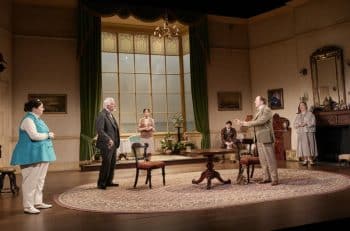
    By Rory O’Sullivan It is fitting that after a year mired in controversy, particularly over its relations with Irish actors and directors, the Abbey Theatre should choose ‘Drama at Inish’ for its Christmas show. Plays like this almost invariably swaddle audiences in a cotton wool of nostalgia for the easy days they depict, but which no one has ever lived through. For the Abbey that sense of nostalgia must be overpowering, since the playwright, Lennox Robinson, was one of its venerable institutions. After the deaths of Yeats and his collaborator, Augusta Gregory, Robinson became the world’s window into the Irish Literary Revival, telling war-stories at university debates just as David Norris does now. He looked and walked and talked just like Yeats. He also served as the Abbey’s General Manager for much of the 1910s and was on its Board of Directors for his whole life afterwards; according to some versions of the theatre’s history, it was largely because of Robinson that the theatre stayed open during some of its most difficult times. He was competent, careful and likeable: three rare qualities in a building full of artists. He was also genuinely a good playwright – but not a great one. His works tend to have beginnings, middles and ends; the characters are consistent and usually a little interesting, and the writing is mostly clever and original; but there is never much in the way of theme. The plays are full of stereotypes telling jokes or parodying something, and if there is any drama at all it is safely smothered in marriages at the end. They can be good fun, but nothing is ever at risk in them; they are the kind of plays that Ibsen built a career by destroying: ‘A Doll’s House’ without the famous twist. ‘Drama at Inish’ is a little more complicated than that, but not much. Set entirely in a hotel in ‘Inish’ – a mid-West Cork town equivalent to Schull – it begins with the arrival of an actor and actress from Dublin, Hector de la Mare (Nick Dunning) and Constance Constantia (Marion O’Dwyer), who have come to perform highbrow works from the theatrical canon in the town’s pavilion every evening for the tourist season. They have been hired by local business magnate John Twohig (Mark O’Regan), whose sister Lizzie (Aoibhinn McGinty) runs the hotel, in the hope that a departure from the usual circus-fare will draw holiday-makers to Inish and away from the towns nearby.  The characters are mostly parodies: the actors are snobbish and self-absorbed, Lizzie is a spiteful middle-aged spinster, and John is a drunk. His wife, Annie Twohig (Helen Norton), is overall a sensible person though without much personality, but their son, Eddie (Tommy Harris), is madly in love with Christine Lambert (Breffni Holahan), the city-slicking woman who comes down every year to audit the business accounts.  The shows turn out extremely popular, but soon the townspeople begin to behave like the characters in the plays. Eddie goes existential, reads Turgenev and threatens suicide; Lizzie becomes a Medea shouting recriminations at Peter Hurley (Marcus Lamb), her childhood friend, now the local TD, who apparently jilted her years before for another woman; a confused Peter points out that Lizzie and his wife have been friends for years. Near the play’s end, Peter breaks the party whip and sinks a government bill after seeing Ibsen’s ‘Enemy of the People’ the night before. When the chaos becomes too much, John and Annie dismiss the actors and invite the circus in for the rest of the Summer. ‘Drama at Inish’ itself is the sort of play an English Professor teaching Robinson would instinctively choose to lecture on: a play about what it means to perform and watch plays. On that particular topic, playwrights can usually manage to speak with some insight; here, the problem is not that the work lacks thematic moments, but that it doesn’t at all know what to do with them. One of the gags involves John Twohig ranting that he had worked hard to provide wealth and a house for his wife and son; “A Doll’s House?”, Constance Constantia asks with a ‘checkmate’ kind of a look; “Exactly”, John replies, as if it was obvious, and keeps ranting. Like the townspeople of Inish, the play skips uncomfortably over any moment where a theme threatens to jump in and complicate things. One of the subplots contains a revelation of a secret and possibly aborted pregnancy; ironically, it is so brushed-over that an audience could leave the theatre forgetting it occurred at all.   This fear of its own subject matter leaves the play with nowhere to go once its basic premise has been unfurled. The last act is little more than a series of dull and pointless vignettes involving characters we have never seen before: a journalist, a garda and a dumb-and-dumber sort of a local. The dismissal of the two performers at the end is businesslike and stilted; O’Dwyer tries to wring what she can out of Constantia’s half-drunken monologue, but there really is nothing much in it.  The show’s director, Cal McCrystal, spent his publicity hours telling rte.ie and ‘The Irish Times’  that none of this is really the important thing, and that if people laugh the show succeeds. He usually works as a comedy consultant for big films, and was brought in to direct as a kind of subject-matter expert, to the great chagrin of the actors and directors in dispute with the Abbey; who, ‘The Irish Times’ say, cited it as yet more proof of the theatre’s neglect of Irish talent. But McCrystal seems to have done the play some good: it often is funny, and strikes many notes other than the loud, frantic caricature that poor comic performances often hammer dead. Marion O’Dwyer’s performance is the best, lampooning the character of Constance Constantia without ever losing her. Ian O’Reilly (of Moonboy) also impresses in the middling-to-minor role of Michael, the coal boy; he has one big

    Loading

    Read more

  • Posted in:

    Review: Project Arts’ “Mother of Pearl” is more theory than theatre

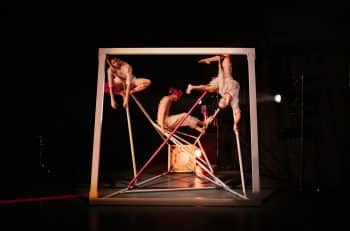
    By Rory O’Sullivan   EMILY AOIBHEANN’S ‘Mother of Pearl’ is the second in a two-part production and follows ‘Sorry Gold’, which played at this year’s Dublin Fringe Festival. There are three dancers and three musicians in the cast: respectively, two women and a man, and two men and a woman. Aoibheann herself is one of the musicians, joined by guitarists Ciarán Byrne and Ronan Jackson. Its cinder-block walls make the stage feel like a warehouse; and the set, whose design team included the visual artist Liing Heaney, is dingy and dystopian like the cities of ‘Blade Runner’. The Project Arts Centre contributes to this, now firmly in the run-down-cinema rather than deconsecrated-church class of theatrical venue. The stage is more like the interior of an unconscious mind than a physical place, which as a setting works well for this gleefully abstract performance. The playbill tells us that “Pan, God of the Wild, travels to the Ocean to dance with a pearl – a freakish hyper object from a post-natural age”, but the show is not really interested in its story. ‘Mother of Pearl’ instead offers a game of moods and concepts: the ugly and the beautiful, the industrial and the ecological, the trapped and the transcendent. At the curtain’s rise we see Cathi Sell dancing in a sequined leotard andcradling a stone; to which, while working through contortions, her approach is in turn affectionate and dismissive. At times she seems about to throw it across the stage. Rainy crackling sounds play out as she moves, like water falling on stones. Then nearly fifteen minutes are given over to a tedious unveiling of the performers and objects onstage. They all start hidden under curtains. Taking advantage of this long distraction, Sell whirls away, drops the stone, changes clothes, and comes back. The musicians emerge and play an electric guitar, electric bass, and accordion. The other two dancers, Becky Neal and Michael Gillick, are revealed tangled among the objects. The objects are: a cluster of foot-sized platforms caged in wiry metal, two chairs and a kettle whose purpose I could not discern, some pyramidal scaffolding halfway between a set of monkey bars and a gallows, and the show’s eponymous pearl, appropriately white and smooth. But the pearl does not really come into it until the end of the show’s middle third, which is its best and contains some genuinely resonant theatre. With the guitars and accordion playing tone-music composed by Aoibheann herself, the contrasting ideas onstage finally take form and speak to one another. Sell and Neal dance almost as one body and coax Gillick, who is in theory the God Pan, down from the high scaffolding. Pan swings on the bars and wraps himself around them, beauty and terror embodied; we turn to see Sell and Neal entwined together on the clustered platforms; Pan runs everywhere around the stage in a Dionysiac frenzy; after some soul-searching, he joins the other dancers and they pull down the high scaffolding. Throughout all of this the pearl stands inert in the middle of the stage, an embodiment of aesthetic transcendence and perfection. It was the sphere, after all, that the Pan-worshipping Greeks considered the perfect shape, continuous and limitless in every direction. Parmenides and Plato both said it was the shape of the universe. When Pan is at last allowed access to the pearl it is only as part of a single consciousness merged with the other two dancers’. They take turns jumping around on top of it as the others hold it still. With these gears all rotating, the show is able to get some mileage out of its images and motifs. In an interview with the Irish Times Aoibheann cites the philosopher Tim Morton, who has argued against separating the concepts of nature and civilisation, contending that they are inextricably one. This argument grounds the show as the metal scaffolding, the pearl, Pan and the two dancers all flow in and out of one another like waves. In this ‘Mother of Pearl’ grazes the best of abstract theatre as it has existed since Beckett: a mode of reasoning without a conclusion, a reasoning of images and emotions rather than of mind. It should have stopped there. Instead the show ends with the theatrical equivalent of pumping diesel into a petrol engine. The dancers, and then the musicians too, all break off and run around the stage yelling, screaming and thrashing generally. Chairs are upturned; the curtains come back and are thrown around. Then it is on this chaos that the big black curtain closes to end the show. A woman behind the curtain screams sharply three times, enough to thoroughly discomfortthe whole audience, and the cue is given for everyone to applaud. The ending is rash and pointless and deadens the effect of what comes before. Like the soporific reveal of cast and set at the beginning, it is a gesture towards a fashionable kind of abstract theatre that aims to bully and disturb audiences. It is easy to shock an audience, but hard to shock an audience while doing good theatre. The beginning and end are certainly unsettling, but only that. Neither manages to negotiate a place in a performance whose successes are always in spite of them. Before the show’s run Aoibheann wrote a pretty exorbitant piece for rte.ie which is mostly about the meaning of the pearl. An oyster will create a pearl in response to some kind of irritant in its mouth: proverbially a grain of sand, in truth normally a parasite. It surrounds the irritant with a smooth coating that protects the oyster, and over time the coating becomes a pearl. For Aoibheann, the pearl basically stands for art itself: “I”, she writes, “am the irritant”. Later she asks the following, which I quote for you to puzzle over: “The extraction of the pearl kills the oyster. Considering nature, is product still more valued than ecology? Can we say the same about art?”. If the point

    Loading

    Read more

  • Posted in:

    Shame us, Séamus (or at least say something genuine)

    When I was a young man, I managed various used and rare book stores for a company based in Washington DC. As part of this book ‘empire’, we leased a large warehouse across the Potomac River in Arlington, VA. It comprised several cavernous rooms. In one of these rooms stood a veritable Everest of books. Further, the entire heap comprised a single title – undustjacketed, misbound and/or damaged US editions of Seamus Heaney’s Poems 1965-1975. Ironically, close by squatted a larger mound of equally misshapen copies of a later printing of the Complete Poems of Robert Frost. To recoup some of his loss, an unscrupulous binder, rather than honouring his contract and pulping the volumes, had sold them to us for a price that would importune a covert cash payment. Kevin Kiely’s bluntly titled, Seamus Heaney and the Great Poetry Hoax, (Areopagitica Publishing, 2018), opens with a comparative appraisal of these two milk bucket obsessed northern agrarians, Frost and Heaney. Kiely focuses on Heaney but neither poet is to his taste. He finds Heaney’s incessant reliance on rural themes disingenuous and out of touch. Certainly, Kiely has a point. What else but nostalgia and bathos could steer anointment and garlanding of the award-winning poet by ensconced academics, wealthy potentates and entertainers who writes lyrics which extol the virtues of peat and cow shit? As Kiely so admirably and doggedly points out, as a consequence, there is nothing honest in Heaney’s work. I think we can agree that Ezra Pound, though for the most part a fine judge of poetry, was a spotty judge of character. Though he called his birthplace of Hailey, Idaho, half savage Pound initially misconstrued Robert Frost’s New England Yankee ‘plain speak’, an intrinsic characteristic of Frost’s work, as providing some sort of spare, down-on-the-farm expression of the American ethos when in reality it was just a faux homespun ‘higher hokum’. Yet I and, in his lukewarm assessment of Frost, Kiely would agree that the folksy American’s snake oil and illusory tales are more genuine than Heaney’s. This even though Frost was little more than a gentleman farmer and Heaney was, at least at one time, a genuine farm boy. If, as Kiely states, and I concur, Frost’s fancies ring truer than Heaney’s what does that say about Heaney’s oeuvre generally? In Heaney’s infinitely tired reprises of farm life – the damp, the smells, the stoic heroism, the sentimentality – one hears faintly the same sort of bombast one gets from America’s ‘Good Gray Poet’, Walt Whitman, who most certainly lived in a country that never existed and never will. If it’s not naïvete, both Whitman’s and Heaney’s approaches manifest sheer cunning. Kiely is correct and, given Heaney’s stature, courageous to tilt at Heaney’s legacy. Whitman was constrained sexually by the very culture he bloviated about. Thus his product was a cry for acceptance which he somehow thought he could gain by pandering to the existing order. And to a frightening degree, it worked – for all the wrong, nationalistic, jingoistic reasons. As Kiely does, let’s assess one of Heaney’s most famous lines from one of his most read and ‘beloved’ poems, Digging. Heaney writes: “Between my finger and my thumb The squat pen rests. I’ll dig with it”. The poem has about it a lassitude as though Heaney himself had grown tired of his subject matter. He opens with a wholly inept and personally disingenuous image which compares two wholly different utile appendages, a pen and a spade — reworking Bulwer-Lytton’s famous quote of pens/swords. Then, after a 22-line instructional on how to use a spade, he resorts to the murky bathos of comparing his pen to that shovel. Kiely, by now frustrated with Heaney’s metaphorical fuzziness, queries “how much earth can you dig with a pen”? But it’s worse. At first, though still painfully sentimental, the shovel-incised blocks of bog, of dead (yet organic) matter, serve the living by providing heat and fertiliser. But what is the bog? History? Tradition? Heaney’s mind may have done some digging. But his pen can only record the process. Within reason and art, the pen does not do the digging. And Heaney is no André Breton, no surrealist, as Kiely points out, so the mental image flounders and flops. Kiely trounces Heaney’s stances on Irish history, international politics, Nobel, institutional pandering and how these factors influenced his poetry. Kiely demonstrates that to avoid the convulsions Ireland faced, especially from 1968 to 1988, Heaney, more often than was tolerable, wrote nostalgia about farm life or buried his poems’ relevance in a miasma of prehistory. Heaney’s stance reminds one of Yeats’ position on Northern Ireland before the Easter Rising. Though Yeats continued to generally support non-violent solutions, he was shattered by the brutal treatment at the hands of the British inflicted on the Irish nationalists as evidenced in his superb poem Easter, 1916. However, Yeats solution of a non-violent literary rebellion with nostalgic Celtic roots reminiscent of Heaney’s bathos, smacks of wishful thinking. As is well known, the far more pragmatic James Joyce would dub Yeats’ and Lady Gregory’s Celtic Twilight the ‘Cultic Twallette’ in his masterpiece, Finnegans Wake. Further, as an individual living the bloody hypocrisy of American foreign policy, I’m certain that palling around with a war criminal like Bill Clinton, as Heaney did, does not speak well of one’s character. And, Seamus, the same went for the Nobel, which the poet Ed Dorn referred to as the Dynamite Prize. The Nobel was in recent years given to yet another American mass murderer and apologist for the very Wall Street that bankrupted Ireland, Barack Obama. And there is some foul whiff that our current golden-domed Baboon-in-Chief should be foisted with Stockholm’s much tarnished award. Kiely also points up another insidious influence on Healey’s ascendance from ‘the Land of the Fee and the Home of the Knave’ — literary critics Harold Bloom and Helen Vendler. It’s bad enough that across the pond, these two old literary fossils have erred so much toward the ‘I’ centered, solipsistic lyric that our current poetic product has all the

    Loading

    Read more

  • Posted in:

    Social History Isn’t History With Politics Left Out

    2016 was inevitably an outstanding year for the history industry as publishers, writers, and those elements of the intelligentsia that love a good commemoration got to work on the Easter Rebellion’s hundredth anniversary. The Irish people have an interesting relationship with their own history. It is, like their relationship to Catholicism, frequently the subject of fervent debate, at certain period followed slavishly as orthodoxy, and on other occasions the subject of shame. In the more modern Ireland that began to emerge from the 1960s a new revisionism took hold about the history itself. Revisionism itself became a pejorative term as scepticism about our history joined forces with those who would be sceptical about the benefit of Catholic Ireland. In the 1970s liberalism, secularism and scepticism about nationalism ascended. The first historical-revisionist tract was produced by a Jesuit priest named Fr Francis Shaw. His scepticism about 1916 was so overt that it was thought best to delay publication for six years as the country was, in 1966, fervidly commemorating Easter Rising anniversaries. Fr Shaw’s revisionism seems mild by the yardstick of today – he blamed 1916 for the division of Ireland, the Civil War and the fact that little or no commemoration was possible of those who gave their lives in World War I. Eunan O’Halpin and Guy Beiner take us through the various commemorations in Irish life in their essay ‘Remembering and Forgetting’ as a final input to the exhaustive and very stimulating ‘Cambridge Social History of Modern Ireland’. What this book reminds you of is the timely and regular nature through which historians not only review earlier conclusions but also attempt to put a new narrative account on what has previously been thought of as undisputed territory. it is noteworthy that one of the best-selling books on the 1916 centenary celebrations was a book about how children were treated though the week-long rebellion. The editors of the Cambridge Social History, Mary Daly, Professor Emeritus of Modern History at UCD, and Eugenio Biagini, Professor of Modern and Contemporary History at the University of Cambridge, are quick to point out that social history is not just history with the ‘politics’ left out. That said, they are robustly critical of an over-emphasis on political, constitutional, and institutional histories of Ireland. “Our emphasis is on economic and social change, our focus on people and cultures, instead of institutions and political ideologies”, they assert in their introduction. The book suggests a purposeful placing of Irish history in the context of wider European and global events. This is challenging stuff but with 40 distinct contributors cover ground of interest to both academic and general readers. The wide-ranging topics include previously taboo subject matter like sex and class in Ireland. Thankfully, as historian Joe Lee acknowledged in his Irish Times review, this is not a textbook. More than half the contributors are based outside of Ireland, which again shows a purposeful focus on diversity of thought by the editors. Lee has said of this book that the historian’s delight is a reviewer’s nightmare. The book is not a rainy-day read. One of the great tragedies of recent Irish scholarship is the number of posts in economic and social history that have either fallen vacant or simply just not been continued. It is to be hoped that Irish universities and corporate philanthropy will re-discover the benefits of social and economic history and invest in it. My own view is that local history, as well as social and economic history, deserves investment to counterbalance the overarching political narrative. Amongst the essays included here is one by Terence Dooley, Professor of Modern History at Maynooth University, on the fate of the Big House, the preserve of the ascendancy class and a symbol of an Ireland that is now essentially gone. Dooley deals both with the social destruction of that class but also the physical destruction of its physical heritage. This still makes for sad reading, in particular, when one looks at the Department of Finance’s memorandum in 1929, declining to take Russborough House in Wicklow, one of Ireland’s greatest houses, into state ownership because it was only of interest to “connoisseurs of architecture” and had never been associated “with any outstanding events or personalities in Irish history”. Despite the obvious neurosis that afflicted the early state with regard to the Big House there should surely be now an argument for a much more comprehensive policy to preserve heritage properties of every description, if only to assuage tourism’s endless search for new venues and more enchanted and more promotable ways. Henry Patterson, Emeritus Professor of Irish Politics at Ulster University, takes up the challenge of Irish working class experience and why, despite the best efforts, this did not translate into support for the Irish Labour party. He quotes UCD economist Cormac O’Gráda as acknowledging that by 1939 Fianna Fáil had become the party of the working class. Even the 1970s were never socialist. Moreover, unsurprisingly the recent displacement of the Labour party has been at the hands of a resurgent Sinn Féin which is reaping an electoral harvest and an indelible presence in working-class areas, from peace in our time. Patterson (‘The Irish Working Class and the Role of the State, 1850-2016) acknowledges why working-class politics made so small an impression on Irish life, pointing to the obvious conservatism and anti-communism of the Catholic Church and the fact that James Connolly threw in his lot with nationalism as a progressive force in Irish life. The other reason that class consciousness never took hold in Ireland is probably the existence of the Big House and the ascendancy class. The fact that the ruling class in Irish society were not drawn from the majority Catholic population meant that for several hundred years radicals had no class enemy to tilt at but the ascendancy. Jennifer Todd, Professor of Politics at UCD, and Joseph Ruane, Emeritus Professor of Sociology at UCC, make a timely point (‘Elite Formation, the Professions, Industry and the Middle

    Loading

    Read more

  • Posted in:

    Legal affairs

    Village is loth to get into the salaciousness that drives the professional classes in decadent Dublin. Nevertheless the integrity of the judiciary, and indeed the perception of that integrity, has to be beyond doubt and a story unfortunately came our way which challenged it, anonymously, and was accompanied by affidavits submitted for in camera family proceedings. A bankrupt developer with an alpha personality and omega ethics alleged in the affidavits, which he was never allowed to open in court, that Irish High Court and Supreme Court judgments against him were tainted with bias because the lead Supreme Court judge in his case had an alleged affair affair with the High Court Judge who determined the matter originally, and that the Supreme Court judge anyway had shown in dealings with him in the judge’s former life as a barrister, that he despised him. The developer’s affidavits are clumsily drafted and he is careless as to whether the relationship may have continued at times when the Supreme Court judge heard the action – on occasion fudging the tenses about the timing of the relationship. Nevertheless as a matter of fact the relationship had ended by the time of the Supreme Court hearing, even if it had subsisted, insignificantly and irrelevantly, during the High Court hearing. The High Court judgment was persuasively damning of the developer personally, finding he had deliberately and fraudulently failed to make certain disclosures and misled the court and his ex-wife. The developer claimed he had been in the process of preparing disclosures when a settlement was reached that obviated the necessity for him to make the disclosures. But the High Court, on the facts, said there was no evidence of this. He had engaged in litigation misconduct. The appeal was fast-tracked to the Supreme Court but took four years to be heard. At the last minute, the Supreme Court panel of judges was apparently changed, with the particular Supreme Court justice who had allegedly had the affair stepping in to replace a judge who had been originally listed to sit. The developer claims to have been wrong-footed by the change between the judges and would have aimed to pre-empt the Supreme Court judge sitting on the matter had he known he intended to do so. He claims he had already advised his solicitor of the potential for the judge being compromised. His legal team noted that day one of a two-day appeal was already over, and they didn’t dare question the judicial etiquette. The Supreme Court upheld all the High Court’s substantive reasoning. When the judge endorsed his alleged former lover’s strong judgment without – according to the developer – “canvassing” all the developer’s fundamental grounds, the developer sought redress on grounds that there was a reasonable suspicion of objective or apprehended bias. Justice must not just be done but be seen to be done, was the cry. However, these days thankfully an alleged affair between judges that may have been finished for years does not constitute, or rather does not necessarily constitute, a reason for the appellate judge to refuse to hear an appeal of his former lover’s judgment. For obvious reasons the developer had difficulty getting any Irish lawyers to take on his prurient case. In the end he sought help from UK barristers but ultimately the Official Assignee in Bankruptcy successfully objected to the developer taking a judicial-bias challenge because he was bankrupt and therefore lacked the standing to take the case. The Assignee in Bankruptcy took the reasonable stance that even if the judgments were overturned it would not be appropriate for the Assignee, who alone could take the decision do so, to refight the substantive issues of fraud, failed disclosure etc on the part of the dubious developer. Even if the unsubstantiated allegation of bias could be proved, it would achieve nothing, for the case was not worth re-running. Michael Smith

    Loading

    Read more

  • Posted in:

    Planning in Donegal

    Gerard Convie is a man who wears sober ties and measures his words. He worked for the County Council in Donegal, once Ireland’s most beautiful and wildest county, as a senior planner for nearly 24 years. He has claimed that during his tenure in the Council planning irregularities were perpetrated by named officials at the highest level in the Council. He claims these included former Manager Michael McLoone – who has initiated defamation proceedings against Village magazine (though we’ve heard nothing in a year) – as well as named county councillors. Convie had a list of more than 20 “suspect cases” in the County, a ‘cesspit’. Two years ago the government initiated a review of his allegations. Then a Minister dismissed them as lacking substance and closed it down. Convie claimed this made him look bad and sued. And got a payout and – in September – , the appointment of a senior lawyer, Rory Mulcahy to look into his allegations. The ‘review’ [by god is this not an Inquiry or Tribunal] is non-statutory ie makey-uppy and Minister Alan Kelly has reserved the right for himself or his successor not to publish its findings. So he has provided in surprisingly hazily- drafted terms for review of “all written allegations received in the Department in relation to certain planning matters n [sic] respect of Donegal County Council”. Originally the terms contained a confidentiality clause but following further correspondence this seemed to disappear. In November, Convie expressed his concern that his evidence may be shared beyond the ‘review” and said he considered the change may represent “bad faith” and even “affect my continued cooperation with the exercise”. The terms also fail to make it clear if it will address impropriety ie corruption or just ‘bad practice’’ie incompetence though if it does not address impropriety it’s possible that Convie will feel slighted and have another payday.

    Loading

    Read more

  • Posted in:

    Review 2015 in Village

    January The Minister for Health, Leo Varadkar, reveals he is gay to a receptive Miriam O’Callaghan, becoming the first openly-gay government minister in Ireland. The Irish economy is not some kind of exemplar, says President Michael D Higgins, controversially but magnificently. Mahon tribunal reverses its finding of corruption against Ray Burke because the tribunal never revealed that whistleblower, James Gogarty, had made unsupportable allegations against the likes of Nora Owen, TD, and Supreme Court justice, Seamus Henchy. Nobody names the lax lawyers, who permitted it, or demands return of their fees. SIPTU’s Jack O’Connor sets out principles for a Charter for parties on the Left.   February 13 men aged 50-70 to appear before the bank inquiry; no women. Gardai arrest Paul Murphy, TD, along with three other anti-austerity activists and politicians, leading to public speculation about “political policing”. Former Fianna Fáil minister Pat Carey reveals his homosexuality publicly. The Irish Times announces the reintroduction of a paywall for its website, beginning on February 23. Michael D Higgins gives us another poem. March Solicitor Brian O’Donnell barricades himself into his Palace in Killiney with help from the ironically titled Land League. The Sunday Independent reports that O’Donnell scion, Blaise, didn’t know how rich his parents had made him. Contrariwise, The Mail reports Blaise got a €156m London office block from Dad. Ireland’s rugby year peaks with Six Nations Championship. Belfast County Court finds Asher’s Bakery guilty of discrimination for refusing to bake an ‘Eric’n’Ernie’ cake bearing a pro-gay-marraige slogan. april Joan Burton proposes a cap on the property tax when the freeze on increases start to register, at the end of the year. Minister Alan Kelly to allow builders of one-off houses to opt out of the usual building-control certification requirements. John Fitzgerald writes that borrowing to fund the bank bailout costs around €1bn a year, a small fraction of the total fiscal adjustment of €30bn since 2008. Gerry Adams tells CBS he never pulled a trigger, ordered a murder or set off a bomb during the war in the North. Ed Moloney, of course, disputes this. May A smug Jeremy Paxman, on the verge of retirement, lays into British Labour leader, Ed Miliband, on Newsnight and is overheard at end asking “are you ok, Ed?”. Miliband says “yeah” and wonders if Paxman is himself ok. Broadcaster and political editor of the TV3 television channel, Ursula Halligan, publicly declared her homosexuality and her support for a ‘yes’ vote for marriage for homosexuals and lesbians in the Constitutional marriage equality referendum. Competition Authority finally getting serious over CRH. Mary Harney promised investigation a political generation ago. Broadcasters Bill O’Herlihy and Derek Davis died. Charles, Prince of Wales, and his wife visited the west of Ireland, including Mullaghmore, County Sligo, where his great-uncle, Lord Mountbatten, was murdered by an IRA bomb in 1979. Referendum on two amendments to the Constitution – the 34th (marriage equality) wins; and the 35th (presidential election voting) loses. NY Times and Guardian, Village and Broadsheet. ie publish the Dáil Record of Catherine Murphy’s allegations about Denis O’Brien’s banking arrangments. The Irish Times, Independent, Mail, Sunday Business Post wait for clarification from the courts. June Strong, clear clarification from High Court on the unambiguous existence of the privilege for Dail utterances. Binchy J as predicted clarifies that he never intended, nor could it have been intended, his comments would apply to reporting of utterances in the Dail. Exciting dream team of Catherine Murphy, Stephen Donnelly and Roisin Shortall to form Social Democrat party. RTE tells Atheist Ireland it will reconsider the title of the Angelus Ireland’s poorest kids hit by lone-parent payment cut. “We are not God,” acknowledges Pope Francis, and we shouldn’t “trample his creation underfoot.” The average American woman now weighs 166 pounds — as much as the average 1960s man. Dutch government ordered by court to cut carbon emissions in landmark ruling. Central bank Governor Patrick Honohan explains “the bank guarantee should not have included subordinated debt nor existing senior-term debt”. Joan Burton slams social welfare fraudsters for “giving two fingers to their neighbours”. July The hottest month in history Brian Cowen scathingly tells the banking inquiry his ‘friends and colleagues’ were private people not bankers though doesn’t explain relaptionship with Fintan Drury, or golf. Media consider performance a triumph. Greece votes no to bailout plan but government imposes it anyway. Yanis Varoufakis resigns as Greek Finance Minister. august IS destroys 200 year old temple in Palymyra, Syria. September INBS, Michael Fingleton appears before Oireachtas banking inquiry but is let off hook Radical socialist Jeremy Corbyn elected leader of British Labour Party. October Five adults and five child Travellers die after fire at Carrickmines, Residents object to rehousing of the survivors nearby. Budget will reduce USC but is light on plans for investment. The Archbishop of Dublin, Diarmuid Martin tells a synod of bishops in Rome that Irish people “struggle to understand abstract moral principles” and that the recent debate about same-sex marriage in Ireland has been conducted by lay people in language that traditionally belongs to the Roman Catholic Church: ‘equality, compassion, respect and tolerance’”. November Judge Brian Cregan announces he does not have the legal powers necessary to conduct his inquiry into write-off sales of loans by IBRC do not allow him to. 130 people murdered by IS in Paris. Peter Robinson says he will resign as First Minister. Former Minister Pat Carey resigns after improper media leaks about alleged paedophilia. December IFA President Eddie Downey declares he has been thrown under a bus by his colleagues after it was revealed he received €147,000 annually and CEO, Pat Smith, half a million annually, from often impoverished farmers. David Cameron announces Britain’s intention to bomb IS in Syria.

    Loading

    Read more