Entertainment

Random entry RSS

  • Posted in:

    Jes Paluchowska reviews ‘Men’s Business’ at the Glass Mask Theatre: viscerally disomfiting

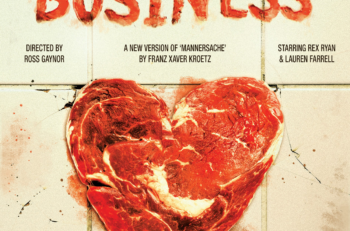
    Butchering romance J Grafton Street’s Glass Mask Theatre is offering a delightfully unpleasant chance to observe two people destroy each other from 11 February  to 1 March. Men’s Business is Simon Stephens’ widely acclaimed translation of Franz Xaver Kroetz’s rarely performed 1972 cult classic, Mannersache. Rex Ryan and Lauren Farrel star as Victor, a welder with strong opinions about what it is that women are supposed to do, and ‘Charlie’,  the owner of a butcher shop whose name we only learn when reading the programme after the play, as she is not referred to by that once.   We meet the couple in media res, dining in the back of Charlie’s shop before proceeding to the first of many sex scenes of Men’s Business. Ryan, who graced Glass Mask last summer as the charismatic but troubling Gian Lorenzo Bernini in a production of Elizabeth Moynihan’s Celebrity, does not hold back in this role. His Victor is hateful, controlling and overall abrasive, hiding a fragile, self-doubting weakness behind performative over-masculinity. We love to hate him, which is a good thing, since for the solid first half of the show that is almost exclusively what we will be doing.  ‘Charlie’ is at first more quiet, the almost too-innocent victim, clinging to her uncommitting partner as he turns more and more obviously abusive.  All things come to an end, however. Farrell, in her first appearance at Glass Mask, delivers almost a double performance, captivatingly transforming on stage in front of our eyes to after reaching her breaking point. Despite the slower start, by the bloody end she expertly balances the line between sympathetic and abject. Do not let yourself be fooled by the heart-shaped poster and the release in Valentine’s season. Men’s Business is not about romance. Or rather, if it is, it does not have very nice things to say about it.  From the very first scene, when Victor tells ‘Charlie’ that she is not beautiful, we know that something is rotten, and hope, for her sake, that the relationship is doomed. The signs are certainly there.  Despite ‘Charlie’s’ best attempts to lead her almost-boyfriend back to her place, the pair never meets outside of the butcher shop. All of their intimacy is set with the background of cleavers, deboning knives and hanging legs of meat, occasionally to be interrupted by ‘Charlie’s’ work – sifting through entrails or chopping off finer cuts. The lighting and sound choices further flesh out the non-romantic point, breaking off colour and music mid-thrust, leaving the supposed intimacy awkward and uncomfortable to watch.  all things human boil down to soft tissue and fluid mechanics The message is clear: despite what grander hopes the parties might have, all things human boil down to soft tissue and fluid mechanics.  One hell of a message to discuss on the way home with your date.  Finally, it would be remiss to not mention the charming performance of the third actor, who not once failed to steal the show when they appeared on stage. Spice the dog takes on the role of Wolfie, ‘Charlie’s’ dog whom Victor, for one reason or another, deems his romantic rival. Some viewers may be disturbed, as Men’s Business contains implied, off-stage depictions of violence towards animals. Let them be assured that Spice at the end is fine and a very good dog indeed. While not comparable in size to venues such as Abbey or the Gate, Glass Mask continues to provide a much-needed artistic alternative in Dublin theatre. Its productions are consistently off-mainstream, and the directors are not afraid to take them in unexpected directions. In Men’s Business’s case, the script directions of Kroetz’s plays would usually lead to a more dialogue-heavy adaptation. An extra layer of choreography, sound and lights that the Theatre settled on adds on significantly to the image. The effect is strong, if lacking in subtlety. It knows it can never be Ibsen, so why bother trying. Glass Mask’s next show, Little One written by Hannah Moscovitch and starring Hannah Brady and Dan Monaghan, premieres on 18 March 18, with tickets starting at €20. Glass Mask describes it as a “gripping psychological thriller” that “challenges our perceptions of memory and explores the complexities of what it means to love”.  If that is a claim you would like to verify yourself, beware. It will not run for more than two weeks and seating is extremely limited.

    Loading

    Read more

  • Posted in:

    Review: Medea’s incomprehensible crime

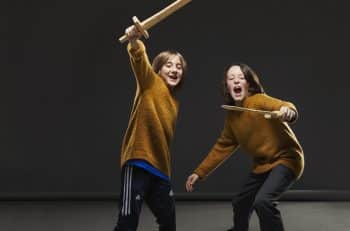
    The new production at the Gate makes Medea’s children more than mere victims By Anna Mulligan Like the play itself, the set for Oonagh Murphy’s Medea walks the line between the mundane and the mythic. The children have a teddy bear named Hercules, and the play takes place in a bedroom whose sloping sides, rising inwards, give the impression of an attic or a crawl space. At the apex is a kind of hovering wooden grid, as if the technicolour bedroom is not an attic but a dungeon, an oubliette, where Medea’s two children have been forgotten.  This might be a reference to the eyes of the gods, watching as they might in Euripides’ play, from a safe distance. It’s hard to know; the play draws on its myths indirectly in ambiguous flashes of memory, as when Medea’s children (played on this particular night by Oscar Butler and Jude Lynch) loosely re-tell the contours of their father Jason’s adventures, passing the time in their locked bedroom. Murphy’s new version of Medea is effectively a retelling of the old story from the children’s point of view. While we wait in the locked room for the play’s titular character, the boys summarise, speculate about and replay the story of their parents. At one point, while fighting, the younger brother uses magic to escape the boundary of “his side of the room” and play keep-away with the golden fleece, until the elder makes a false promise to take it back, his fingers crossed. Medea and Jason’s magic and betrayal come up in their spat, but not in the children’s telling of the parental love story, which one boy says was a “win-win” – Jason got the fleece, Medea got to leave home, they both found love. No harm, no foul. The two young actors shine from the beginning of our time with them, when they act out a series of death games. First they try to play dead, quietly, for as long as possible, and then they take turns choosing their own death – shot by a nerf gun, mauled by a bear, hit by an arrow and then dead of a seizure. The games are edgily acted, comic and unnerving without being heavy-handed in their foreshadowing of the deaths that the audience knows are coming anyway.  There were times in this early section when I thought I was waiting for Medea, as the titular character and one who generally dominates any story she populates, but the strength of the script is that I was not. When Medea did arrive, there were times when I felt she was a distraction from the main event of the brothers’ story, which is a testament to the reframing achieved by Mulvaney and Sarks. The play returns in the meandering of the children’s reflections towards death, and whether dead things count; towards being small, and whether small people count. The adults in Medea are playing games with the children, but the play itself takes them seriously on their own terms – their skills, their questions, the deaths they choose for themselves, which are for laughs. Over and again the boys run full tilt into the locked door, rattling the handle, showing us that they are not by choice narrative footnotes. Not long before the climax of the plot, they have a contemplative conversation about the meaningfulness of being small – as small as specks, compared to the glow-in-the-dark stars papering their ceiling – but when they have drunk Medea’s poison, as instructed, she won’t let them lie back down in that corner, and die looking at the stars. It’s at this point that Eileen Walsh’s character of Medea breaks through her lyrical and sentimental register into a rage until they stand up and allow themselves to be dressed and staged by her, so that they die in her arms. Medea’s character is a difficult needle to thread; the play struggles with her. We meet her dressed for distress in her pyjamas, dishevelled, telegraphing her tortured love for her children, her bitterness with Jason, her despair at the prospect of returning home to her father. None of it rings true: her singsong declarations of eternal love for them do not feel authentic, but neither do her moments of stagey bitterness and resolve in planning the death of Jason’s new love seem any truer at their core. Her moment of rage when the children resist her cajoling is a moment of clarity – but what does it mean? The crime no one can make sense of is still the crime no one can make sense of. Walsh’s Medea tries on different motives, but does not commit. Is she turning to murder to avoid returning to Colchis? Is she destroying the thing – the people – that she thinks Jason wants and cares for the most? Is she attacking the evidence of her life with Jason, now destroyed? Is she bored? She stages the crime for Jason by taking the children from their contemplation in the dark among the stars to a beam of light from the finally open door, locked for so much of the action. She’s not hiding them; they are to be displayed. In this way, the play’s conclusion is intentionally inconclusive; neither she nor the audience get to see the look on Jason’s face when he understands whatever it is she wants him to understand. Jason’s absence is deeply felt in the bedroom, where his golden fleece – now a purloined jumper that still smells of him, kept in a drawer – is lovingly cradled.In Jason’s absence, the children are not needed outside the bedroom; Medea visits them to update them on their status in the acrimonious separation. This is the thematic heart of the new Medea; the children, forgotten, are trapped by the weight of our captivation with heroes and demigods like Jason and Medea, whose children are pawns and cannot escape. The contemporary framing – the bickering of the shared bedroom, the word

    Read more

  • Posted in:

    Weather forecasts are horribly inaccurate.

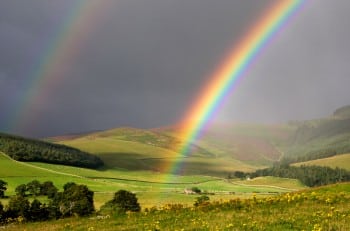
    WEATHER FORECASTS were always things for older people, like manners and leaf tea. And indeed for olden days: D-Day was only possible because of some superhuman advance-weather-divining from a sage in Blacksod. Many of the ‘War’ generation seemed obsessed with the weather forecast, well beyond the point of refusing to acknowledge its shocking deviance. The weather forecast was the most tedious thing on television. Of course, in Ireland, you couldn’t make plans. Outside of sustained heat waves, no one in Ireland should plan a picnic or barbecue in advance. So you never did. I never cared. I just got on with it. Operationally, you just had to look at the sky when you got up out of your bed and assume it would last. Equally, in Ireland, there was always a good chance of grey. Like today only greyer. Beyond that it seemed pointless, and unyouthful, to speculate. But there are other decisions – a snap weekend away, a walk, dependant others to be born in mind, that may depend on an accurate weather forecast – and so with age you find yourself seeking comfort in experts. And when you pay attention you find they nearly always seem to get it wrong. It’s not that they get it wrong with hurricanes, snowstorms and heatwaves, it’s that they get it wrong – all the time – saying it’s going to shine, or rain, where you’re going to be. The first thing to notice, even before they get it wrong, is that they smother you with ambiguity, those beguiling, soothing-tongued prognosticators: ‘Sunshine and scattered showers, in the West’. ‘Partly clear becoming cloudy, with a risk of rainspells, in the afternoon’. ‘Fine becoming fair’ It means nothing. Words like ‘should’, ‘possibly’, ‘probably’, ‘may’, ‘likely’, ‘some’ and of course ‘occasional’ compound the cloudiness. Getting it wrong is the weather forecaster’s speciality. One study found that when television meteorologists in Kansas predicted that there was a 100 percent chance of rain, it didn’t rain at all a third of the time. On the evening before the worst storm to hit the UK for almost 300 years, the BBC’s well-liked Michael Fish proclaimed on the night of October 15, 1987: “Earlier on today, apparently, a woman rang the BBC and said she heard there was a hurricane on the way. Well, if you’re watching, don’t worry, there isn’t”. There was; and gales at 115mph caused utter devastation across the southern half of the country, leaving 18 people dead, 15 million trees flattened, and damage of £2bn. Though his boss, Bill Giles – the lead forecaster for the station – took the blame for the mistake in 2011, the term “Michael Fish moment” is applied to public forecasts, on any topic, which turn out to be embarrassingly wrong. On September 29, 2016 the National Hurricane Center in Miami announced that Hurricane Matthew was nothing to worry about just before it exploded into a Category 5 monster that slammed Haiti, killing over 1,000 people before moving on to wreaking 30 mortalities in the US. In Ireland, during the big freeze of January 2010, Batt O’Keeffe, as minister for education, directed all schools to close for three days, based on a Met Éireann forecast of snow and ice. A thaw immediately kicked in, and he ignominiously rescinded his decision. Documents released under freedom of information to thejournal.ie a few years ago revealed widespread anger at this carry on in Ireland. Typical letters to the Met service were: “How can Met Eireann get away with wrong forecasts so much, I am baffled? If another service provider got it wrong so much, that service provider would be long gone… Met Eireann says one thing and the sky above our heads says another”. “What a joke. From forecasting that today would be mostly sunny yesterday to now saying it will be dull and cloudy. This is not forecasting, it’s nowcasting”. Some years ago Donegal County Council decided to start up its own weather-forecast website because RTÉ was reporting the north-west as a constant wash-out when Donegal had in fact had a scorcher of a summer. However, let’s be clear: the issue of regional bias is a different problem which I don’t want to get into (because it’s ludicrous). I’m talking here just about inaccuracy. Last year dodgy councillor and hotel mogul, Donegal’s Sean McEniff, threatened to sue Met Éireann for money lost by cancelled business. He instructed his solicitors to investigate the possibility of legal action against Met Éireann over what he claimed as an inaccurate weather forecast. Sadly he died shortly after the instruction. The main problem, it seems to me, is that the weather in Ireland is made over the seas, particularly the vast Atlantic ocean but also the Irish sea, and so varies over very small distances. If you live in Germany or Colorado there’s simply less sea to go around and you can see the weather coming. We’re also precariously positioned in a zone of complex transition between warm, moist air (sometimes of tropical origin) moving northwards and colder, denser, drier air (usually of polar origin) which is moving southwards. This is the devious and manipulative ‘polar front’ that ruins so many weekends. Nevertheless it is claimed, by those concerned only with the facts, that one-day forecasts have an average accuracy within 2 degrees, and that they predict rain (or a lack thereof) correctly 82 percent of the time. That drops to 70 per cent at three days, but even the seven-day forecast has a 50 per cent chance of being accurate. The UK Met Office does a 10-day forecast but – wisely, given its reputation – has ditched its seasonal forecasting which really never amounted to much more than hubris. In April 2009 the Met Office had unwisely issued a press release about the oncoming summer – “barbecue weather”. But it was a washout. A project at the 2018 Young Scientists Exhibition tended to absolve Met Éireann: two boys from Avondale Community School concluded that: “The

    Loading

    Read more

  • Posted in:

    Unturning The Stones On Murder

    See below : The Press Ombudsman has upheld part of a complaint that Village magazine breached the Code of Practice of the Press Council of Ireland. The complaint was made under Principle 1 (Truth and Accuracy) of the Code of Practice. Other parts of the complaint are not upheld. Among the issues that have delayed the restoration of power-sharing government in the North is the failure of the DUP and the British government to honour previously-made agreements to deal with what are known as legacy issues. These include a promise to establish some form of historic truth commission to investigate the role of the British state and its security forces in the killing of hundreds of people during the conflict. A documentary film, ‘No Stone Unturned’, examines the deaths of six Catholic men in the Heights bar in Loughinisland, County Down, in June 1994, just three months before the first IRA ceasefire in August 1994. The men were shot dead while watching the Republic of Ireland play Italy in the World Cup on 18 June, when two masked loyalists walked into the bar and one fired indiscriminately at the customers and staff. Those murders were the subject of a 2016 report by the Police Ombudsman of Northern Ireland which found, following an earlier whitewash by the same office, evidence of Royal Ulster Constabulary (RUC) collusion in the protection of Loyalist paramilitary informants, who may have carried out the murders. While he found no evidence that the police knew in advance about the murder plot, the Ombudsman was heavily critical of how the RUC Special Branch handled informers, and failed robustly to disrupt the activities of UVF paramilitaries operating in south Down and to share intelligence with detectives investigating this UVF gang. He claimed there was a “hear no evil, see no evil, speak no evil” approach. The 160-page report by Dr Michael Maguire also found police informants at the most senior levels within loyalist paramilitary organisations were involved in the importation of guns and ammunition. In the film, made by Oscar-winning director, Alex Gibney, three loyalists who were involved in the attack are identified, while it is claimed that the automatic rifle used was among a large consignment imported into the North with the knowledge of the RUC Special Branch and MI5 in the late 1980s. One of those named, Ronald Hawthorn, and his wife Hilary, were among those arrested following the massacre, but have never been charged, while another loyalist, Gorman McMullen, is named in the documentary as the getaway driver. A second attacker is also named and is believed to have left the North in the late 1990s and re-settled in England. The film claims that Hilary Hawthorn identified the gang members, including her husband, in two calls she made to an anonymous police phone line in the wake of the killings, and in an unsigned letter sent to a former SDLP councillor. Her voice was recognised by police officers with whom Hilary Hawthorn worked in an RUC station, while in the anonymous letter she also claimed to have been involved in the planning of the attack. Ronald Hawthorn was arrested and questioned in August 1994, just weeks after the atrocity, while his wife was detained a year later. Neither was ever charged in connection with the killings. The documentary explains that Ronald Hawthorn was only named as ‘Person A’ by the Police Ombudsman, Dr Michael Maguire, who did not disclose the names of the three suspects, in a detailed and shocking report published in 2016. Another confidential and unpublished report prepared by Office of the Police Ombudsman of Northern Ireland (PONI) identified the suspects by name. It was subsequently sent anonymously by post to journalist Barry McCaffrey, who has spent years researching the Loughlinisland killings and who helped to make ‘No Stone Unturned’. The PSNI is currently investigating the leaking of this confidential document to McCaffrey. The published PONI report by Dr Maguire sets out how the killings were carried out by the UVF which directed its members in Down and Antrim to organise attacks on nationalists following the killing of three of its members on the Shankill Road by the INLA in early June 1994. The Ombudsman concluded that there was collusion in the Loughinisland killings involving unnamed members of the RUC. He found that the VZ58 rifle used in the attack and subsequently used in a wide range of loyalist murders was part of a consignment imported from South Africa by police and MI5 informant, Brian Nelson, in late 1987 or early 1988. Maguire wrote: “My conclusion is that the initial investigation into the murders at Loughinisland was characterised in too many instances by incompetence, indifference and neglect. This despite the assertions by the police that no stone would be left unturned to find the killers. My review of the police investigation has revealed significant failures in relation to the handling of suspects, exhibits, forensic strategy, crime scene management, house to house enquiries and investigative maintenance. The failure to conduct early intelligence-led arrests was particularly significant and seriously undermined the investigation into those responsible for the murders”. During the attack, Maguire said, “one of the masked men crouched down, shouted ‘Fenian Bastards’ and opened fire indiscriminately with an automatic assault rifle. Both men then fled the scene in a waiting Triumph Acclaim car driven by an accomplice. The car was driven in the direction of Annacloy and found the next morning abandoned in a field on the Listooder Road between Crossgar and Ballynahinch. The car was destroyed while in possession of the police in 1995”. The Ombudsman recorded how the families of the victims complained at the time that the vehicle should have been retained for potential future examination, especially in light of advances in forensic science. They state that police “wilfully destroyed” this exhibit, which they viewed as “wholly unsatisfactory and unreasonable”. Dr Maguire said: “In addition, investigative opportunities were undermined by the way in which information relating to those involved in the

    Loading

    Read more

  • Posted in:

    Acting Deep, and Acting Shallow

    In September, Elisabeth Moss twice used the word “fuck” as she accepted the best-actress Emmy for her role in the TV series ‘The Handmaid’s Tale’. As it was a live broadcast, the network (CBS) was using a time delay and so was able to bleep out the offending words. There were many reports online and on television in the hours and days that followed about the gaffe. None of them included the actual “fucks” as they were never broadcast, but then neither did practically all of the reporting outlets use the word either, opting for “f-bomb” or “f—” instead. Perhaps the attack on puritanism, which is at the heart of the show and the novel it is based on, is more necessary even than the liberal media establishment thinks. And yet, was it a gaffe? Two other gestures by Moss on that night may cast some light on the matter. First, the soles of her shoes had the handwritten message “off” on one shoe and, presumably, “fuck” on the other. The credit for this is perhaps equally due to her stylist, Karla Welch, who displayed the sole of the “off” shoe on Instagram with this message: “You”ll have to guess what the other shoes says.… our note to the patriarchy #teamresistance”. This “fuck” goes unseen, just as the other went unheard, but the message is clear enough. The other notable gesture by Moss from the same ceremony is captured in a cheekily smiling photo of her holding two award statues with her right middle finger raised to the camera. This did the rounds on Instagram too, after Moss posted it on her own profile. Those “fucks” seem a little less spontaneous now. And so what?, you may ask. The reason why this celebrity tittle-tattle is of interest is that Moss is a Scientologist, and her behaviour on the night was analysed by some commentators as being a deliberate Scientologist ploy. In a story that circulated in very similar versions on The Hollywood Reporter, Mashable, The New York Daily News and elsewhere, Moss’s speech is described as following the Scientologist practice of ‘going down the tone scale’ in public utterances, in order to make yourself more relatable to the average person. High-tone speech and behaviour are a turn-off, apparently, and Moss’s actions at the Emmys and various other on-camera bird-flipping incidents down the years are alleged to fit this kind of deceptive thinking. So what is real, and what is acted, in her actions? It’s an interesting question because her profession is to act, and she is undoubtedly excellent in ‘The Handmaid’s Tale’, as she has been in the two seasons of ‘Top of the Lake’, and as she was for years in ‘Mad Men’. In all of these, her major roles, Moss plays an obedient, or obedient-seeming, efficient performer of tasks expected of her, who occasionally and dramatically breaches the bounds that she ought to respect. These flashes are what keeps us interested in her. And they are the moments when we think we might be able to see the real actor, the common thread of her concerns working across various TV stories. ‘The Handmaid’s Tale’ is the story of women who live as sex slaves and are forced to be surrogate mothers in a misogynistic near-future America. The problem that the dystopian society faces with these ‘handmaids’ is that they are impossible to live without, as they are the only fertile women left, and they are impossible to live with, as the narrative makes clear. As a result, they are made visible and invisible. They cannot be imprisoned in some cage in the basement because their role in society is sacred and ceremonialised. So they are imprisoned in a fully public, open prison. They may not speak out of turn, they may not show their faces and they may not have any independent existence. They do not even have enough power over their own lives to be able to end them. Their mode of speech and interacting with one another is a way of expressing this odd position. The costumes and the sexual politics, and the frontierism of a society under threat from an unnamed enemy, all point to puritanical America (and England). The characters must act a certain way with one another and speak in a highly coded manner. As part of their training for this new acting role in society, they are forced to publicly condemn each others’ previous lives in the abhorrent finishing school that is the segue between the end of their normal, pre-dystopia lives and the beginning of their lives as handmaids. Much of the enjoyment of watching the characters in this show comes from trying to interpret whether this emotional labour that the women are performing is merely on the surface, or deeply felt. The distinction is that between what is known as shallow acting, which is the smile and bare minimum of eye contact you get at a burger restaurant, and deep acting, where people in service positions really align their inner beliefs with those of the organisations they work for. In ‘The Handmaid’s Tale’, we gradually realise that all of the handmaids are engaged in shallow acting, and this realisation has the force of making them seem to be liberated on the inside, and lends optimism to their plight, and opens up the possibility of a second season (which is on the way). Many critics of Scientology, whose numbers are legion, have pointed out the irony that Moss is receiving accolades for her portrayal of a victim of a totalitarian cult. Viewing her in this light, and examining her actions and words on that Emmy night, are we confronted with the maniacal, glazed-eye, single-mindedness of the cult member, trapped inside a web of self-deceiving, selfimproving, self-belief that Scientology helps people be, as Moss herself has recently said, “a better you, not necessarily changing who you are”? Is any of this important? Does it matter that it is Moss who delivers

    Loading

    Read more

  • Posted in:

    Social History Isn’t History With Politics Left Out

    2016 was inevitably an outstanding year for the history industry as publishers, writers, and those elements of the intelligentsia that love a good commemoration got to work on the Easter Rebellion’s hundredth anniversary. The Irish people have an interesting relationship with their own history. It is, like their relationship to Catholicism, frequently the subject of fervent debate, at certain period followed slavishly as orthodoxy, and on other occasions the subject of shame. In the more modern Ireland that began to emerge from the 1960s a new revisionism took hold about the history itself. Revisionism itself became a pejorative term as scepticism about our history joined forces with those who would be sceptical about the benefit of Catholic Ireland. In the 1970s liberalism, secularism and scepticism about nationalism ascended. The first historical-revisionist tract was produced by a Jesuit priest named Fr Francis Shaw. His scepticism about 1916 was so overt that it was thought best to delay publication for six years as the country was, in 1966, fervidly commemorating Easter Rising anniversaries. Fr Shaw’s revisionism seems mild by the yardstick of today – he blamed 1916 for the division of Ireland, the Civil War and the fact that little or no commemoration was possible of those who gave their lives in World War I. Eunan O’Halpin and Guy Beiner take us through the various commemorations in Irish life in their essay ‘Remembering and Forgetting’ as a final input to the exhaustive and very stimulating ‘Cambridge Social History of Modern Ireland’. What this book reminds you of is the timely and regular nature through which historians not only review earlier conclusions but also attempt to put a new narrative account on what has previously been thought of as undisputed territory. it is noteworthy that one of the best-selling books on the 1916 centenary celebrations was a book about how children were treated though the week-long rebellion. The editors of the Cambridge Social History, Mary Daly, Professor Emeritus of Modern History at UCD, and Eugenio Biagini, Professor of Modern and Contemporary History at the University of Cambridge, are quick to point out that social history is not just history with the ‘politics’ left out. That said, they are robustly critical of an over-emphasis on political, constitutional, and institutional histories of Ireland. “Our emphasis is on economic and social change, our focus on people and cultures, instead of institutions and political ideologies”, they assert in their introduction. The book suggests a purposeful placing of Irish history in the context of wider European and global events. This is challenging stuff but with 40 distinct contributors cover ground of interest to both academic and general readers. The wide-ranging topics include previously taboo subject matter like sex and class in Ireland. Thankfully, as historian Joe Lee acknowledged in his Irish Times review, this is not a textbook. More than half the contributors are based outside of Ireland, which again shows a purposeful focus on diversity of thought by the editors. Lee has said of this book that the historian’s delight is a reviewer’s nightmare. The book is not a rainy-day read. One of the great tragedies of recent Irish scholarship is the number of posts in economic and social history that have either fallen vacant or simply just not been continued. It is to be hoped that Irish universities and corporate philanthropy will re-discover the benefits of social and economic history and invest in it. My own view is that local history, as well as social and economic history, deserves investment to counterbalance the overarching political narrative. Amongst the essays included here is one by Terence Dooley, Professor of Modern History at Maynooth University, on the fate of the Big House, the preserve of the ascendancy class and a symbol of an Ireland that is now essentially gone. Dooley deals both with the social destruction of that class but also the physical destruction of its physical heritage. This still makes for sad reading, in particular, when one looks at the Department of Finance’s memorandum in 1929, declining to take Russborough House in Wicklow, one of Ireland’s greatest houses, into state ownership because it was only of interest to “connoisseurs of architecture” and had never been associated “with any outstanding events or personalities in Irish history”. Despite the obvious neurosis that afflicted the early state with regard to the Big House there should surely be now an argument for a much more comprehensive policy to preserve heritage properties of every description, if only to assuage tourism’s endless search for new venues and more enchanted and more promotable ways. Henry Patterson, Emeritus Professor of Irish Politics at Ulster University, takes up the challenge of Irish working class experience and why, despite the best efforts, this did not translate into support for the Irish Labour party. He quotes UCD economist Cormac O’Gráda as acknowledging that by 1939 Fianna Fáil had become the party of the working class. Even the 1970s were never socialist. Moreover, unsurprisingly the recent displacement of the Labour party has been at the hands of a resurgent Sinn Féin which is reaping an electoral harvest and an indelible presence in working-class areas, from peace in our time. Patterson (‘The Irish Working Class and the Role of the State, 1850-2016) acknowledges why working-class politics made so small an impression on Irish life, pointing to the obvious conservatism and anti-communism of the Catholic Church and the fact that James Connolly threw in his lot with nationalism as a progressive force in Irish life. The other reason that class consciousness never took hold in Ireland is probably the existence of the Big House and the ascendancy class. The fact that the ruling class in Irish society were not drawn from the majority Catholic population meant that for several hundred years radicals had no class enemy to tilt at but the ascendancy. Jennifer Todd, Professor of Politics at UCD, and Joseph Ruane, Emeritus Professor of Sociology at UCC, make a timely point (‘Elite Formation, the Professions, Industry and the Middle

    Loading

    Read more

  • Posted in:

    Clear Limerick

    A crisis provides a chance for change. Now is the time to pull back from proposed light rail spending that doesn’t deliver value for money…

    Loading

    Read more