Architecture

Random entry RSS

  • Posted in:

    Dublin’s North Inner City

    Dublin’s North City fell out of fashion after the flight of the future Duke of Leinster to Kildare St and the Act of Union. That’s more than two centuries ago and the journey back has been slow. It suffered shocking poverty over succeeding generations, the collapse of world-class mansions into tenements, dereliction, the flight of nearly all private residents and a drugs and crime epidemic. In the last twenty-five years it has been subjected to an inundation of third-rate private-sector apartments, the re- division of many old houses including the removal of period features and a pogrom of gang killings. It has also witnessed wholesale immigration and a degree of cultural diversity. It has a dramatic need for new apartments but the focus for new development in 2018 appears to be hotels and (high-quality if expensive) student housing, not – perhaps because standards are in flux – apartments. It seems likely a naïve Minister for Housing and Planning will indulge a reduction in building-height standards that may compromise perhaps the area’s principal attraction, its historic human scale. CONSERVATION The focus of this piece is on one small new pattern of development: some exciting conservation projects. ORMOND QUAY The construction of Ormond Quay Upper and Lower – named after James Butler, 1st Duke of Ormonde – began during the 1670s with the development of the former lands of St. Mary’s Abbey by Sir Humphrey Jervis, and with the setting out of a formal quay-line and carriageway as part of the Corporation’s grant of substantial lands to Jonathan Amory in 1675. These developments were facilitated by the construction of two bridges under the auspices of Jervis linking the walled medieval city with the new north-side suburbs: Essex Bridge (now Grattan Bridge), erected in the late 1670s, and Ormond Bridge (now O’Donovan Rossa Bridge), completed by 1684. The speculative development of the quay front soon followed, with the lands of Ormond Quay Upper developed as a fashionable residential parade with associated commercial uses under the freehold of Lord Santry, Henry Barry.   1-1A ORMOND QUAY LOWER The house on the corner of Capel Street and Lower Ormond Quay is most famous from its appearance on a late-18th-century Malton print (the ones you find on greasy place mats and on bathroom walls in Dublin 6) with a view across the river to the then Custom House where the Clarence Hotel now stands. It’s been derelict for twenty years since it served as offices for a solicitors firm fronted by Liam Cosgrave Junior who was disgraced after unedifying information about planning corruption emerged in the planning tribunal. It comprises an existing four-storey over basement protected structure with four bays and two shopfronts facing Ormond Quay and two bays with one shopfront facing Capel Street. The shopfronts are shuttered and now messy. There was previously a fast food restaurant at street level. The façade of the building is rendered and in a poor state of repair; however, there are interesting features including arched windows at first-floor level and corner quoins. Permission has been granted for development comprising conservation and a change of use at first, second and third floor levels from commercial occupancy to use as short-term-lease guest suites and change of use of the ground floor and basement to restaurant/cafe use, supervised by James Kelly of Kelly and Cogan Architects. Indeed it might be argued that in view of the strategic significance of the site, facing the overblown Temple Bar, in effect an ambassador for the North Side, public uses – pub or restaurant – might have been suitable for the entire building. The site of No 1 Capel Street was originally occupied by a larger house, which also occupied part of neighbouring plots. The exact age of the building is unclear but it is shown on a map dating from 1784, and also on a 1795 image by James Malton. The building was used as the state lottery office before 1800 and was then in a variety of uses including draper, feather merchant, stationer, bookseller and bookbinder in addition to briefly accommodating solicitors’ offices. By the mid-19th-century the building had been stucco-finished, with quoin detailing and decorative moulding added. The facade to the quays was partly blank but included an arched window at street level. During the Civil War in 1922 the façade and shopfront of the building were damaged. A new shopfront was then provided on the façade to Ormond Quay, which was divided into two parts and included a new entrance lobby onto the quays, though access to the building was, and remains, tricky with narrow pavement on two sides and a torrent of parking-free traffic down the quays. By the late 20th century the retail/commercial unit at ground floor level had been subdivided. It is stated that the building has been largely unaltered since the late eighteenth century, with the exception of the alterations to the shopfront and the plastering over the original brick façade. Original fabric, including the gothic rounded headed windows to Capel Street and the quays, survives, as do internal joinery works including architraves, staircase and doors. The building retains its commercial character, while the original plan form is substantially intact. 18 UPPER ORMOND QUAY On Upper Ormond Quay, to the South of the area, the Dublin Civic Trust is leading a project to restore an interconnected pair of riverfront merchant buildings. – the quayside house dates to 1842-43 and the rear building to the 1760s. The four-storey over basement house includes a rare arcaded Georgian shopfront composed from cut granite of, depending on who you listen to, a date of 1789 or around 1810. This is the most challenging and transformative building project the under-celebrated Trust has embarked on since its foundation in 1992 and is one of the most significant initiatives of its kind in Ireland. Both buildings require extensive structural stabilisation and careful conservation of fabric. The project will restore residential use to the upper floors and traditional shop use below. Number 18 started life as a river-fronting

    Loading

    Read more

  • Posted in:

    Vulnerable Monsters

    Emma Gilleece reviews ‘SOS Brutalism: a Global Survey’; published by Park Books, 2017 (RRP €68) ‘SOS Brutalism; A Global Survey’ is the first-ever international survey of Brutalist architecture from the 1950s to the 1970s, a collaboration by the Deutsches Architekturmuseum DAM and the Wüstenrot Foundation. It is an understatement to say that this book is a colossal contribution to architectural discourse and twentieth-century conservation. As explored in its essays, even the process of defining this enigmatic genre, still muscular and enthralling after almost 65 years is like grasping wet soap. Each contributor eagerly tries to grip it with the same enthusiasm and excitement that these Brutalist pioneers must have felt when their concrete ‘monsters’ were taking shape. Nevertheless, the debates and divisions are all part and of Brutalism’s contrary appeal. Cult Status The godfather of modern architectural criticism, Kenneth Frampton, contextualises Brutalism in the foreword to the book, incisively distinguishing it for example from the“people’s detailing” of the shallow-pitched, tile roofs, cavity brick walls, invariably white “amiable, unchallenging, anti-street, garden-city aesthetic” which “came under therubric of contemporary architecture asopposed to the pre-war notion of a severelyabstract modern architecture”. The scope of the database of brutalist constructions, contained in an accompanying tome, is staggering: more than 750 pages. It was an important basis for the selection of the book’s 120 case-studies from twelveregions extending to Africa, the Middle Eastand Oceania. Accompanying the survey are essays from its editors and contributors exploring questions such as whether a building is now Brutalist, or merely a late-modern, exposed-concrete, edifice; the discrepancy between the terms New Brutalism and Brutalism; contemporary efforts to preserve Brutalist buildings across the globe and theassumed continuity debate. The goal of the book is to spotlight the evaluation and preservation of the heritage value of Brutalist works. This is no small task for Brutalism is divisive. Popular Culture The compiling of the database sosbrutalism.org by architectural crowd-sourcing, reflects the egalitarian nature of Brutalism mirrored by the role social media has played in Brutalism’s renaissance. For example, think of the international reach to thePreston Bus Station campaign in 2012 which swung its fate from razing to Grade II listing. In recent years Brutalist architecture has achieved a second flowering (cementing?)on social media where its images bulge and captivate. However, there is also a renewed interest in Brutalism in scientific journals, symposia and exhibitions. It appears it’s position in the cycle of fashion and derision is upwardly bound. Perhaps not uncoincidentally, too late for many exemplars. The database was launched in October 2015 with 250 entries. By September 2017, ithad grown to 1,100 Brutalist buildings, many formerly undercelebrated, of which 120 are endangered through neglect or intended demolition. Experts, architectural buffs and photographers contributed to the survey either by contacting them directly, or by adopting the #SOSBrutalism hashtag. The Irish Contribution The only Irish case study is Stephenson, Gibney and Associates’ practice head-quarters Molyneaux House, Dublin (1971- 73)written by Erika Hanna. Hanna describes the now anachronistic attitudes not only of that firm but also of Irish planning at that time: “They also publicly delighted in confounding the conservation lobby and were at the center of the most high-profle controversies…demolishing a Georgian streetscape to construct offices for the Electricity Supply Board; building the bunkerish Civic offices on the remains of Viking Dublin;and erecting the Central Bank building higher than its planning permission permitted”. In the endangered list for Ireland they include; the IDA Small Business Centre(1983), by Scott Tallon Walker, highlighted inred as under threat; Stephenson and Gibney’s Fitzwilliam Lawn Tennis Club (1973); and the Ulster Museum Extension by Francis Pym (1962-64). Sadly Fitzwilton House (1964-1969) by Shoolheifer and Burley is in red but will soon be crossed out by demolition. With the refurbishment of the former Central Bank on Dame Street, this book and the publication later this year of ‘More Than Concrete Blocks: Dublin City’s Twentieth-century buildings and their stories, 1940 – 73 Vol. II’ (Dublin, Four Courts Press), no doubt Brutalism will attract new fans overcoming the visceral aesthetic contempt always evident from those with unimaginative good taste.   Design This hardback is accompanied by a bonus paperback supplement of contributions made to the international symposium on Brutalism that took place in Berlin in May 2012. The retro, voguishly-burlap-bound book perfectlycaptures its scintillating subject era. Many will recognisethe book’s nod to the design of Reyner Banham’s seminal book The New ‘Brutalism: Ethic or aesthetic?’ (1966), the bible of Brutalism which knew, as times were changing, heralded its death. The photographs, both colourand atmospheric black-and-white; sketches; plans andsections make it a joy to turn each page and the list in the Appendix counterpoints the easy joy with evocations of the arresting magnitude of the speed and scaleof loss. The Appendix lists 986 buildings as of September 2017. Threatened/endangered buildings are markedred, demolished buildings are crossed out. Geographic coordinates are provided. More Than a Catalogue More than a catalogue, the book’s fantastically researched essays try to define elusive Brutalism, charting its rise and fall and pinpointing its appeal. The movement went beyond aesthetics. These buildings are embedded in the debates of their time when questions of design profoundly refracted a larger political context.Although an international movement, it was regionally-embedded coinciding with a period of decolonisation and nation-building (Africa, Asia), of reconstruction (Europe, Japan), and of rapid modernisation (North/Latin America, Middle East). Wherever we look, Brutalist buildings leered, all over the world, in most political systems. How many Brutalisms are there? Did the end of Brutalism coincide with the fall of thewelfare state and the beginning of neoliberalism? Did Brutalism become too costly atsome point, because the labour required for customised sculptural products was too expensive? Oliver Eiser’s essay, ‘Just what isit that Makes Brutalism Today so Appealing’,decrees that a new form of Brutalist architecture is long overdue. Annette Busse inher paper, ‘From brut to Brutalism, Developments between 1900 and 1955’, delves into the significance of the difference in the meaning of the words brut and brutal in English, French and German; and into the

    Loading

    Read more

  • Posted in:

    Referee!

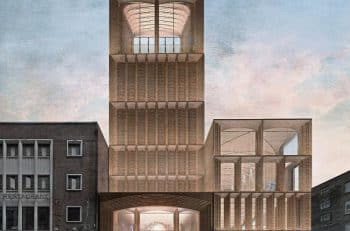
    On-side Rugby is religion for Limerick. The city mercifully did not inherit the class exclusivity associated with the sport. In the latter decades of the twentieth century Munster victories, usually over Leinster, sustained Limerick’s morale in the face of prejudice. In gratitude its City and County Council has granted permission for a rugby museum which will shoehorn a seven-storey show-stopper into a Georgian streetscape. With a rugby hero and a billionaire philanthropist tax-exile fronting the project they have the public on side. Does the new class of money and celebrity overrule our planning laws? The Players A new sports museum for Limerick, was announced in December 2016. Its applicants were Rugby World Experience Ltd set up that same year with a registered address in Lucan, Co. Dublin. It has three Directors: Chairman Paul O’Connell, Paul Foley and Sue-Ann Foley. Former Ireland, Munster and Irish Lions captain Paul O’Connell, Limerick native, basso profundo, family giant, Lidl man of squeaky cleanliness is the perfect frontman. Paul Foley is a former Limerick City Council Senior Executive Officer in the Department of Economic and Planning Development. Sue-Ann Foley is the daughter of JP McManus. Limerick’s greatest/richest son, and Chair of the JP McManus Benevolent Fund. The Coach John Patrick ‘JP’ McManus, money-trader and gambler, hails from humble beginnings but has for 30 years been resident in tax-friendly Geneva, Switzerland, while retaining a suite at the Dorchester Hotel in London. He is a doughty force in Limerick, particularly in Limerick City and County Council which even has a hall named after his most famous horse, Istabraq. His charity has funded schools, palliative care units, and every type of local sports clubs. Any criticism against a JP McManus project in Limerick is an attack on Santa Claus. It is McManus’ €10m seed funding that is making this project happen. O’Connell has said the rugby museum was a notion put to him by JP McManus during his playing days, but the idea has gained momentum since he retired. The Dashing Out-Half An unexpected dash for Rugby World Experience was the commissioning of renowned London-based, Irish-born architect Níall McLaughlin, twice shortlisted for the Royal Institute of British Architects Stirling Prize. His work includes the extension to the National History Museum London, the Carmelite Prayer room in St Teresa’s Church Dublin and college buildings in Oxford and Cambridge. Try The museum would be of scintillating contemporary design with, it is hoped, a sensitive palette of materials, mainly brick in keeping with the Georgian aesthetic. However, the architect’s report admits that “the brick selection and brickwork quality will present a challenge and it may be decided to use precast panels”. High Tackle The proposal is for a seven-storey building, 32-metres high (the architect originally intended the tower to be 36 metres in height), with a two-storey portico fronting O’Connell Street, and a two-storey block to the rear. There would be a three-storey block built over the existing Fine’s Jewellers, at the junction of O’Connell Street and Cecil Street. Inside, the development would see the existing buildings’ 1335sqm floor area increased to 2787 sqm “multi-media visitor experience, exhibition and education space”, plus retail (81sqm) and café (83sqm) at ground-floor level. The scheme is context-free: a bold attempt to subvert an aesthetic built up over centuries by breaching the established building height on Limerick’s main street, its beating heart. The design also self-consciously does not replicate the Georgian fenestration rhythm perhaps in an effort to minimise the perception of extra floors. Spear tackle The plan involves the razing of 40 and 41 O’Connell Street, and of 1 Cecil Street, a corner site on two prominent streetscapes within Newtown Pery, Limerick’s Georgian area. The Beautiful Game Lewis’ Topographical Dictionary of 1837 called Limerick’s Newtown Pery “one of the handsomest modern towns in Ireland”. The historic Georgian city is an example of ambitious eighteenth-century Italian-inspired town planning whose integrity should be respected through the retention of the characteristic continuous heights and building-frontage alignment that contributes to a quality unrivalled anywhere in the world, albeit that it has been allowed to dilapidate. Substitution The buildings that stand in the way are not protected but are listed on the National Inventory for Architectural Heritage, an indication that national government thinks they merit protection. There have been some changes to them over the second half of the twentieth century, including the cement-rendering of the façade, the replacement of an earlier shop front and the blocking up of window openings on the side elevation. These could easily be removed. The off-side rule Both sides of this site sit within an Architectural Conservation Area (ACA), protected under Section 81 of the Planning and Development Act 2000-2008 which states that an ACA is: “a place, area, group of structures or townscape, taking account of building lines and heights, that is of special architectural, historical, archaeological, artistic, cultural, scientific, social or technical interest”. ACA protections extend to the carrying out of works to the exterior of a building within the Area regardless of whether or not it’s a protected structure. The aim of designating areas is to protect their “special characteristics and distinctive features” from inappropriate actions. The ‘Statement of Character and Identification of Key Threats’ set out in Chapter 10 of the Limerick City and County Development Plan 2010-2016 notes: “This ACA constitutes the core heart of Limerick City’s Georgian Heritage within the City Centre…The streets of Newtown Pery represent a unique example of eighteenth and nineteenth-century planning in Ireland…The streets leading to The Crescent and Pery Square conform to eighteenth-century town planning, defining the streetscape by their adherence to fixed proportions and ordered harmonious symmetry. They combine to form an architectural heritage of great urbanity and considerable beauty”. This appears damning for McLaughlin’s acontextual, proportionately unfixed, asymetrical and inharmonious effort. But the ACA statement goes on: “The irregularity which emerged in relation to the treatment of heights, facades, and type of buildings combined with the rigid street pattern gives Georgian Limerick a distinct sense of place…All of these

    Loading

    Read more