attack

Random entry RSS

  • Posted in:

    As sad as Assad

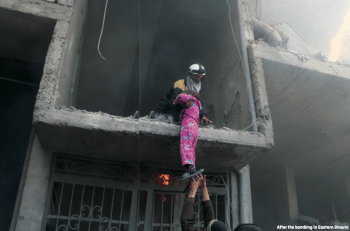
    Unthinkable suffering The Syrian army’s apparent chemical attack on Douma on April 7 was the worst atrocity of an infernal six-week military campaign in Eastern Ghouta. This in turn was the latest horrific chapter in a war lasting seven years which has brought unthinkable suffering to millions of innocent civilians. The relentless bombardment of Eastern Ghouta, backed by Russia and Iran, follows a cruel siege of the area lasting almost five years. These events reflect the most destructive and tragic elements of human nature: when ruthless powers encircle and terrorise the vulnerable, unchecked by any higher authority. The scenes being broadcast from the region are glimpses into an abyss of inhumanity – children being dragged from underneath rubble, parents convulsed with grief, neighbourhoods reduced to debris. The repeated bombing of hospitals and obstruction of aid convoys entering Ghouta are the most depraved aspects of the Syrian army campaign. They are examples of what Holocaust survivor Primo Levi called “useless violence” – suffering inflicted for its own sake and for no other purpose. Putin’s geo-political game Russian President Vladimir Putin has been providing military and diplomatic support to Bashar al-Assad since 2015 when he was losing the Syrian civil war – partly to secure Russian economic interests and partly to assert Russia’s dominance over the US in the region. The civilians of Eastern Ghouta are pawns in Putin’s geo-political game, and it appears he faces little consequence for directing this inferno of mayhem and bloodshed from Moscow. The wholesale destruction of Eastern Ghouta resembles the fate suffered by Aleppo and Homs earlier in the Syrian war and by Grozny, capital of Chechnya, during Putin’s first venture in politicised mass killing, a year into his reign. In each of these war zones the wretched plight of civilians incited him to an extreme of merciless aggression. Putin and al-Assad appear to share a psychopathic relish for attacking the weak. Aerial footage of Aleppo after the worst bombardments in 2016 showed apocalyptic scenes of ruination. The Russian and Syrian forces may as well have dropped a nuclear bomb on this once thriving, exotic city. Night after night on our television screens we are witnessing similar destruction and misery visited upon another mass of civilians, and hearing the same lies from Russian and Syrian officials who deny appalling events that are plain for all the world to see. Footage now emerging of Eastern Ghouta reveals almost a carbon copy of the haunted, hollowed-out cityscape that remains of Aleppo. Syria abandoned Article 1 of the Charter of the United Nations, set out at its inception in 1945, committed members to “tak[ing] effective collective measures for the prevention and removal of threats to the peace, and for the suppression of acts of aggression or other breaches of the peace”. Humanitarian protections for civilians in war zones were enshrined in the UN’s Fourth Geneva Convention of 1949. Grave breaches of these conventions include “wilful killing”, “wilfully causing great suffering or serious injury” and “making the civilian population or individual civilians the object of attack”, all of which have without question been perpetrated on Eastern Ghouta. The UN as it currently stands is nothing more than a politically redundant talking shop for Syria. Hand-wringing about the awfulness of the latest atrocity is invariably followed by diplomatic paralysis. Where power is concentrated most – among China, the US and the EU – moral courage appears absent. The US government, supported by the UK and France, mounted a sharp military response to the chemical assault on Douma, as it did last April when 80 civilians were killed by nerve agents dropped by Syrian army planes in Idlib province. We could ask why the relentless killing of civilians by every other weapon imaginable does not warrant intervention. As before, it is likely that such a measure will not be followed by substantive protections for Syrian civilians who will remain at the mercy of al-Assad and Putin. It primarily served as a show of US military might and of Trump’s willingness to impose a supposed tougher line than Obama on chemical weapons. It   also conveniently shifted public attention from the Mueller investigation into Trump’s alleged links with the Russian administration during his election campaign. An international peace-keeping force The Syrian conflict is a complex and deadly quagmire, involving armies and militias from several countries. Any attempt to resolve it is fraught with risk. And yet the choice to allow this slaughter of innocents to continue is a defilement of our collective humanity. If a large international peace-keeping ground force were based in Syria Putin would be far more cautious in the use of his military power there, and in his sanctioning of al-Assad’s violence. This would require courage from several of the world’s most powerful nations and would involve some risk to the domestic popularity of their leaders. It would be a show of collective strength to cold-blooded autocrats who answer to nothing else. A long-term political settlement is another challenge altogether, but in the interim this would give some protection to civilians caught up in the war. Putin and his allies have been emboldened for too long by having no limits placed on their behaviour and by the implied international attitude that the lives of Syrian civilians are not of much value to the rest of the world. Liam Quaide Liam Quaide is a clinical psychologist and the Green party election candidate for East Cork

    Loading

    Read more

  • Posted in:

    Some devils got him

    The Westminster terrorist attack on 22 March of last year, by lone attacker, Khalid Masood (52), who drove a car into pedestrians and fatally stabbed PC Keith Palmer, is not the first time that terrorists have selected the Palace of Westminster, and its surrounds, to perpetrate an act of violence. 39 years ago, on 30 March 1979, the Irish National Liberation Army (INLA) murdered Airey Neave, Conservative MP and Margaret Thatcher’s shadow secretary of state for Northern Ireland, in a devastating car bomb attack. Apart from reaffirming Thatcher’s determination to defeat Republican paramilitaries, Neave’s assassination robbed the Conservative Party of one of its most open-minded, albeit controversial, thinkers on Northern Ireland. By the standards of the day, Neave was a remarkable figure. On the one hand, he was a public figure: war-hero, writer, barrister and politician. He had escaped from Colditz, a Nazi prisoner of war camp during the Second World War; was the author of five semi-autobiographical books; established a practice at the bar; and was Conservative Party MP for Abington, 1953-1979. On the other hand, he was an elusive and secretive individual, retaining close links to the British Secret Intelligence Service throughout his adult life. During the Second World War he worked for MI9, a subsidiary of MI6, later holding the rank of commanding officer of the Intelligence School 9, Territorial Army (TA). Neave’s greatest contribution to political life came in the autumn of his career, following his promotion as shadow secretary of state for Northern Ireland in 1975. Neave’s appointment to Thatcher’s shadow cabinet, in the wake of her election as leader of the Conservative Party in February 1975, had important ramifications for the Conservative Party’s Northern Ireland policy. From the moment he took up his new shadow cabinet portfolio, until his murder by the INLA, Neave’s “first priority”, as he noted in April 1978, was to defeat Republican terrorism. Although often preoccupied by security-related issues, and despite misguided arguments to the contrary, Neave remained committed to finding a workable solution in the hope of ending direct rule in Northern Ireland. As a pragmatist, confronted by the political reality that the mainstream political parties in Northern Ireland could not agree on the terms of devolution, he instead championed reform of local government in Northern Ireland, as an interim measure. By initially supporting the establishment of his so-called ‘Council of State’, subsequently followed by a proposal to create one or more Regional Councils in Northern Ireland, Neave sought to end, as he phrased it in November 1977, `’civil servants’ paradise`’, which existed under direct rule. Unfortunately, Neave’s assassination by the INLA robbed him of the opportunity to implement his proposals to reform local government in Northern Ireland.   New archival material from Neave’s personal papers and the National Archives of the UK iliuminate the events of 30 March 1979. Neave commenced his working day, like any other. Following breakfast, he left his at at Westminster Gardens, got into his powder-blue Vauxhall Cavalier saloon, and made the short journey to the houses of Parliament, the Palace of Westminster. His morning was spent preparing for the forthcoming British general election (scheduled for 3 May) and dealing with day-to-day constituency matters. Following lunch, he decided to stop for the day and return home to spend time with his wife Diana. It was in the members’ lobby that Neave held his last conversations, chatting to colleagues before crossing to the members’ exit and taking the lift to the five- floor underground car-park to pick up his car. At 2.58p.m., an enormous explosion engulfed New Palace Yard. Soon after, as Neave’s sole biographer Paul Routledge wrote, smoke was seen billowing from the smouldering wreckage of a Vauxhall car on the ramp leading up from the MP’s underground car-park. It was a “haunting image”, with sheets of headed house of Commons writing paper “blowing gently in the breeze”, recalled Lord Lexden, Neave’s former political advisor on Northern Ireland. Police officers rushed to the scene and came upon an unidentifiable man, dressed in a black coat and striped trousers. Initially, the victim was believed to be Alan Lee Williams, a Labour MP. In fact, in the car lay sixty-three-year-old Neave. Surveying the burning wreckage, the mangled frame of the car and the glassless windows, it was apparent that some type of bomb had exploded. “He’s still alive! Clear the area!”, a policeman shouted. Within minutes, an ambulance crew arrived to find the still unidentified figure, who was breathing, slumped over the steering wheel, his face burned beyond recognition. A doctor, nurse and firefighters soon joined the entourage, before Neave, with his right leg blown off below the knee, was eventually freed after half an hour. He was quickly taken to Westminster Hospital where he underwent emergency surgery. It was too late. Neave died on the operating table. Thatcher received news of Neave’s murder while preparing for a party-political general-election broadcast at BBC headquarters. Her first thought was reportedly: “Please God, don’t let it be Airey”. When it was confirmed that Neave was indeed the victim Thatcher was described as “numb with shock”. Later that day she informed a BBC reporter that “… some devils got him and they must never, never, never be allowed to triumph, they must never prevail”. Following Neave’s murder, attention immediately turned to who had perpetrated this brutal crime. Initially, the Provisional Irish Republican Army (PIRA) claimed responsibility. In fact, the real perpetrators were the INLA. Formed in 1975, with a pledge to establish a “republican and socialist” state, the movement had previously been known as the People’s Liberation Army, having sprung up in late 1974, when the Official IRA attacked members of the newly formed Irish Republican Socialist Party (IRSP). At the time of Neave’s death, it was believed that the INLA had approximately 60 active members. The INLA basked in the publicity following Neave’s murder. A spokesperson for the terrorist organisation said that Neave’s assassination “had a tonic effect in Northern Ireland where there had been celebrations in Belfast,

    Loading

    Read more

  • Posted in:

    Review 2015 in Village

    January The Minister for Health, Leo Varadkar, reveals he is gay to a receptive Miriam O’Callaghan, becoming the first openly-gay government minister in Ireland. The Irish economy is not some kind of exemplar, says President Michael D Higgins, controversially but magnificently. Mahon tribunal reverses its finding of corruption against Ray Burke because the tribunal never revealed that whistleblower, James Gogarty, had made unsupportable allegations against the likes of Nora Owen, TD, and Supreme Court justice, Seamus Henchy. Nobody names the lax lawyers, who permitted it, or demands return of their fees. SIPTU’s Jack O’Connor sets out principles for a Charter for parties on the Left.   February 13 men aged 50-70 to appear before the bank inquiry; no women. Gardai arrest Paul Murphy, TD, along with three other anti-austerity activists and politicians, leading to public speculation about “political policing”. Former Fianna Fáil minister Pat Carey reveals his homosexuality publicly. The Irish Times announces the reintroduction of a paywall for its website, beginning on February 23. Michael D Higgins gives us another poem. March Solicitor Brian O’Donnell barricades himself into his Palace in Killiney with help from the ironically titled Land League. The Sunday Independent reports that O’Donnell scion, Blaise, didn’t know how rich his parents had made him. Contrariwise, The Mail reports Blaise got a €156m London office block from Dad. Ireland’s rugby year peaks with Six Nations Championship. Belfast County Court finds Asher’s Bakery guilty of discrimination for refusing to bake an ‘Eric’n’Ernie’ cake bearing a pro-gay-marraige slogan. april Joan Burton proposes a cap on the property tax when the freeze on increases start to register, at the end of the year. Minister Alan Kelly to allow builders of one-off houses to opt out of the usual building-control certification requirements. John Fitzgerald writes that borrowing to fund the bank bailout costs around €1bn a year, a small fraction of the total fiscal adjustment of €30bn since 2008. Gerry Adams tells CBS he never pulled a trigger, ordered a murder or set off a bomb during the war in the North. Ed Moloney, of course, disputes this. May A smug Jeremy Paxman, on the verge of retirement, lays into British Labour leader, Ed Miliband, on Newsnight and is overheard at end asking “are you ok, Ed?”. Miliband says “yeah” and wonders if Paxman is himself ok. Broadcaster and political editor of the TV3 television channel, Ursula Halligan, publicly declared her homosexuality and her support for a ‘yes’ vote for marriage for homosexuals and lesbians in the Constitutional marriage equality referendum. Competition Authority finally getting serious over CRH. Mary Harney promised investigation a political generation ago. Broadcasters Bill O’Herlihy and Derek Davis died. Charles, Prince of Wales, and his wife visited the west of Ireland, including Mullaghmore, County Sligo, where his great-uncle, Lord Mountbatten, was murdered by an IRA bomb in 1979. Referendum on two amendments to the Constitution – the 34th (marriage equality) wins; and the 35th (presidential election voting) loses. NY Times and Guardian, Village and Broadsheet. ie publish the Dáil Record of Catherine Murphy’s allegations about Denis O’Brien’s banking arrangments. The Irish Times, Independent, Mail, Sunday Business Post wait for clarification from the courts. June Strong, clear clarification from High Court on the unambiguous existence of the privilege for Dail utterances. Binchy J as predicted clarifies that he never intended, nor could it have been intended, his comments would apply to reporting of utterances in the Dail. Exciting dream team of Catherine Murphy, Stephen Donnelly and Roisin Shortall to form Social Democrat party. RTE tells Atheist Ireland it will reconsider the title of the Angelus Ireland’s poorest kids hit by lone-parent payment cut. “We are not God,” acknowledges Pope Francis, and we shouldn’t “trample his creation underfoot.” The average American woman now weighs 166 pounds — as much as the average 1960s man. Dutch government ordered by court to cut carbon emissions in landmark ruling. Central bank Governor Patrick Honohan explains “the bank guarantee should not have included subordinated debt nor existing senior-term debt”. Joan Burton slams social welfare fraudsters for “giving two fingers to their neighbours”. July The hottest month in history Brian Cowen scathingly tells the banking inquiry his ‘friends and colleagues’ were private people not bankers though doesn’t explain relaptionship with Fintan Drury, or golf. Media consider performance a triumph. Greece votes no to bailout plan but government imposes it anyway. Yanis Varoufakis resigns as Greek Finance Minister. august IS destroys 200 year old temple in Palymyra, Syria. September INBS, Michael Fingleton appears before Oireachtas banking inquiry but is let off hook Radical socialist Jeremy Corbyn elected leader of British Labour Party. October Five adults and five child Travellers die after fire at Carrickmines, Residents object to rehousing of the survivors nearby. Budget will reduce USC but is light on plans for investment. The Archbishop of Dublin, Diarmuid Martin tells a synod of bishops in Rome that Irish people “struggle to understand abstract moral principles” and that the recent debate about same-sex marriage in Ireland has been conducted by lay people in language that traditionally belongs to the Roman Catholic Church: ‘equality, compassion, respect and tolerance’”. November Judge Brian Cregan announces he does not have the legal powers necessary to conduct his inquiry into write-off sales of loans by IBRC do not allow him to. 130 people murdered by IS in Paris. Peter Robinson says he will resign as First Minister. Former Minister Pat Carey resigns after improper media leaks about alleged paedophilia. December IFA President Eddie Downey declares he has been thrown under a bus by his colleagues after it was revealed he received €147,000 annually and CEO, Pat Smith, half a million annually, from often impoverished farmers. David Cameron announces Britain’s intention to bomb IS in Syria.

    Loading

    Read more