changement

Random entry RSS

  • Posted in:

    Equality over freedom

    Politics is a continuum from equality to freedom. If freedom is the vertical axis of a graph and equality the horizontal axis, every society – and every citizen – decides where the balance should be. A libertarian society tending towards survival of the fittest will not foster equality; an egalitarian society may need to be enforced by a strong state to the detriment of individual licence, and so on. Philosophers from Tocqueville to Hayek to mainstream liberals accept there is a trade-off. Village tends to the egalitarian end of the scale: truly free equality, after education and reflection – precise processes for which have been touted by many modern philosophers – is a mature and more stable goal than equal freedom. Workaday politics can be charted and defined on the graph. However, the same political action can be justified by different points on the graph. Issues like divorce, gay marriage, and abortion can be deemed imperatives of either freedom or equality. In this respect the language used is not a definitive indicator of the politics. A campaign can claim to be about equality but in fact on analysis be defined by positions only of freedom. Any campaign fronted by Simon Harris or Leo Varadkar – agents above all of the propertied, of the status quo for the wealthy – is unlikely to be rooted in any real substantive equality. It is perfectly legitimate to campaign for gay marriage or abortion because you want yourself or others to exercise rights to freedom to get married or have an abortion. Telltale signs if you do so you may include that you are less likely to make common cause with campaigns for others suffering discrimination of all sorts. You may ignore issues like racial equality, Travellers rights; you may express no concern about economic, social and educational inequalities. It is legitimate but it is not Village’s political motivation of preference. For Village recent referendums reached the right solutions but were disappointingly rooted in the politics of freedom rather than that of equality. The egregious wrongs in Irish society are best resolved by solutions driven by equality. This society above all facilitates those who are economically adroit. It provides opportunity for people who are strong; worse still it provides opportunity for them to make mistakes (trashing the environment is the one posterity will most register). It provides very little vision as to how they should exercise their freedoms. – this is in part the problem of 100 channels but nothing on the television. But on a societal scale. It is now time to move on to new agendas that are really radical. These include: agendas of radical redistribution of wealth in society, of radical changes to the opportunities available to those who have suffered traditional discrimination, including (still) to women and to those of minority sexual orientations, to racial minorities including Travellers; of educational opportunities facilitated by positive discrimination so even (or especially) the poorest in society can be whoever they want to be; of redistribution of power so it is exercised at the lowest, most local, most democratic levels; of attenuation of property rights so they are exercised in the common good. The goods in society should be distributed by that society so those least well off are most compensated. Everyone in society is morally equal, they should be treated by society in a way so they can participate in the fruits of the earth equally. It is a myth that the fruits of the earth are distributed in accordance with merit – they have been accumulated largely by force and luck. The idea that in 2018 a child’s future is determined by the time it reaches two years old is an abomination. Ireland is growing up politically. Ireland has waved good-bye to the invidious influence of an unrealistic Church and voted the right way on divorce, gay rights and abortion. However, these are really liberal causes focused on issues of identity. It is time we addressed the issues of endemic inequality enshrined down the generations. As regards the Constitution we do need to abolish Article 41 which recognises the woman’s life within the home, so devaluing women who choose not to work within the home; and to eliminate the part of the preamble which invokes the Constitution “in the name of the Holy Spirit”. Indeed the Constitution’s premises relate to another era and the whole document should be reconceived. More generally, materialism, capitalism and competition have had their day, it is time to welcome in a new agenda – of equality of outcome/condition: equality of wealth and power, of quality of life, of environment, of education, of fulfilment and happiness, of respect and opportunity. This should be achieved through politics and laws. The constitution should be amended to reflect it too. The most radical change would be to enshrine equality of outcome/condition as a constitutional imperative across the range.

    Loading

    Read more

  • Posted in:

    Panoramaphosa

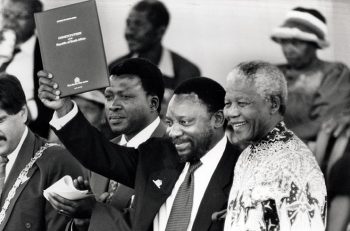
    On a recent drive to Cape Town International airport the ‘Rainbow Nation’ was nowhere to be seen. Instead it was like old times when I was the Irish Times Correspondent there in the 1990s. The scene carried a strong message of the work that faces the country’s new President Cyril Ramaphosa. Along the motorway known as ‘Settlers Way’ there was a clear run out of town to deposit the hired car and catch the early-morning flight to Lanseria north of Johannesburg. The other carriageway, the one carrying traffic into the city centre, told an entirely different story. On that side the traffic was chock-a-block and consisted almost in its entirety of white minibuses carrying black workers from the vast townships of Gugulethu, Langa and elsewhere. They were travelling in their thousands to service the needs of the white population of the city and its wealthy suburbs. Earlier that week in Franschhoek, a tourist and wine-producing town , it was also like old times. The restaurants were full of white folk of retirement age being served by waiters from the Black and Cape Coloured Communities. In Johannesburg restaurants things were different but only slightly. There were tables occupied by white clients and tables occupied by black clients but no tables at which blacks and whites dined together. These casual and anecdotal observations don’t tell the full story but they are an indication of how deeply-ingrained apartheid and its legacy have been in South African society. It will take a very long time and a great deal of patience to make significant changes but there is no doubt that the country’s new President, Cyril Ramaphosa, is a patient man. -Nelson Mandela indicated that Ramaphosa was his preferred successor but the African National Congress (ANC) was, and still is, a very complicated organisation and as in most African countries ethnic loyalties played their part in the succession stakes. Ramaphosa is a member of the small Venda nation. His opponent for the vice- presidency and eventual presidency, Thabo Mbeki, was a Xhosa, a group that produced Mandela himself, his political partners Oliver Tambo and Walter Sisulu as well as the influential churchman Archbishop Desmond Tutu. Nelson Mandela merely indicated a preference for Ramaphosa but his estranged wife Winnie mobilised the ANC Youth League behind Mbeki’s candidacy. Ramaphosa’s time for campaigning had been limited due to his involvement in negotiations on a new Constitution. All these factors: tribes, internal ANC politics and time constraints played their part in his defeat by Mbeki. Ramaphosa had to wait until December of 2017 before he could make his move. Mbeki, a small bookish man with a penchant for the poetry of W B Yeats, fell under the spell of American pseudo-scientists who peddled the theory that HIV did not cause AIDS. The result for South Africa was disastrous but the ANC’s response was predictable. As a former liberation movement, loyalty had been vital to the organisation’s very existence during the struggle against the apartheid regime but it became a hindrance to progress after the party came to power. ANC loyalty kept Mbeki in power amid a catastrophic AIDS epidemic, just as it kept Jacob Zuma in a presidency that smacked of intense corruption and maladministration. After Mbeki had won the nomination to become Mandela’s vice-president, Ramaphosa made a rare rash decision. He refused to attend Nelson Mandela’s presidential inauguration in Pretoria in 1994. From then on, however, he matured and played a political waiting game, concentrating on business opportunities that made him one of South Africa’s wealthiest men with a personal fortune of more than $550 million. During that time Zuma, a member of the Zulu nation, the country’s largest ethnicity, became entangled in a web of deals with the Guptas, a wealthy Indian business family. Corruption allegations abounded and a new glossary of political terms was spawned, the most prominent of which was ‘State Capture’ suggesting much more than personal corruption. The phrase indicates the belief that the entire State and its institutions had been ‘captured’ by the Guptas and their allies in the ANC. And Zuma was not the only ‘captured’ ANC member. In Parliament, as the popular newspaper City Press recently put it, six ministers sat in what it has been tempted to call the “Gupta Corner” of the Government front bench. Ramaphosa has recaptured the cabinet in a quick reshuffle in order to get moving but by doing so has increased tensions and enmity within his own party. The ANC’s traditional loyalty to its leader in this instance could provide a positive counteraction to its negative effects in the past. He has got off to an energetic start, setting out on early-morning exercises in his Ronald McDonald socks in various parts of the country, ranging from the promenade at the prosperous Cape Town suburb of Sea Point, to the beach at East London; and on a long walk at 5.30 am in the Cape from the black Township of Gugulethu to the ‘coloured’ community of Athlone. In each case these were exercises in building up his profile in local communities as a man of the people instead of his image as a wealthy man who loves fast cars and good wine. In parliament his State of the Nation address was delivered without interruption, a very rare happening in a place where raucous heckling is frequent. In that address he touched on the country’s problems which he has vowed to solve. The education system is in a parlous state. Poverty abounds mainly in non-white areas but also amongst Afrikaans-speaking people who have always had a “poor white” section of their community. Health services need reform. Public transport is almost non-existent with Uber taking over its role especially in white areas. There have been a number of murders of white farmers, and Ramaphosa caused raised eyebrows among them by stating in his address that he would pursue the expropriation, without compensation, of land that had been confiscated from blacks. Right-wing commentators saw their chance and

    Loading

    Read more

  • Posted in:

    Party climate poopers

    To say that environmental issues didn’t have much of an impact on Election 2016 would be a bit like observing that feminism hasn’t exactly been the defining feature of Donald Trump’s exciting US presidential run. The topic was completely ignored in the botched opening Leaders’ Debate on TV3, and again, on RTÉ’s seven-way debate the following week. The Green Party had fallen foul of an internal RTÉ decision to exclude it from a slot among the extended parties. This telling ruling was upheld in the High Court, and sure enough, RTÉ’s Claire Byrne steered the seven leaders through two long hours of questions and answers without a mention of anything remotely environmental. Ironically, the same journalist had dramatically dashed in an Air Corps helicopter only a few weeks earlier to interview some of the latest victims of this winter’s extreme flooding event. This dramatic fare, with long shots of ruined farms and submerged houses, interspersed with heart-rending stories of loss and struggle, is understandably grist for RTÉ’s current affairs mill. It is standard training in journalism to ask the five Ws – who, what, where, when – and why. We are getting lots of who, what, where and when from our media on flooding disasters and other climate- fuelled events, but precious little time is being devoted to that all important final W: why. And the ‘why’ is of course climate change. This vast topic made it into the last few min-includes lots of easy utes of the nal leaders’ debate, where just the savings, by 2020 four main parties were involved. Presenter Miriam O’Callaghan admitted in her introduction to it that it hadn’t featured at all in the campaign up to that point – the media weren’t asking and the politicians sure as hell weren’t going to bring it up spontaneously. O’Callaghan lobbed the climate grenade into the reluctant lap of outgoing Taoiseach, Enda Kenny, who – shocked that there might be an Idea in play – took fright and ubbed his lines. First off, he announced that the EU’s 2020 targets (20% emissions reduction versus 2005) “are targets we cannot reach”. Fair enough. And why, prime minister, would that be? “We have a chance with the abolition of milk quotas to expand greatly the capacity of our national herd…to increase our dairy herd by 50%”. Having fessed up to the fact that Ireland has chosen not to meet its 2020 targets, Kenny then went on to make the following quite extraordinary statement: “The targets that are set for 2030 are dif cult targets, but we will meet them”. The targets he is referring to are for a massive 40% cut in emissions. Given our inability to hit 20%, which includes lots of easy savings, the idea that we can escalate to an infinitely tougher 40% target in just one more decade suggests, to the cynical, that Kenny knows for certain that he will be long gone before the fantasy 40% emissions cuts by 2030 are exposed as a sham. So, the world’s greatest existential threat, according to Mr Kenny, is a distant second to pushing the agri- industrial expansionist agenda on behalf of the IFA and the food PLCs it so often appears to speak on behalf of. These same transnational organisations offshore their tax affairs to ensure the Irish Exchequer gets as little as possible. Glanbia, for example, routed its €40 million profits in 2014 via brass-plate companies with no employees in Luxembourg in order to cut its Irish tax bill to a paltry €200,000, or an effective tax rate of 0.5%. These patriotic enterprises represent, in the view of our Taoiseach, so vital a national interest as to set aside all other considerations to ensure their burger and baby milk powder export operations are in no way impacted by binding international emissions targets. To be fair to Mr Kenny, when asked to choose between agricultural expansion and climate chaos, the three other major party leaders also waffled and equivocated in equal measure, all fearful of riling up the assorted special interest groups that maintain such an effective lock on Irish environmental policy. Both Micheál Martin and Joan Burton did try to point out that the transport sector is on an equally ruinous trajectory, but the clear instruction that O’Callaghan pursued single-mindedly was to pitch climate policy in Ireland as either pro- or anti-farmer. This obsessive focus on agriculture seems to be a rut that RTÉ’s PrimeTime has dug for itself, as reflected in its paltry two efforts at covering climate change since 2009, which have lurched from cack-handed to catastrophic. Having attracted a slew of written complaints, the BAI will rule in the coming weeks on whether PrimeTime’s most recent ‘climate debate’, in early December, was in breach of broadcasting regulations. While climate and environmental issues were squeezed to the periphery of both the media and political framing of Election 2016, there was sufficient to be gleaned from the assorted party manifestos to suggest that whatever coalition is eventually assembled to lead the 32nd Dáil might represent a step forward on the hugely underachieving FG/Labour coalition, and the woeful Alan Kelly in particular. While Labour’s stewardship of the Environment ministry was a huge failure, the loss of outgoing Energy Minister, Alex White is a genuine setback, as he is regarded as one of the few politicians with the brains to truly understand climate change, and the guts to speak publicly on it. Not that it in any way helped his own political cause. The obliteration of Renua signals that the Irish public is in no mood to return to the simple-minded moral certainties of the 1980s. For the Green Party, turning a 2.8% national share of vote into two seats was an impressive achievement; whether such slender representation can really add a green hue to the new Dáil remains to be seen. While both Labour and the Green Party have plenty of useful things to say about addressing climate change and moving Ireland towards decarbonisation, given that the two

    Loading

    Read more