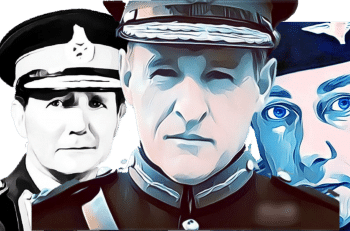
David Cleary

Random entry RSS

  • Posted in:

    Bloody Sunday murderers operated a mobile torture chamber. By David Burke.

    Introduction. The brutality displayed by David Cleary (Soldier F) and Ron Cook (Soldier G) of 1 Para on Bloody Sunday in Derry on 30 January 1972 was not an aberration. After murdering a string of unarmed civilians,  they were taken to Fort George where they beat up a group of innocent prisoners including a priest. They then returned to Belfast. What is revealed here for the first time is how they used the armoured personnel carrier or ‘pig’ assigned to them as a mobile torture chamber to electrocute people in Belfast in the weeks after Bloody Sunday. 1. Murder Cleary is alive and may yet face criminal charges for his actions on Bloody Sunday when he and Cook (who is dead) were conveyed in their ‘pig’ into the Bogside at speed. They leapt out of the vehicle and took up positions behind a low wall adjacent to a ramp on Kells Walk from where they shot Michael Kelly. Kelly was unarmed and standing at a nearby rubble barricade, a threat to no one. Cleary, Cook, ‘Corporal E’  and ‘Private H’, [the EFGH unit] moved into Glenfada Park North, where their killing spree continued. The Saville Inquiry found that Cleary or Soldier H shot William McKinney dead; also that this unit was responsible for the shot that wounded Joe Mahon;  and that either Cleary or Cook fired the shot that wounded Joe Friel. Saville opined that the EFGH unit also murdered William Wray; injured Joe McMahon, Joe Friel, Michael Quinn and Patrick O’Donnell; and possibly injured Daniel Gillespie. There was no excuse for their behaviour. According to Saville: In our view none of the soldiers fired in the belief that he might have identified a person in possession of or using or about to use bombs or firearms. Saville also found that: The last gunfire casualties were Bernard McGuigan, Patrick Doherty, Patrick Campbell and Daniel McGowan, all shot in the area to the south of Block 2 of the Rossville Flats within a very short time of each other. We are sure that Lance Corporal F fired at and shot Bernard McGuigan and Patrick Doherty, and it is highly probable that he was also responsible for shooting the other two casualties. This soldier fired across Rossville Street from the Rossville Street entrance way into Glenfada North. Cleary was a cruel, cynical and clinical killer. He shot Patrick Doherty in the buttock while he was on the ground crawling away from him. As Doherty lay crying out in pain, his life draining away from him, Barney McGuigan, an exceptionally brave and humane man, stepped forward with a white handkerchief looking to help Doherty. Cleary dropped to one knee, aimed his rifle and shot McGuigan in the head. 2. ‘Beasting’ of prisoners After the shootings, Cleary and Cook led the ‘beasting’ of prisoners at Fort George in Derry. According to a local priest, Fr Terence O’Keeffe, who was among the prisoners, G had “scary eyes” and an “almost psychotic look”. The pair “roamed” among the prisoners, stamping on their feet, kneeing them in the groin, forcing their faces up against electric heaters, spitting in their mouths and engaging in other acts of “idle brutality”. Fr O’Keeffe recalled Cook as having had “the sadistic edge” on Cleary. See also: Soldier G – real name Ron Cook – the Bloody Sunday killer with ‘the sadistic edge’ over his ‘partner’, Soldier F. By David Burke. 3. Torture and mutilation When they got back to Belfast they showed no remorse.  Byron Lewis (Soldier 027)  was a radio operator who accompanied them on their patrols. In 1975 he provided an account which was discovered by Tom McGurk in 1997. This key discovery led to the establishment of the Saville Inquiry as it constituted new evidence. Some passages from it were published in The Sunday Business Post, and later at Saville. The unpublished passages – quoted here for the first time – reveal that a few weeks after Bloody Sunday, Cleary and Cook and others were briefed by ‘Lieutenant 119’, another veteran of Bloody Sunday, for an operation at the  Divis Flats on the Falls Road. According to Lewis “several blokes”, by which he means young Catholic residents of the area were “beasted severely”.  He was in a pig parked in between the main tower and the annex 30 or 40 metres away was [Redacted] pig on waste ground among some derelict buildings. Beyond that could be seen the glow of the fires. Then I noticed [Cook] and [Cleary] running towards the pig with a bloke bent double between them. They kept him going head first into the armour plating. The bang was quite audible where I was. He was temporarily knocked out but was revived and thrown into the back of the pig. There was a purpose in hauling the prisoner to the back of the ‘pig’. Cleary and Cook had prepared it for the torture of any prisoner they brought back to it.  Lewis wrote: The most fiendish screams and squeals then let loose [Cleary and Cook] had wired [the captive] to the batteries and were electrocuting him. Lewis and his comrades in 1 Para referred to other regiments of the military as ‘crap-hats’. The ‘crap-hats’ on duty with them let the torture session continue. As Lewis has revealed: Meanwhile during this racket the [Commanding Officer] of the crap-hats had walked over to where I was standing. He remarked about what was happening. [Soldier H] and I passed it off lightly. He then went on to ask if we had been in Derry the previous month. On answering, yes, he turned and walked away with an air of turning a blind eye. This deplorable behaviour was not confined to F and G. Lewis reveals that: At this point the other pig disappeared for ten minutes. The bloke inside had been castrated, electrocuted, the features of his face sliced with a knife and generally kicked and beaten. Lt 119 was also aware of what was going on but

    Loading

    Read more

  • Posted in:

    David Cleary, mass murderer, aka Soldier F, named in Ireland's parliament. How will Twitter respond?

    Deputy Peadar Tóibín, leader of Aontú, referred to Soldier F by his real name, David James Cleary, in  Dáil Éireann, the Irish parliament, yesterday (9 February). Cleary was a cruel, cynical and clinical killer. He shot Patrick Doherty in the buttock on Bloody Sunday while he was on the ground crawling away from him. The bullet tore up his spine. As Doherty lay crying out in pain, his life draining away from him, Barney McGuigan, an exceptionally brave and humane man, stepped forward with a white handkerchief looking to help Doherty. Cleary dropped to one knee, aimed his rifle and shot McGuigan in the head. A UK injunction prohibiting the naming of Cleary does not apply in the Republic of Ireland.  The Cathaoirleach of the Dáil had no difficulty with Deputy Tóibín’s contribution. Village magazine named Cleary last year in a series of articles about the Ballymurphy massacre and Bloody Sunday. Twitter suspended our account after a tweet we issued named the soldier. Other accounts were suspended too, including one belonging to the brother of one of those murdered on Bloody Sunday. In a move that is the very definition of perversity, the PSNI are threatening to prosecute him. One can imagine the international outcry that will ensue if the force pursues a prosecution. The Irish contingent in the US Congress will be incandescent. There will be an anger that will unify Dáil Éireann as one if they dare proceed.  The fact that Cleary has been named by Deputy Tóibín under Dáil privilege has been tweeted and retweeted by a number of people living in the Republic of Ireland. Cleary’s name is now permanently available on the website of the Oireachtas. It will be interesting to see how Twitter responds this time around. A TikToc with a recent photo of the former 1 Para lance corporal is in circulation. Yet another recent colour photograph has been transmitted on Twitter (the publication of this picture did not lead to a suspension of the relevant, presumably as it went under the Twitter radar.)  Deputy Tóibín’s contribution was made as part of a question he put to the Taoiseach. Micheál Martin had no difficulty with the fact Cleary was named. Deputy Tóibín’s question was as follows: Ten days ago the Taoiseach laid a wreath at the Bloody Sunday Memorial in Derry. At the time and since then the Taoiseach has indicated the families of those who were lost, who were murdered, on Bloody Sunday need to find justice. We are looking at the likelihood that there is going to be an amnesty. If there is an amnesty in the North of Ireland, it means there is no rule of law and that the perpetrators will get away with murder. I attended the 50th anniversary of the Ballymurphy massacre, and speaker after speaker got up on the trailer that day and said the British Government quite simply wants to get away with murder. That is what is happening here. Over recent debates in which I have participated, I have made an effort to name every single victim of the Bloody Sunday massacre, the Ballymurphy massacre, the Springhill massacre, the murders that were researched in Operation Greenwich and those today in the Ombudsman’s report. Is it not shocking that we know the names of the people who lost their lives, the people who were murdered, but we do not know the names of the people who perpetrated those murders. Most people, for example, would not know Lance Corporal David James Cleary, better known as Soldier F, who is accused of murdering civilians on Bloody Sunday. Most people would not know the alphabet of British Army perpetrators of murder. We need to ensure people know their names. The Taoiseach has recounted what has happened, but I am asking him what steps will he take to ensure those names are known throughout the country for the murders they have committed. The Taoiseach responded as follows: In the first instance, I have told the Deputy what we are doing. I do not agree with the amnesty at all and I do not take it as a likelihood. The Irish Government has entered into discussions with the British Government and all of the parties in Northern Ireland in respect of the proposals that emanated from the British Government last year. We have made it very clear we do not accept any unilateral actions in respect of legacy that would represent a breach of the Good Friday Agreement and subsequent agreements. OTHER STORIES ABOUT BLOODY SUNDAY, THE BALLYMURPHY MASSACRE, BRIGADIER FRANK KITSON AND COLONEL DEREK WILFORD ON THIS WEBSITE: Bloody Sunday: Brigadier Frank Kitson and MI5 denounced in Dail Eireann   The covert plan to smash the IRA in Derry on Bloody Sunday by David Burke Soldier F’s Bloody Sunday secrets. David Cleary knows enough to blackmail the British government. Learning to kill Colin Wallace: Bloody Sunday, a very personal perspective Lying like a trooper. Internment, murder and vilification. Did Brigadier Kitson instigate the Ballymurphy massacre smear campaign? Where was Soldier F and his ‘gallant’ death squad during it? Another bloody mess. Frank Kitson’s contribution to the wars in Afghanistan and Iraq. 300,000 have died in Afghanistan since 1979. Lying like a trooper. Internment, murder and vilification. Did Brigadier Kitson instigate the Ballymurphy massacre smear campaign? Where was Soldier F and his ‘gallant’ death squad during it? A Foul Unfinished Business. The shortcomings of, and plots against, Saville’s Bloody Sunday Inquiry. Kitson’s Private Army: the thugs, killers and racists who terrorised Belfast and Derry. Soldier F was one of their number. Soldier F and Brigadier Kitson’s elite ‘EFGH’ death squad: a murderous dirty-tricks pattern is emerging which links Ballymurphy with Bloody Sunday. A second soldier involved in both events was ‘mentioned in despatches’ at the behest of Kitson for his alleged bravery in the face of the enemy. Mentioned in Despatches. Brigadier Kitson and Soldier F were honoured in the London Gazette for their gallantry in the face of the enemy

    Loading

    Read more

  • Posted in:

    Soldier F’s Bloody Sunday secrets. David Cleary knows enough to blackmail the British government.

    By David Burke, author of ‘Kitson’s Irish War: Mastermind of the Dirty War in Ireland’. 1. Kitson’s Private Army. Lance Corporal David Cleary was a member of the elite Support Company of the 1st Parachute Regiment which was commanded by Colonel Derek Wilford. Wilford reported upwards to Brigadier Frank Kitson. All were assigned to 39 Brigade area which operated in Belfast and its environs. Support Company of 1 Para was known as ‘Kitson’s Private Army’ and was infamous for its brutal behaviour in Belfast. Kitson reported upwards to General Ford at British Army HQNI at Thiepval Barracks, Lisburn. Lance Corporal Cleary was ‘gazetted’ or  ‘mentioned in dispatches’ for his “gallant” behaviour during the internment swoops of August 1971. Cleary could not have received that minor honour without the full support of his superiors. Clearly, he was one of the more important soldiers in Kitson’s Private Army. 2. Kitson’s Private Army is sent ‘on loan’ to Derry. Brigadier Patrick MacLellan of 8 Brigade in Derry also reported to General Ford. 1 Para was sent on loan to Brigadier MacLellan to assist him block a NICRA march from reaching the centre of Derry city on 30 January 1972. The troops of 1 Para were merely meant to man a few barriers and be on standby to conduct a possible snatch and arrest operation if rioting by youths got out of hand. On the afternoon of 30 January 1972, Cleary perpetrated his infamous murder spree. There are a number of indications that his behaviour was part of a ruthless counter-insurgency strategy formulated in Belfast behind the back of 8 Brigade. The plan was  to wipe out the IRA in the Bogside and Creggan and put an end to the ‘no-go’ area that had become known around the world as “Free Derry”. The official British narrative is that of Lord Saville. His inquiry concluded in 2010 that Cleary and his colleagues span out of control at the same time, disobeyed orders in unison and murdered unarmed civilians as a pack for some utterly inexplicable reason. 3. Military Intelligence and MI5. A clue as to what happened on Bloody Sunday can be gleaned from the fact British military intelligence and MI5 were in receipt of information that 40 Republican gunmen were going to be present in the vicinity of the Rossville Flats (shown on the map below). The information, however, was fallacious. What is crucial to appreciate is that the spy’s handlers believed the information was true. On Bloody Sunday the troops of Support Company raced up Rossville Street in a convoy of military personnel carriers (‘pigs’) which fanned out into an attack formation as if to confront a salvo of bullets from IRA gunmen. Instead, they encountered the harmless occupants of a nearby barricade and then proceeded to murder them before killing other unarmed civilians in the vicinity. The overwhelming majority of their victime were male and young. Typical, IRA volunteers were young men. Cleary was one of the most violent of the killers. He shot a number of people in the back. One of them was lying on the ground. He aimed at his anus so the bullet would travel up and demolish his spine. He blew apart the skull of another man who was walking towards a fallen victim while waving a piece of cloth. 4. Secret Orders. Aside from two or three Official IRA members who fired a few shots on Bloody Sunday, there were no armed and active Republicans in the Bogside. The Official IRA discharges did not spark the massacre. The Provisional IRA did not take up any arms at all that day. Support Company ended up murdering unarmed civilians, none of whom presented them with any danger. Shortly before the massacre,  Cleary (Soldier F) received a visit from his commander, Colonel Derek Wilford at the yard which the company was using as its temporary HQ beside a church. As Cleary let slip in a statement he made nearly 50 years ago to the Widgery tribunal, the visit was an ‘unusual’ development. For the avoidance of any doubt the word he – Cleary – used in that statement was ‘unusual’. Cleary and his Widgery tribunal minders must have included the reference to Wilford’s visit in the statement as there were multiple witnesses to it. Furthermore, Wilford was scheduled to testify at the Widgery tribunal where he was likely to describe his movements anyway. Cleary, however, did not reveal what orders Wilford gave him during their discussion. Soldier G, another of the  Bloody Sunday killers, was present for the meeting. Wilford probably gave them orders – or confirmed  earlier instructions  – to open fire as soon as they got out of their ‘pig’ at the 40 IRA gunmen the dubious intelligence source has said would be waiting for them. 5. C Company, the fig leaf for the assassins of Support Company. Wilford had taken C Company and Support Company to Derry. The soldiers of C Company dressed in the type of outfits they wore when arresting rioters in Belfast. Their clothing was light. They were unencumbered by equipment. All of this enabled them to run at speed to catch fleeing rioters. They formed up behind Barrier 14 (which can be seen on the left of the illustration with this article). MacLellan’s plan was to divert the NICRA march around the corner between William Street and Rossville Street up towards the Rossville Flats. Officially, C Company was under the command of Brigadier MacLellan of Derry’s 8 Brigade for the day. He had instructed all of the troops of 1 Para to remain on foot and confine their actions to the vicinity of William Street where the rioting was expected to take place. Unlike Support Company which disregarded most of MacLellan’s orders, C Company paid them some heed. 6. General Ford. Bloody Sunday would not have happened if C Company and Support Company had not been ordered into action. MacLellan had not wanted to release them but was told so to

    Loading

    Read more

  • Posted in:

    A Foul Unfinished Business. The shortcomings of, and plots against, Saville’s Bloody Sunday Inquiry.

      By David Burke. 1. 50-year Concerted Cover-up. The British government’s determination to absolve all British soldiers involved in killings during the Troubles means that there are now precious few opportunities to get to the bottom of what really happened during the Ballymurphy massacre and on Bloody Sunday. The Bloody Sunday cover-up went into high gear in April 1972 with the report by the duplicitous Freemason and Lord Chief Justice of England and Wales, Lord Widgery. See: Mission accomplished. The unscrupulous judge who covered-up the Bloody Sunday murders. Soldier F and other paratroopers have been protected by the British State for five decades. None of them now face prosecution. This perversion of justice began with the connivance of the Lord Chief Justice of England and Wales, John Widgery, a former British Army brigadier, Freemason and oath-breaker. 2. A stab in the back: the Ministry of Defence’s charade of sympathy while waging a secret black propaganda campaign of vilification. Widgery’s report was condemned as a whitewash around the globe, something that forced the grey-suited gnomes in Whitehall to plot a course correction within two years of its publication. This involved a pretence at sympathy for the relatives of the 14 murder victims of Bloody Sunday. The charade manifested itself in December 1974 when the Ministry of Defence (MoD) announced that it was going to pay out £41,500 to the families of those killed in Derry as a gesture of “conciliation and goodwill”. Slyly, while this was taking place, a cohort of black propagandists were vilifying the victims of the massacre. The smear campaign was led by Hugh Mooney, T. E. Utley, Brian Crozier and the smearmeisters of the sinister Information Research Department (IRD) of the Foreign Office. The money spent on the various smear campaigns was probably a multiple of the cynical token gesture afforded to the families. The policy of carrot and smear was not a success and the issue remained an open wound. The relatives’ families pressed ahead with a  campaign for justice assisted by an array of activists, artists, lawyers, politicians, authors and journalists. Finally, in January 1998, Tony Blair announced a fresh inquiry to be led by Lord Saville of Newdigate. Blair stated that Widgery had rushed his work, had failed to take evidence from the wounded and had not read the eyewitness accounts personally. 3. A cynical prediction about the likely outcome of the Saville Inquiry. Tom Hayden, a Californian State Senator and former anti-war movement leader, who has studied state-sponsored cover-ups, predicted in 1998 that: “The more cynical analysis of the new Bloody Sunday inquiry under Lord Saville is that it will become another exercise in damage control, with perhaps some new drops of truth leaking out. In this scenario, the innocence of the victims will be reaffirmed once more and responsibility for the shooting lodged with an isolated “rogue” element of the army. Any inference of knowledge, complicity, or accountability at higher echelons will be rejected. A further apology will be offered, compensation paid, and perhaps a memorial constructed. As American cover-up and damage-control specialists would say, “let us bottom this up and get it behind us”. [1]   4. The MoD plots to deny Saville access to witnesses. The Ministry of Defence plotted to thwart Saville from the start. Author Anthony Verrier submitted a statement to Saville warning him that:  “I know several members of the Parachute Regiment. One particular member of the Battalion in question who was present in Derry on Bloody Sunday was a mature student on one of my courses. I discussed Bloody Sunday with him. My understanding from him was that the soldiers had been instructed not to assist the Inquiry. This student told me that he had received a letter from the MoD which said he would be provided with legal advice should he wish to make a statement to the Inquiry but he was advised not to. He did not want to be involved in the Inquiry and did not want to give evidence. I am not sure if he has made a statement to the Inquiry“. [2] 5. Murder as material for comedy. Soldier Cleary, also known as “Soldier F” shot Patrick Doherty in the buttock while he was on the ground crawling away from him. As he lay crying out in pain, Barney McGuigan stepped forward with a white handkerchief looking to help Doherty. Cleary dropped to one knee, aimed his rifle and shot McGuigan in the head. All of the victims of Bloody Sunday were shot in cold blood. None of them posed any sort of a threat to the elite soldiers of Support Company of 1 Para who slaughtered them. Behind closed door, the civil servants at the MoD had little more than disdain for the victims. They gave the game away when, in 1999, Saville asked them about the whereabouts of the rifles which had been discharged on Bloody Sunday, i.e. the murder weapons which had extinguished the lives of 14 people. This sparked an internal email stating: “The Bloody Sunday Inquiry are after records (if any) of what happened to the Bloody Sunday weapons .. On Tuesday the Battle of Hastings Inquiry will want to find the longbow which put Harold’s eye out!”. [3] An email of such depravity could hardly have been circulated as a joke if the employees at the MoD had an ounce of respect or sympathy for the 14 victims, the many wounded, their distraught relatives and the people of Derry. 6. The MoD secures the anonymity of the Bloody Sunday trigger men Saville made his introductory statement at Derry Guildhall on 3 April 1999. Oral hearings began on 27 March 2000, with an opening speech by Christopher Clarke QC, counsel to the Inquiry. The first witness took the stand on 28 November 2000. The tribunal ruled in December 1998 that the soldiers of 1 Para would be named, save in exceptional cases. The Ministry of Defence appealed this ruling to the Court of Appeal which

    Loading

    Read more

  • Posted in:

    Soldier F and Brigadier Kitson’s elite ‘EFGH’ death squad: a murderous dirty-tricks pattern is emerging which links Bloody Sunday with the actions of paratroopers in Belfast in August 1971. A second soldier involved in both events was ‘mentioned in despatches’ at the behest of Kitson for his alleged bravery in the face of the enemy.

      By David Burke. 1. “No other perpetrator involved would be given anonymity, for some reason Soldier F is a protected species”. In the last week, Colum Eastwood MP, the Leader of the SDLP, named ‘Soldier F’, in the House of Commons, under privilege. ‘Soldier F’ had faced murder charges for his actions on Bloody Sunday which had been dropped. The world now knows that former Lance Corporal Cleary is ‘Soldier F’. He is a small man who joined the Parachute Regiment in 1966. Eastwood said that, “For 50 years he has been granted anonymity and now the government want to grant him an amnesty. No one involved in murder during the Troubles should be granted an amnesty.” After his speech, Eastwood told BBC NI that: “Over the past couple of weeks his name has been plastered on Free Derry Corner, it has gone viral on social media. The people of Derry know his name. There is no reason for him to be granted anonymity. No other perpetrator involved would be given anonymity, for some reason Soldier F is a protected species.” The Speaker of the Commons has confirmed that Eastwood did not abuse parliamentary privilege in naming Cleary. 2. David Cleary’s Killing Spree. On Bloody Sunday in January 1972 Cleary was conveyed into the Bogside at speed in a Saracen vehicle or “pig”. He and his colleagues leapt out of it and took up positions behind a low wall adjacent to a ramp on Kells Walk from where they shot Michael Kelly. Kelly was unarmed and standing at a nearby rubble barricade, a threat to no one. Cleary and three of his colleagues, Corporal E, Private G, Private H, [the EFGH unit] moved into Glenfada Park North, where their killing spree continued. The Saville Inquiry found that Cleary or Private H shot William McKinney dead; also that this unit was responsible for the shot that wounded Joe Mahon,  and that either Cleary or Private G fired the shot that wounded Joe Friel. Saville opined that the EFGH unit also murdered William Wray, injured Joe McMahon, Joe Friel, Michael Quinn and Patrick O’Donnell, and possibly injured Daniel Gillespie. There was no excuse for their behaviour. According to Saville: “In our view none of the soldiers fired in the belief that he might have identified a person in possession of or using or about to use bombs or firearms.” Saville also found that: “The last gunfire casualties were Bernard McGuigan, Patrick Doherty, Patrick Campbell and Daniel McGowan, all shot in the area to the south of Block 2 of the Rossville Flats within a very short time of each other. We are sure that Lance Corporal F [i.e. Cleary] fired at and shot Bernard McGuigan and Patrick Doherty, and it is highly probable that he was also responsible for shooting the other two casualties. This soldier fired across Rossville Street from the Rossville Street entrance way into Glenfada North”. Cleary was a cruel, cynical and clinical killer. He shot Patrick Doherty in the buttock while he was on the ground crawling away from him. As Doherty lay crying out in pain, his life draining away from him, Barney McGuigan, an exceptionally brave and humane man, stepped forward with a white handkerchief looking to help Doherty. Cleary dropped to one knee, aimed his rifle and shot McGuigan in the head. Cleary was a cruel, cynical and clinical killer. He shot Patrick Doherty in the buttock while he was on the ground crawling away from him. As Doherty lay crying out in pain, his life draining away from him, Barney McGuigan, an exceptionally brave and humane man, stepped forward with a white handkerchief looking to help Doherty. Cleary dropped to one knee, aimed his rifle and shot McGuigan in the head. 3. A Pat on the Back: mentioned in despatches. Cleary was “mentioned in dispatches” for confronting the enemies of the Queen in the London Gazette in February 1972. This was a few weeks after Bloody Sunday. The citation was for his alleged courage in Belfast the previous August 1971. The odds are astronomically high that Cleary was one of those involved in the shooting of unarmed and innocent civilians in what became known as the Ballymurphy massacre. It is now beginning to look like Cleary and a group of paratroopers attached to the Support Company of the 1st Battalion of the Parachute Regiment (1 Para) were identified, recruited and groomed to carry out the extermination of civilians in any circumstance, including on occasions when they posed no threat to the British Army. The man in charge of Cleary and his comrades was Colonel Derek Wilford. He is on record as having said that all Catholics support the IRA. Thus, to kill a Catholic was tantamount to killing a supporter or member of the IRA. That attitude was undoubtedly shared by Cleary and others in 1 Para. The contempt and disdain they had for Catholics became grotesquely manifest in the Bogside on Bloody Sunday. Wilford reported to Brigadier (later General) Frank Kitson. Of the pair, Kitson is the far more significant. First, he was the superior officer. Second, Wilford did not take over command of 1 Para until July 1971 by which time the soldiers of 1 Para had been engaged in countless violent confrontations with civilians in Belfast. (The murderous violence of 1 Para did, however, gather momentum after Wilford’s appointment.) Third, Kitson had disclosed the technique of terrorising a community which harboured insurgents in his infamous book ‘Low Intensity Operations’. An analysis which makes sense of what took place in Ballymurphy from a British Army counterinsurgency perspective – and which is based on the content of ‘Low Intensity Operations’ –  can be found at: Brigadier Kitson’s motive for murdering unarmed civilians in Ballymurphy. From the standpoint of the British Army, Kitson’s book should never have been published. However, the author was entitled to 50% of the royalties of the sale thereof and this may account for the indiscretion of publishing

    Loading

    Read more