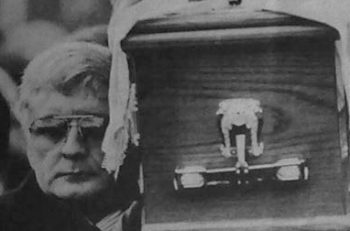
John McMichael

Random entry RSS

  • Posted in:

    The Official IRA planned the murders of journalists Ed Moloney and Vincent Browne.

    An Irish Times insider passed a spiked Ed Moloney article about the Official IRA to its commanders, who spread a rumour he was a terrorist, expecting the UDA would murder him. The material was later published by Vincent Browne inspiring plans by the Official IRA to murder him. By David Burke. Ed Moloney A MEETING WITH THE HARD EDGE OF THE UDA’s INNER COUNCIL Shortly after the February 1982 general election, Ed Moloney of the Irish Times found himself standing in a room “in the office of Andy Tyrie at the UDA’s HQ in Gawn Street on the Newtownards Road” with three senior UDA leaders. The trio included John McMichael, a member of the UDA’s Inner Council and Commander of the Ulster Freedom Fighters (UFF), the name the UDA used when it perpetrated assassination, torture and other acts of violence. The name was used so that the UDA itself would not be proscribed. No-one was fooled, least of all the British government and its security services. The second individual was “a very senior member of the Inner Council who is still alive”. Ed Moloney does not want to name him. The third man was Davy Payne, one of the UDA’s most feared killers and torturers. Like the other two, he was a member of its ‘elite’ Inner Council. John McMichael Moloney still recalls how “Payne was to my left. The other two were to my right. Their presence lent considerable authority to what Payne told me, since these three were the UDA’s main military men on the Inner Council”. Ed Moloney survived his encounter with these men. He continued to work as the Northern Editor of the Irish Times and went on to be voted Irish journalist of the year in 1999. Before the encounter with the UDA, he had worked for  Hibernia and Magill. After his time at the Irish Times, he went to work at the Sunday Tribune. He now lives in New York and publishes a blog, ‘The Broken Elbow’. He has contributed to Village. He is also the author of a string of acclaimed books about the Troubles. A CRITIC OF THE WORKERS PARTY During the course of Moloney’s work he had gathered ample evidence that the Official IRA (OIRA) was still in existence despite claims by its political wing, Sinn Féin the Workers Party (SFWP), to the contrary; and, moreover, that it was engaged in a wide range of criminality including bank robberies and extortion. After SFWP won three seats in the February 1982 general election, the party found itself holding the balance of power. The new SFWP TDs voted for Charles Haughey as Taoiseach in a stark choice between him and Garret FitzGerald of Fine Gael. Dick Walsh of the Irish Times, who was an ally of Cathal Goulding, chief of staff of the Official IRA, was appalled by his party’s support for Haughey. He described the development as a “Hitler-Stalin pact of sorts” in the Irish Times. The pact was never destined to last and Haughey’s government would collapse eight months later when the SFWP deputies withdrew their support. After the February 1982 election, Moloney wrote two pieces for the Northern Notebook of  the Irish Times. He has explained to Village  that one part of the series “dealt with the political journey SFWP had taken to power in the South. That part duly appeared on the Saturday as all Northern Notebooks did”. He submitted a second piece which was not published. It  “dealt with the continued existence of the SFWP’s military wing and the various criminal activities it was involved in, including racketeering and paramilitary activity”. This part “never appeared and I was never officially informed nor given any explanation by the Irish Times.  I cannot even say whether my copy was even shown above the level of sub-editor”. Moloney believes that “the real SFWP/OIRA influence was wielded at sub-editor level where stories could be changed and challenged without senior figures even knowing”. Shockingly, someone in the Irish Times – position unknown – passed the article to the Officials behind Moloney’s back. Moloney subsequently handed the research over to Magill, then edited by Vincent Browne, who published a two-part series on SFWP in March and April 1982. The magazine flew off the shelves and sold out completely. This was egregiously embarrassing for SFWP. It later changed its name to the Workers Party (WP) in an effort to distance itself from the whiff of sulphur that clung to the Sinn Féin part of its old name. Vincent Browne (left); Cathal Goulding on the cover of one of the two 1982 Magill articles which incensed the Official IRA; Ed Moloney (right) As Moloney has confirmed to Village, “I certainly gave Vincent the material I had gathered over the years, including material the IT had refused to publish”. THE MACHIAVELLIAN OFFICIAL IRA PLOT TO MURDER ED MOLONEY That the OIRA tried to set Moloney up for murder is not in doubt. The only issue is whether they did so after the publication of the Magill articles, or before. If it was before, it means that the murder attempt was designed to prevent the information he had gathered from reaching the public. If after, it was an act of revenge and a possible attempt to prevent further revelations. The plot was deeply Machiavellian: two Sinn Féin the Workers Party members told the UDA that Moloney was in the INLA. “Since people like Andy Tyrie and John McMichael knew me and doubted the claim, the UDA stayed its hand. The allegation against me was apparently made to the UDA by two members of Sinn Féin the Workers Party” Moloney has told Village that: “I learned about the threat to my life from the late UDA North Belfast Commander Davy Payne who informed me one day that the UDA had been told that I was a member of the INLA but, since people like Andy Tyrie and John McMichael knew me and doubted the claim, the UDA stayed its hand.

    Loading

    Read more

  • Posted in:

    Did Thatcher sanction the Finucane murder? It is now up to PM Boris Johnson and his Home Secretary, Priti Patel, to order a full judicial inquiry into the murder of Patrick Finucane to establish whether or not Margaret Thatcher gave Sir Patrick Walker, Director-General of MI5, the green light to murder him.

    Update: this article was published in October 2019. One year later the British government has refused to carry out a judicial inquiry. One of the stated reasons is that the PSNI and Police Ombudsman are reviewing the case. However, no  review is about to take place. Patrick Finucane’s widow has responded by saying that “as long as there is breath” in her body she will continue to seek answers about her husband’s murder and that the decision by the British government was “quite a shock” and showed “startling arrogance at ignoring the highest court in the land”,  i.e. the UK Supreme Court which has ruled that an inquiry should take place. Mrs Finucane has also pointed out that Brandon Lewis, the Northern Ireland Secretary of State, did not go into any detail about why the decision to refuse the inquiry was made. It  “does seem rather bizarre” she added  “that he [Lewis] is insisting the police [will investigate]” as the PSNI later issued a statement saying there is nothing new to investigate. The Police Ombudsman has no funding for a review. In any event such a review would be pointless and it is a judicial inquiry that is required. Clearly, there are other reasons Lewis and his boss Boris Johnson are blocking an inquiry. Village’s 2019 investigation addressed some of the issues the Tories, MI5 and other elements of the British Establishment are trying to suppress. That article starts here: Introduction: Margaret Thatcher and the cold-blooded murder of an Irish lawyer On 12 February, 1989, the UDA assassinated Patrick Finucane, a highly-regarded Belfast solicitor, at his North Belfast home. Finucane, who was 38-years-old, was shot 14 times by two masked UDA gunmen who sledgehammered their way into his house. His wife Geraldine was also injured during the attack which took place while the couple was enjoying a meal with their young family. In 2019 the Supreme Court in London ruled that the British Government had failed to investigate the murder properly. The only tenable reason for this is because the murder was organised by MI5, the intelligence service attached to the Home Office. A retired Canadian judge, Peter Cory, investigated the murder on behalf of the British State. During his inquiry MI5 officers broke into his office and stole some of the evidence he had accumulated. Cory also told Geraldine Finucane that he had seen a document relevant to her husband’s case which was marked  “for Cabinet eyes only”. Mrs Finucane knows no more. This raises the distinct possibility that her husband’s case was discussed in Whitehall in sinister circumstances before the murder. These revelations formed part of BBC NI’s compelling seven part Spotlight  series,  ‘The Secret History of the Troubles’. They have been ignored by the mainstream British media. Put simply, the finger of blame is now pointing at Margaret Thatcher. It now looks like she gave MI5 the green light to murder a perfectly respectable, law abiding lawyer. If Thatcher  and her circle did not order the murder, why are the Tory top brass so terrified of an inquiry? MI5 was led by Sir Patrick Walker at the time the assassination was planned and executed. If MI5 was involved, it is inconceivable he did not call  the shots – literally. When David Cameron was in 10 Downing Street he told the Finucane family that he could not order a public inquiry into the scandal. When Finucane’s brother Martin asked him why, he turned to Mrs Finucane and said: “Look, the last administration couldn’t deliver an inquiry in your husband’s case and neither can we”. According to Cameron this was because “there are people all around this place, [10 Downing Street], who won’t let it happen”. As he was saying this, he raised a finger and made a circular motion in the air. Theresa May, who was Cameron’s Home Secretary between 2010 and 2016, did not order a proper inquiry either when she took over at 10 Downing Street. The opportunity and duty to do the right thing and call one has passed to Theresa May’s successor, Boris Johnson, and his Home Secretary, Priti Patel. Yet, will they prove every bit as disdainful and corrupt as Blair, Cameron and May and continue the cover-up? Time is fast running out to hear what potentially key living  witnesses have to offer about the Finucane case. The list includes  Thatcher’s then Home Secretary, Douglas Hurd. Born in March 1930, he published a 524 page autobiography in 2003.  Unfortunately, there is no entry under the word “Finucane” in its index. Village  offers him the freedom of this website to inform our readers about what he know about the case, most particularly anything about “cabinet eyes only” documents. The evidence that continues to accumulate points to the probability that Finucane, a skilful lawyer, was targeted by the British State because he had mastered the intricacies of the Diplock Court system in NI and was representing his clients to the best of his very considerable abilities. A lot of Provos were walking free from court. In the mind of Thatcher and others in London, he had to have been a Provo and his death warrant was approved. In these circumstances, the task of assassinating him was passed to Walker and his gang of cutthroats at MI5. However, Finucane was not a Provo. On the contrary, he represented both Republicans and Loyalists. Who ever heard of a Provo securing the freedom of the Loyalist enemy? Moreover, he was married to a Protestant. Finucane was perfectly innocent of any involvement with the IRA although he was vilified as a member after his death. Insofar as the UDA was concerned, the kill-order was issued by Tommy ‘Tucker’ Lyttle, the UDA’s ‘brigadier’ or commander in West Belfast. Ian Hurst, who served with the then top secret Force Reconnaissance Unit (FRU) of the British Army, has stated “with cast iron certainty” that Lyttle was a British agent who was “handled” by the RUC’s Special Branch (RUCSB) using the codename “Rodney Stewart”. Lyttle himself

    Loading

    Read more