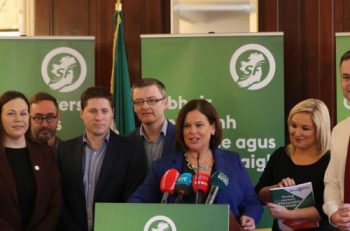
Mary Lou McDonald

Random entry RSS

  • Posted in:

    Sinn Féin: not quite yet.

    Sinn Féin’s exciting economic and social agenda needs to be weighed against its ambivalence on violence, its cultism and its environmental weaknesses. By Michael Smith. Village believes equality of outcome, sustainability and accountability are the most important policies.  So how does, now rampant, Sinn Féin fare under these criteria? Of course Sinn Féin has been attacked for the alleged profligacy of its manifesto. For me its manifesto is an impressive piece of work and the high point of Sinn Féin’s offering. Nevertheless, economically, it uses smoke and mirrors and it is not clear by how much it would exceed the alleged fair-weather fiscal space of €11bn.   The Economy Sinn Féin plans to abolish the USC for incomes under €30,000 (costing €1.2bn)  and abolish the local property tax (costing €485m). It would increase stamp duty on commercial property and introduce a 15.75 tax rate on employers’ PRSi on salaries over €140,000. It would increase CAT from 33% to 36%.  It would impose  a 1% wealth tax (over €1m) and a 5% high-income levy.  Exciting and progressive stuff. It would spend an additional €6.5bn on house-building and €1.6bn on health over a five-year government, It would giveaway €2.4bn in tax reductions every year, and increase overall taxation by  €3.8bn annually It claims it will run a surplus every year, rising to €3.4bn by 2025, and misleadingly claims that the Department of Finance has somehow endorsed its package as a whole. This generation has been so profligate in terms of consumption and environmental degradation that it should be aiming to live more within its means and only to borrow for the benefit of the rising and future generations. To this end, Sinn Féin’s economic and social manifesto seems a proportionately radical approach. It is regrettable it is not proposing increases in capital gains tax, even on windfall land rezoning profits, and it is offensive that a republican party would not tax property, an atavistic regression to the Irish obsession with the land, ill-befitting a modern party with left aspirations.  Its proposals on REIT and IREF property vehicles are informed and appropriate.  It proposes increasing the Dividend Withholding Tax (DWT) for REITs and IREFs from 25% to 33%, applying a rate of 33% Capital Gains Tax on all property disposals by REITs and IREF and applying the full rate of commercial stamp duty on REITs and IREFs . This is targeted stuff: someone in Sinn Féin’s been talking to subversives in real estate. However, it again betrays a lack of seriousness for a socialistic party in eschewing increases on our 12.5% corporation taxes, or financial transaction taxes.   Of course the manifesto is not everything, particularly in circumstances where coalition is its only route to government.  Sinn Féin’s commitment to actually implementing a radical left agenda is unclear bearing in mind its defining preference for irredentist nationalism first over socialist ideology second, and its willingness to coalesce with Fianna Fáil or even Fine Gael.  Track Record Nor is its track record in power impressive.  Its performance at local-authority level is consistently banal.  In Northern Ireland, apparently unbeknown to Mary Lou McDonald, there seem to be more homeless per capita than in the Republic (a 2017 report from the Northern Ireland audit office, for example, said that “since 2005-06 around 20,000 households each year have presented as homeless with an average of 50% accepted as statutory homeless“; and its health service is by far the worst in the UK.  The governance Sinn Féin has provided North of the border is not distinctive or particularly leftist. Dysfunctionalities More generally Sinn Féin is cultist, over-disciplined and secretive, hitched to supportive plutocrats in the US,  and ambivalent about democracy and transparency.  Its internal elections never seem fully open.  It had a serious internal bullying problem. Its leaders lie casually about its, and the IRA’s, past.   It was certainly the case in the past that Sinn Féin leaders deferred to the IRA army council.  It is alleged, with some evidence – e.g. Máirtín O’Muilleoir’s consultations with veteran republicans as Stormont collapsed, and Mary Lou McDonald’s volte-face on a border poll – still to be the case. If it is no longer the case – and this is definitive – at the very least Sinn Féin should explain when and how the transition occurred. Many Sinn Féin leaders accept that overall the IRA campaign, which killed 1800 (out of 3500 killed in total during ‘the Troubles’ was a mistake, despite the systemic and evil provocations.  The single biggest move that might attract nay-sayers to Sinn Féin would be to apologise for its largely blind support for the inexplicably still-undisbanded IRA. As it is, it is vulnerable to the, sometimes disingenuously contrived, efforts of the media and other political parties, to highlight the litany of Sinn Féin ambivalence to IRA violence, such as the focus on its dubious role in imputing criminality to Paul Quinn who the IRA appear to have murdered, after the cease fire.   Nationalism, particularly irredentist nationalism, is a dead end and ultimately incompatible with equality which seeks to eliminate barriers, including borders, to treating people equally. In Sinn Féin’s case nationalism has taken the shape of support for violence.  It seems to me that violence, in the North, verged too often on the anti-egalitarian.  If you support shooting someone you are in effect saying not alone are they not equal, or somehow worth less, you are saying they are worth nothing.  That was a bad start for an egalitarian agenda. If not sectarian, Sinn Féin is at least tribal. It is systematically scathing of Unionism and it is anti-British.   Whatever about the vicious lies told casually about Paul Quinn, Mary Lou McDonald took the opportunity to march behind an “England get out of Ireland” banner at last year’s New York St Patrick’s day and stated that Slab Murphy, convicted on overwhelming charges of tax evasion, was “a good Republican”. Sinn Féin is still the party of anti-Black-and-Tan-bandwagonning and the late-night Tiocfaidh.   Its efforts to reach out to Unionists in the North rarely seem tailored to actually appeal to sceptical Protestants. Even in the South it is divisive. Sinn Féin’s campaign rhetoric has not

    Loading

    Read more

  • Posted in:

    Villager June 2018

    Harris asleep Young Simon Harris seems to think the women of Ireland will stay loyal to him if he just puckers up and adopts the mantra that it was all an honour and done for Mná na hÉireann. The night before the referendum he tweeted in what is being seen as a ‘Song of the Camino’ moment: “will sleep tonight in the hope of waking up to a country that is more compassionate, more caring and more respectful. It has been an honour to be on this journey with you and to work #togetherforyes. See you all tomorrow!”. Unfortunately no-one cares how well the Minister for Health sleeps, they care how well the mistreated patients under his aegis sleep. And Villager has been struggling to get the image of the eager nightcap-topped and pyjama-ed Simon out of his fevered head. Sinna Gáel Sinn Féin’s new leader Mary Lou McDonald has said it wants to form a coalition government after the next election with either Fine Gael or Fianna Fáil. “I want to lead the party into government. I want to do that from the strongest possible position. I want us to discuss, debate, agree with others a programme for government”, Ms McDonald told The Irish Times in an interview. All those years, all that effort, pretending Sinn Féin wasn’t just Fianna Gael for slow learners. The view from Dalkey David McWilliams, a metaphorical bow-tie wearer, sometimes gets a hard times in these columns but his Irish Times Saturday feature packs an economic punch and is always accessible and often entertaining and there’s no worthy ideology he won’t eventually come around to or at least promote. But he’s what Villager’s primary teachers used to call a notice box and he’s often wrong. Recently he said Dublin needs to be like Belfast in its policy on high buildings in its historic centre, to avoid a housing crisis. No expert says height is a solution to the housing crisis. The real problem is one of density in Dublin’s suburbs not height in its uniquely-human-scale city centre. Indeed fiddling around with heights sows confusion and is partly responsible for inertia in the city centre as developers wait for ever greater flexibility in standards and correlative extra profitability for their hoarded sites. McWilliams also said people are emigrating because of housing. But Ireland has net immigration. Armchair planning. The view from Dublin’s South Inner City The ascendant Press Up group has outbid several property developers to buy the Celtic Revival style headquarters of New Ireland Assurance on Dublin’s fast-rebeautifying Dawson Street, a more elegant counterfoil to the jaded global offering of next-door Grafton St. The group led by Paddy McKillen Junior and Matt Ryan is paying €38 million for the two interlinking five and six-storey office blocks. Despite helpful suggestions from the Irish Times’ veteran property correspondent, Jack Fagan, Press Up won’t demolish the buildings, but instead will convert the ground floor into restaurant and other retail uses and to add the usual greedy extra office floor to bring the overall office content to 70,000sq feet. In his day Paddy McKillen liked nothing better than a bit of façade-retention but Junior is cornering the market in historic refurbishments with Roberta’s and Dollard in the former Temple Bar printers that Senior (and Bono and Edge) wanted to demolish a decade ago, and the exquisite Art Deco Stella Cinema in Rathmines for which demolition permission had been granted. A bit of authentic taste will get you quite far in sophisticated Dublin now. And if it’s not real, Pressup can elegantly fake it – as with the (actually newish) Vintage Cocktail Club on Crown Alley, and the ye olde Peruke and Periwig pub on Dawson St and Lucky Duck on Aungier St. No pub paraphernalia for these whizzes, as they reportedly prepare for a stock-market otation, but not, Villager is certain, for a downturn. Weird Norman defines normal Norman Tebbit, the former Chairman of the Conservative Party, has announced that he will be boycotting religious services at Bury St Edmunds, Suffolk, whenever the Reverend Canon Joe Hawes officiates, because the Rev is gay. Lord Tebbit has described him as a “sodomite”, an offensive term. Tebbit, who has been worshipping at the cathedral for nine years, has explained that he finds “it difficult to accept a sodomite as a member of the clergy who will, for example, be called upon to conduct marriage services. I will struggle to attend if he is officiating”. Lord Tebbit discovered that Hawes, aged 52, is in a civil partnership with another cleric, the Reverend Chris Eyden, from a newsletter last March and that he was destined to become the cathedral’s most senior official. “The cathedral has taken this decision and I disapprove of it but I do not wish to damage the cathedral in any way. I will maintain my financial support for it every year because it will be there long after the dean and I are gone”. Tebbit is part of a dwindling generation that deems loving relationships between adults of the same sex to be offensive. What is really sickening is Tebbit’s toleration of an actual sinner, Sir Peter Morrison MP, who served as his Deputy Chairman back in the 1980s. Morrison was a violent child rapist. We need look no further than official British archive records for proof of Morrison’s proclivities. The archives show that on 4 November, 1986, Sir Antony Duff, Director-General of MI5, wrote to Sir Robert Armstrong, Margaret Thatcher’s Cabinet Secretary, after allegations of child abuse had been made by separate sources against Morrison. Morrison had been accused (entirely accurately as it transpired) of child abuse. Duff opined that Morrison was only a minor “security danger”. After the Morrison memo came to light in July of 2015, Armstrong (famed for his use of the phrase “being economical with the truth”), defended his inaction thus: “Clearly I was aware of it…but I was not concerned with the personal aspect of it, whether he should or should not be

    Loading

    Read more