• Posted in:

    An appalling vista: disturbing indications of Kitson's foreknowledge of a third massacre of innocent civilians. Tragedy took fifteen lives including two children. By David Burke.

    New evidence has emerged about the UVF’s bombing of McGurk’s Bar in Belfast in December 1971. The explosion caused the entire structure of the premises to collapse, killing fifteen Catholic civilians – including two children – and wounding seventeen more. It was the deadliest attack in Belfast during the Troubles. Brigadier (later General Sir) Frank Kitson commanded the British Army in Belfast 1970-72. He was a counter-insurgency guru who created havoc on the island before he was drummed out of it by William Whitelaw, the first British secretary of state for Northern Ireland. One of the conscious choices Kitson made while still in Ireland was to take on the IRA but not Loyalist terrorist gangs such as the UVF. This coincided neatly with the policy of the British government of Edward Heath which decided to intern  members of the IRA but not Loyalist paramilitaries. On these grounds alone, the British state became indirectly responsible –  through inaction – for the crimes of the UVF, including the McGurk tragedy. Worse still, there are indications that Kitson may have exploited elements of the UVF as a proxy assassination apparatus for the British state in Belfast. 1. Redaction of Evidence The sliver of new information about the massacre was recorded in a log by the 2nd Battalion Royal Regiment of Fusiliers (2RRF)  approximately forty-two minutes after the bombing. It relates to the proprietor of the bar, Patrick McGurk, and the nearby Gem Bar. Britain’s Information Commissioner’s Office has upheld a decision by Britain’s National Archives to withhold a section of the log from the families of the victims of the massacre. The Archive acted in consultation with the British Ministry of Defence (MoD). The 2RRF log reveals: Owner of pub a moderate RC [Roman Catholic] unlikely to have allowed people to use it as a mtg [meeting] place. Bar close to Gem Bar which is a [REDACTED]. 2. The Gem Bar The information relating to the Gem Bar remains withheld even though the venue no longer exists. When they were making their case for a full declassification of the log, the families of the victims of the attack presented archival evidence to the Information Commissioner’s Office that the Gem Bar was: The original target of the bombers; Known as an Official IRA bar; Recorded in British Army files as the local HQ of the Official IRA; Under British Army surveillance; And that the premises had been targeted by 2 RRF two nights before the bombing during which 2 RRF arrested and questioned six customers from the Gem Bar raid. Put simply, the perceived connections between the Gem and the Official IRA was a known fact and therefore any information pointing in that direction was not going to endanger anyone, especially as the pub has long since closed. Moreover, former known members of both wings of the IRA walk about Belfast without any concern for their safety. Some of them have published books about their paramilitary careers, others have been interviewed on the record by the press, radio and TV Despite this reality, the log remains redacted. 3. Reaction of the families Ciarán MacAirt is a grandson of two of the victims of the McGurk’s Bar Massacre and has been fighting for sight of the information – all of it – for five years. He said: After 50 long years fighting the British state’s lies, our families are outraged but unsurprised that it is withholding evidence relating to the mass murder of our loved ones in McGurk’s Bar. The British state has lied to us from the moment the bomb exploded up to this very day.  Police Service Northern Ireland and the Office of the Police Ombudsman either failed to find this evidence or found it and buried it again as it has been left to the families to expose the truth about the McGurk’s Bar Massacre and its cover-up by the British state. Nevertheless, even when we discover new evidence, the British authorities withhold it from us and deny us access to the truth. In the meantime, many of our older family members are infirm or have gone to their graves without any justice. A video about the attack can be accessed here: https://www.youtube.com/watch?v=uQRLFnBxoWQ 4. The shape of an extremely disturbing state of affairs. The redaction is deeply disturbing. There is no good explanation for it. Why do the MoD censors want the redacted words withheld from public scrutiny, even after more than fifty years? The shape of an extremely disturbing state of affairs involving dirty tricks, collusive murder and black propaganda is swimming into focus. The following scenario is one that offers an explanation for what happened in 1971, and why the British State still feels it necessary to redact the document. 5. Kitson and the IRD Brigadier Frank Kitson was involved in a black propaganda operation that swung into action shortly after the bombing. He was almost certainly aided and abetted by Hugh Mooney who worked for the Information Research Department (IRD) of the Foreign Office. Mooney had been sent to Belfast to destabilise the IRA through the deployment of psychological operations (PsyOps). Kitson, who commanded the British Army in Belfast and its environs, was a meticulous planner who became deeply engaged in propaganda operations during his two years in Belfast. He was also the British army’s foremost counterinsurgency expert having honed and developed his skills in Kenya, Malaya, Oman and Cyprus. His infamous treatise about counterinsurgency, ‘Low Intensity Operations’ was published in 1971. One of the hallmarks of Kitson and Hugh Mooney was the meticulous manner in which they planned their operations in Ireland, invariably well in advance of their deployment. The black propaganda operation that swung into action after the bombing of McGurk’s Bar was up and running a little over four hours after the attack. The operation was a sophisticated affair, one that involved the coordination of senior British Army officers (including Kitson and his superior Lt. General Sir Harold Tuzo, General Officer Commanding Northern Ireland), the

    Loading

    Read more

  • Posted in:

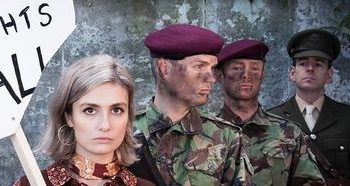
    Shot at by a handkerchief. A review of 'One Para' at the New Theatre, Dublin. By David Burke

    When Stephen Spielberg was making ‘Schindler’s List, in the early 1990s, he invited some of the Holocaust survivors who had been saved from the gas chambers by Oscar Schindler onto his movie set. The guests mingled with the actors and crew during a break. Amid all the lights, the electrical wires criss-crossing the set,  the extras who were playing the SS chatted amicably with each other. Someone noticed something odd: the SS group – and they alone – were being shunned by Spielberg’s special guests, the survivors. This was because the extras looked so much like the real thing, they exuded a cruelty that, nearly half a century later, disturbed the visitors. I felt something similar watching  the actor playing Sergeant Hutton of 1 Para during Gerard Humphrey’s riveting new play about Bloody Sunday, ‘One Para’ at the New Theatre. Andrew Kenny plays a foul mouthed, racist bigot who bullies one of his more junior colleagues, Scarrif, urging him to shoot at the unarmed and harmless civil rights marchers in the Bogside. His bragging about his colonial exploits in 1 Para is a whirlwind education in the crimes committed by men like him. Every so often he cracks a crass joke or make a jibe that should make the audience wince but something more disturbing happens: there is nervous laughter. The audience out in the dark is cowed by Hutton. If you want to know what Stockholm syndrome is like, go and see this play. Sergeant Hutton on internment and the Ballymurphy massacre: We sorted Belfast out in one night… You saw the photos put up on the wall in the corporal’s mess. .. we swept down the Black Mountain straight into Ballymurphy and shot forty bogwogs – we wasted eleven of them. Victor got himself a priest and all. He won the regimental sweepstake! The UDR wallahs told him he should put in for a bounty! While the menace and darkness of this 75 minutes play shoots at the audience through the mouth of Kenny, the piece works because each cast member hits their target dead centre. The overarching ingredient, however, is the crisp dialogue Gerry Humphreys places in their mouths. He manages to convey the complexities of  Brigadier Frank Kitson, the MRF death squads, the Ballymurphy and Bloody Sunday massacres with rapid fire shots of succinct dialogue that hits you in the solar plexus. He has a genius for boiling down the complex into brilliant historical one liners. When Hutton is asked about his actions by a military police officer he barks: “I am a professional soldier. If I had not shot – I truly believe he would have shot me! The military police officer snaps back at him: With a handkerchief? Humphreys sprinkles the script with the occasional piece of humour to lighten the brutal dialogue, but he does so with such subtlety and deftness that he never once crosses the line or disturbs the equilibrium of what is a deadly serious issue. One Para is directed by Anthony Fox. The set design is by Robert Ballagh. The show continues until the weekend. If you can, catch it. The run comes to an end on Saturday. OTHER STORIES ABOUT BLOODY SUNDAY, THE BALLYMURPHY MASSACRE, BRIGADIER FRANK KITSON AND COLONEL DEREK WILFORD ON THIS WEBSITE: Bloody Sunday: Brigadier Frank Kitson and MI5 denounced in Dail Eireann   The covert plan to smash the IRA in Derry on Bloody Sunday by David Burke Soldier F’s Bloody Sunday secrets. David Cleary knows enough to blackmail the British government. Learning to kill Colin Wallace: Bloody Sunday, a very personal perspective Lying like a trooper. Internment, murder and vilification. Did Brigadier Kitson instigate the Ballymurphy massacre smear campaign? Where was Soldier F and his ‘gallant’ death squad during it? Another bloody mess. Frank Kitson’s contribution to the wars in Afghanistan and Iraq. 300,000 have died in Afghanistan since 1979. Lying like a trooper. Internment, murder and vilification. Did Brigadier Kitson instigate the Ballymurphy massacre smear campaign? Where was Soldier F and his ‘gallant’ death squad during it? A Foul Unfinished Business. The shortcomings of, and plots against, Saville’s Bloody Sunday Inquiry. Kitson’s Private Army: the thugs, killers and racists who terrorised Belfast and Derry. Soldier F was one of their number. Soldier F and Brigadier Kitson’s elite ‘EFGH’ death squad: a murderous dirty-tricks pattern is emerging which links Ballymurphy with Bloody Sunday. A second soldier involved in both events was ‘mentioned in despatches’ at the behest of Kitson for his alleged bravery in the face of the enemy. Mentioned in Despatches. Brigadier Kitson and Soldier F were honoured in the London Gazette for their gallantry in the face of the enemy during the internment swoops of August 1971. Soldier F, the heartless Bloody Sunday killer, is named. Mission accomplished. The unscrupulous judge who covered-up the Bloody Sunday murders. Soldier F and other paratroopers have been protected by the British State for five decades. None of them now face prosecution. This perversion of justice began with the connivance of the Lord Chief Justice of England and Wales, John Widgery, a former British Army brigadier, Freemason and oath-breaker. Counterinsurgency war criminals, liars and cowards: Kitson and Wilford, the brigadier and colonel who led the soldiers who perpetrated the Ballymurphy Massacre. Brigadier Kitson’s motive for murdering unarmed civilians in Ballymurphy. The McGurk’s Bar cover-up. Heath’s Faustian pact. How a British prime minister covered up a UVF massacre in the hope of acquiring Unionist votes to enable the UK join the European Economic Community, the forerunner of the EU.

    Loading

    Read more

  • Posted in:

    Counterinsurgency war criminals, liars and cowards: Kitson and Wilford, the brigadier and colonel who led the soldiers who perpetrated the Ballymurphy Massacre.

    By David Burke. The denial of justice for political gain. Next week will see the release of the long-awaited inquest report into the Ballymurphy massacre during which British soldiers killed and wounded a large number of unarmed civilians in Belfast. The atrocity took place after the introduction of internment in August of 1971. Adding insult to inqury, the victims were vilified as gunmen and terrorists. A documentary entitled ‘The Ballymurphy Precedent’ will be broadcast on Channel 4 on Wednesday 12 May. It contains detailed re-enactments of the actions of Kitson’s and Wilford’s troops. RTE will also be showing it at a date yet to be determined. Meanwhile, the British Government led by Boris Johnson proposes to grant all British soldiers implicated in murder in Northern Ireland immunity from prosecution, contrary to the Stormont House Agreement. Incredible as this may seem in Ireland and across the globe, it has enhanced Boris Johnson’s standing in the eyes of large numbers of the British electorate. Johnson has also set himself on a collision course with the Irish Government. Taoiseach Micheál Martin has stated that: “There is an agreement in place with the British government, with the parties in Northern Ireland and indeed with victims’ groups and that is the Stormont House Agreement of 2014 and that any move from it would amount to ‘a unilateral breach of trust”’. He added: “For us the victims are the priority and the victims remain the priority. There has to be adherence to that agreement. If people have new ideas to present they have to involve all of the parties, and above all the concerns of victims irrespective of who committed the atrocities. People must be held accountable”. Johnson’s Minister for Veterans, John Mercer MP, resigned last month in protest at what then looked like the British Government’s reluctance to change the law to prevent the prosecution of British soldiers accused of murder in Northern Ireland. In his resignation statement, he said he was stepping down to “try and shift UK Government position towards looking after these people and preventing the repeated and vexatious nature of litigation against those who served is a huge task”. There have been further developments and insights into the free rein afforded to British soldiers in Northern Ireland to shoot at human targets. Last week the trial of two paratroopers accused of shooting Official IRA volunteer Joe McCann while he ran away from them collapsed. Judge James O’Hara pointed out that: “At that time, in fact until late 1973, an understanding was in place between the RUC and the Army whereby the RUC did not arrest and question, or even take witness statements from, soldiers involved in shootings such as this one. This appalling practice was designed, at least in part, to protect soldiers from being prosecuted and in very large measure it succeeded.“ Her Majesty’s Killers. The Ballymurphy Inquest report may not address the roles played in the massacre by two of the most notorious British soldiers to set foot in Northern Ireland during the Troubles, Brigadier Frank Kitson and Colonel Derek Wilford. Kitson is a counterinsurgency expert who had served in Malaya, Kenya, Cyprus and the Oman before he was sent to Northern Ireland as the brigadier in charge of the 39 Brigade area which included Belfast, 1970-72. He set up the Mobile Reaction Force (MRF) which carried out the murder of a series of unarmed civilians in Belfast in the early 1970s. Kitson’s own pen has long since exposed him as a racist and anti-Catholic bigot. He committed perjury at the Saville Inquiry into Bloody Sunday (January 1972) on an industrial scale. Wilford assumed command of 1 Para on 21 July 1971. 1 Para formed part of 39 Brigade. Wilford believes that virtually all Catholics in Northern Ireland are IRA supporters, and has said as much in public. He had served with the SAS for two years and trained with American paratroopers at Fort Bragg, the US Army Special Forces School before coming to Ireland. He was also a veteran of Malaya and Aden. He joined the Parachute Regiment as a company commander in 1969. Perceived as a bit of a loner, he was given to reading the classics, in their original Latin. The number of unarmed Catholic civilians murdered by 1 Para reached unprecedented levels after Wilford’s arrival. Many were shot in the back or while lying on the ground. He reported directly to Kitson. The number of unarmed Catholic civilians murdered by 1 Para reached unprecedented levels after Wilford’s arrival. Many were shot in the back or while lying on the ground. He reported directly to Kitson. Both men are still alive and unrepentant at the multiple deaths caused by their troops including those who died during the Ballymurphy massacre. Wilford took 1 Para to Derry early the following year, an event that resulted in Bloody Sunday. Wilford committed perjury at the Widgery and Saville inquiries into Bloody Sunday. He has also admitted lying to the press. He is the keeper of many secrets about that massacre. While Wilford presents himself as an officer who has always been loyal to the paratroopers who served under him on Bloody Sunday, the truth is that he has thrown them to the wolves to save his own skin. One of them is facing murder charges for his actions on Bloody Sunday. Meanwhile, Wilford cowers in Belgium. While Wilford presents himself as an officer who has always been loyal to the paratroopers who served under him on Bloody Sunday, the truth is that he has thrown them to the wolves to save his own skin. One of them is facing murder charges for his actions on Bloody Sunday. Meanwhile, Wilford cowers in Belgium. Operation Demetrius was the code name ascribed to internment which commenced on 9 August 191. 342 people were swept up on that day and taken to to makeshift camps in a series of dawn swoops by the British Army. 105 were released after two days. Instead of

    Loading

    Read more

  • Posted in:

    Did Thatcher sanction the Finucane murder? It is now up to PM Boris Johnson and his Home Secretary, Priti Patel, to order a full judicial inquiry into the murder of Patrick Finucane to establish whether or not Margaret Thatcher gave Sir Patrick Walker, Director-General of MI5, the green light to murder him.

    Update: this article was published in October 2019. One year later the British government has refused to carry out a judicial inquiry. One of the stated reasons is that the PSNI and Police Ombudsman are reviewing the case. However, no  review is about to take place. Patrick Finucane’s widow has responded by saying that “as long as there is breath” in her body she will continue to seek answers about her husband’s murder and that the decision by the British government was “quite a shock” and showed “startling arrogance at ignoring the highest court in the land”,  i.e. the UK Supreme Court which has ruled that an inquiry should take place. Mrs Finucane has also pointed out that Brandon Lewis, the Northern Ireland Secretary of State, did not go into any detail about why the decision to refuse the inquiry was made. It  “does seem rather bizarre” she added  “that he [Lewis] is insisting the police [will investigate]” as the PSNI later issued a statement saying there is nothing new to investigate. The Police Ombudsman has no funding for a review. In any event such a review would be pointless and it is a judicial inquiry that is required. Clearly, there are other reasons Lewis and his boss Boris Johnson are blocking an inquiry. Village’s 2019 investigation addressed some of the issues the Tories, MI5 and other elements of the British Establishment are trying to suppress. That article starts here: Introduction: Margaret Thatcher and the cold-blooded murder of an Irish lawyer On 12 February, 1989, the UDA assassinated Patrick Finucane, a highly-regarded Belfast solicitor, at his North Belfast home. Finucane, who was 38-years-old, was shot 14 times by two masked UDA gunmen who sledgehammered their way into his house. His wife Geraldine was also injured during the attack which took place while the couple was enjoying a meal with their young family. In 2019 the Supreme Court in London ruled that the British Government had failed to investigate the murder properly. The only tenable reason for this is because the murder was organised by MI5, the intelligence service attached to the Home Office. A retired Canadian judge, Peter Cory, investigated the murder on behalf of the British State. During his inquiry MI5 officers broke into his office and stole some of the evidence he had accumulated. Cory also told Geraldine Finucane that he had seen a document relevant to her husband’s case which was marked  “for Cabinet eyes only”. Mrs Finucane knows no more. This raises the distinct possibility that her husband’s case was discussed in Whitehall in sinister circumstances before the murder. These revelations formed part of BBC NI’s compelling seven part Spotlight  series,  ‘The Secret History of the Troubles’. They have been ignored by the mainstream British media. Put simply, the finger of blame is now pointing at Margaret Thatcher. It now looks like she gave MI5 the green light to murder a perfectly respectable, law abiding lawyer. If Thatcher  and her circle did not order the murder, why are the Tory top brass so terrified of an inquiry? MI5 was led by Sir Patrick Walker at the time the assassination was planned and executed. If MI5 was involved, it is inconceivable he did not call  the shots – literally. When David Cameron was in 10 Downing Street he told the Finucane family that he could not order a public inquiry into the scandal. When Finucane’s brother Martin asked him why, he turned to Mrs Finucane and said: “Look, the last administration couldn’t deliver an inquiry in your husband’s case and neither can we”. According to Cameron this was because “there are people all around this place, [10 Downing Street], who won’t let it happen”. As he was saying this, he raised a finger and made a circular motion in the air. Theresa May, who was Cameron’s Home Secretary between 2010 and 2016, did not order a proper inquiry either when she took over at 10 Downing Street. The opportunity and duty to do the right thing and call one has passed to Theresa May’s successor, Boris Johnson, and his Home Secretary, Priti Patel. Yet, will they prove every bit as disdainful and corrupt as Blair, Cameron and May and continue the cover-up? Time is fast running out to hear what potentially key living  witnesses have to offer about the Finucane case. The list includes  Thatcher’s then Home Secretary, Douglas Hurd. Born in March 1930, he published a 524 page autobiography in 2003.  Unfortunately, there is no entry under the word “Finucane” in its index. Village  offers him the freedom of this website to inform our readers about what he know about the case, most particularly anything about “cabinet eyes only” documents. The evidence that continues to accumulate points to the probability that Finucane, a skilful lawyer, was targeted by the British State because he had mastered the intricacies of the Diplock Court system in NI and was representing his clients to the best of his very considerable abilities. A lot of Provos were walking free from court. In the mind of Thatcher and others in London, he had to have been a Provo and his death warrant was approved. In these circumstances, the task of assassinating him was passed to Walker and his gang of cutthroats at MI5. However, Finucane was not a Provo. On the contrary, he represented both Republicans and Loyalists. Who ever heard of a Provo securing the freedom of the Loyalist enemy? Moreover, he was married to a Protestant. Finucane was perfectly innocent of any involvement with the IRA although he was vilified as a member after his death. Insofar as the UDA was concerned, the kill-order was issued by Tommy ‘Tucker’ Lyttle, the UDA’s ‘brigadier’ or commander in West Belfast. Ian Hurst, who served with the then top secret Force Reconnaissance Unit (FRU) of the British Army, has stated “with cast iron certainty” that Lyttle was a British agent who was “handled” by the RUC’s Special Branch (RUCSB) using the codename “Rodney Stewart”. Lyttle himself

    Loading

    Read more

  • Posted in:

    An Offence Against The State

    On 1 December 1972 a car bomb exploded beside Liberty Hall in Dublin. Fortunately no one died but George Bradshaw, a CIE bus driver, and Thomas Duffy, a bus conductor, perished in a second explosion at Sackville Place. No one has ever been charged with these crimes. The UVF belatedly claimed sole responsibility for them but there are legitimate doubts about the veracity of this claim. These bombings were part of four bombings in Dublin’s north city centre at the end of 1972 and beginning of 1973 and are to be distinguished from the even more horrific bombings in the same general area in 1974.   A State In Denial Margaret Urwin has just published ‘A State in Denial’ which unravels a web of intrigue connecting the British Secret State (BSS) to loyalist paramilitaries at a variety of levels. No objective reader of this impressive work could doubt that London focused the might of its counter-insurgency arsenal against Republicans while turning a knowing blind eye at loyalist wrongdoing and also arming and colluding with them. Irwin’s book is fascinating for its dissection of official papers to discern what was going on behind closed doors.   The Man with the English-Belfast Accent The publication of ‘A State in Denial’ is timely as yet another anniversary of the 1972 Dublin bombings comes around. On that fateful evening a man with a mixed English-Belfast accent parked a car bomb beside Liberty Hall. After he alighted, he asked someone who had just left the building when it was likely to empty out for the night. One of the cars used by the bombers to get to Dublin was a Ford Zephyr which had been stolen in Antrim from an Englishman called Joseph Fleming the previous August, along with Fleming’s driver’s licence. Fleming’s licence was put to use on two occasions in November 1972 by an imposter posing as Fleming, to hire cars in Belfast. The imposter was either extraordinarily reckless or had good reason to believe Fleming’s licence was not detailed on the lists circulated by the RUC to carrental companies. He obtained a number of cars over the space of a week, a timespan which underlines his confidence about the use of a stolen licence; and all this at a time when an epidemic of car bombings was bringing Belfast to a standstill. In addition, he left his fingerprints and handwriting on the forms he completed. Another significant fact was that he spoke with a mixture of a Belfast and English accent.   Kitson’s Military Reaction Force The UVF would have us believe that its volunteers: • Stole Fleming’s car in August 1972 and hid it for three months, and; • Drove it across the Border with its original registration plates on display, and; • Proceeded to Dublin at the same time – and possibly as part of a convoy of cars, parked it with explosives, and • Faced an extremely high risk of detection because the rental cars had been acquired using a stolen licence which the gang must have believed was on an RUC watchlist; • Yet all the while possessed the confidence to proceed without any high-level protection from the BSS. It is unlikely this is what happened. On the other hand, the highly secretive Military Reconnaissance Force (MRF) of the British Army had the nerve, skill and high-level protection in place to undertake just such an operation. The MRF was literally above the law. It was a sprawling organisation established by Brigadier Frank Kitson in 1971 to engage in agent-recruitment; surveillance; drive-by shootings (deploying the type of weapons the IRA were known to carry); laundry collection, to detect the residue of explosives on clothing; and even brothel management, to collect gossip and obtain blackmail material. It had access to loyalist agents recruited by the British Army and M15. Stealing vehicles and hiding them at its Palace Barracks HQ for use later was one of its known practices. The MRF could easily have arranged for the details about Fleming’s vehicle and licence to have been erased from the RUC watch lists. With this backing, the loyalist gang that bombed Dublin (or at least some of them) would have enjoyed the confidence to hire the cars and drive them to Dublin.   Albert Ginger Baker Albert Ginger Baker, an alleged British Army deserter, who joined the UDA in the early 1970, ticked all the boxes as an MRF agent. His family have claimed that he was involved in the 1972 bombings. In 1976 the Sunday World published an article exposing his links to a ‘Captain Bunty’, a mysterious figure who can only have been his handler. The pair met regularly in a Belfast coffee bar. Baker was involved in a string of gruesome sectarian murders in Belfast. During one of them, James Patrick McCartan, a 22-year-old forklifttruck driver, was stripped naked, hung up by his ankles and punched, kicked and beaten with a pickshaft, while a dagger was used to stab him in the hands and thigh over 200 times. He was threatened with castration and dropped head first from the ceiling. Eventually one of Baker’s UDA superiors gave him a pistol and told him to kill McCartan. Baker put a hood over his head, and blasted into his skull three times. A grenade Baker’s gang used in another attack was standard British Army issue, which raises questions about how they acquired it. It is doubtful the prospect of bombing Dublin could have troubled the conscience of those in the BSS who ultimately controlled men like Baker. Baker suffered some sort of a crisis in 1973, and fled to England where he confessed to a string of sectarian murders to the police in Warminster, in Wiltshire. As far as the BSS was concerned, some rather nasty cats were now peeping out of the bag. Damage limitation became the order of the day. Hence, while Baker was convicted and sent to prison in 1973, his secret link to the MRF was

    Loading

    Read more