newspaper

Random entry RSS

  • Posted in:

    The Irish Times won its struggle for trust on the Centenary

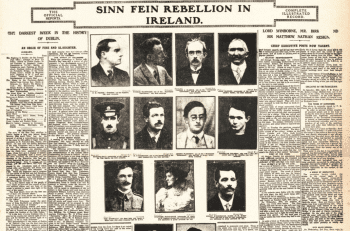
    The Irish Times has had a mixed 1916 commemoration. Even its own audiences seem hardwired to expect a certain bias from the newspaper of reference, but one particular decision – or probably a non-decision no one ever thought to check for unfortunate implications – certainly didn’t help. For its 1916 anniversary issue the paper produced a replica cover from 100 years ago, but decided to cut the original banner headline: ‘Sinn Fein Rebellion In Ireland’. The page-two explanation – that broadsheets aren’t what they used to be, and the resized 2016 dimensions (half the size of the 1916 original) meant the original would no longer t in its entirety and, although it had been shrunk somewhat, any further reduction in print size would render it unreadable, and something had to go… convinced some, but left others unimpressed. If space was the only issue, then why leave two mastheads on the front page, one modern and one vintage? Assuming the plausible explanation that it was a design decision, and nothing more, the online row it generated speaks much about the perceived trust issues the paper has with its audience. Irish Times journalists are prone to complain that their paper is often held to a higher standard than others, and that may be the case, but it is also a backhanded compliment. Its readers expect more from it, and are therefore more inclined to complain when it does not live up to expectations. The Irish imes garners complaints because what the Irish Times says matters to its in a way that most other newspapers do not. Being an opinion leader comes with a price. Twitter media accounts come in two avours. There are those that engage, joining in conversations with followers over the stories of the day, even on occasion adding their contributions to the joke of the day on the medium, and there are those that broadcast, casting their bread upon the waters for others to consume, but never acknowledging that the audience is talking back. Irish Times’ editor Kevin O’Sullivan falls into the latter category. His twitter stream is a list of links to articles he finds it worth highlighting, mostly from his own publication, occasionally from farther afield. While it is assumed that O’Sullivan curates his own Twitter account, he does not engage with his followers online, or share his thoughts on the news of the day, beyond a brief “interesting” or “scintillating” appended to a story link. And since he does not share his thoughts in detail, the only insight into the thinking of the man helming the paper of record derives from the stories he deems worthy of sharing. Irish Times 1916 coverage, as highlighted by its editor in the period from Patrick’s Day to the end of Easter Week, was colourful and varied, with thinkpieces by regular and occasional columnists (Fintan O’Toole on Shaw and Casement; Niall O’Dowd on the American input to rebellion; though oddly, no one expurgating the German contribution). Beyond this, the Irish Times chose to reproduce a letter from Francis Sheehy-Skef ngton to Thomas MacDonagh making a case for pacifism, an offbeat Q&A by cynical Frank McNally: “To question the Rising is to be found guilty of unIrish activity”, Eunan O’Halpin was mean about the Proclamation (“a speech not a Proclamation”), atheist Donald Clarke goaded that it didn’t need to be atheistic, and Miriam Lord wished fervently that we could hold an Easter party every year. Diarmuid Ferriter appeared here and there with as usual more good history than acute insight. Some ideas that sounded like cringe-inducing embarrassments, such as the new proclamations created by schoolkids, generated genuine wonder. What does it say of a modern nation if children are calling for an end to homelessness while ministers hide behind constitutional guarantees of private property? On the new-media side, a particular highlight must be the Irish Times’ Women’s Podcast on Margaret Skinnider, volunteer, sniper, school- teacher, trade unionist, and would-be hotel bomber (of the Shelbourne – the newspaper’s readers may have pondered that it might as well have been the Irish Times itself). The Irish Times has even produced a book called unexcitingly the ‘Irish Times Book of the 1916 Rising’. And then there was its own 2016 Proclamation, with dodgy prose: “First among our values is the belief that every citizen must have both [sic] the legal, civic [sic] and political rights necessary for full citizenship”, but a progressive core: “we commit our governments to a continuing process of reducing inequality”. If schoolchildren came out with a simple vision of an Ireland where no one is homeless, the Irish Times’ editorial proclamation for 2016, attempting to cherish all its children equally, had the look of a family Christmas tree, with everyone adding their favourite bauble to the decorations until it became top-heavy, over-owing with good wishes, inclusiveness, and a feelgood spirit that made it look like an out-of-shape heavyweight next to the Spartan declaration of a century ago. Perhaps a little like the Irish Times itself. Gerard Cunningham

    Loading

    Read more

  • Posted in:

    Election Times

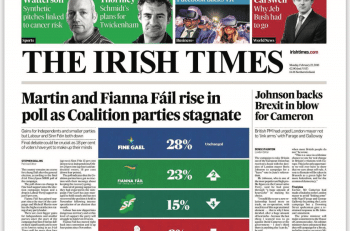
    The story of an election is much more than a few headlines, but the Irish Times front pages mercifully, if languidly, devoid of the kind of blatantly partisan positioning seen elsewhere, provide in hindsight a neat narrative of the campaign, with the slow realisation that Fine Gael was in trouble, the lack of a clear alternative emerging, and of course, “events, dear boy”. While its columnists and editorials may have declaimed preferences in the run-up to the general election, the Irish Times‘ front page generally affected a more neutral stance, certainly by comparison with the anti-Sinn Féin headlines which dominated the Irish Independent and its Sunday sister during the February campaign. The ‘newspaper of reference’ (formerly “of “record”) began the month in ‘phoney war’ mode, leading on Monday 1 February with coalition plans to “target home buyers and parents in poll pledges”. On the Tuesday, with still no election date declared, the story was “Taoiseach prepares Fine Gael ministers for election”. Perhaps ominously, on both days the below- the-fold story concerned the revelations regarding “Grace” a young woman with intellectual disabilities abused while in HSE care in a foster home. The story would feature again several times during the month and, by the end of the campaign, would threaten to inculpate Michael Noonan. Wednesday’s paper finally brought the official election notice, leading with Fine Gael ministers outlining their election promises, but the shine was short lived. Thursday, and the first election poll, brought “disappointing news for Coalition parties”. Much of the remainder of the campaign was spent trying to push back against those low poll numbers, which stubbornly refused to rise. By the first weekend, Fine Gael had announced a “tax U-turn to hit voters earning €100K” (the top 10% of all earners, though Irish Times readers would be better paid than the average). The election narrative was dominated at first by Fine Gael (at least on the front page) but it changed dramatically in the second week. The murderous Regency Hotel rampage called attention to cuts in Garda numbers and resources and Fine Gael, which prides itself as a law and order party, found itself on the back foot. At one point Sinn Féin’s Mary Lou McDonald attacked the government for being soft on crime during an RTÉ radio debate. By the end of the week, the lead story that Garda “may be issued with new weapons” helped to restore marginally Frances Fitzgerald’s battered image, but you know you (we?) are in trouble when Sinn Féin are attacking you from the right on crime. Meanwhile, bubbling below the fold, the news was no better. Lowry, Drumm and Luas strikes festered, and the Times awarded the first TV debate to Micheál Martin. Week Three began with Labour striking out to create a separate identity, promising “an abortion vote in any new deal” – definitely a plus for liberal Irish Times readers. Smaller parties got their first acknowledgement the following day, as the lead reported they did best in the previous night’s debate. For the rest of the week, it was almost as if the Irish Times tired of the “boring” election campaign, with more conventional “newsy” lead stories on an HSE inquiry into baby deaths, welfare benefits for migrants, and Brexit. Week Four began with the writing on the wall, summarised in a single Monday headline “Martin and FF rise in polls as Coalition stagnate”. Tuesday the paper reported Kenny and Martin had “equal backing in race for Taoiseach”, and the final TV debate failed to resolve anything for this hard-to-please newspaper as “leaders fail to land killer punch”, before Kenny’s “last-ditch call for vote in favour of stability.” Below the fold on the same day, the first mention of Sinn Féin in a front-page headline volunteered no favours: “Canvasser for Adams owns hay shed where ‘Slab’ Murphy cash was found”. ‘Slab’ was also the subject of one of the few passionate editorial columns (now perhaps self-deprecatingly titled “the Irish Times view”). Others quite reasonably despaired of the “short election, short of vision”. But while front pages covered national trends, debates and polls, and columnists inside the paper from Una Mullally (who, surprisingly for someone with a political agenda, gave up interest) to Breda O’Brien (vote for people of conscience, if you know what I mean) via Fintan O’Toole (who in the end detected an unlikely victory for social democracy) and Noel Whelan (who again somehow spotted the Fianna Fáil revolution implausibly early) ventilated partisan viewpoints, perhaps the most concise reportage on what happened on election day was by religious affairs correspondent Patsy McGarry, who on the day of the count reported from the north inner city, less than ten minutes from Tara St in a neighbourhood where few read the Irish Times, and fewer would share its editorial concerns: one, a hooded man, was picking up rubbish and putting it in a black plastic bag.“I didn’t vote. I don’t have a voting card. I was abroad for five years. It’s not important at all”. Gerard Cunningham

    Loading

    Read more