pro-life

Random entry RSS

  • Posted in:

    Illiberal liberalism

    College campuses around the world are renowned as centres of free thinking, individuality, and acceptance of those from all walks of life. And they are; as long as you think the right way that is. In recent years, it has become more and more normalised for people to be silenced because their opinions are seen as unpopular. In the lead-up to the abortion referendum debates raged across the nation, with students being particularly vocal, perhaps because they had little internal opposition. Although most, if not all, universities have pro-life societies, their Student Unions hold a pro-choice stance. In my experience many students feel demonised by the authoritarian view of the majority and are unable to express their opinions freely for fear of vituperation from other students. The impeachment of Katie Ascough, the former UCD Student Union president in late October 2017 is a notable example of the backlash some pro-life students face. Ascough made the decision to remove information concerning access to abortion from the SU’s magazine ‘winging it’, claiming she was acting on legal advice due to the strict laws surrounding the publication of such material and information. The decision led to the reprinting of the student magazine at an estimated cost of 8,000, a figure which her antagonists claimed was far higher than any potential fine that would have been incurred from the printing of the original material. Ascough was further criticised for making a decision that was not in line with her Student Union’s pro-choice mandate, which had been formally voted in by the student body the previous November. The grounds on which Ascough were impeached were somewhat questionable, however. She did, after all, act in accordance with the law, and technically did not actively withhold the information as it was readily available from other sources. What she did do was express a hugely unpopular opinion which was met with immediate ridicule and condemnation from fellow members of the Student Union and the student body. Posters and pamphlets were spread around campus with pictures of the original copy of ‘winging it’ containing the pricing information of obtaining an abortion and information on where to obtain abortion pills online, accompanied by pictures of President Katie Ascough’s campaign manifesto. Would the reaction have been the same if she had come out with a pro-choice guide? Perhaps not. My own experience as a student in DCU has had similar if less extreme overtones. It is almost automatically assumed that you are pro-choice; it is what is expected of you from other students. Certainly, the Student Union encouraged students via social media, not only to vote Yes in the referendum but to take part in pro-choice events which were happening throughout the year and particularly coming up to the referendum itself. DCU’s Student Union is not an outlier here, as almost every student union in the country supported the pro-choice movement. I was not the only student who saw a problem with this lack of representation for pro-life students. An organisation called Students for Fair Representation, led by a small band of DCU students, petitioned for the DCU Student Union to take a neutral stance on the abortion debate, stating in a Facebook post: “College is a time when we make up our minds on important social and political issues – like the abortion issue. But why does our Students’ Union – our voice – only pick one side of such a controversial issue to represent us and invest our welfare money in?”. From my experience, the conversations being had on campus were dominated by pro-choice opinions and this was easy to see from social media. I can’t even begin to count how many of my friends on Facebook put the Yes filter on their profile pictures. It is perfectly natural for members of the Student Union to support a movement they feel strongly about, after all, they are only human. But I feel it is also important to feel supported by the Union which claims to represent the interests of all students. It is imperative, if you have been elected, to represent those who have elected you rather than your own politics. Membership of a student union is not optional. They should be slow to take stances that even political parties, membership of which is very clearly optional, see as issues of conscience. Liberalism has several guises but the one that is subversive of those who are perceived as less liberal is unattractive, especially where the zeal of the Liberals seems to be in inverse relation to the complexity of the issue. The tainted legacy of the long-intolerant Catholic Church may be that it has left us a society of intolerant liberals, most dramatically our young people. Dearbhla Gormley

    Loading

    Read more

  • Posted in:

    Abortion on the march

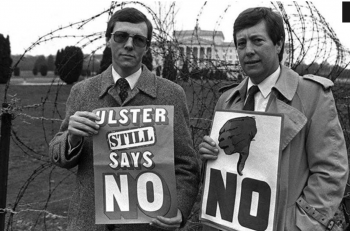
    After the abortion-repeal referendum, there is momentum for change in the North, though DUP-dependent Theresa May has indicated she will not not facilitate it. It has made reluctant bed-fellows of DUP traditionalists and Catholic moral conservatives. DUP Assembly Member Jim Wells has had the DUP whip withdrawn for openly criticising the party leadership. “I’m anti-gay marriage, anti-abortion. I would be conservative, and maybe that’s not the new image the party wants”, he has said. Wells went to Dublin to take part in the ‘Save the Eighth’ march. DUP leader Arlene Foster has noted support from former Sinn Féin voters disaffected by its stance on abortion, coming her party’s way. In early June Ian Paisley Jr tweeted: “I have a letter from a local priest in my constituency thanking the DUP for its stance on these issues and assuring me that he is urging his parishioners to vote DUP because of the stance we take on social matters”. Up to 50% of the North’s Catholics are estimated to be socially conservative, to varying degrees, with 2% to 3%, mostly urban, being fundamentalists. A minority of these actually vote DUP, for moral reasons. On the other hand, however, there are internal strains in the DUP, with some in favour of allowing abortion in certain circumstances and moving away from Paisleyite fundamentalism. Moreover, influence is not all one-way, with the recent West Tyrone by-election emboldening Sinn Féin to a Repeal stance. On May 3 Sinn Féin’s Órfhlaith Begley won that Westminster seat with a majority of just under 8,000. Pro-life campaigners ran a vigorous campaign targeting Sinn Féin in the election. The constituency is 68% Catholic, much of it rural and conservative. Sinn Féin calculates that it only lost approximately 1,000 votes on the issue. It accepts that not all its voters supported the right to choose, but most seem prepared to accept the party position. A factor was that Mary Lou McDonald came out clearly for repeal. Her statement may not have been as strong as most pro-choice campaigners would want, but it was clear. “Sinn Féin is campaigning in the upcoming referendum to remove the Eighth Amendment from the Constituion”, she said. “We are doing this because this is a public health matter. The Eighth Amendment should never have been put into the constitution because that was never the appropriate place to address issues of women’s health”. It’s a long way from the IRA in the 1930s which declared that it would take its social policy from Papal encyclicals. It’s even a big shift since the 2015 Westminster election in Fermanagh and South Tyrone. There pro-lifers had targeted Sinn Féin. In response, it circulated a lea et in the name of Martin McGuinness: “I hold very strong personal views on the issue (abortion) myself and have always been and remain pro-life… As one of the leading parties in the Assembly, Sinn Féin will continue to block the extension of the 1967 Abortion Act to the North”. Despite this letter, sitting Sinn Féin MP Michelle Gildernew lost her seat. While there has been no vote in the North on the issue, the clear majority of ‘yes’ votes in Southern border counties is suggestive of attitudes in the North, even in rural areas. These are areas where communities straddle the Border, and most people have family on both sides. Ballyconnell, Co Cavan, is on the Border with South Fermanagh. It voted ‘yes’ by almost two-to-one. Clones, Co Monaghan, is surrounded on three sides by Fermanagh. All five polling booths had a ‘yes’ majority. The same was true of parts of North Monaghan, physically, economically and socially intermeshed with Tyrone. The villages of Emyvale and Glaslough were strongly ‘yes’. That could be seen in East Donegal. Lifford, on the Border with Strabane, where most residents in several housing estates are from Strabane, voted 51% ‘yes’. From Monaghan and Donegal, there are indications that many members of the Presbyterian Church, the North’s largest Protestant denomination, did not support their Church’s call for a ‘no’ vote. In Aghabog, Co Monaghan, with a strong Presbyterian community, ‘yes’ took 160 votes to 140 ‘no.’ Nearby Drum is as Presbyterian and Orange a village as any in Ulster. It voted ‘no’, but narrowly, with 110 ‘yes’ and 119 ‘no’. In Monaghan even more than Donegal Presbyterians congregations are rural and doctrinally conservative. Thus, urban Protestants in the North could reasonably be assumed to be more pro-choice. In the longer term, the Referendum result will modify attitudes in the North. A significant driving factor of Unionism is the genuine fear of ‘Home Rule is Rome Rule’. Most Unionists would recognise there have been signi cant changes in the South, but would have certain doubts. This vote is proof of big change. In the foreseeable future it is unlikely that any significant proportion of the Protestant population will move to support Irish unity. A 2016 BBC poll showed 72% of them (and 47% of Catholics) against. But even in conservative Northern Ireland, now be sieged to the South and East by abortion liberals, a wave of change is rolling. Anton McCabe

    Loading

    Read more

  • Posted in:

    The appeal of Repeal

    There have been many turning points and defining moments as the debate over repealing the Eighth Amendment has unfolded over recent weeks. Some of these have been the powerful stories of individual women or groups of women; others have been the remarkable statements of specific organisations and yet others have been the unexpected campaigning experiences on the ground. Not least of these turning points has been the remarkable fund-raising campaign launched by Together for Yes just two weeks ago. It had a target of €50,000 initially but quickly increased to €100,000, €250,000,€300,000, €450,000 and surpassed €500,000 in the space of just ten days. But what moved even veteran campaigners were the heart-breaking stories and compelling responses of many of the almost 15,000 thousands who contributed. And for some, who made the decision to contribute despite being hardly in any position to afford to, they were matched in turn by other women and men welcoming the chance to make a public statement and many other thousands who contributed in silence. It was truly amazing the way you could see, feel and watch the secrecy that still thrives in Ireland as many who contributed asked to be anonymous, but were glad that they had found a way to make their statement within a society that silences and renders invisible their actual experiences as women in this country. Other defining moments have been the courageous statements by some organisations that have refused to have their stories manipulated in the interests of those who want to deny women access to health services in their own country and to reproductive justice for all women in Ireland – including migrant women, adoptees and women with disabilities. I would highlight in particular the statements of Downs Syndrome Ireland (DSI), Migrants and Ethnic-Minorities for Reproductive Justice (MERJ), Adoption Rights Alliance (ARA) and Inclusion Ireland (II). Without the timely intervention of Downs Syndrome Ireland (DSI) appealing against the exploitative use of images of children with Downs Syndrome, such images would have been far more pervasive. DSI has been joined by Inclusion Ireland making visible the often hidden experiences of women with disabilities, too many of whom have been denied the right to have a child or who have experienced disrespect and marginalisation within the maternity services in Ireland. It has been the persistent campaigning and activism of MERJ that has ensured that the rights and experiences of migrants and ethnic minorities have been kept in the forefront of the campaign for Repeal: “We often hear about Irish women who are forced to travel to England to access abortion. But what about the stories of the people who can’t travel to access healthcare due to legal status, lack of money, lack of childcare, disability, etc? Migrants and ethnic-minorities face enormous barriers to accessing abortion and maternity services and are disproportionately affected by the 8th amendment. Let’s remember Savita Halapanavar, Ms. Y and the countless others”. Another critical turning point and special moment in this Together for Yes Campaign has to be the very powerful and unstinting voice rarely heard in the mainstream debate on reproductive justice. The Adoption Rights Alliance (ARA) puts forward its compelling case for Repeal in the strongest possible terms. “For our organisation, the Eighth Amendment represents the latest incarnation of the control that was exerted over the thousands of women and girls who were forced to relinquish their children for adoption and who were incarcerated in Mother and Baby Homes, Magdalene Laundries and other institutions. Since 1983, all pregnant women in Ireland have been denied the right to choose whether to proceed with a pregnancy, just as adopted people’s natural mothers were denied any choice. ARA is opposed in the strongest possible terms to the notion that adoption represents a viable alternative to abortion. We firmly recognise the right of a woman to choose not to pro- ceed with a pregnancy. Adoption should only ever be utilised in situations where a child genuinely needs a home, and not as a mechanism whereby women and girls are forced to carry to term and then relinquish the child to a closed, secret system”. Individual voices have also brought new and unexpected emotional experiences to the urgent Repeal cause – in the last few days the story recounted by Chris Fitzpatrick, Obstetrician and Gynaecologist has caught the imagination of many. “I am a doctor. I am supposed to look after people. The woman sitting in front of me is crying. She has had a scan. Her baby’s brain has not developed. The baby will not survive. The woman is 20 weeks pregnant. Her partner has his arm around her. Her mother and father are on their way. Some of her in-laws too. I go over the options. It’s too early to make any decisions. Emotions are too raw. The midwife is very kind to them. We go through everything again the next day. The woman says she cannot go through the rest of the pregnancy. She is too upset. She is wringing her hands in anguish. I cannot help her. She will have to go to England. She and her partner will have to make their own arrangements. Of course, I’ll see her back afterwards. She has our number. She will have to talk to the doctors in England about how to bring the baby home. She wants to bury her baby with her grandparents. The woman is still crying. I offer her a tissue. I have a ticket for the hospital car park. They won’t have to pay on the way out. Inadequate gestures. Cold comfort. There is nothing more I can do. Doctors in another country will look after her. Everyone tells us how important communication between doctors is. I don’t lift a phone. I don’t write a letter. My hands are tied. As they leave, they thank me. I wonder: for what? I close the door of my office. I can hear the woman crying on the corridor.” (Chris Fitzpatrick, consultant obstetrician and gynaecologist (and former

    Loading

    Read more