• Posted in:

    As sad as Assad

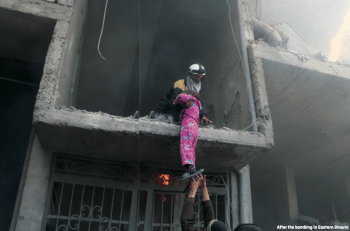
    Unthinkable suffering The Syrian army’s apparent chemical attack on Douma on April 7 was the worst atrocity of an infernal six-week military campaign in Eastern Ghouta. This in turn was the latest horrific chapter in a war lasting seven years which has brought unthinkable suffering to millions of innocent civilians. The relentless bombardment of Eastern Ghouta, backed by Russia and Iran, follows a cruel siege of the area lasting almost five years. These events reflect the most destructive and tragic elements of human nature: when ruthless powers encircle and terrorise the vulnerable, unchecked by any higher authority. The scenes being broadcast from the region are glimpses into an abyss of inhumanity – children being dragged from underneath rubble, parents convulsed with grief, neighbourhoods reduced to debris. The repeated bombing of hospitals and obstruction of aid convoys entering Ghouta are the most depraved aspects of the Syrian army campaign. They are examples of what Holocaust survivor Primo Levi called “useless violence” – suffering inflicted for its own sake and for no other purpose. Putin’s geo-political game Russian President Vladimir Putin has been providing military and diplomatic support to Bashar al-Assad since 2015 when he was losing the Syrian civil war – partly to secure Russian economic interests and partly to assert Russia’s dominance over the US in the region. The civilians of Eastern Ghouta are pawns in Putin’s geo-political game, and it appears he faces little consequence for directing this inferno of mayhem and bloodshed from Moscow. The wholesale destruction of Eastern Ghouta resembles the fate suffered by Aleppo and Homs earlier in the Syrian war and by Grozny, capital of Chechnya, during Putin’s first venture in politicised mass killing, a year into his reign. In each of these war zones the wretched plight of civilians incited him to an extreme of merciless aggression. Putin and al-Assad appear to share a psychopathic relish for attacking the weak. Aerial footage of Aleppo after the worst bombardments in 2016 showed apocalyptic scenes of ruination. The Russian and Syrian forces may as well have dropped a nuclear bomb on this once thriving, exotic city. Night after night on our television screens we are witnessing similar destruction and misery visited upon another mass of civilians, and hearing the same lies from Russian and Syrian officials who deny appalling events that are plain for all the world to see. Footage now emerging of Eastern Ghouta reveals almost a carbon copy of the haunted, hollowed-out cityscape that remains of Aleppo. Syria abandoned Article 1 of the Charter of the United Nations, set out at its inception in 1945, committed members to “tak[ing] effective collective measures for the prevention and removal of threats to the peace, and for the suppression of acts of aggression or other breaches of the peace”. Humanitarian protections for civilians in war zones were enshrined in the UN’s Fourth Geneva Convention of 1949. Grave breaches of these conventions include “wilful killing”, “wilfully causing great suffering or serious injury” and “making the civilian population or individual civilians the object of attack”, all of which have without question been perpetrated on Eastern Ghouta. The UN as it currently stands is nothing more than a politically redundant talking shop for Syria. Hand-wringing about the awfulness of the latest atrocity is invariably followed by diplomatic paralysis. Where power is concentrated most – among China, the US and the EU – moral courage appears absent. The US government, supported by the UK and France, mounted a sharp military response to the chemical assault on Douma, as it did last April when 80 civilians were killed by nerve agents dropped by Syrian army planes in Idlib province. We could ask why the relentless killing of civilians by every other weapon imaginable does not warrant intervention. As before, it is likely that such a measure will not be followed by substantive protections for Syrian civilians who will remain at the mercy of al-Assad and Putin. It primarily served as a show of US military might and of Trump’s willingness to impose a supposed tougher line than Obama on chemical weapons. It   also conveniently shifted public attention from the Mueller investigation into Trump’s alleged links with the Russian administration during his election campaign. An international peace-keeping force The Syrian conflict is a complex and deadly quagmire, involving armies and militias from several countries. Any attempt to resolve it is fraught with risk. And yet the choice to allow this slaughter of innocents to continue is a defilement of our collective humanity. If a large international peace-keeping ground force were based in Syria Putin would be far more cautious in the use of his military power there, and in his sanctioning of al-Assad’s violence. This would require courage from several of the world’s most powerful nations and would involve some risk to the domestic popularity of their leaders. It would be a show of collective strength to cold-blooded autocrats who answer to nothing else. A long-term political settlement is another challenge altogether, but in the interim this would give some protection to civilians caught up in the war. Putin and his allies have been emboldened for too long by having no limits placed on their behaviour and by the implied international attitude that the lives of Syrian civilians are not of much value to the rest of the world. Liam Quaide Liam Quaide is a clinical psychologist and the Green party election candidate for East Cork

    Loading

    Read more

  • Posted in:

    Cold, and Hot

    Someone has finally said it. The Cold War is back. The man who made the statement was Antonio Gutierres and he carries some weight on the matter as Secretary General of the United Nations. Up to now most commentators and experts have stopped short of using those two words. They have spoken of a “deterioration in relations” between Russia and the United States and an end of trust between the two countries. But to those of us who remember the First Cold War certain alarm bells have started to ring. There are people alive today who remember the Cuban Missile Crisis which brought us to the verge of annihilation. In those days both the Soviet Union and the United States had enough weaponry to destroy the planet several times over but the two sides were led by men whose political flexibility served to bring the crisis to an end. Back then the US was led by John F Kennedy and the leader of the Soviet Union was Nikita Khrushchev. Today both powers can still destroy the world but they are led by Donald Trump and Vladimir Putin. A direct military clash between the two in Syria has been avoided so far and, hopefully, will be avoided in the future but the hostile propaganda that characterised the old Cold War is being used to full effect. As in hot wars the first casualty in cold wars is the truth. Nuclear warheads remain in both camps but in today’s world a new set of weaponry exists that was unheard of back in the days of Kennedy and Khrushchev. Propaganda used to be issued on radio, TV, the newspapers and, occasionally, from the pulpit. There were lots of opinions doing the rounds but the Soviets saw to it that very little news, fake or otherwise, emerged from their territory. Back then we were told that the, Soviet peoples, and the Russians in particular, were brainwashed automatons ready to give their lives at a moment’s notice if their leaders asked them to. The Red Army would pour through the Fulda Gap in its hundreds of thousands to end what we considered to be civilisation. Before long we would be as brainwashed as they were and would be ready to do the bidding of our masters. For me that particular vision of Russia came to an end on a warm July evening in Moscow in 1991. I had arrived a month earlier as the Irish Times correspondent and was settling in to life in what was still the Union of Soviet Socialist Republics. On that afternoon my wife and I decided to visit the Novodevichy Monastery one of the city’s numerous historic sites, famous for its beautiful frescoes in the Cathedral of Our Lady of Smolensk. It was there that we caught our first glimpse of a member of the dreaded Red Army that was all set to annihilate us. What we saw was not what we had expected. The soldier’s appearance was far from terrifying. He was a raw-looking kid in his late teens or early twenties. His uniform cap was slouched back on his head in a manner that would engender the ire of a sergeant in that far less threatening military organisation known to us at home as the FCA. But that was not all. This boy in uniform was not alone. He walked arm-in-arm with his mother. It was a striking message to us that Russians are as human as we are and in this case perhaps more so. As for the automatons who believed everything their leaders told them, well that wasn’t true either. There was a burgeoning industry in jokes about the past leader Leonid Brezhnev’s ineptitude. The current leader Mikhail Gorbachev was mocked by sophisticated Muscovites as a country bumpkin with a south-Russian accent. Workers took things easy under the slogan: “They pretend to pay us, so we pretend to work”. Intellectuals had their own slogan which went: “How can we know what our future is today when we don’t know what our history will be tomorrow”. Russians didn’t need western propaganda to persuade them that things were not working well. So how have they ended up supporting Putin? The answer has a lot to do with Boris Yeltsin. Yeltsin brought hope initially but eventually Russia’s economy and its moral compass disintegrated under his rule. Crony capitalism took over from crony communism. Some people became immensely rich while others were selling their belongings in Moscow’s underpasses in order barely to exist. The gun became a major business tool. The Russian Mafia emerged from the shadows and many of its members had backgrounds in the security services. The tradition of the razborka, the settling of matters by the gun, became a major feature of everyday life. On one occasion that I particularly remember a family visited the grave of one of its members only to be blown to pieces by a bomb planted by a rival group. TV pictures showed the crows picking at human flesh on the branches of the cemetery’s trees. While this was going on the West indulged Yeltsin. If the 1996 presidential election was rigged then it was done to save the country. If Yeltsin wandered at night in the Washington streets in his underpants it was endearing. If he couldn’t manage to get off the plane in Shannon he was “tired”. Russians knew better. Ordinary people rang the Irish Times Moscow office to apologise for their president’s behaviour. The word stabilnost (stability) was on everyone’s lips. Then along came Putin. Russians craved stability and they got it. The West’s tone changed. Here was someone who might make Russia strong again. Bit by bit the demonisation of Vladimir Putin began. Relentlessly he was portrayed as the evil emperor. As time went on he helped the propagandists by behaving as they predicted. We have now reached the stage that any allegations against him are instantly believed. He was responsible for Trump’s election even though it

    Loading

    Read more

  • Posted in:

    Put in perspective

    As we know well in Ireland cash is one of man’s greatest temptations. It’s a recurring theme in Russia. In the venal world, for example, of Fyodor Dostoevsky’s ‘The Idiot’ (1869) most of the characters succumb to greed. General Ivolgin desires money to support his addiction to alcohol and to allow him to spend time with his mistress. Lebedev is willing to put his hands into a replace to retrieve a package that Nastassya Filippovna has discarded, with 100,000 roubles inside. In the society of The Idiot, money not only creates one’s fortune it also obtains one a bride. ‘Bids’ for Nastassya Filippovna range from 75,000 roubles to 100,000 to over a million. Money, then, is a clear symbol of the perversion of human values in the novel. Russia fell into a similar stupor at the end of the Cold War when excessive wealth corrupted Russian politics as Boris Yeltsin amply filled the role of the Idiot, his powers declining in a haze of vodka as the plot unfolds. It was out of this pit of iniquity that Vladimir Putin rose to power, the short but muscly former KGB of cer emerging from obscurity to become prime minister and then being elected President in 2000 when Yeltsin finally lost his reason. The US embassy cables published by WikiLeaks in 2010, revealed that American diplomats considered Putin’s Russia had by then become “a corrupt, autocratic kleptocracy centred on the leadership of Vladimir Putin, in which officials, oligarchs and organised crime are bound together to create a virtual ma a state”. A 2007 CIA report estimated Putin’s wealth at $40bn. Indeed the one-time biggest foreign investor in Russia, Bill Browder, told Business Insider that Putin was worth $200bn, making him the richest man in the world. He claimed “the first eight or 10 years of Putin’s reign over Russia was about stealing as much money as he could”. A BBC Panorama investigation earlier this year showed he has a $1bn palace on the Black Sea Coast. Funds for it were diverted from the super-rich who thought it would be spent on healthcare. But of course for most Russians, after a decade of buoyancy, all is not good on the cash front because of Ukraine-fallout sanctions, and the collapsing currency and oil prices. The Russian economy shrank 3.7 percent in 2015, and 4.1 in 2014 in rouble values, but in dollar terms it is 40% below peak. Oil prices rebounded in early February to above $35 per barrel but they had peaked in 2012 at close to $110 (when oil and gas constituted 52% of government revenue) and government forecasts are based on €50. Real wages fell 10 per cent year-on-year in December, the 14th consecutive month of contraction. Russia is running an unsustainable budget deficit of almost 5%. Soon a key thresold will be reached where over 50% of an average income is spent on food. Putin’s dastardliness and vulnerablity to exposé is even more drastic on the security front. For example, it has been alleged that, presumably under the direction of Putin, the Russian secret services, the FSB, bombed apartment blocks in Moscow in 1999 killing almost 300 people and pinning the blame on Chechnyan separatists. Of course, Putin was able to use the war in Chechnya to good propagandistic effect but he may have created hostages to fortune, even in furtive Russia. Such tactical ethical nihilism might have appeared in another of Dostoevsky’s extraordinary novels, Devils (1872). Towards the end one of the conspirators Lyamshin is put on trial and asked, “Why so many murders, scandals and outrages committed?”. He responds that it was to promote: “the systematic destruction of society and all its principles; to demoralise everyone and make hodge-podge of everything, and then, when society was on the point of collapse – sick, depressed, cynical and sceptical, but still with a perpetual desire for some kind of guiding principle and for self-preservation – suddenly to gain control of it”. Destruction and demoralising animates much of Putin’s policy from Crimea to Ukraine, Syria to Chechnya. Russia consistently operates standards that are more indiscriminate than Western military powers. Last September Putin shocked the world by weighing into the Syrian conflict with air strikes against rebel-held targets. Controversially the primary targets did not seem to be ISIL. An article in Time magazine by Timothy Snyder argued that the motivation for Russia’s intervention in Syria was to turn Europe into a ‘refugee factory’, compelled to accommodate many more beleaguered victims than have already arrived. This is based on the credible assessment that the Putin views the stability of the European Union as a threat to Russia. He will also have appreciated the opportunity to create a client authoritarian regime in the Middle East and to play to a growing anti-Islamic gallery in Europe, particularly in the former Soviet Union. Ironically, Putin started as a centrist in Russian terms. However, he was threatened by nationalist support for electoral protests against his regime in 2011-12, and now by economic instability and public poverty. If Putin fails to deliver in Ukraine, there is a probability of a challenge to his authority from a more radical nationalist agenda. Confronting Putin may be the greatest geopolitical challenge that Europe has faced since the end of the Cold War. Machismo, personal and political, is a big part of his schtick. Whether it’s bare-back horse-riding, descending in a deepwater submersible, posing with a massive pike he’s just caught or a tiger he’s tranquilised, or drinking 24-year-old vintage wine with Berlusconi he’s not notably alive to his feminine site. It’s Haughey for the twentieth century, gone global. He divorced in 2014 and is now living with a fecund gymnast. Man-on-Man buddy of Trump. Antagonist of Elton John. Scathingly self-righteous denier of any connection with the characteristic polonium poisoning of Alexander Litvinenko in London, despite the finding of a former English judge that he had “probably authorised it” and the dead man’s allegation that “the howl of protest from around the world

    Loading

    Read more