• Posted in:

    Dag Hammarskjold

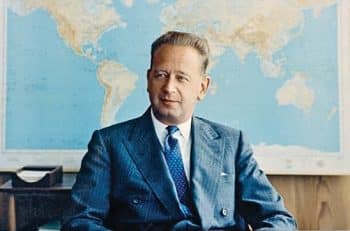
    The youngest and best UN Secretary General, 60 years after his assassination. By Chay Bowes Dag Hammarskjold was the second ever, and some say the greatest, Secretary General of the UN. When he died sixty years ago this year, President John F Kennedy suggested that Hammarskjold had been “the greatest statesman of our century”. At 47 years of age on his appointment, Hammarskjold was the youngest ever secretary-general of the United Nations and one of only two people to ever be awarded the Nobel prize posthumously. Are his life, innovations and untimely death relevant in 2021? Dag Hjalmar Agne Carl Hammarskjold was born in 1905 to a wealthy Swedish ‘noble’ family, the son of a future Swedish prime minister and politician Hjalmar Hammarskjold, who would serve during the first part of the first world war. Dag Hammarskjold had a relatively privileged early life at the family home at Uppsala castle. Despite his materially comfortable surroundings, Hammarskjold experienced much personal difficulty within his conservative and emotionally rigid family. Roger Lipsey, in his work ‘Hammarskjöld: a Life’ (2016) suggests: “There were enough confusing psychological crosscurrents to generate sterile excellence and recurrent personal misery”. Essentially Lipsey posits that Hammarskjold was given ample opportunity to achieve a life of “high-level mediocrity” but despite the restrictions and emotional limitations of his upbringing he would achieve great things. Hammarskjöld has been credited with coining the term “planned economy”. He co-drafted the legislation that opened the way to the creation of Sweden’s welfare state Hammarskjold attended the “Katedralskolan” one of the oldest educational establishments in Sweden (Est 1236 ) and went on to take law and philosophy degrees in 1930 at the University of Uppsala. He had by then already been appointed to the post of assistant secretary of the “committee on employment” in the Swedish government. Hammarskjold excelled as a civil servant and by 1936 had been appointed to the Swedish central bank serving as secretary of its general council between 1941 and 1948. Hammarskjöld has been credited with coining the term“planned economy”. He co-drafted the legislation that opened the way to the creation of Sweden’s welfare state. In 1947 Hammarskjold was made Sweden’s delegate to the organisation for European Economic Co-operation where he assisted in the implementation of the Marshall plan to resurrect Western Europe economically. Despite being appointed by a government of Social Democrats, Hammarskjold never actually joined any political party himself. The United Nations By 1951 Hammarskjold joined Sweden’s delegation to the United Nations General Assembly in Paris. Hammarskjold’s conviction that smaller, less powerful nations should be protected was central to his vision for the UN as a peacekeeping entity. He quickly became Chairman of the Swedish delegation. Hammarskjold wanted the United Nations to be a dynamic tool for its members with pragmatism at its core. The Suez Crisis, Innovation and Pragmatism Hammarskjold exercised his own personal diplomacy to get the UN to nullify the use of force by Israel, France, and Great Britain following Nasser’s commandeering of the Canal; At the outbreak of the Suez crisis in 1956, the United Nations had never deployed peacekeeping forces. rticle 43 of the UN Charter provides that All Members of the United Nations, in order to contribute to the maintenance of international peace and security, undertake to make available to the Security Council, on its call armed forces, assistance, and facilities, including rights of passage, necessary for the purpose of maintaining international peace and security. Working alongside Canada’s foreign Minister Lester Pearson who had initially sown the seeds of the concept in Hammarskjold’s mind, the concept of peacekeeping as we know it today was formulated. Hammarskjold pulled together enough support and commitment from member states to establish the United Nations Emergency Force or UNEF which stood ready for deployment in weeks. The essential tenets of that initial UNEF mission remain at the core of all UN missions to this day. The Congo, Context and Global Relevance The decolonisation of Africa had reached a pivotal moment by mid-1961. Neither the Soviets nor the Americans supported colonialism. They nevertheless saw the relinquishing of colonial possessions by Britain, Belgium, France and Portugal as an opportunity to expand their influence in newly independent states. Certainly the remaining minority-white governments of the region such as South Africa and Rhodesia had significant concerns about the decolonisation process. In 1960 the Belgian government officially relinquished its sovereignty in the Congo and a nationalist leader Patrice Lumumba was elected Prime Minister. In a vain attempt to appease his rivals and preserve unity, he appointed the opposition leader Joseph Kasavubu as president. However, days later the army mutinied. In the midst of this turmoil, large umbers of white Belgian settlers began to leave the Congo with Belgian forces intervening on the grounds of protecting its citizens. In May 1960 Moise Tshombe announced that the province of Katanga, which held most of Congo’s mineral wealth, was declaring independence. Among the valuable minerals and deposits Katanga held were uranium and cobalt. A Belgian commercial entity called the “Katanga mining union” immediately began to support the breakaway government based in Elisabethville. The immediate effect of such financial support for Katanga was that it was wealthy enough to stand alone against Congo proper, with the Belgian mining interests ensuring that their assets in the region would remain under their control. In September 1961 Hammarskjold was on a mission to facilitate an end to this evolving conflict in Katanga. Hammarskjold firmly believed that the post-colonial growth and liberty of the newly independent Congo should not be influenced or restricted by its old colonial ruler, Belgium. The defence and preservation of the infant independent Congo became a personal priority. He along with 15 others died in a plane crash on 18 September 1961 in what is now Zambia. He was on his way to negotiate a  cease-fire between UN forces and Katangese troops under Moise Tshombe. In her definitive work, which served to stimulate renewed UN investigation into Hammarskjold’s death, British academic Susan Williams, (‘Who killed Hammarskjold?’, Oxford University Press 2014) contends that

    Loading

    Read more

  • Posted in:

    UNambitious

    Ireland will again exercise its place on the Security Council to promote consensus rather than vision and values. By John-Vivian Cooke Ireland took a seat on the UN Security Council for the term 2021/22 on 1 January. This is the fulfilment of a key strategic goal of Irish foreign policy. However, having secured that seat on the Security Council, what will we do with it? If the record of our last term on the Security Council in 2001/2 is anything to go by, the answer will be disappointingly little.  Our feeble performance then was despite a highly professional and effective team representing us in New York but largely due to a  deliberate choice to set modest ambitions: a tactic that shows every sign of being repeated again in January. The tragedy is that Ireland is capable of so much more. There are two reasons to be pessimistic that we will deliver this time around. The first is the excessive strain likely to be placed on the organisational capacity of the Department of Foreign Affairs and Trade (DFA). The Department`s budget could well face deep cuts as a consequence of the current Covid-19 recession, a recession which could be made worse by a hard Brexit in the new year. Any cuts to the DFA`s budget will occur precisely at a time when it is trying to meet the additional demands for resources for our Security Council term. Moreover, Ireland’s Security Council  agenda will have to compete for funding with other budgetary priorities such as meeting our international development aid commitments and the planned expansion of the number of missions around the world. The plan to open 26 new diplomatic missions has only reached the half way mark and the if the department is to meet its targets under the Global Ireland strategic plan, funding will need to be found for the remaining 12 missions. Even if the department finds a way to balance its budget, there will be other pressures on its institutional resources.  There are absolute limits to the time that any minister, in general, can dedicate to any specific policy issue and Brexit will be the topic that will preoccupy the Minister for Foreign Affairs. This preoccupation is set to be replicated throughout our diplomatic structures with the consequence that expertise and experience that, in normal circumstances, would be available to support the UN team, will be diverted to manage Brexit. No matter the quality of our diplomatic representation at the UN, the ability to set policy priorities and give direction on diplomatic strategy can only come from the legitimate and formal authority of the elected minister. Second, even in ideal domestic circumstances, the structure of international relations imposes intrinsic limitations on Ireland`s ability to determine outcomes at the UN. The distinction between the elected members of the Security Council and the five permanent members (P5) institutionalises the privileged position that the P5 members are granted under the UN charter in their role as Great Powers. Notwithstanding the notional sovereign equality of states in the charter, and under international law generally, the blunt truth of international relations is that the P5 do act differently and they are treated differently from other, lesser, states. Great Powers are qualitatively different from all other states by virtue of the resources they possess: elements of power that simply are not available to even medium-size states. The quintessential qualification for Great Power status is the ability to project military power, both conventional and nuclear. The measure of a state`s power is proportionate to the magnitude of its forces; the distance they can be projected; and the duration for which they can be deployed. This power, in turn, rests on the fiscal and economic resources of the state.   But to acknowledge the difference among states is not to condone or excuse it. The fact that the US ¨doth bestride the narrow world like a Colossus and we petty men walk under his huge legs¨ does not mean that we must ¨peep about to find ourselves dishonourable graves”. But, if we are to accomplish honourable ends, we must set ourselves far more ambitious goals while still retaining an unsentimental understanding of how world politics operates. There can be no mistaking that the distribution of power creates a difference of kind rather than a difference in degree between the permanent and elected members of the Security Council. Some analysts describe the P5 as having a systemic role in constituting international norms and institutions while small states such as Ireland are ¨System Ineffectual¨. Yet the temptation is for elected members to see themselves as merely mini versions of the Great Powers and to develop strategies that compensate for their lack of power. The Norwegian Minister for Foreign Affairs, Ine Marie Eriksen Soreide, succumbed to exactly that temptation in her comment that: ¨(N)o-one can take care of Norwegian interests like Norway can. To uphold and strengthen the multilateral system and rules-based order, that`s a core foreign policy interest for Norway”. Instead we should adopt a new sui generis understanding of how small states such as Ireland operate in international politics. The established perspective on international relations treats all states as unitary actors that exercise various forms of power in pursuit of their national interests. This puts small states in the same category as Great Powers and predicts that the foreign policy of small states will be oriented to increasing their autonomy. In practice, the opposite occurs: small states seek to limit the autonomy of the Great Powers by enmeshing them in the constraints of international norms and regimes. Simon Coveney acknowledged as much when he said ¨(T)he basis for our campaign to be on the Security Council was to be vocal on these key issues around adherence to international law standards that apply through international structures and systems that protect small and weaker states as well keep dominant and powerful states in check”. Indeed, the current ‘Global Island Ireland’ strategy paper makes the point that ¨the European Union and United Nations in amplifying Ireland’s voice and extending

    Loading

    Read more

  • Posted in:

    The Right to have Rights

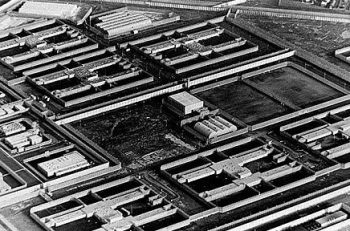
    Hannah Arendt’s famous phrase ‘the right to have rights’ was coined in her 1958 book ‘The Human Condition’. The condition of being stateless, of being a displaced person, which began its modern history in Europe with World War I, has been experienced since by untold millions who have had to listen to the claim that ‘human rights’ are universal and fundamental – but not for them. Once we had the glamorous figure of the cosmopolitan, the person who belonged to the world, the global community; that figure has been displaced by the refugee, who belongs nowhere, but is to be found everywhere in the paradigmatic settings of the modern and contemporary world – the prison camp, the internment zone, the refugee camp, the ghetto, the jail, the arena of suspension where people live in a place that is always outside the country that it is inside. Arendt pointed out that the creation of such places and conditions is a political decision, not just a terrible catastrophe. It is the prevailing form of the penal colony, the new home that we have built to house the theory of human rights. Since Arendt, and most especially in the indebted work of Giorgio Agamben, it has become clear that the concentration camp of the twentieth century was not some historical anomaly, but that it is actually one of the paradigm sites of Western modernity. The internment camp is a zone of suspension, of ‘rendition’, a place that is always outside the country it is inside – Guantanamo is the best-known example, although there many such places – our best- known example was The Maze in Northern Ireland. Those entrapped there expose the hollowness of any claim to universal human rights, to having rights just on the basis of being human. Arendt said it plainly: the refugee, the displaced person, has regularly been denied the right to have rights. The denial is a political decision. It takes its most popular form in the denial that there are any ‘political prisoners’ in the denying country, although enemy countries are full of them. Its political nature has been counterpointed more clearly since 1948, since the United Nations began its series of declarations of Human Rights, unabated since that date; rights of men, women, children, of minorities, of the disabled, of all indeed who can be characterised as having been ‘excluded’, which means that even the ‘poor’, a constituency which enlarges globally by the hour, faster than ever since the almost perpendicular rise of neo-liberalism in the decades before and after the financial crash. Reading these rights, as ‘declared’ (whatever that means), in that bland United Nations universalistic rhetoric, it is hard to know whether to laugh or cry. Such noble vacuities, such actual atrocities – produced by the same state systems that have prevailed since 1945. It was part of Arendt’s long argument, which began in 1943 with her essay “We Refugees” (about Jewish migrants who had become ‘stateless’, that condition in which they had no rights) that asked why European civilisation had so successfully produced the barbarism that made statelessness pandemic and human rights so unavailable to the millions of ‘displaced persons’ of World War II. Part of her answer was that this barbarism was so successful precisely because it was so concealed within or behind the declarations of universal rights and justice which the West, in the case of the American and the French Revolutions, had made central to the powerful ideology of what mutated into Western ‘freedom’. Arendt’s question then was: how could such an ideology be developed (as through the UN declarations) and simultaneously traduced (as in American foreign policy)? It is too feeble an explanation to put it down to hypocrisy. Hypocrisy on this scale occurs when the people who most sincerely believe in the peaceful principles are those who most regularly betray them in violent action. The British spent three centuries in perfecting their international reputation as hypocrites, a nation that believed itself to be peaceful even as it waged endless wars. Now that role has been assumed, largely, by the Americans. But, to achieve world domination is one thing; world hegemony is another. That’s what the World Wars were fought for. Arendt achieved notoriety with her reporting on the 1961 trial of the Nazi Adolf Eichmann, which was published in book form as ‘Eichmann in Jerusalem: A Report on the Banality of Evil’, where she developed the central figure of the ‘desk-murderer’, the bureaucrat who administered the death-camps. But her key point was that this was a show-trial, that pretended to be an example of universal justice triumphing over universal evil. Rather, it was in fact a national victory of the Israelis over their Nazi persecutors. In this exemplary instance, we are shown how the language of universalism can be used as a disguise for a state’s policies. The jurist who had the ambition to do that for a successful Nazi state, Carl Schmitt (1888-1985), described in his ‘Nomos of the Earth’ (1950), how the European system of international law had been replaced by an American one, with the UN as its legislature and the International Tribunal or Court as its executive. In effect, the language of universal rights was used to ratify the aims of American foreign policy; Nuremberg, Tokyo, Damascus, the Hague were, like the Moscow show trials of the 1930s, elaborate pretences that something objectively true was being defended from the current version of sectarian betrayal – war criminality, terrorism, the new terms of ‘war crime’ and its flourishing neighbourly companions, such as ‘ethnic cleansing’. Danilo Zolo has demonstrated in Victor’s Justice how the Kosovo war of 1999, that infamous intervention (to be followed by interventions in Iraq, Afghanistan , Libya and elsewhere, saving the ‘people’ of those countries for democracy, largely by killing and dispossessing them), with its International Court at the Hague, which could try anybody but Americans, is the most egregious example so far of how the language of universal rights has been perverted

    Loading

    Read more

  • Posted in:

    Hands off civil society

    The UN’s Secretary General, Ban Ki Moon, has called civil society “the oxygen of democracy” but its space is shrinking. This may be jargon, but it is inspired by a serious threat to democracy – the undermining of basic rights: freedom of expression, freedom of association, and the right to peaceful assembly. Civicus grandly describes itself as the ‘World Alliance for Citizen Participation’. It is more down to earth when highlighting failures to address this shrinking civil society space. In recent months environmental and land-rights activists have been assassinated in Honduras and South Africa. Civil society organisations in Egypt are being prevented from receiving funds from foreign sources. In India the police have repeatedly sought the arrest of a couple who criticised Prime Minister Narendra Modi for his role as Gujarat chief minister during the Gujarat riots in 2002 in which at least 790 muslims (and 250 Hindus) died. The police have confiscated their passports and blocked their bank accounts and their homes have been raided. A woman human-rights defender has been arbitrarily detained in Bahrain with her 15-month-old son. A new law in Jordan is imposing arbitrary conditions on the formation of civil society organisations. An activist opposing a hydropower dam in Cambodia has been given a suspended sentence. That is disturbing and unacceptable. However, some will argue that only happens elsewhere. But civil society space is shrinking in Ireland too: different means, same intent. Civil society organisations here are strangled with cuts and encumbered with ever greater levels of bureaucracy such as charity regulation, lobbying legislation and tendering demands; and are spending too high a proportion of their time reporting on endless indicators. For example our long-standing local not-for-profit development companies providing programmes to tackle unemployment and social exclusion suffered reductions in funding from €84.7m in 2008 to €48m in 2014 and have been required to submit detailed competitive tenders. Most got through the process but some didn’t. Those that did are now bogged down in an indicator-dominated programme. The environmental pillar of social partnership has been under severe pressure due to reductions in funding arising from cutbacks in the environment fund and Department of Finance obstruction. The Minister for the Environment implied he was considering removing An Taisce, the largest environmental NGO, which has been critical of him, from the list of bodies consulted over big planning applications. Organisations are bound into service-provision contracts that preclude criticism of the state. The structures for engagement with the State have been dismantled. There is an evident hostility to and a demonisation of protest and dissent. We can’t stand aloof in Ireland from this global attack on democracy and ostensibly valued freedoms. Locally, as internationally, those in power do not want these organisations giving voice to and mobilising dissent to a model of development that impoverishes, generates inequality and destroys the planet we live on. Civicus are seeking to foster greater coordination between civil society organisations to face down these threats. Civicus and Human Rights Watch hosted a meeting of regional and international civil society organisations to explore the agenda for a campaign on these issues. They identified the need to develop a new positive narrative about the contribution of civil society to national life. This seemingly basic step was prioritised in the face of what was described as ongoing stigmatisation and vilification of civil society organisations. A second step was to inform the general public about the nature, causes, and extent of restrictions on civil society activists and organisations. A third step was to broaden the debate beyond advocacy organisations and those working on civil and political rights. They noted that restrictions are increasingly applied to anti-poverty and development-focused organisations. Civicus are seeking inputs on how best to develop this global campaign. The International Civil Society Centre is the “global action platform” for international civil society organisations (ICSOs). It works to support the “world’s leading ICSOs in maximising their impact for a sustainable and more equitable world”. It is also initiating a process of consultation on a ‘Civic Charter’ which it will launch in October 2016 as a means of building international solidarity for civil society organisations. Some key directions have been suggested, including the need for new ideas for collective advocacy to reverse repressive legislation targeting civil society organisations, the adoption of progressive institutional frameworks for civil society engagement with Governments, and the recruitment of eminent persons to demand the release of unjustly imprisoned civil society activists. Civil society in Ireland should prioritise the re-appropriation of civil society space. It must participate in these global campaigns and aim to get international demands tailored to address how civil society is specifically being eroded here. As we face increasingly intractable inequalities and irreversible climate change it is a political imperative. Niall Crowley

    Loading

    Read more

  • Posted in:

    Unruly

    What is meant by the Rule of Law and is such a concept honoured in Ireland today? I believe that the rule of law though arguably an unqualified good is not being adhered to in this state save mostly by the judiciary and that the legal system and erratic observance of legality by state officials renders our democracy fragile. In my view Ireland draws close to that amorphous notion, a failed state that cannot in reality uphold the rule of law. This opinion piece will not be a comprehensive pathology but will point out many of the salient practical features which show how the rule of law is breaking down. The Rule of Law: Theoretical Incoherence? We first need to probe the many senses in which the rule of law is described. Joseph Raz, a legal positivist who believes in “perfectionist liberalism” has suggested that the rule of law is merely a kind of shorthand description of the positive aspects of any given political system. From a different vantage point the fundamentalist Christian legal philosopher John Finnis considers that the rule of law is: “[t]he name commonly given to the state of affairs in which a legal system is legally in good shape”. Another philosopher Brian Tamanaha chimes to negative effect that the rule of law is “an exceedingly elusive notion” which leads to “rampant divergence of understandings” and is similar to the amorphous concept of Good in that “everyone is for it, but has contrasting convictions about what it is”. At bottom, there is no consensus: it is elusive at best: a form of smokescreen or professional hypocrisy at worst. But let us endeavour to be constructive. For example Carothers, though sceptical, adds a worthwhile positive definition of the rule of law as: “a system in which the laws are public knowledge, are clear in meaning, and apply equally to everyone. They enshrine and uphold the political and civil liberties that have gained status as universal human rights over the last half-century. In particular, anyone accused of a crime has the right to a fair, prompt hearing and is presumed innocent until proved guilty. The central institutions of the legal system, including courts, prosecutors, and police, are reasonably fair, competent, and efficient. Judges are impartial and independent, not subject to political influence or manipulation. Perhaps most important, the government is embedded in a comprehensive legal framework, its officials accept that the law will be applied to their own conduct, and the government seeks to be law-abiding”. Now let us stress-test certain aspects of this detailed expurgation against the patient – in this context Ireland Inc. Yes of course rights exist in our still fine, if shopworn, constitutional matrix and are enforced by the courts in many instances but there is also an undue deference to the executive that has led to the non-enforcement of social and economic rights particularly the right to housing by the courts. There is an excess of judicial caution on other rights-based claims, particularly where issues of financial iniquity and the countervailing amorphous blob, public policy, are implicated. There is also widespread violation of privacy by the state and its police force, in particular. The overly sanguine way we as a nation have accepted, in effect, what has been police and state criminality with respect to privacy for the last thirty years without widespread outcry is baffling. At least there are signals of an upsurge in civil disobedience, which when peaceful, as Habermas, the German sociologist of critical theory and pragmatist, would contend, leads to a vitalisation of democracy. Not here. Further, the scandal that is our banking structures, the disgrace of the banks varying interest-rate repayments in breach of agreements, the sometimes unconscionable evictions, are not conterminous with the rule of law. NAMA is a mess formulated by the neoliberal club which did its best to avoid a proper new deal for the Irish people. The banking inquiry was a poorly performed French farce. What is desperately needed is a right to housing. Eviction should be rare, require rehousing, and should only follow meaningful intervention by an arbitrator who can determine whether the consumer can repay and whether the bank – with or without the enlistment of a vulture fund – is bundling the mortgage at a bargain-basement rate to private-law profiteers. Further, many of our state institutions have major structural problems. The Garda are not progressive in training and intent: they do not seek justice or the truth, but rather a result. They, at times spin, embellish or at worst, manufacture evidence – and, to be candid, at times act criminally and in violation of the rule of law. Finally, there are limited independent checks and far too close a nexus between politicians and the police. The recent moving of the deckchairs by the Garda Commissioner will not change the culture or training of the force, its group think or, arguably, its competence. It needs a radical ovehaul and a redirection so primarily promotes truth- seeking, investigative process. The impartiality and independence of our judiciary needs at times to be severely questioned because there is far too close a nexus between politics and judicial appointments. Though most are appointed on merit, many of our judges are appointed for their proximity to political parties. Further, some judges have an aggrandised sense of themselves: certainly they are not servants of the state as that is not a judicial function, but rather, they are the servants of the constitution which is a bulwark to protect the people against state excess. Judges also need, in the interest of public confidence as to their impartiality, to declare their share-holdings and indebtedness to the banks. Moreover, parts of the government left itself open to the accusation, during the bugging crisis, that it was also mired in corruption. In the strictest sense it observed the rule of law but, in manner, it laid itself open to the criticism levelled elsewhere by the late great Christopher Hitchens of being crypto-fascist, pursuing a

    Loading

    Read more

  • Posted in:

    Protect!

    The new Minister for Social Protection will face a number of significant challenges. She has to deal comprehensively with the damage of the immediate past, while expediting long overdue reforms, and at the same time stay on top of new welfare challenges associated with changing forms of family, employment patterns, demographic trends: all betrayed by pervasive inequalities. The UN has provided some valuable guidance for the new Minister – in the Concluding Observations of the United Nations Committee on Economic, Social and Cultural Rights on the third periodic report of Ireland about implementation of the International Covenant on Economic, Social and Cultural Rights of June 2015. The Committee strongly advised that austerity policies should only be temporary and only cover the period of the crisis. They recommended that Ireland restore pre-crisis levels of social protection. They stated that Ireland must strengthen policy capacity with a disaggregated data strategy and adequate rights and equality-proofing mechanisms. Five key priorities for the new Minister for Social Protection are suggested: Redressing the impact of austerity cuts on children at risk of poverty, young people under 26, and lone parents. These groups suffered serious collateral damage from austerity budgets that failed to protect the vulnerable; Reversing reductions in welfare payments that left recipients below the poverty line; Tackling long-term unemployment in a manner that promotes inclusion in the labour market for all those who want employment, including people with disabilities, and all women; Ensuring the contribution of social welfare payments to the growing crisis in family homelessness. Changing the male breadwinner model and responding to new forms of family diversity.  The universal Child Benefit was reduced over a number of austerity budgets from €166 per month in 2010 to €130 pm in 2013, with additional cuts to the higher payments for the 3rd + child. This payment was increased by €5 over budgets 2015 and 2016 and is now €140. The combined impact of these cuts and parental unemployment means child poverty doubled over the crisis period. Social-welfare-dependent single families with children suffered cumulative cuts over the crisis. The number of jobless households with children also burgeoned. Tackling child poverty is far more complex than simply restoring child benefit to its pre-crisis level. The new Minister must take seriously the advice offered by the National Economic and Social Council (NESC0 and by various commissions and expert groups. A tiered and better targeted child-income-support system is a prerequisite for efficiently tackling child poverty but avoiding unnecessary unemployment and poverty traps. Austerity disproportionately damaged the young. Its mechanisms included emigration, deterioration in the quality of employment and severe social welfare cuts – with job-seekers’ allowance reduced by more than half for those under 25 (from €204 to €100). Many young people have emigrated to avoid not only poverty and unemployment but also low-quality employment and underemployment; others remain trapped in the parental home unable to afford the transition to independent adult life or to move to larger urban centres to seek employment. An immediate priority is resolving the situation of the 600 young people who, unable to sustain residential tenancies on such an inadequate income, are left dependant on emergency homeless services. The new Minister should revisit the previous Minister’s overzealous cuts to lone parents’ income disregards, and the decision to compel lone parents, once their youngest child is 14 years old, to work full-time. It is clear that this policy is not conducive to the wellbeing of parents or children. Various creative alternative reform proposals have been offered to promote a more positive reform agenda capable of addressing poverty and respecting parents’ choices for reconciling care work and paid employment. While the EU Survey of Income and Living Conditions (SILC) shows poverty, deprivation, consistent poverty and inequality rose over the crisis (Table 1), Watson and Maitre (2013) still nd high levels of efficacy in Irish social transfers. Despite social welfare cuts, Irish welfare payments were relatively effective in cushioning people from the worst effects of rising unemployment and falling incomes. Social transfers reduced the post-transfer poverty rate by 53% in 2004, but this rose to 71% by 2013. Despite such an impact, deprivation rates still rose from 13.7% to 24.5% between 2008 and 2011, and up to 30.5% in 2013 before decreasing. Deprivation rates for lone parents, however, peaked at 63% in 2014 (CSO). The NESC has outlined the significant social impact of the crisis (2013). It estimated that 10% of the population experience food poverty. There is growing use of ‘soup kitchens’ and runaway homelessness. The welfare system is the core mechanism for economic equality. There are, as Micheál Collins argued in last month’s Village, lessons to be learned from mistakes in previous recoveries where the failure to prioritise welfare increases saw social-welfare-dependent households’ fall dramatically behind general incomes. The new Minister must commit to, and budget for, adequacy and indexation of all social welfare payments, not just those considered ‘deserving’. These increases need to be a policy priority, not crumbs – or an afterthought. Since 2011 social welfare rates have not been decreased except for two social welfare cuts which decreased the adult working age payment by €16. As Focus Ireland recently observed these cuts coupled with an increasing cost of living, have resulted in a considerable erosion of living standards for those reliant on social welfare payments as can be seen in this comparison of recent increases in the Consumer Price Index (CPI) with stagnant Irish social welfare rates (Table 2). The last five years have seen an unprecedented level of reform in the State’s employment services, in particular merging institutions into INTREO. The Pathways to Work 2016-2020 policy document does acknowledge services are struggling to reach quality standards, with uneven service delivery and poor guidance capacity. Other capacity gaps are now being addressed by ‘Job Path’, private-sector services for the long-term unemployed. These are based on a ‘pay-by-results’ model which will probably increase pressure on people to take poor-quality employment. The new Minister must carefully consider whether this work- first activation model

    Loading

    Read more

  • Posted in:

    UNrealistic

    At the end of last September, under the shadow of the glimmering New York skyline overhead, the world celebrated the dawn of a new era. The UN Summit on the Sustainable Development Goals (SDGs) concluded with a massive party in Central Park, graced by the presence of superstars such as Ed Sheerin and Beyonce. The party was sponsored by Gucci, Citi, Unilever, Google and others. Many of their super-rich executives could well have been watching the party from their high-rise apartments in that most elegant part of the planet. Some people had paid upwards of $10,000 for VIP passes to the party. All proceeds went to charity, of course. There was no whiff of a world on the brink of collapse, threatened environmental destruction and violent extremism, the one that had been so eloquently articulated by Pope Francis in his landmark address to the UN General Assembly the previous day. The gap between the optimistic, almost euphoric atmosphere in some UN quarters and the pessimistic, almost despairing perspectives of others, including Pope Francis, was palpable at the Summit. On the one hand, famous business moguls, UN officials and many states, including Ireland, lined up to hail the goals as a new beginning. On the other hand, many wondered whether yet more goals would make any difference at all or even whether they would take us in the wrong direction altogether. Whatever your perspective, the SDGs are now a universally agreed UN document. For the most part, they set out important objectives for the world, 17 in all. They point to all the critical areas of human development that must be addressed if we are to tackle inequality, poverty and environmental destruction. They set 167 indicators of progress which are to be monitored and followed up annually. Importantly, for the first time ever, they promise to “leave no-one behind” and put a deadline of 2030 on achieving that goal. While as individual objectives the SDGs are desirable, as a global policy framework they are deeply flawed in at least four ways. Firstly, the sheer number of goals agreed and the lack of real interconnection between them has turned them into a shopping list. Everything becomes equally important. Yet the truth is that global imperatives exist. There are critical enablers which everyone needs to address alongside second-level priorities, which can be reached only on condition the first are being achieved. So the SDGs create a kind of policy fog in which it is hard to see the wood from the trees. Secondly, despite years of debate, the goals fail to resolve the decades old conundrum of sustainable development. This is the fact that ‘economic’, ‘social’ and ‘environmental’ dimensions do not really sit side by side or form interlocking circles. The ‘economic’ and the ‘social’, in reality, are dependent on the ‘environmental’. We need to move away from the inadequate cliche of interlocking circles to a ‘doughnut’ model as put forward by Oxfam. There is no overarching agreement in the SDGs that we need to move towards a world which lives within planetary boundaries. This is a real opportunity lost. Thirdly, however worthy the SDGs are, they are weak voluntary initiatives rather than an international treaty. Of course, voluntary initiatives have an important role in setting norms, but they only thrive when the environment is conducive to their realisation and are matched by strong implementation measures. The goals are debilitated by dysfunctional power structures, which render them a side-show, if not quite irrelevant to the main drivers of power. Unfortunately, important policies are being actively promoted by the same states that signed up to the SDGs and whose actions elsewhere directly contradict many of the goals. One alarming example is the emerging rules on global trade and investment, epitomised by the Transatlantic Trade and Investment Partnership (TTIP), which is being negotiated between the EU and USA. Controversial proposals within TTIP include Investor State Dispute Settlement mechanisms. These will effectively facilitate MultiNational Corporations to circumvent domestic court systems and sue sovereign states through a confidential arbitration mechanism in challenging governments for introducing regulations that in multinational businesses’ view harms their interests or profit margins. This raises concerns about the state’s right to regulate on a wide range of public policies, including extreme poverty and environmental standards. SDGs do not even enter into these negotiations. Another example is continued state subsidies and investments in fossil fuels. If remaining below the agreed 2°C-increase target for global temperatures is to be possible, a basic pre-requisite for the SDGs, 80% of known remaining fossil fuels need to remain under ground. Yet in 2014 the global economy missed the decarbonisation target needed to limit global warming to 2°C for the sixth year running. Fourthly, the respective roles of the state and the private sector in SDG development and implementation is deeply concerning. The visibility of the private sector and the pledges made in New York reflect the way that major corporations have managed to skew the agenda. One official pledge made by MasterCard at the SDG Private Sector Forum to bring 500 million people in the developing world into the credit market, thus enabling them to achieve Goal 8, is indicative of this. A pick-and-mix approach to the SDGs is already evident, facilitating corporations to use them to their marketing advantage while not addressing basic human rights and issues such as lack of accountability. The UN appears to have already relinquished control of its own message about the SDGs to the corporate sector through its ‘Global Goals’ campaign. This was launched during the Summit. In signing a licensing agreement for the Goals with key sponsors such as Gucci, Citi and others, it effectively delivered the SDGs, a key global public good, into private ownership. A clause in the campaign agreement means that those who use the goals’ branding must do so in ways which do not damage the partner brands. Technically speaking, therefore, if an NGO such as Trócaire or Christian Aid, draws attention to the systemic problems of corporate power whilst using the goals’ branding, they are in breach of the licence. Though it

    Loading

    Read more