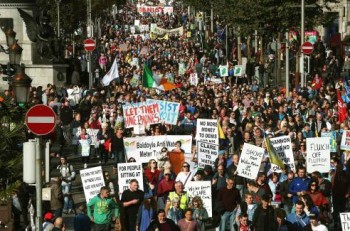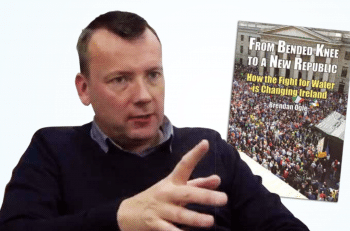
‘From Bended knee to a New Republic: How the fight for water is changing Ireland’ by Brendan Ogle, promises in its opening pages to take us on a journey “through the travails of a nation broken, sold and left in penury”. Ogle, unlike the many politicians and political parties he describes, fulfils this promise. The book brings you on a fascinating, inspiring, informative, and thoughtful journey through inequality in Ireland and “a nation’s fightback against it”. It should be clear from this that the book, just like the protest movement itself, is about much more than water. It comprehensively answers the question that many have asked: why was water the “issue that Irish people would take their first and biggest real stand against austerity?”. Ogle is the Education, Politics and Development organiser for the Unite trade union in Ireland and one of the founders of the Right2Water and Right2Change campaigns. The first quarter of the book provides detailed analysis of the political, economic, and social circumstances that gave rise to the Irish water protests which are “the biggest (per capita) and most peaceful protest movement for social change anywhere in the world”. These include the global water privatisation agenda, austerity, poverty and the health and housing crises. Neoliberalism is explored before an analysis of the self-evisceration of social democracy through Tony Blair’s ‘third way’ acceptance and implementation of neoliberalism, and its adoption by the Irish Labour Party. He suggests the Labour Party has become an “obstacle to progress toward a more equal Ireland, and is in fact an enabler of neoliberal inequality”. Ogle spends the rest of the book describing how the Right2Water campaign was organised and the challenges it faced in becoming a mass movement. He recounts how he and Dave Gibney, the other main organiser in Right2Water, withstood difficult negotiations with local communities who had been let down by trade unions in the past but had started this new movement in order to build trust and a strong working partnership with them. He writes about how ‘civil society’ organisations failed to offer much support to the movement. He describes the constant work required to build unity amongst the fractious left-wing parties that make up the ‘political pillar’ of the movement. We can read how he and others in the water movement which “could so easily have been just another failed campaign in a failed Republic”, actually developed the most successful mass-protest movement in modern Irish history. It is, therefore, an essential read for those looking to understand not just how and why the water movement developed in Ireland but for those seeking lessons of how to build successful social movements. A central purpose of the book is to set out the origins and purpose of the water movement, and to tell the story of the water activists, which, as Ogle rightly says, you won’t read about in the media or many other places. The book provides an important contribution to documenting Ireland’s recent socio-political history and geography, particularly the excluded voices and views in society which are too often ignored. The book documents how the movement was built from the grassroots up in working class communities like Edenmore in Coolock in Dublin and by “wonderful people” from all over Ireland “who were determined to make a difference”. It tells the inspiring story of water activists such as Karen Doyle, a “housewife and mother who also works part-time outside the home” from ‘Cobh says No’. She got involved in the water charges movement and formed one of the hundreds of ‘meter watch’ groups, which were the heart of the movement across the country, to obstruct water meters being installed. It is from such actions that a broader social movement was born. Ogle writes: “every week-day morning someone would rise about 4.00 to 5.00 am and find where the meter contractor vans were heading. Text alerts were sent so that by the time the vans arrived people like Karen were at estate entrances to protest. A caravan and trailer were procured and soup, tea and coffee produced every day for sustenance. Margaret Thatcher would have hated it. Society! People came from their homes, their individual isolated bolt holes, to start sharing stories about where it had all gone wrong, how their lives had been impacted by the breaking of a nation, which gave them the strength, the determination, to do something about it”. These groups, according to Ogle, faced problems from “some on the ultra-left” who saw the local groups “as a vehicle for advancing their own agenda, viewing people like Karen as potential recruits”. He describes how “people who got involved in a campaign out of genuine concern for their community and their country”, were hurt as they found themselves “the focal of bitter and personalised attacks”. He notes that in the past “many have walked away from the campaigns, surrendering them to the dogmatic ultra-left and the inevitable failure to deliver on their promise”. But not this time. Karen and many other community activists like her continued on and developed their own spaces and confidence to keep building a broad and inclusive movement. important in this was the support given by the Right2Water trade unions, and Unite in particular through its political economy education. It ran nine free ‘political economy’ courses for 150 ‘non-aligned’ community activists “with the objective of giving activists who were central to the growing water movement access to the type of information that would enable them to understand the political economic agenda behind water privatisation”. This was a very innovative approach which provided an important longer term empowering aspect to the movement. Ogle writes how “through the training we not only helped them connect with each other on a national level but showed how the tax and privatisation agenda are global issues…giving renewed energy as to how to challenge the neoliberal consensus”. Ogle persuasively tackles the critiques of the water movement in relation to water conservation. He highlights how people in the UK, which has