Malcolm James Coxall showed the Power of One, politically – particularly in the case of THM water contamination
by Village
Malcolm James Coxall showed the Power of One, politically – particularly in the case of THM water contamination
by Village
Forget the excitable claims of celebrity chefs and food writers: the most damaging of all farm products is pasture-fed meat
by Village
The centre held in the European Parliament elections (except in Germany, France and Austria) and even more so in Ireland, with a few vocal exceptions
by Village
Progressives should embrace crypto as opportunity-egalitarian and because they eliminate the cut to the dollar-US, but they’ll need to get over its capitalist associations

by Village
Irish people aren’t as good as migrants at working
by Village
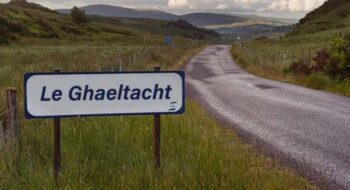
Protecting a declining minority and its language requires coherent efforts by the community in collaboration with official bodies, but sectoral powerbrokers are promoting only individualised participation
by Village
The funding from Coimisiún na Meán for court and local-democracy reporting should not be financial aid to publishers and broadcasters but rather the promotion of journalism
Posted in:
by Village
The reason your newspaper is thin and thinly written is because of declining readership and profitability
by Village
Loaded racist language is intended to fudge circumstance-driven fear and foreigner-oriented hatred
by Village
But history’s monsters may be partially tamed by a rereading of a work of mythology by a genius described by Shaw as “the greatest living Irishwoman”

by Village
When I went to the bird feederThe holly tree said send her my love.

by Village
Our job is to effect transformation: of that moment of illumination, of that conversation, of how atoms in a room change when a troubled individual walks in

Posted in:
by Village
Temple Bar authority let Smock Alley Theatre off €359k in rent but pretends arrears, as it is wound up, are only €54,766 and total liabilities €174,089

by Village
Keir Starmer, a bureaucrat who looks at government as a problem to be solved by missions, pledges and steps which shift
by Village
Triple Lock: What is it and why we should keep it
by Village
Peter Casey (66): Irish entrepreneur, former Rank Xerox Asian Sales Manager of the Year, CEO of Claddagh Resources recruitment company, former panellist on Dragons’ Den, candidate for Irish President in 2018 – one of three Dragons, coming second after attacking travellers, and in 2019 and 2024 for the European Parliament in Midlands-North-West; and racist fool.
by Village
Renters across the country continue to be compelled to share bedrooms with strangers despite calls from housing organisations to introduce legislation that prevents the “warehousing” of tenants. By Conor O’Carroll New analysis by Village Magazine of rental listings has found the practice of multiplying the number of occupants in a room remains widespread, forcing many to share rooms with strangers. Over 100 ads for shared rooms were found across property website Daft.ie and Facebook, including several rooms with two bunk beds crammed together. Prices for these shared rooms range from €350 a month up to almost €900 in some cases. One ad features a property in Galway with four rooms filled with multiple beds. For between €600 and €660 a month, it is available five days a week, with the property also listed on Airbnb. Another property listed for €500 a month in Ballyfermot, Dublin, features a cramped room with two bunk beds and little personal space, while another double bunk-bed room in East Wall for €580 a month is accompanied by the following description: “If you don’t mind sharing a large bunk bedded room with 3 men then this will suit very well” [sic]. Some of the ads were also written in Spanish or Portuguese, specifically targeting international students. A report from the Irish Council for International Students published late last year found that “almost a third of students studying in higher education share a room with at least one other person”. A report from the Irish Council for International Students published late last year found that “almost a third of students studying in higher education share a room with at least one other person”. H, a 22-year-old student at NUIG who wished to remain anonymous, was one of those left with no choice but to share a room. He told Village the search for suitable accommodation was an arduous process, made more difficult when with the number of scams he encountered. H admitted that he came close to following through with one scam, to the point of sending a copy of his passport before realising all was not right and backing out before he lost any money. This experience led to H becoming demotivated with the process. He would spend days going through rental listings and dialling numbers looking to find accommodation only to not find anything. And having arrived in Ireland from Dubai without accommodation, he was desperate for anything. A €720 per month shared room in Knocknacarra, Galway, quickly became his only option. With roughly one metre of personal space for belongings, H was shocked, calling the standard of accommodation for students “a joke”. Before coming to Ireland, he said he was aware of the housing crisis, but believed it was concentrated in Dublin and wasn’t as bad in Galway. He had initially steered clear of NUIG’s student accommodation options, saying they were charging extortionate amounts for what he described as “like a jail cell”. However, “that became reasonable when you couldn’t find anything else”, H said. Two of H’s housemates were even forced to share a double bed, such was the desperation for accommodation. And with 17 other tenants in the house, the shared kitchen quickly became practically unusable. H said that the cramped conditions in the property meant that there was a high turnover of tenants with many people finding it impossible to cook meals and find space for their personal belongings. The conditions were made worse by the fact that for the price he paid for the shared room, H said he could get a studio one-bed apartment back in Dubai. Even with a roof over his head, H told Village that finding other accommodation was not straightforward, particularly with many landlords demanding references. “Being realistic here”, H said, “you come into this country and you can’t really give references for your first rental”. After a few months of trying H eventually found a room to himself in a converted attic, joking that he now has “at least eight metres of personal space”. The current rules on overcrowding are to be found in the 1966 Housing Act, stating that a house may be considered overcrowded a) if two people of the opposite sex aged 10-years or older and not living together as a couple sleep in the same room or b) are such that the free air space in any room used as a sleeping apartment, for any person is less than four hundred cubic feet. Local authorities are responsible for enforcing the legislation and it grants them the power to serve a notice to desist from overcrowding, which if not complied with can result in a fine of €100. However, this law has previously been criticised as “outdated” and “cumbersome” by local authorities, with the need for far stronger penalties. Over 40,000 inspections of private rental dwellings took place in 2022, according to last year’s Local Authority Performance Indicator Report, up from just over 17,500 inspections in 2021. Over 91% of dwellings inspected were found to not be in compliance with minimum standard regulations, though it is unclear how many of these related to overcrowding. The vast majority of inspections took place in Dublin and Cork, with the respective councils making up over half of the total inspections. Galway City Council, where H’s accommodation was situated, conducted the least number of inspections of any local authority with just 133. Responding to the findings, Labour Party leader Ivana Bacik told Village “the fact that so many people are forced to consider sharing a room with a stranger shows just how few homes are available to rent or indeed to buy”, providing “yet more evidence of the Government’s utter failure to deliver on homes for people”. Following an investigation by RTÉ into cases of serious overcrowding in 2020, the government promised to introduce legislation granting further powers to local authorities to inspect suspected cases, with Minister for Housing Darragh O’Brien acknowledging that “the provisions of the [1966] Act are dated”. However, the Residential
by Village
As government again removes asylum-seekers and their tents, the notion of ‘a criminal offence in principle’ remains unknown to law and the Canal Act expressly disapplies itself to persons using canal property for less than a week in one place. By Michael Smith. Ten days ago, on 11 May, I asked the Department of the Taoiseach to explain the legality of its removal of tents on the canal. I suggested its statement (about previous similar removals) that it was a criminal offence “in principle” to pitch a tent on public or private land was misleading as the specific Canals Act expressly disapplies itself to “persons using canal property for a period of not more than one week at the same place”. It is an established legal principle that a specific law or byelaw prevails over a more general law or byelaw. It is also the case that trespass is not in principle a criminal offence. As government again removes asylum-seekers and their tents, the notion of ‘a criminal offence in principle’ remains unknown to law and the Canal Act expressly disapplies itself to persons using canal property for less than a week in one place. The Government Press Office reply, issued fully ten days later, is disingenuous and waffly. This is reprehensible in the case of some of the most vulnerable people in the country. My question to the Department of the Taoiseach I note your statement by way of Q and A yesterday https://www.gov.ie/en/press-release/b147d-questions-and-answers-on-mount-street/#:~:text=However%2C%20it%20is%20a%20criminal,refusal%20to%20remove%20the%20tent.: ‘Can International Protection Applicants be prosecuted if they did not take up the offer of IPAS accommodation in Crooksling or Citywest? No. However, it is a criminal offence, in principle, for a person to pitch a tent on public land, or on private land without consent. Depending on the circumstances, for example, the person may be moved on, requested to remove their tent or the tent may be seized if there is a refusal to remove the tent. Each case would be considered on their own set of facts on the question of a prosecution’. In fact the following section of bye-laws under the Canals Act is relevant and it expressly, in Section (3), the only section dealing with persons — like the asylum-seekers — “using canal property for a period of not more than one week at the same place” exempts pitching of a tent for less than a week https://www.irishstatutebook.ie/eli/1988/si/247/made/en/print#article30: ’30. (1) No person shall place or use any structure, tent, caravan or vehicle as a dwelling on canal property, except with the written permission of the Commissioners. (2) Any such structure, tent, caravan or vehicle placed or used on canal property in contravention of this Bye-law may be removed and stored by, or on the authority of, the Commissioners. (3) This Bye-law shall not apply to persons using canal property for a period of not more than one week at the same place’. In view of the apparent illegality, described above, of the removal of vulnerable people and the tents in which they have been compelled to seek refuge along the Grand Canal, can your office please state precisely what Act or Bye-law justified the actions affecting asylum-seekers perpetrated by government agencies on 9 May described in the following article https://www.irishtimes.com/crime-law/2024/05/09/asylum-seekers-warned-by-government-of-possible-prosecutions-for-failure-to-move/ and mandated by a government information leaflet?”. The Government Press Office reply, issued fully ten days later, is disingenuous and waffly. This is reprehensible in the case of some of the most vulnerable people in the country. The government’s reply The Government is working intensively to source additional accommodation, with the focus currently on sourcing State land where tented accommodation can be provided, or vacant State-owned buildings. That work is ongoing within departments and agencies. Once viable sites are identified they will be operationalised as soon as possible. There remains a serious concern for the health and safety of people staying in tents by the canal, and about the impact of the lack of sanitation facilities. Whilst temporary barriers have been erected as a mitigation measure, access to the towpath and footpath adjacent to the canal is unimpeded. It is a criminal offence, in principle, for a person to pitch a tent on public land, or on private land without consent under the Roads Act 1993 and the Criminal Justice (Public Order) Act 1994, taking into account the specific set of facts and circumstances that may be engaged. All departments and agencies will continue to work in the best interests of all concerned. It is a criminal offence, in principle, for a person to pitch a tent on public land, or on private land without consent under the Roads Act 1993 and the Criminal Justice (Public Order) Act 1994, taking into account the specific set of facts and circumstances that may be engaged.
by Village
Although the Department of Enterprise originally did not disclose the number, it has now revealed that all 18 of the 18 applications reviewed in the audit of the Immigrant Investment Programme were found to be deficient. By J Vivian Cooke. Further details have emerged about the Department of Justice’s 2019 internal audit of the Immigrant Investment Programme, (IIP), the contents of which were first revealed in Village Magazine’s February/March issue. Even in the redacted form, the previously unpublished document outlined the serious defects in the operation of the programme. In the judgement of the auditors, the IIP’S ‘Overall Risk Rating’ was “Medium/High Risk” which indicated that, among other things, the governance of the scheme, its compliance and monitoring checks and the unit’s management controls were inadequate to ensure the effective operation of the scheme. FILLING IN THE BLANKS However, the specific results of the audit methodology which were withheld by the Department have now been released. Shockingly, although the Department originally did not disclose that number, it has now revealed that all 18 of the 18 applications reviewed in the audit were found to be deficient in some respect. Furthermore, 11 of the 18 files failed to establish that THE funds to be invested were legitimate. Similarly, 12 of those cases did not contain sufficient evidence of background checks performed on the individuals. Almost two thirds of the files sampled by the audit were shown to be seriously delinquent in as much as they did not comply with the most basic qualifying requirements of the programme. Original redacted version of the 2019 audit report obtained by Village in February 2024. Although closed to new applicants in February 2023 because the department was overwhelmed by the deluge of application from China, pressure from international oversight bodies such as the OECD, Financial Action Task Force and the EU had been mounting for years. These bodies found schemes such as the IIP were open to abuse leading to high risks of money laundering and tax evasion. One EU report found of the residency by investment programmes examined “Cyprus presents the highest risk, followed by Ireland, and Malta” of abuse. The report also noted: “In Ireland, a previous CBI – [Citizenship By Investment] – programme attracted wide criticism and was halted in the 1990s, including on the grounds of inadequate checks on the applicants. Criteria for the granting of Irish nationality by investment were not always met by the applicants, fuelling allegations of corruption and favouritism by the government”. So much for Ireland’s dismal track record with such wheezes. More concerning is the fact that the outstanding applications will be assessed by the IIP Unit of the Immigration Delivery Service using processes and systems that have been consistently and repeatedly found to be utterly deficient. As established by Village Magazine in February, key requirements that were the basis of the criticism of both reports remain unimplemented to this day. The Evaluation Committee responsible for assessing investment proposals was operating without Terms of Reference – the IIP Unit has still not adopted them. In the absence of Terms of Reference, the functions of the Evaluation Committee cannot be extended to include oversight of the scheme – a key recommendation to improve delivery. The programme continues to operate without having a Risk Management Framework document, the adoption of which was identified as an essential element to the proper conduct of the scheme. Monitoring and following up of both applicants and their investments continues to be unsatisfactory, as it has always been for the duration of the scheme. The Department makes it clear that the extent of its responsibility is purely to screen applicants and approve proposed investments insofar as they comply with the scheme’s requirements. After approval, the only monitoring that the Department conducts is to ensure that the money promised is transferred to the appropriate Irish bank account. Anything after that is a matter for someone else. “The IIP Unit is not responsible for managing or overseeing the individual projects themselves…An applicant’s investment in a particular project is a private business transaction between the investor and the project”. This situation was unacceptable when it was first identified in 2019 and it remain unacceptable today.