Archives

OK

Random entry RSS

Loading

  • Posted in:

    MEMORANDUM

    Over coming months, Village will outline a suitable platform for a radical new movement on the LeftMEMORANDUMTo: New Left GovernmentFrom: Tom HealyDate: March 2016Re.: Priorities to improve the economy and living conditions

    Loading

    Read more

  • Posted in:

    Enough!

    SF and Labour should co-operate in pursuit of the values of Connolly and Larkin. By Frank Connolly

    Loading

    Read more

  • Posted in:

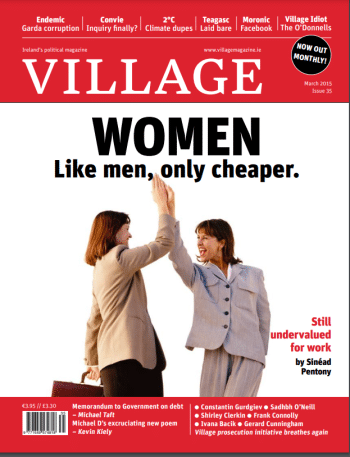
    21% of Irish workers are low-paid.

    By Sinéad Pentony. Low pay is endemic and entrenched in the Irish economy, and the situation for many low paid workers can only be described as grim. The government is setting up a Low Pay Commission and introducing a range of legislative changes to address a number of issues relating to low pay. Will it be enough to reverse the trends of erosion in workers terms and conditions? The incidence of low pay refers to the share of workers earning less than two-thirds of gross hourly median earnings. Median earnings is the level of earnings which divides the employees into two equal groups. Half earn less than the median and half earn more. Recent international data from the OECD show that the incidence of low pay in Ireland was among the highest in the OECD at 21.8% (more than 1 in 5 Irish workers) and this has increased since 2003. Research by Eurostat (2012) calculates the low pay threshold in Ireland at €12.20 per hour, which is paid to a single adult. The Eurostat research uses 2010 data, and incomes have continued to fall since then, which means the low-pay threshold will also have fallen in recent years. Using the latest CSO income data for 2013 it is possible to estimate that the low-pay threshold is now approximately €11.50, which is very close to the ‘living wage’ rate of €11.45. The low-pay threshold of around €11.50 is significantly higher (over 30% more) than the minimum wage, which is set at €8.65. The minimum wage is the wage floor but this is not sufficient for working people to make ends meet. 12.6% of adults who are employed are living in poverty. A growing number of workers earn so little that they qualify for Family Income Supplement (FIS), an in-work, means-tested State benefit for low-income working families with children. The Department of Social Protection’s annual report shows that in 2013 the number of working families in receipt of FIS increased by almost 30% to 42,000 families, supporting over 90,000 children. While FIS provides essential income support to families on low pay, is it being used as a State subsidy to low-paying employers who could pay their workers more? There is a gender dimension to low pay, with the Eurostat research finding that almost one quarter (23.6%) of women are in low paid jobs compared to 17.6% of men. Education is a factor influencing the extent of low pay. Over 30% of workers with a low level of education are in low paid jobs compared to 13% of workers with a higher level of education. The type of contract of employment impacts on the prevalence of low pay. Twenty-eight percent of workers on fixed-term contracts are on low pay, compared to 20% of workers on contracts of indefinite duration. Zero-hour contracts have become increasingly common. These contracts oblige workers to be available at the employer’s discretion, with no guarantee of a minimum number of paid hours per week. They are particularly prevalent in the catering, hospitality and the fast food sectors. Workers on zero hour contracts are more likely to be on low rates of pay with no minimum number of hours guaranteed. The Low Pay Commission is expected to consider a range of issues including: • 
The changes in earnings since the minimum wage was last increased in 2011. • 
The unemployment and employment rates generally. • 
The expected impact of a change in the minimum wage on employment, the cost of living and national competitiveness. • 
Changes in income distribution and currency exchange rates. The Low Pay Commission will be made up of employer and employee representatives, labour-market experts and civil-society organisations. It will be set up on a non-statutory basis initially pending an amendment to the National Minimum Wage Act, expected in 2015. The government has given approval to legislate in 2015 for an improved framework for workers who seek to better their terms and conditions where collective bargaining is not recognised by their employer. These are positive and necessary steps required to improve the terms and conditions of low-paid workers. While the Low Pay Commission does not appear to have the scope to deal with the issue of zero-hour contracts, research has been commissioned by the Department of Enterprise, Jobs, and Innovation into the prevalence of zero-hour contracts and the impact of such contracts on employees. Hopefully this will highlight the exploitative nature of these contracts and pave the way for their abolition. The UK experience provides some useful lessons. A Low Pay Commission was established there in 1998 to address issues including: eliminating ‘extreme’ low pay and introduce a wage-floor; addressing the situation whereby many people on very low pay who also qualified for in-work benefits were subsiding low-paying employers; and reducing the incidence of child poverty by increasing family incomes. The UK Low Pay Commission is charged with balancing the need for wage growth with concerns about the impact on employment, and enjoys widespread industry support as a result. However, its role is now seen as too narrow and short term. Some say it should have been called the Minimum Wage Commission as that is its main remit. A broader and more ambitious strategy is required to tackle low pay in the UK, the prevalence of which has increased in recent years. The Irish Low Pay Commission should have a broad ‘decent work’ agenda, which is more than setting wage rates. Fragmentation in the world of work needs to be addressed – characterised by job insecurity, non-family friendly working conditions, and a lack of quality opportunities. The planned introduction of collective bargaining rights and approval for new legislation that will replace sectoral wage-setting mechanisms will help address some of the issues on this agenda. However, the protection of part-time workers’ terms and conditions remains a big issue. Mandate and the Irish Congress of Trade Unions argue that the EU Directive on the protection of part-time workers has not been fully incorporated in the relevant Irish legislation.

    Loading

    Read more

  • Posted in:

    Wasting anger.

    By Michael Smith. Colm McCarthy, Ireland’s most unangry man, has stated portentously if unoriginally that “anger is not a policy”. He likes to reach smugly for a metaphorical spreadsheet that emits efficacious public policy to him alone, at his click. He’s right of course.  Always right! The Roman stoic philosopher Seneca agreed with him: anger was “worthless even for war”. For Catholics anger is one of the seven deadly sins. Aristotle, contrariwise, endorsed a bit of anger, at least when deployed to prevent injustice. The opposite of anger is a kind of insensibility, he reckoned. At the far end of the cultural spectrum (from Aristotle, not necessarily from McCarthy) the Sith Lord Sidious, from ‘Star Wars’, tells Anakin Skywalker who has metamorphosised into evil Darth Vader: “I can feel your anger. It gives you focus, makes you stronger!”. But in Ireland the strength has always outgunned the focus. Anger as represented in risings has an honoured tradition here dating back to Silken Thomas, the Desmond rebellions and Hugh O’Neill, in the sixteenth century. The State was founded in anger and indeed blood; and the 1916 Rising Proclamation refers to six rebellions in the previous 300 years. Of course post-colonial revolution focuses not on separatism but on politics, not quite so much on by what country as on by whom and how a country is governed. The most famous modern protests internationally were in 1968. Globally, exposure of the contradictions of capitalism has latterly again spawned anger on the streets, in the polling booths and in opinion polls: with Occupy and the Indignados, protests in Egypt and the rise of hard-right and hard-left poles in Europe, and of the Tea Party in the US. Characteristic of the latest wave of international protest has been the participation of ordinary people, not lobbies with lists of demands. Their mix of revelry and rage condemns the corruption, inefficiency and arrogance of the 1%, even if – whatever about protests – solutions are rarely coherent or consensual. In Ireland after an extraordinarily slow start a campaign is rallying to threaten the fundaments of a bondholder-friendly, unimaginative, regressive and arrogant government. The campaign has been a shrewd if rough-hewn balance of consensus and sulphur. The problem is it has coalesced around the wrong issue. A recent article in the Irish Times was headlined “Protest works – if it breaks rules”. Fine. But one rule it must not break is choosing the right thing to protest over. Even if doing so gets gratifyingly up the capacious nose of the establishment. On its own terms the water-tax campaign has been a resounding success, consensual, cross-party (opposition parties anyway) good-spirited though with a hard-nosed edge. There has been some violence. Joan Burton got ignominiously imprisoned in her car. A garda was hit by a stone outside the Dáil; and respect has gratifyingly disintegrated, taking the discourse with it. So An Taoiseach was told he was a c*** at a meeting about the Easter Rising commemorations, and feisty new Environment Minister Alan Kelly told Mattie McGrath TD to fuck off, because he was annoying him. Sinn Féin too has been busily registering its contempt at the irascible personage of the Ceann Comhairle. It sat in in the Dáil with very little immediate provocation from the speaker, and has stridently broken most of the august rules on parliamentary privilege. The problem is that if revolution, anger or even contempt were the currency we would have been rich half a millennium ago. But the history of revolution – that Marxists predicted would replace the bourgeoisie with the proletariat – instead dictated that the bourgeoisie was always replaced with the bourgeoisie, after a decent break. Not so exciting. The revolutionary generation in Ireland took the country through to the conservative, protectionist, frugal and religious fifties and sixties. The Civil War parties delivered nothing but conservatism, albeit sometimes – proving the point – cynically dressed up as socialism. The Labour Party failed to deliver on exciting manifestos every time it fell for power. The most hated government in Ireland’s history was replaced with a government so close in orientation to it that it is indistinguishable. It failed to deliver the anti-bondholder, anti-corruption, anti-profligacy policies its component parties had championed at election time. Meanwhile rampant, power-thirsty Sinn Féin which secretly dominated the December 10 water-charge protest, seems poised to replicate the mistakes of Fianna Fáil’s policy-free nationalistic populism in the South but with a retardation of 90 years. In the North Sinn Féin part-fronts one of the least radical governments in Europe. And after a crisis that looks like it has been almost entirely wasted it is still possible for Ireland’s best selling newspaper to feature on its cover Michael Fitzmaurice, newly elected independent TD for Leitrim/South-Roscommon, as the future of change. Fitzmaurice is chair of the burn-the-environment turfcutters, a cross of the earnestness of Peter Mathews and the gombeenism of Jackie Healy Rae (and their visual cross to boot). He is a man without a single coherent idea. He now plans to establish a party to replicate this vacuum as a platform and to stand 25 candidates in the general election. It will be “neither left or right wing but down the middle”. The problem is that if you’re not ideological you’ll split, because your troops will be annoyed when it turns out they didn’t get what they marched for – when they realise they got something else that only you thought they wanted. There are unlikely to be any great ideologies waiting to be discovered (though certainly we all crave new ideas): keep it Left, Right and maybe Green – and, if you must, Conservative or Liberal but spare us ideology-free nationalism, down-the-centrism or turfcutterism. After 100 years of independence! Michael Fitzmaurice is a split waiting for a movement and a generation, to squander. In other words what McCarthy said is true: anger and the reaction it generates does not effect social change or even clever ideas. Look at how the angry-about-planetary-destruction

    Loading

    Read more

  • Posted in:

    How optimism lifted.

     In the Sticks by Shirley Clerkin. There was optimism and all the babies slept peacefully in their beds among the quiet, velveteen hills.  The piano played cheerful melodies, tinkling beads on a necklace out the open windows to the birds that flitted contentedly on the air. Plans were gone over, knitting clacked, beds were dug, bees hummed. Geology moves glacially, mostly. The drip drop of water on stone erodes, slowly. Even grykes start without trumpets. Summoning latent defects, you might say.  Roots loosen too, making way for opportunists into the ecosystem balance. Cleavage. Tranquilised by parental oblivion the babies still sleep soundly. Some sort of birdsong lifts from the land. Cadences stack but hollowness creeps into the resolutions. Missing notes pass unremarked as the ability to hear the complexity and richness of sound is lost. Bookended music is enough. The piano goes out of tune. The water whiles the time away with the moon. Under the enchanted cloak of darkness, a minor key sounds, an orthostat rolls closed the crescent moon and reason goes backstage. The babies grow into adults and disquieted by the silence, one day they stir and wake.  A plaintive requiem pipes from the hilltops. Where are the missing notes? The quavers, the crotchets, the long held minims? They feel like erratics in their own place. No one can measure or know their alienation. Sorry for your loss, the handshake at every wake in the country has no purpose now. The Living Planet Index, which measures the trends in thousands of mammals, birds, reptiles and amphibians shows a 52% decrease between 1970 and 2010, my lifetime. The WWF, alive and kicking for many years, measuring, recording, advocating, campaigning, produced the report, but there is little comfort for them in the new data. No good looking down at the coffin of loss, looking to your neighbour and saying, “I told you so”.  ‘The Living Planet Report – Species and Spaces, People and Places’, peddles the message that we can change, we can grasp the opportunity that we have so far failed to grasp and close this destructive chapter of our history. But can we? Maybe I am writing in February. Maybe my fingers type loss and pessimism but late in the month and into March, when little signals of life push forth to keep the snowdrops company, optimism will restore me – about human nature. During another dark winter night, in  November at the Guth Gafa (Captive Voice) Film Festival in Headfort, Kells, I was left bereft and grieving after watching the film ‘Virunga’. This gripping documentary, now available on Netflix, follows the Virunga National Park rangers led by chief warden Emmanuel de Merode, a passionate French journalist, Melanie Gouby and gorilla-carer Andre Bauma, as they try to secure the Park, which is home to some of the last mountain gorillas on the planet. Bauma has an unswerving and beautiful belief that his purpose in life is to protect the gorillas. His affinity with them is the humanity grounding the film, but his is an attachment not shared by all. In the midst of armed conflict, the UK Oil Company SoCo International tries to muscle up oil exploration in this World Heritage Site, a place that is of Outstanding Universal Value. Virunga World Heritage Site meets three of the requisite criteria – to contain superlative natural phenomena or areas of exceptional natural beauty and aesthetic importance; to be an outstanding example representing major stages of earth’s history; and to contain the most important and significant natural habitats for in-situ conservation of biological diversity, including those containing threatened species of outstanding universal value from the point of view of science or conservation. Virunga National Park is a refuge for 22 primate species, including one third of the world population of mountain gorillas. It is universally important. In the film the oil interests cleaved every potential niche to access the oil resources of the park, encouraging dissent among the local supporters for the National Park while appearing to offer bribes to park rangers.  Like old cartoons, dollars per barrel gleamed in the eyes of Homo sapiens, extinction saddened the eyes of Gorilla beringei. Following the WWF campaign and the film, SoCo has committed to withdraw from Virunga but, worryingly and typically, oil concessions still exist for the park. The Belgian Director de Merode, was shot and injured just before the release of the film last April, by unknown men. Courageously the rangers battle on, even though real risks to their lives exist – over one hundred rangers have lost their lives since 1996. They believe that a sustainable development model can secure the landscape for their and nature’s future. I believe it too.  But, wheelers and dealers always have their eye on the prize. Writer Christopher Potter asks the only question:  “The story of the survival of human beings is particularly difficult to tell as a story of adaptation in nature.  How did the weakest ape come out so far on top?”. ‘How?’ is my preoccupation as February drops, so cold. •

    Loading

    Read more

  • Posted in:

    Back to school.

    By Tony Lowes. The environment is the enemy of jobs”.  That’s what my lad recently reported was the universal belief of all those in his Leaving Cert ‘Civic, Social and Political Education’ (CSPE) class in our west cork community school. To be honest, it’s what most people think in modern Ireland. To object to developments in rural Ireland is a swift route to social ostracisation – or worse. But if we don’t protect the environment our dwindling natural resources will be used foolishly and the ultimate cost of cleaning up will one day be too great – or too late – to pay. Yet Dan and his school mates are no different from the current revisers of Directives in Brussels or the Kerry Councillors with their Material Contravention motions to overrule planning protection. Environmental regulation is under unceasing attack at every level. The buzz word is ‘light regulation’. Light regulation? Isn’t that an oxymoron, a paradox, like ‘open secret’? We rely on the environment for life itself. It’s just that the connections can be hard to see. Let’s look at what happens with – say – industrial peat extraction and public health. In 2009 the group I work with received an anonymous letter from a hotmail account. It was a detailed missive with photographs demonstrating the devastation of hundreds of hectares of raised bogs in Westmeath by large industrial operators. We found no planning authorities had any record of these activities. We spent five years pursuing the authorities to require them to assess the activities and protect the environment. We filed a Petition to the European Parliament. We went through the planning process all the way to the High Court where even now three cases await final determination. We commissioned a satellite survey of exposed peat-lands from University College Cork and presented the Department of the Environment with detailed maps of 126 extraction sites of more than 30 hectares across 19 local authorities, the vast majority of which their subsequent site visit reports confirmed required planning permission. Why does this matter? Is it the quixotic defence of a rare bog orchid? Well partly: fragile ‘biodiversity’ matters; and bogs are a significant carbon store also. It matters also because the drainage of peat – and forestry and land reclamation on peaty soils – releases organic carbon into the water – the ‘peaty colour’ you sometimes see. When this water is treated with chlorine, THMs [Trihalomethanes – a group of chemicals like chloroform that are associated with cancer] are formed. According to the EPA’s Quality of Drinking Water in Ireland we analysed for our complaint, almost 600,000 consumers in 153 water supply zones are currently receiving drinking water exceeding the European Union / World Health Organisation’s parametric limit for THMs. And nobody has told the consumers, even though the law says they must be informed. The Directive and the Irish Regulations say that: “In such cases consumers shall be informed promptly thereof and given the necessary advice”. THMs are volatile – prolonged showering, jacuzzis, steam-rooms become dangerous, pregnant women may be at greater risk, etc. Ireland’s defence to the EU’s investigation was assembled by the Environmental Protection Agency and the Health and Safety Authority. “The public should be reassured that all exceedences of the standards are examined to determine if there is a potential danger to human health”, the joint document said. It concluded that there is “not enough evidence to prove that THMs pose a health risk in the short term”. Carcinogens by their nature are not “immediate” risks. Cigarette smoking, exposure to asbestos – these are not immediate risks either. They have to deny any public health risk because the Commissioner for Energy Regulation [who also regulates water] is committed to giving a 100% discount for consumers receiving water unsafe for human consumption. And a 100% discount to 600,000 consumers would end water charges more quickly than any marches on the Dáil. Meanwhile, the public will continue to drink potentially dangerous water that could be made safe – if they knew – by a simple charcoal filter. The eight or nine ‘mini Bord na Mónas’ who are doing the extraction – most of them registered outside the state – have been lobbying the Government (‘from high up’) over the loss of jobs that potential controls could mean. The booming mushroom industry – which is now almost half of all Irish horticultural products – relies on peat to grow its crop. Our competitive advantages will be lost, they say: 3,500 jobs will be at risk. Hence the Minister is told regulation is a ‘threat to national food security’. He has been told that peat should be removed from planning controls altogether and subject instead to – you guessed it – “light regulation”. If we want a more progressive Ireland we’ll have to go back to school. • Tony Lowes is one of the founders and a Director of Friends of the Irish Environment, an environmental lobby group established in 1997 to ensure the implementation of European environmental law.  

    Loading

    Read more

  • Posted in:

    Economics has yielded to politics.

    By Constantin Gurdgiev. January’s IMF review of the economic situation in Ireland rained a heavy dose of icy water over the overheating Government spin machine, and much of the IMF concerns centre around exactly the same themes that were highlighted in these
 very pages last month. Top of the IMF worries list is growth. Budget 2015 assumed GDP expansion of 3.9 percent in 2015, with 3.4 percent average growth from 2016 through 2018. The Central Bank is now forecasting 3.7 percent for 2015. The IMF forecasts growth of 3.3 percent in 2015, 2.8 percent in 2016 and “about 2.5 percent thereafter”. In simple terms, 2015-2018, the cumulative discrepancy in the forecast for growth between the IMF and the Government is now just shy of 3.3 percentage points. Put differently, based on IMF forecasts, the Irish Government may be significantly overestimating the economic prospects for the country. It is interesting to note that the IMF assessment of the Budget 2015 measures contradicts the mainstream Irish media and Irish Left’s view. The IMF had this to say about the measures: “Income tax cuts that increase the already strong progressivity of the system are the main items. While not significant to the revenue intake, reductions in property taxes by 14 local authorities, including Dublin, are a setback for collections from this recent broadening of the tax base”. Doing away with tax breaks is fine, if it is done in an environment of falling distortionary taxes. Still, coupled with elimination of the property capital gains relief, Budget 2015 hardly represented a transfer from the poor to the rich, but rather a net tax increase on the upper earners, especially the self-employed professionals, relative to the lower waged. The drivers behind the IMF’s sceptical view of our prospects are those discussed in this column before. Export growth is likely to be much shallower than the Government expects, while domestic demand is still suppressed by massive debt for households and companies. Consider the IMF’s estimates for public debt. First, public debt fell from 123 percent of GDP in 2013 to 111 percent of GDP at the end of 2014. Impressive as this change might be, it is driven by one-off changes and not by any significant debt drawdowns. Consolidation of IBRC into General Government accounts and its subsequent liquidation first pushed Irish Government debt up by 6.2 percent of GDP (€12.6 billion) in 2013, and then reversed most of the same in 2014. All in, IBRC’s liquidation shaved six percentage-points off our 2014 debt-to-GDP ratio. Furthermore, changes in the EU accounting rules raised our 2013 GDP by 6.5 percent. Stronger economic conditions and the smooth exit from the Troika Programme have meant that the Irish Government was free to spend some of the borrowed cash reserves on buying out IBRC-linked bonds held in the Central Bank. This drawdown of previously borrowed cash contributed to a 4 percentage-point drop in our debt-to-GDP ratio. For all the Government’s bravado, last year’s economic recovery contributed only 1.75 percentage points to the debt decline or roughly one sixth of the overall improvement. Still, barring adverse shocks, we remain, for now, on course to drive the debt-to-GDP ratio below 100 percent before the end of 2019. As the IMF notes, however, a temporary drop of two percentage-points in the forecast nominal GDP growth rates for 2015-2016 would push our debt-to-GDP ratio to 117 percent in 2016. On the other hand, a one percent rise in primary spending by the Government would push the public deficit to 3.6 percent of GDP in 2015 and 3.0 percent in 2016, instead of the Government’s projections of 2.7 percent and 1.8 percent, respectively. The IMF is concerned that the Irish Government is suffering from ‘adjustment fatigue’, and that this may increase when the upcoming political pressures of the general election start looming. The danger is that “…medium-term fiscal consolidation is at risk from spending pressures, requiring the adoption of a clear strategy to enable the restraint envisaged to be realised. … As the public investment budget is already low, current expenditures will have to bear the brunt of spending restraint, while ensuring the capacity to meet demands for health and education services from rising child and elderly populations. Nominal public sector wages and social benefits must be held flat for as long as feasible and the authorities will need to continue to seek savings across the budget”. Somewhat predictably, the Irish authorities have offered no strategy for fiscal management beyond 2015 and no expenditure policy solutions that can address these risks. Instead of sticking to promised costs moderation, the authorities told the IMF that increased current spending, including on higher public-sector wages, can be offset by “discretionary revenue measures”. In other words, should the Government want to fund pre-election giveaways to its preferred social partners (aka workers in the public-sector) it can simply hike taxes on less favoured groups. A slip of the veil revealing the ugly nature of our politics-captured economic strategy. Politics is now firmly displacing economics in both the way we set our forecasts, and how we interpret the data. Take, for example, our reported near five percent growth in2014. Various recent ministerial statements extolled the virtues of the Government that made Ireland “the envy of Germany” as the best performing economy in Europe. Largely ignored in the official rhetoric was that much of this growth came from “contract manufacturing outside Ireland that is dominated by a few companies”. The problem is that none of it has any real connection to Ireland and, as the IMF notes, much of it “could quickly turn”. Private domestic demand, excluding aircraft leasing and investment in tech services-linked intangibles, rose by closer to three percent. Again, according to the IMF this figure may be a more realistic estimate of the real recovery. In other words, somewhere between 30 and 40 percent of the recorded growth in 2014 was down to just one accounting trick. And multinationals had plenty of other accounting tricks up their sleeves

    Loading

    Read more