Archives

OK

Random entry RSS

Loading

  • Posted in:

    Yes in May.

    By Grainne Healy. In many ways the coming out of Minister Leo Varadker was the starting gun for the marriage equality referendum campaign. His announcement brought the forthcoming campaign to the attention of the media and the public in a manner few expected. On a yet to be determined Friday in May the Irish electorate will get to vote on whether or not they want lesbian and gay people to be able to marry the person they love. This is a referendum that is about recognition – recognition of the love and commitment that gay and lesbian couples have for each other; recognition that some of them want to get married so as to have Constitutional protection for their relationships and families; and recognition that they should have the right to choose to get married like all other citizens. A successful Register to Vote initiative (YesEquality) has been organised. Some 40,000 new voters put their names on the electoral register. These mostly young, first-time voters will be a crucial cohort in May. All recent polls on voting intentions show that a majority will vote Yes, but until now those being polled have not been engaged with the campaign. Younger voters are hugely supportive of the proposal. Ensuring that the youth vote is mobilised and informed is a key challenge. Student and youth organisations are already launching initiates in this regard. Irish society has come a long way since decriminalisation of homosexuality in 1993. Civil Partnership in 2010 was a milestone on the road to equality for same-sex couples. Civil marriage equality will bring equal recognition before the law for lesbian and gay people. If you support the campaign, you could: Start conversations: Conversations about the referendum at home or in the work place are important. Ask others how they are thinking of voting. Encourage them to check the register and to vote. Explain your reasons for voting Yes. (see www.marriagequality.ie for information). Donate: A fundraising initiative (#sharethelove) asking people to give small personal donations or organise fundraising events for the campaign has been launched. If you text Love to 51500 you will get a text back telling you how to make a donation. Encourage your friends to donate too. Get organised locally: Join or form a local group interested in canvassing in the run up to the vote. Identify the spaces in your locality where people gather, and where you could canvas their vote. Groups are forming, targeting train stations or simply planning to knock on doors with campaign leaflets. Note the date: Make sure you put the referendum date in your diary when announced. Vote Yes on the day. Tell ten others about the date and organise to go together to vote or give a lift to those who need support to get to the polling station. Many civil society organisations are gearing up to support the campaign, including the Trade Unionists for Civil Marriage Equality, USI’s #makegráthelaw, students for marriage equality, and Faith in Marriage for people of various faith communities who intend to call for a Yes vote. A coalition campaign for civil marriage equality will soon be launched. ICCL, GLEN and Marriage Equality will play leading roles in co-ordinating it. This grassroots-led, grassroots-targeted campaign will be looking for local community groups and bodies who support a Yes vote to ensure that as many doors as possible are knocked upon and as many Dart/Luas/train stations and football/sporting occasions as possible have a Yes campaign presence. The Children and Family Relationships Bill (2014) is being debated in the Oireachtas. It will bring greater equality for diverse family types including addressing issues of guardianship, parenting and the right to apply to be adoptive parents for same-sex couples. Voters must see clearly that the referendum is not asking people to judge whether or not lesbian and gay people make good parents or should be allowed to parent. Lesbian and gay people already make wonderful parents. This issue is likely to be raised by the opposition and voters must understand that what they are being asked to vote on is the right for lesbian and gay people to enter the institution of civil marriage. We want to live in a country where you can marry the person you love. •


    Loading

    Read more

  • Posted in:

    Stealthy privatisation of community and public services.

    By David Connolly. Thursday the 19th February 2015 is a day of great significance for workers and organisations in the Local and Community Development sector. On that day Local Development companies will be informed of the outcome of a tendering process imposed by the Department of Environment (DoE) for participation in the new Social Inclusion and Community Activation Programme (SICAP). This programme will run from April 2015. These fifty-one local development companies were, in effect, forced to submit detailed competitive tenders for thirty-two designated “lots” based on county boundaries. These same companies have been operating in the same geographical areas for almost twenty years delivering Government-funded programmes that tackle poverty and social exclusion. New structures in the Local Authorities will make the decisions in relation to the offer of contracts and the oversight of programme implementation. This fundamental change in local development will have a seriously detrimental impact on the poorest and most disadvantaged communities across the country. In early 2014, in a fundamental shift from previous practice, the Department of Environment, Community and Local Government [DoE] decided that their new SICAP funding programme would be subject to a public-procurement process. This requires the existing local development companies to participate in competitive bidding, in some cases with each other, or with private or voluntary-sector providers. This approach was presented in the context of the reform of Local Government and as being a requisite for compliance with new European Union procurement Directive. The local development companies were originally established by Government in the early 1990s to tackle-long term unemployment in the most disadvantaged areas. They have developed and managed a whole range of initiatives and services including access to employment, adult education, training and lifelong learning, enterprise support , community development, child-care and rural development. At this stage they also managed a plethora of Government funded programmes including the local employment service, LEADER, Jobs Clubs, TUS, Rural Social Scheme, and the Community Employment programme. Despite the general success of the work undertaken, the previous and current Governments have consistently targeted these companies for substantial cuts and continual restructuring. Since 2008 their core budget has been cut by over 50 per cent. The Community Development Programme was terminated. The work of the Local Employment Service was privatised last year. Further funding cuts of between five and fifteen percent were imposed in the most recent budget. The forthcoming announcement of contracts for SICAP could result in the closure of up to fifteen local development companies. Almost 2,000 workers are employed in these community-based local development companies. The majority are members of Trade Unions, mainly SIPTU. The Union members have fought a rearguard action over the past two years to try and prevent the damage to this vital community infrastructure. Different tactics have been adopted to engage with the local employers and with the Department that controls the funding and determines role and function of the companies. However, Senior officials in the DoE with the backing of the previous Minister, Phil Hogan, have been determined to drive these public services down the route to privatisation. This approach is consistent with the broader agenda being pursued by this Government. The Minister refused to meet with the workers representatives. The Department has ignored a recent Labour Court recommendation that there should be full and inclusive engagement between the Unions, Employers and the funding Departments. The signs are ominous. The current obsession among senior public servants is to force significant sections of essential public and community services into private ownership, through enforced procurement and privatisation. This is imposing increased hardship and despair on the poorest and most vulnerable communities, many of whom are being abandoned to market forces for future services. •

    Loading

    Read more

  • Posted in:

    Gogarty and the redactions.

    By Frank Connolly. In the Spring of 1996, I met with Jim Gogarty at his home in north Dublin. Over a conversation lasting a couple of hours he told me of the day in June 1989, during a general election campaign, when he was present in the Swords home of then minister, Ray Burke. He said he witnessed his employer, Joseph Murphy Jr, and builder Mick Bailey each hand over a package which he believed contained €30,000 in cash in return for a promised 700-acre land re-zoning. The allegation ultimately resulted in Burke’s resignation as foreign minister and TD and to the establishment of the Planning and Payments tribunal headed by Justice Feargus Flood in the Autumn of 1997. The notes and taped transcript of my interview that night were provided to the tribunal, at its request, and used to substantiate the allegation, long in circulation, that Burke had received illicit contributions over many years in return for securing favourable and lucrative planning and re-zoning decisions at Dublin County Council. In its 2002 report, the tribunal found that the former minister had received other substantial rewards; and he was subsequently jailed for tax offences. When providing the transcripts of our interview, and acting under advice from lawyers for the Sunday Business Post where details of Burke’s misbehaviour were published during those years, I requested that contents that were not relevant to the terms of reference of the tribunal, and that included unproven and unsubstantiated allegations against other individuals, should be redacted before they were circulated to other interested parties. Among those individuals, as widely reported in recent years, was a different former minister, from a different party and a former, now deceased, Supreme Court judge whom Gogarty claimed had also received illicit payments from his employer, Joseph Murphy Sr. Not so widely reported was a claim by Gogarty that a third former minister, still active in politics, was also involved in swinging votes at the council to benefit certain developers. Whatever about my request, Flood and his legal team, in an effort to confine lines of inquiry to those relevant to the tribunal’s terms of reference and to avoid revealing the identities of individuals not immediately involved in its inquiries decided to redact some information from witness statements. This was the practice of the tribunal until 2005 when the Supreme Court ruled in an action taken by developer Owen O’Callaghan against the judicial inquiry, that all statements made by Tom Gilmartin, which had previously been redacted, should be provided in their entirety in order to test the credibility of his evidence. Gilmartin was, of course, the source of the explosive allegations of corruption against O’Callaghan and others, including Bertie Ahern and other prominent politicians. As a consequence of its earlier practice of withholding certain statements made in the interview with me, and presumably in private with the tribunal, and on the basis of the Supreme Court ruling in the O’Callaghan case, Joseph Murphy and a co-director Frank Reynolds appealed a finding of obstruction and hindrance made against them, and in 2010 the Supreme Court quashed the tribunal decision to deny them their substantial costs. This decision led to a successful appeal by former assistant city and county manager, George Redmond, who was found to have been at the epicentre of a decades-long planning scandal, against the findings of corruption made against him. He and others including Burke, JMSE and the Bailey brothers had had adverse findings made against them, based on Gogarty’s evidence. Other findings of wrongdoing against Redmond, Burke and others arising from different modules of the tribunal remain in place. The final report published in 2012 dealing with the Gilmartin allegations and the findings against O’Callaghan, Ahern, Padraig Flynn and a host of others, still stands. “Another fine mess” is how the Irish Times editorialised recently when recounting the sequence of events that have unfolded. But the newspaper’s concern, and that of its contributor David Gywnn Morgan, professor of law at UCC, was not directed against the tribunal but rather at the manner in which some judges of the higher courts have unpicked decisions made by public inquiries. The professor suggested that “the judiciary has applied its own standards to very different and particular institutions without regard to the different context”. Some of the learned colleagues have also had ‘skin in the game’ in that they have a long history of antagonism, even before they were appointed to the bench, towards the planning tribunal, in particular. A number of senior barristers argued back in 1998 that the tribunal’s sweeping orders of discovery against well-heeled banks, businessmen, lobbyists and politicians were hardly justified by claims that a few councillors had pocketed small sums in return for planning favours. Now we know that the corruption was more endemic and went far higher up the political and commercial food chain – and that most of those involved have walked away with their bank accounts in rude health. •

    Loading

    Read more

  • Posted in:

    RIAIsing the stakes.

    By Michael Smith. Intrepid followers of architectural tumult will recall how a letter arrived in the in-boxes of polo-necked members of the Royal Institute of the Architects of Ireland (RIAI) on 11 November, from the President Robin Mandal. “Let me state there is no basis to any allegations of corruption or fraud in the organisation,” it expostulated. Eoin O’Cofaigh, a former President, had complained about the payment of €500, 000 without any tender process to Bluebloc Digital, a company 50% owned by Odran Graby, the son of the veteran RIAI Chief Executive, John Graby, for IT services. Robin Mandal suggested in correspondence and indeed in an article in the Sunday Times that Eoin O’Cofaigh himself employed Bluebloc Digital when O’Cofaigh was president. But this is not true. Bluebloc Digital was incorporated in 2003, four years after O’Cofaigh wrapped up his presidency. There is another company, Blue Bloc, owned by Margaret Graby and Odran Graby, wife and son of CEO John, with which Mandal got confused. If O’Cofaigh employed it it was for negligible sums, not so clearly demanding a tender process. Cutting through the confusion about alleged nepotisms, O’Cofaigh wrote perfectly reasonably of the failure to seek tenders: “None of us want a Rehab, a Positive Action, a DSCPA situation”, to the board – before resigning. With six other RIAI eminences, including ex-President Joan O’Connor. O’Cofaigh has been the most prominent member of an RIAI ‘reform group’ campaigning against an amendment to Building Regulations, which make it mandatory for architects, and other professionals, to certify that new buildings comply with those Regulations. Many architects feel the Regulations prejudice the members of their profession by requiring stringent guarantees with little financial gain; and, less convincingly, that they prejudice the client and the public interest. Mandal and Graby are better disposed to the Regulations, on the basis they provide work for architects. Some of the dissentients wonder if there is any compromise entailed in the RIAI supporting the Department of the Environment’s bullish stance on the Regulations and governmental funding to the RIAI of around €1m for architectural training. Brothers Aidan and Ciaran O’Connor, both RIAI members, are respectively the Environment Department official responsible for drafting the Regulations and the OPW-employed ‘State Architect’ with a key role in deciding who is contracted to carry out architectural training. A recent article in Village speculated that the reason behind the hoo-ha was in fact existential angst in the beleaguered architectural profession and frustration with the genteel stance of the RIAI on the building-regulation burdens. However, more information has come our way via the details of now-compromised confidential talks. The fifteen surviving ex-Presidents of the RIAI have met three times in the last two years and on two of those occasions resolved by firm majorities to seek the resignation of the CEO. Graby seems to have irritated most of the Presidents whose grand-standings it has been his solemn duty down the years to facilitate during their short and honorary ascendancies. An anodyne note of the proceedings of one of the meetings of the ex-Presidents was prepared by Tony Reddy, architect, in whose office the meeting had convened, recognising the need for the aid of “independent experts” but omitted a controversial agreement to seek the CEO’s retirement. Reports suggest some of the ex-Presidents are refusing to pay their membership fees until the CEO departs, though nearly all of them seem adverse to bringing negative publicity down on their beleaguered institute and few have the spine that O’Cofaigh and Joan O’Connor manifested in resigning. More dramatically still – since he reports to them – is the mediation session for Council members that was organised in October 2014 in Bewleys Hotel, on the M50. The meeting was confidential. Nearly all Council members, around twenty, including the President Robin Mandal, attended, with the exception, insofar as Village could ascertain, of three. The main topic of the day was again the CEO and governance issues; and unfortunately for John Graby, the agreement by consensus was that the veteran CEO must retire. All in attendance, including Robin Mandal, openly discussed matters in a somewhat fraught atmosphere, and it was agreed that immediately following the conclusion of the day a meeting would be arranged between the CEO, Mandal and the mediator involved to initiate the process of retirement of the CEO, and succession. This did not happen, and two weeks later the mediation conclusion was concealed at an RIAI egm as, some might say, was their duty and entitlement. The position of the CEO was defended. This repudiation of the mediation-mandated strategy, it would appear, was a significant factor in the subsequent resignations by the seven Council members. The first mention of this confidential process was by Robin Mandal in an October letter to members, in breach of the agreement, when he implied the mediation process was a result and symptom of lack of “cohesiveness” at Council level and “the constant onslaught and disruption by a minority”, though it is arguable it was a constructive attempt to advance discussions on the removal of the CEO sensitively outside the official Council structure in a confidential forum necessarily remote from the influence of the CEO himself. Graby’s position is compromised in a number of respects: he is the conduit for complaints against RIAI architects but also an architect himself – a clear conflict. It is also bad practice to expect a CEO to pursue complaints against those who pay his salary. It is undesirable that he is Director of an architects’ insurance company which needs to get sensitive information about the members who pay his salary. And the provision for the President to appoint arbitrators, for which many RIAI members are qualified, could lend itself to the no-doubt inaccurate appearance of CEO influence or favouritism, if for example the recent resignees and Mandal/Graby loyalists were in competition for appointment as arbitrator. The annual personal RIAI credit-card bill for the CEO has in some years been some tens of thousands of euro, raising jaded

    Loading

    Read more

  • Posted in:

    Planet Earth: quarry and dump.

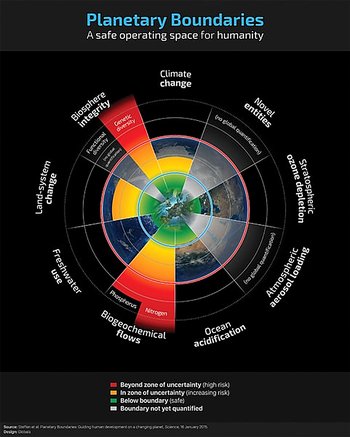
    By John Gibbons. In 2009, some months before the ill-fated UN climate conference in Copenhagen, an Earth system framework was proposed by an international collaboration of environmental scientists. Their aim was to establish a measurable set of ‘planetary boundaries’ with a view to identifying a ’safe operating space’ for humanity. The researcher team, involving scientists from a range of disciplines, developed a set of nine key boundaries, beyond which lay the risks of “irreversible and abrupt environmental change”. In January 2015, the team published an in-depth update on their investigations in the journal Science, and it was discussed in depth at the recent World Economic Forum in Davos. The findings took even seasoned environmental commentators and observers by surprise. The paper confirmed that humanity has already breached four of the nine key boundaries, namely biodiversity loss, deforestation, atmospheric CO2 levels and the flows of nitrogen and phosphorus used in agriculture into the world’s waterways and oceans. The era known as the Holocene began almost 12,000 years ago, just as the last Ice Age was in full retreat and climatic conditions favourable to humans led to our exponential surge. Human expansion was marked throughout this period with spasms of extinctions, as well as major changes in land cover and use. Our mastery of fire in particular allowed humanity to alter entire ecological systems radically, thousands of years before the industrial revolution. We have been a significant force on the planet for millennia; what has so profoundly altered in the modern era has been the rate and scale of change. In the last two centuries, human numbers increased more than seven-fold. In the 20th century alone, we consumed more energy than used by all humans in the preceding 10,000 years. And in the first decade and a half of the 21st century, the exponential surge in human numbers and impacts has continued unabated. Growth, expansionism and the meeting of human needs and desires primarily by consumption is the dominant ideology of this era in human history, and are essential to the ever-expanding engine of globalised capitalism. In this paradigm, the entire natural world is both a quarry from which we can extract an unlimited supply of ‘resources’ to fuel the Age of Man and a dump into which we can quietly excrete the toxic by-products of this whirlwind of activity. To downscale the biosphere into a single human body, you could also identify nine key systems which operate both independently and as part of a closely integrated biological system. The heart, lungs, liver, endocrine system, brain, nervous system, kidneys and digestive system are all ‘boundary’ systems, and each in turn support myriad sub-systems, as well as combining to define our overall health and well-being. The ‘planetary boundaries’ report is the planetary equivalent of the doctor informing an individual that his heart is badly damaged, his lungs are diseased, his liver is barely functioning and his kidneys are showing signs of acute organ failure. The good news is that his brain is still functioning well, his digestive system is in reasonable shape and his neurological function appears normal. After the initial shock, how would you expect the patient react to this news? Humanity’s collective response thus far has been to call the doctor a quack, accuse him of faking the x-rays and lab results and head out the hospital door with a bottle of scotch in one hand and a cigar in the other. While all nine boundary systems are important, by far the most critical are biosphere integrity and climate change, as these are what are known as overarching systems, upon which all other systems depend, and “operate at the level of the whole Earth System, and have co-evolved for nearly four billion years”. Prof. Will Steffen, lead author on the ‘Science’ study describes the pace of change as the most striking aspect of their findings. “Almost all graphs show the same pattern; the most dramatic shifts have occurred since 1950”. It is, he added, “difficult to overestimate the scale and speed of change. In a single lifetime, humanity has become a planetary-scale geological force”. This is genuinely new, he pointed out, “and indicates that humanity has a new responsibility at a global scale”. In a masterful piece of understatement, the study authors advise: “The precautionary principle suggests that human societies would be unwise to drive the Earth System substantially away from a Holocene-like condition. A continuing trajectory away from the Holocene could lead, with an uncomfortably high probability, to a very different state of the Earth System, one that is likely to be much less hospitable to the development of human societies”. That is scientist-speak for a future that looks somewhere between ‘Mad Max’ and Cormac McCarthy’s ‘The Road’. Another of the report’s authors, Dr Steve Carpenter argued that the study’s findings mean “we’re running up to and beyond the biophysical boundaries that enable human civilisation as we know it to exist. It might be possible for human civilisation to live outside Holocene conditions, but it’s never been tried before. We know civilisation can make it in Holocene conditions, so it seems wise to try to maintain them”, he added wryly. As one of 18 experts in the group which completed this study, Carpenter’s main focus was on nitrogen and phosphorus, elements which attract far less headline attention than they actually merit. “We’ve changed nitrogen and phosphorus cycles vastly more than any other element. The increase is of the order of 200–300%.” In contrast, he pointed out carbon has ‘only’ been increased 10–20%. Nitrogen and phosphorus are the inevitable byproducts of the ‘Green revolution’, in which global agricultural output increased dramatically as a result of the massive input of fertilisers, pesticides and herbicides. In the short term, this bought humanity several decades reprieve from the risk of widespread famine, which had been predicted in the 1950s and 1960s, as world population boomed. The father of this revolution was a gifted scientist, Dr Norman Bourlag. In his speech accepting the 1970

    Loading

    Read more

  • Posted in:

    Irish and Sunday Times seek quality behind paywall.

    By Gerard Cunningham. Ireland’s slow-motion media retreat from the open internet is set to accelerate in 2015, as the Irish Times rolls out its much talked-about subscription offer, joining the Sunday Business Post behind a paywall, though a more intriguing move this year may come from the Sunday Times, which is planning a seven-day Irish digital-only product for readers who subscribe to its online Sunday Irish edition. The Irish Times has tried the pay-wall route before, of course. But since last abandoning the comprehensive paywalls in 2008, its online products have improved immensely, with the addition of online blog sections, redesigns of the home-page for mobiles and tablets, a rethinking of how commenting is handled, and lately its regular podcast features, including the breakout success of Second Captains. The new Times’ product will feature a ‘leaky’ paywall, with browsers allowed access to a limited number of articles each month for free. On its website, the Irish Times claims 3.5 million unique visitors each month (January 2013). A recent Nieman Labs survey of US newspapers suggested that every 1m visitors would translate into 5,000 subscriptions. Assuming a subscription rate of €10/month, that suggests Tara street could expect revenues of €175,000 every month, or €2.1m in a year, from the move to pay-walls. But there is a caveat. In most US metro markets, there is one newspaper. In a really big market like New York, there are two or three. The Irish Times is putting up a paywall in a market where the Examiner and Independent remain free online, not to mention TheJournal.ie and RTE.ie. Against that kind of competition, it may not reach the 0.5% conversion rate typical in the American markets Nieman measured. That said, the Irish Times is running at roughly break-even, and has cash reserves of €10m, so it can afford to take some risks – at least in the short- to medium-term. Meanwhile, the Sunday Times, paywalled for several years along with other Murdoch products, has online expansion plans. Early last year, following lengthy complaints from Irish readers unable to find the Irish stories in the online product, an exclusively Irish content app was launched. The year ended with the news that Richard Oakley, former News Editor with the paper would take the reins as editor of a new and expanded digital product, due out in April, “to form a seven day subscription package with the Irish edition of the Sunday Times”. Oakley and the Sunday Times will, in effect, have to invent their new product from scratch. The Irish staff working on the Sunday paper will be able to do some reporting, but to expand from one to seven days the outlet will have to rely on freelances and new hires. The prospect of new opening is in itself a novelty, with most newspapers more likely to announce lay-offs. And although it seems that in line with Rupert Murdoch’s other online offerings, the digital edition’s paywall will not by “leaky”, there will be an introductory offer price. Meanwhile, the latest editorial changes at Independent House, with the appointments of Fionnan Sheahan and Cormac Bourke as editors of the daily and Sunday titles, were quickly followed by news of further lay-offs. Behind the euphemisms of “integration” and “future-proofing”, a further 30 job losses were announced. For every newspaper faced with declining physical sales, there are two ways ahead. The Independent seems set on the cost-cutting route, with mantras of “integration”, “more with less”, and an online product dead-set on aping the Daily Mail model of click-baiting its readers. The two Times are looking at new revenue streams from paying subscribers. They will attract fewer readers behind their paywalls, but the gamble is that those readers they do attract will be more valuable. Meanwhile the Irish Examiner, moribund after one resurrection, is running out of readers, even as it produces some of the best investigative journalism in Ireland. The reboot following the 2013 receivership of Thomas Crosbie Holdings did improve its balance sheet debt position, but it finds itself retreating back to its Munster roots. “De Paper” is much more a regional than a national force, but that is not entirely a bad thing, and it does command an impressive market share in its home province. •

    Loading

    Read more

  • Posted in:

    Back to basics for Galway Harbour scheme.

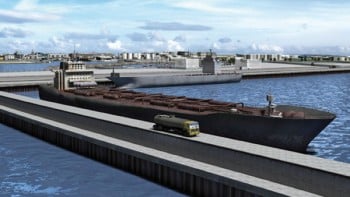
    By Ian Lumley. Galway Harbour Company is seeking permission for the development of a 27-hectare, €52m extension of the harbour, which will include the creation of commercial quays, a deep-water docking facility and the reclamation of lands from the sea. The State-owned company wants a new commercial harbour to accommodate ships up to 40,000 tonnes for Topaz and the local quarry and scrap trade, with infill and a jetty sticking out into the European Habitats and Birds Directive protected bay. The case was heard at a planning hearing in Galway over much of January. The Harbour Company has been following a property development policy since the mid 1980s, when it started selling off surplus sites to builders who went on to construct the Dun Aengus apartments, and the hotel and apartments developed opposite at Richardson’s Bend, as well as the site of the former Shell Oil tank farm which has yet to be built on while its new owner, Gerry Barrett, negotiates with NAMA. The 2011 Bord Snip report considered it “evident that there are too many ports for the trade available that……the sector would benefit from a rationalisation of ownership/management structures. Separate boards, management, auditors and investment plans, are difficult to justify for companies which in some cases have annual turnover of €1 million or less”. Galway’s was around €3.5m in 2013. Denis O’Brien’s Topaz wants to increase its oil import business through the tank facility in Galway city, currently limited to ships of 5,000 tonnes. However the real commercial driver of the project is the international bitumen supply company Cold Chon which has a tank depot for Irish distribution in Galway, but now wants to bring Shell-sourced bitumen from North America in 40,000-tonne tankers, for transhipment in 5,000-tonne tankers to other European ports. The accommodation of Galway as a base for offshore oil and gas drilling, with renewables mentioned as a worthy sop, was also a major part of the case made. Bizarrely, a huge climate-change-indifferent rent-a-crowd, including local politicians, seemed to think all of this a good idea. The business world in Galway was dazzled by the dressing up of the project as a means to accommodate spiffing berthage for cash-rich cruise-liner passengers popping in to buy Aran cardigans, take bus tours all over Connemara, and absorb the ubiquitous craic, presemably, on the odd few days when petroleum ships would not be docking. The increase of flood risk to Galway city centre, and the inadequate road connection from the port to the national road system which threatens to engulf the city centre in traffic seems to have escaped most local concern. The case for Galway Harbour Company was presented by barrister Esmond Keane SC – well known in the Irish anti-environmental world through his representation of Shell and EP Ireland in the Corrib gas saga and for his shepherding of the M3 motorway scheme near ancient, mystic Tara. Some of the most vicious cross-examination I have ever seen at a hearing came when he launched into Mary Hughes, President of the Irish Planning Institute, who was representing Shannon Foynes port, and simply arguing that the scheme contravened the 2013 National Ports Policy, which designated five National ports including Foynes, with Galway only having Regional status. While climate rarely seems to impinge on plan-driven An Bord Pleanála, the following problems may: • 
The 2013 National Ports Policy, which outlined a plan-led strategy, defined a 3-three-tier rating system for ports. The Galway Harbour Extension proposal for a Tier 3 regional port, without direct connection to the national road network, contravenes this national strategy. • 
The plan is based on a flawed socio-economic model of continued fossil-fuel, resource-ravaging and biodiversity-diminishing short term economic development. The Plan facilitates the unsustainable increase in imported fossil fuel and petroleum products and had no integration with the required transition to a low carbon future. • 
The plan worsens HGV and oil-tanker traffic through the urban area of Galway, from Lough Atalia Road to the national roads network. • 
The national ‘low-carbon road map’ provided under current Government policy will require the progressive reduction of import of coal, oil and other products leaving port space at Foynes redundant, and obviating the case for new capacity in Galway. • 
Galway port needs to integrate with the urgent strategic planning needed to protect Galway city from rising sea levels and increased exposure to Atlantic storms. The development constitutes an intervention in a candidate EU-designated Special Area for Conservation and Special Protection Area for birds which the applicants consultants have accepted to be “significant”. • Ian Lumley presented the case for An Taisce at the recent oral hearing in Galway on its port extension.

    Loading

    Read more

  • Posted in:

    Nov 27th – justice in red lights

    By Rachel Moran With the relentless practicalities of running a country it is perhaps unsurprising that our politicians don’t often propose legislation which has, at its heart, the goal of human harmony. November 27th of this year was a welcome exception. With Minister Frances Fitzgerald’s proposal of ‘The Sexual Offences Bill 2014’ we have it within our grasp to prohibit, for the first time in Ireland’s history, by law, the purchase of sexual access to another person. I speak about human harmony here because it is an absolute impossibility in the absence of equality, and equality itself is impossible where one group has not been liberated from the dominance of another. As an abolitionist campaigner, I am often reminded that there are men and trans-persons bought in the sex-trade. My answer is always the same: look who’s buying them. This proposed legislation would make those who buy sexual access to people legally accountable for their actions, irrespective of biological sex. Nobody, however, is ever going to be able to tell me that almost all those abused in the sex-trade are not women and children. They are. After seven years in prostitution I know they are, and it is that simple. The announcement of these proposed laws has been a major milestone in the Turn Off the Red Light campaign. It has been almost four years since I first spoke at the launch of a campaign that turned out to be a long, drawn-out and arduous fight for social justice. Fifteen months of relentless media debates and over 800 written submissions were involved. There were private hearings and public hearings in which the Garda Síochána made it perfectly clear in their evidence to Government that Irish prostitution is directed and controlled by organised crime. Irish politicians visited Sweden to investigate how the Sex Purchase Law was operating there. This lengthy and thorough debate was eventually concluded on June 27th as the Joint Oireachtas Committee on Justice, Defence and Equality unanimously agreed that the Nordic Model should be imported into Irish law. Now, thankfully, Minister Fitzgerald has backed the main points of the campaign. While we of course look forward to examining the Bill in detail, we are overwhelmingly well-disposed to the headings of its contents so far, and glad to see also that a whole new raft of measures to protect children from sexual exploitation is contained in the bill. There are few enough days in all our lives when we can truly say we are proud of our country, or that we are living through a historically significant time. When these things come together, as they do for me at this time, I find myself looking both forward and back. I find myself imagining myself living into my seventies and eighties and looking back on this as a truly significant turning point for my country. And I find myself looking back to my teens and connecting with the absolute sense of injustice I was so immersed in and infused with then. I was not so inured to injustice, though, that I was unaware of it. I always knew the purchase of sexual access to women and girls was a human rights abuse. I knew it because I lived it every day. It is easy for me to imagine my older self looking back on the historical relevance of the enactment of this legislation, but it is harder, much harder, to imagine my teenage self looking forward to it. Justice did not exist in the brothels and the red-light zones and it would have been so very difficult for my fifteen-year-old self to imagine it there. If I could go back and tell myself one thing, it would be this: “On November 27th 2014 a law will be proposed that will bring justice to this red-light street, and all the other streets in the zone, and every brothel in Ireland.” • Rachel Moran is the author of ‘Paid For – My Journey Through Prostitution’ @RachelRMoran

    Loading

    Read more