Programme-renegotiation not enough as even finger-wagging becomes parody – John Gormley


Ireland's political and cultural magazine
Programme-renegotiation not enough as even finger-wagging becomes parody – John Gormley

Mary Fitzpatrick interviewed by Michael Smith Councillor Mary Fitzpatrick, 44, was born and raised on the Navan Road in Dublin’s North Inner City, one of four children of Tom Fitzpatrick, a doctor and dentist who became a Fianna Fáil TD, She went to St Dominick’s in Cabra and to UCD where she studied politics and then Italian and German which she thought might get her a job. She emigrated in the eighties, she worked in France, Italy and the US after getting a Green Card. She worked in international sales for a subsidiary of the Associated Press By 1992 she was selling broadband capacity to the Chicago Board of Trade and others, first in the US and then back in Dublin until 2006, serving the whole of Europe. She says the key to sales is “know your product and sell its strengths”. She now lives in Glasnevin with her husband Seán and three children. Her first election was the locals in 2003/4 and she has served as councillor – always in opposition since then, currently as Fianna Fáil’s Council leader. She is most famous for being shafted by Bertie Ahern in a mutually unedifying tit-for-tat of leaflet drops which in the end secured election for his unprepossessing buddy, Cyprian Brady, ahead of her in the 2007 General Election. Brady got elected on Ahern’s transfers though he’d secured an excruciatingly small number of first preferences. Throughout the interview she is engaging, good-humoured, balanced and disconcertingly charming with an infectious laugh. She had been interested in politics from her childhood, working on her father’s campaigns and got involved with Fianna Fáil “To make a contribution for my community”. She considers herself “a centrist politician, republican, democratic republican politician, my motivation I suppose is equality and equality of opportunity”. I ask if she is open to equality of outcome – to in effect compensate some people in circumstances where people get off to such a difficult start that it’s difficult for them to explore the opportunity she emphasises. She says education is the key, ensuring people have a decent start in life, a decent home. If we could get those two things right, we would be making huge strides towards equality”. Would she describe herself as a socialist like her Nemesis Ahern? “I think in its narrowest and strictest definition it’s a failed political philosophy and it just doesn’t really exist here”. She thinks the Socialist Party are not really serious about socialism. Unusually her hero is Abraham Lincoln: “he really battled through and made real changes, and had personal courage”. Anyone else, anyone in Ireland? |”Not particularly”. What class would she describe herself as? “I don’t”. Does she think that Fianna Fáil has been of service to the country? “Yes absolutely. I think the value of Fianna Fáil hasn’t been what it should be and we need to do better and we’re all committed to doing that, but I think if you look at the entirety of Fianna Fail’s service to the country, absolutely we’ve been of service. But we need to restore value to the brand”. Okay, how would she assess the last Fianna Fail/Green Government? “I can’t answer that question because…Can I come back to it? Later she comes back with “challenged”. Kind. As to what she thinks of Ahern and Cowen, and Martin: “Bertie was your quintessential campaigning politician. Cowen I didn’t know well. I’ve met him a handful of times and he struck me as a very patriotic individual. Micheál Martin, a politician with real determination and real vision to see Ireland recover”. How would she describe his vision in a word? “Ambitious”. How many times has she met Bertie Ahern, and Micheál Martin, roughly (I don’t have a clear picture)? “Well, I must have met Bertie a good number of times; I can’t say. Micheál a good number of times as well, I don’t meet him on a daily basis”. Does she believe Bertie Ahern’s evidence to the Mahon Tribunal – on the digouts for example? “Do I have to answer that question, I don’t want to”. Who owns Bertie’s former constituency den, St Luke’s? “Talk to the General Secretary, Seán Dorgan, he’s the person dealing with it. I don’t use it, but my understanding is the ownership of the property was transferred to Fianna Fáil Headquarters”. Ever met Denis O’Brien? It’s a querulous No. Just asking. . Just what sort of bank guarantee does she think was appropriate? “I don’t think they’d any option and obviously we’ve to await the outcome of a properly independent banking enquiry”. I note there have been a number of reports : “There was a number of reports, but there needs to be an independent one or we’re never going to learn from those mistakes”. Could they not have curtailed it in terms of time or left out unsecured bondholders? “I don’t think any of us know if that was even an option for them”. The current Government. Does she think the government is improving the efficacy of the civil service and the semi-states? “My biggest experience is what they’re doing with water services and in that respect absolutely not. What we’ve had is a situation where they have taken some of our staff, our property tax – €100 million in Dublin, they’ve spent it on consultants to create an organisation that is accountable to nobody and there is no improvement in the quality of the water service”. They shouldn’t start taxing water until they’ve sorted out the problems”. She’s not too keen to say how they should pay for the improvements necessary to get up to those standards. ”Maybe they should have implemented real efficiencies”. “I’m not opposed to environmental charges including water charges – or indeed to property taxes – per se”. She accepts the principle of a local tax to be spent on local services. But “That is not what is happening. Phil Hogan made a public statement to encourage everybody to pay their property tax –

Geni Murphy ‘the Victorian terrace due for demolition contains upstanding remains of a medieval manse house associated with one of the cathedral dignatories’. ‘The report notes: “the most recent archaeological report by V.J. Keeley has not been made available for consultation”’ Despite huge opposition, Kilkenny County Council stands resolved to push through the Central Access Scheme (CAS) in Kilkenny City. The scheme will involve the construction of 2.5km of new road, including a 65m bridge through the centre of the city at a projected cost of €10.7m. Opponents of the scheme claim that the road will be visually intrusive on the urban landscape of Ireland’s best-preserved medieval city, will result in increased levels of heavy-duty traffic through residential areas, will destroy medieval archaeology and will lead to the severance of one side of the city from the other. An Bord Pleanála granted permission in 2009 for the main section of the road to be developed through the city centre (while refusing permission for additional spurs). Opponents are calling for the completion of the outer ring road around the city, which would cost in the region of €44m to complete. Their group argues that its completion, along with the implementation of the Smarter Travel Scheme (which the Council has signed up to) would negate the requirement for a heavy-duty access road. The Council however state that the road is crucial to the city’s future development. In particular, the Council cites the development of the 13-acre, former Diageo brewing site located in Irishtown and the 14-acre old cattle-mart site beside the river, as being particularly dependent on the CAS. However, it can be argued that the IT and educational businesses the Council is targeting for the developments require a well-developed IT infrastructure – not a transport infrastructure; and they are likely to be attracted to sustainable environments. As a city, Kilkenny’s most valuable asset is its built environment and this road threatens the integrity of that environment. The mart site has frontage on no less than three roads and is due for rezoning as a neighbourhood centre – so the requirement for additional access appears to be negligible. A primary concern for opponents is the visual impact of the bridge, which is to transect one of the most exciting views of the River Nore. The bridge also threatens to obscure the view of the extraordinary Palladian Green’s Bridge. Indeed, the view was a ‘protected view’ until the Council de-listed it in order to make way for the construction of the new bridge. Due to the lack of a completed ring road, currently much through-traffic, including HGVs has no choice but to traverse the city through residential areas. Communities along the road’s route are concerned that the development of this road will only serve to further feed this inappropriate traffic through their areas. CAS traffic predictions are c.12,000 vehicles per day. The CAS (or Inner Relief Road as it was then called) was first proposed back in 1978, and the road is a relic of that period of planning in which access for the car was prioritised. Now, however, towns and cities all over the world are trying to minimise the traffic entering their cores – Paris has just introduced a car-free zone along the banks of the River Seine; the entire town of Houten in the Netherlands, with a population of 44,000 people (twice that of Kilkenny) is entirely car-free; Copenhagen, Dubrovnik, Florence, Vienna and Oxford have all introduced smarter travel initiatives which limit car use and dependency. In these cities, the pedestrian and the cyclist are prioritised. Maybe Kilkenny City is not as grand as those cities mentioned above, however the extent of its preserved medieval architecture is unique in Ireland and consistently ranks as one of the primary reasons people visit the city. In 2012, the County Council announced a €15m investment in the development of a ‘Medieval Mile’ tourism initiative which is to run between the two dominating architectural features at either end of the city – Kilkenny Castle in the south and St Canice’s Cathedral in the north. The CAS is to transect this Medieval Mile at the foot of St Canice’s Cathedral, thereby creating a heavy-duty road that travellers of this Mile must traverse in order to reach the cathedral. It has also been discovered in recent months that the Victorian terrace due for demolition contains upstanding remains of a dwelling which a number of Ireland’s leading buildings archaeologists, including John Bradley (NUI) and Cóilín Ó Drisceoill (NUI) claim are medieval in date and highly likely to be the remains of a manse house associated with one of the cathedral dignatories. The report notes: “the most recent archaeological report by V.J. Keeley Ltd. (October 2013) has not been made available for consultation. All of the previous archaeological reports for the site had concluded that there was little or no evidence for standing fabric associated with the manse. Following local pressure and a requirement in July/August from the architectural heritage protection division of the National Monuments Service 21 and 22 Vicar street were stripped of plaster to reveal the underlying stonework. This work has revealed that the south gable of 22 incorporates a late medieval/Renaissance structure which has undergone Victorian alterations. The late medieval/ Renaissance structure is a c 5m high gable containing a chimney breast with shouldering that finds clear parallels in Renaissance buildings in Kilkenny: for examples the former Shee House/Parliament House and the Rothe House. This architectural device is not seen on Victorian buildings in the city.The Town Hall, Fethard, also contains shouldered chimney breasts and in Cork such chimney stacks are a feature of many fortified houses of the sixteenth-seventeenth century (eg. Ightermurragh). The evidence points towards the south gable of 22 Vicar street being the north wall of a building that stood to the south”. According to Ó Drisceoil, houses such as these are like ‘hens’ teeth’ in Ireland. It is surprising then that both the county manager and the mayor have

Alan Shatter was a reforming minister. Profile of Shatter’s reforms (Feb 2014). by Kyran Fitzgerald There are few people who are neutral on the subject of Alan Shatter. Almost by definition, Ministers for Justice stand in the eye of the storm. Usually, they are blown along by events. The murder of Veronica Guerin in 1996 was the defining moment of Nora Owen’s tenure in the department. The report of the Morris Tribunal arising out of the extraordinary behaviour of senior Garda in Donegal had a huge impact during the period in office of Michael McDowell. Security considerations have always ranked high. The temptation is for the serving Minister to spend too much time defending the status quo while fending off demands for improved pay and conditions from some of the most formidable lobby groups in the State. All too often ambitious reform plans get pushed to one side. When Alan Shatter took office in March 2011, he was certainly not a man bearing gifts. His primary task was to implement a series of cost reductions right across the justice and law spheres, involving a programme of closures of Garda stations and courthouses as well as further reductions in payments to barristers and solicitors in civil and criminal aid. The blowback was huge. Gardaí, many of them carrying large loan burdens from property investments, reacted with fury to measures, outside the Minister’s direct control, aimed at cutting their earnings. Aside from the series of general reductions in pay implemented since 2008, Gardaí have been faced with reductions in overtime. The Minister soon became embroiled in a controversy over penalty points, his own in the first instance. The matter of cancelled penalty points has returned to haunt the Force, in recent months. Cutbacks were a feature of Alan Shatter’s early period in office. The programme of Garda station closures soon enmired the Minister in public controversy. More than one in ten of the stations has disappeared include a couple in the Minister’s own Dublin South constituency. Local demonstrations have been staged but the Minister, with the backing of the Garda top brass, has held firmly to the view that it makes little sense for Gardaí to be inside ageing buildings carrying out administrative work. Locals in suburbs like Stepaside, south Dublin, worried about an inevitable surge in burglaries, beg to disagree and some element of payback has been demanded by the Garda. Shatter has been notably indulgent of Garda Commissioner Martin Callinan’s intransigent defence of “his” force over the penalty points debacle, at the Public Accounts Committee, and long prevaricated over affording the Garda Ombudsman Commission access to the Garda’s pulse computer system, without which the Commission’s work is hobbled. Meanwhile, the Dublin South TD, who also has the Defence portfolio, has presided over the closure of army barracks too – in Mullingar, Clonmel and Cavan. His willingness to face down local opposition has earned him brownie points at Cabinet, though it remains to be seen whether an electoral blowback could throw his engine into reverse. If Shatter’s efficiency drive in this area has shredded the nerves of local Fine Gael party worthies ahead of the local elections in May, his moves to shake up legal services, unveiled in November 2011, have won more favour with the ordinary punter – while provoking a firestorm within the legal profession. The Minister’s plan to establish a new Legal Services Regulatory Authority, ending the current system of self regulation of solicitors and barristers and introducing reforms such as multi-disciplinary practices, has the strong backing of the Taoiseach, Enda Kenny – the two men tend to sit side by side in Cabinet and are said to be close, politically. This particular set of reforms answers to a popular demand for a shake-up of two professional bodies which would not be atop any poll of anyone. At a time when the current administration is regularly assailed for acting at the behest of the dreaded Troika, in implementing unpopular cutbacks, implementing a crackdown on professions viewed as greedy, smacks of clever populist politics. Some members of the legal profession have been their own worst enemy. There is universal rage at the huge payouts to lawyers involved in a succession of Tribunals, particularly Moriarty and Flood/Mahon which each will cost around €200m and the fact that over the last eleven years the Attorney General’s office alone (ie not the HSE or DPP) paid €3.2 million to two barristers, €2-€3 million to another seven and a further €1-€2 million to a further 27. The Department of Finance alone paid a staggering €15m to Arthur Cox in the five years up to 2012. There is a perception some lawyers have gorged at the expense of the public purse. Certain law firms appeared to garner spectacular costs from the army deafness actions of the late 1990s, leading to a crackdown on costs by the then Defence Minister, Michael Smith. A surge in personal injury actions led to growing concerns about a so-called ‘compo culture’ that led to the establishment a decade ago of the Personal Injuries Assessment Board by the then Justice Minister, Michael McDowell. Many practitioners regard PIAB as excessively bureaucratic and they claim that ordinary claimants, many with good causes of action, have lost out, but PIAB has reined in to a degree the upsurge in premiums that was threatening business and social and leisure activities across the country. Lawyers insist that the real beneficiaries have been the insurance companies which pressed hard for the changes – the insurers respond that premium levels, in a competitive market, are determined by the cost of claims. While the personal injuries bandwagon was halted, the search for easy profit did not end. Alternative outlets were explored with gay abandon. Some solicitors became directly involved as property investors during the boom years – tempted by a beguiling promise of tax avoidance mixed with capital appreciation, a tasty but ultimately lethal concoction – to the neglect of their responsibilities in the area of compliance.

Official Ireland is indifferent. This time about Donegal. Gerard Convie is a whistleblower, but you won’t have heard of him. Over the last few years Village has helped a number of other whistleblowers whose cases are to varying degrees unassailable but have not been championed by the media or pursued by the authorities: Jonathan Sugarman on Unicredit Bank, Noel Wardick on the Red Cross, Paul Clinton on Treasury Holdings and Dublin City Council, Séamus Kirk on planning appeals withdrawn after a €1m payout in Louth, Colm Murphy on solicitor fraud and Law Society ‘skulduggery’. As Frank McBrearty, the whistleblower whose attempted framing for the murder of Richie Barron led to the instigation of the Morris Tribunal, told Village this week: “without whistleblowers you can’t expose corruption”. But the lack of official interest in these brave citizens, or action on their allegations, bespeaks an overwhelming cynicism veiled only by the correlative rush to be publicly perceived as welcoming of whistleblowers such as the gardai who revealed the penalty-points scandal. As one man’s freedom fighter is another man’s terrorist, so one man’s whistleblower is another’s deluded obsessive. You only really become a whisleblower once your whistle has been heard by the ‘political correspondents’ and the party spokespersons. When you are at your most vulnerable they won’t seek you out or even answer your letters. Convie worked in Donegal County Council as a senior planner for nearly 24 years. He claims it was well known in Donegal and beyond that he would not capitulate to the “goings-on in planning” by certain councillors and senior officials in Co Donegal. He tried to control one-off housing, produced the first design guide, and used to appeal to An Bord Pleanála on his own behalf and at his own expense all decisions to grant planning permission via the infamous S4 motions. This was controversial. He claims one councilor constantly referred to him as a ”wee shit from the North”. Convie has claimed, in an affidavit opened in court, that during his tenure there was bullying and intimidation within the council of planners who sought to make decisions based exclusively on the planning merits of particular applications. In the affidavit, Convie alleges another planner: 1) recommended permissions that breached the Donegal County Development Plan to an extent that was almost systemic 2) submitted planning applications to Donegal County Council on behalf of friends and associates 3) dealt with planning applications from submission to decision 4) ignored the recommendations of other planners 5) destroyed the recommendations of other planners 6) submitted fraudulent correspondence to the planning department 7) forged signatures 8) improperly interfered as described in a number of planning applications 9) was close to a number of leading architects and developers in Donegal, including the head of the largest ‘architectural’ practice in Donegal, with whom he holidayed but the relationship with whom was undeclared. His affidavit also refers to irregularities perpetrated by named officials at the highest level in the Council as well as named senior county councilors. The Minister and Donegal County Council made no defence of any averment in Convie’s Affidavit. Convie had a list of more than 20 “suspect cases” in the County. As he reverted to private practice he claimed that there must be many more, perhaps hundreds, “a cesspit”. His complaints to various Ministers for the Environment and to the Standards in Public Office Commission went nowhere. After the Greens got into government, Environment Minister, John Gormley, announced “planning reviews” in 2010, not of corruption but of bad practice – in seven local authorities including Donegal. Convie’s case studies comprised all the material for the review in Donegal. But when the new Fine Gael and Labour government took over they very quickly dropped the independent inquiries. A lazy 2012 internal review stated: “The department’s rigorous analysis finds that the allegations do not relate to systemic corruption in the planning system…Nonetheless, they raise serious matters, ranging from maladministration to inconsistency in application of planning policy or non-adherence to forward plans, such as development plans”. As regards Donegal, the Department, extraordinarily and scandalously, decided – according to Minister Jan O’Sullivan in the Dáil, that: ‘’ … the complainant [Convie] has failed at any stage to produce evidence of wrong-doing in Donegal Council’s planning department”. Convie felt this left him in an invidious position and, in the absence of any defense of him by from any source, he successfully sued. In the High Court Order all the conclusions by the Minister were withdrawn, including reports on the matters prepared for the Minister by Donegal County Council. The government has been forced to reinstate the planning enquiries. But it will be important to see the ramifications for the civil servants who concluded that Convie’s complaint did not constitute “evidence”, and for the Minister who accepted the conclusions. While some of the council officials who are named in the irregularities in Convie’s Affidavit have retired, some remain in the Council’s employ and have seen their careers soar. The Convie file has been referred to the Attorney General for direction and she has now reported back to the Minister. The Department will report its review before the summer. Meanwhile a taint hangs over the administration of planning in Donegal, and a whistleblower twists in the wind. As Village was going to print, things were finally heating up in Donegal County Council. The Director of Housing and Corporate Services told Village the Council would be responding to Convie’s reported allegations, shortly, and Ethics Officer, Paul McGill, said the matter was being examined by management. As regards County Councillors, the current mayor of Donegal, independent Ian McGarvey, while making it clear he did not wish to be involved in anything ‘scurrilous’, said he would refer the issue to the county secretary. Independent Donegal County Councillor Frank Mc Brearty noted it was difficult for current councillors to ascertain the truth of such matters because of difficulties getting files – even last year when he was mayor. While complimentary of the current
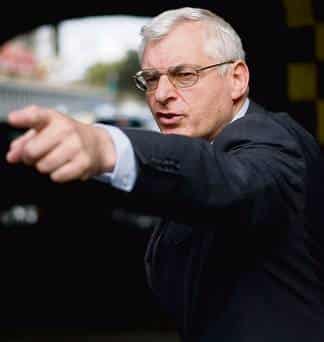
As he announces his intention to retire, we reprint an interview with the strongest voice on Ireland’s radical left. Michael Smith interviews Joe Higgins about a new electoral force on the left I meet Joe Higgins over tea and a brownie, on a grim afternoon in December in Dublin City Centre. He doesn’t want to talk about his background – people are sick of it – he wants to talk about the United Left Alliance. When pushed he claims not to know what forged his politics: he just had a view – rather than any particular experience – of unfair structures and he saw socialism as a way of running society with justice and equality. I ask him what role he sees for the market in all this and he says none – at least for the international markets and the markets in commodities. He’d nationalise the commanding heights. He’d nationalise – and leave nationalised – the banks. And he’d nationalise other major infrastructure and major industries. He’d re-nationalise Eircom and Team Aer Lingus. I suggest that many people wouldn’t know what else he’d like to see nationalised and ask him to explain. He wouldn’t “prescribe that enterprises of a certain size would be nationalised. You’d start with the obvious candidates and then leave it up to democracy – workfloor democracy, participatory democracy, community democracy – to a proper debate as to how best to serve the needs of society”. He wouldn’t nationalise every “corner shop, bed and breakfast or chip shop”. The position is the same as he held in Militant Labour twenty years ago before he was expelled. “I’m a Trotskyist”. He’s always been a Trotskyist, though he draws also from Marx, Engels, Rosa Luxemburg and James Connolly – and times change so thinking evolves. It’s different from the totalitarian approach in former Eastern Europe. Stalinists in the Soviet Union jailed democratic socialists of Higgins’ tradition. I ask him what he thinks of the agenda of equality, sustainability, transparency that Village generally promotes. He wouldn’t disagree with them but you can’t have those agendas in a capitalist society. So what’s his own agenda and that of his socialist party? His agenda would be not to pay a penny to the speculators and gamblers. He’d say goodbye to the IMF as the expression of global capitalism with a history of wreaking social havoc across the world and of acting as shock troops to facilitate multinationals. He’d default, not pay the bond-holders and while he won’t directly say he’d leave the Euro he’d prefer an arrangement that was less of a straitjacket, that allowed devaluation He’d like to see democratic control of the banks, infrastructure and major industries. Then he’d extend that Europe-wide. He’d promote investment in major infrastructure, including health and education, to provide jobs and enhance quality of life. He’d nationalise natural resources along the lines of what the ESB and Bord na Móna did years ago. Alternative energy is a priority. He’d like to see more unity of the working class in a non-sectarian way in Northern Ireland. . As to a United Ireland, democratic socialism would see sectarianism dissipate and the border cease to be an issue. The environment and climate change figure as priorities. Much of his agenda is impossible while capitalist structures remain in place but he’s determined democratic socialism would achieve nearly all the progressive views we discuss. At a local government level he was a robust opponent of developer-led rezonings and for thirty years he’s been lobbying for the Kenny Report which would penally tax the fruits of taxation and allow local authorities to buy development land without paying a premium price. Again it’s down to the process: “as long ago as the 1960s, when the developers bought Fianna Fáil, the problem wasn’t so much corruption as the clout they wielded over the process” of local government and rezoning. On the EU, he believes the European Commission is hypocritical about the European model which is dominated by corporate power including lobbyists. He’s particularly concerned with their trade agenda and is on the EU trade committee. Still he’s open to European solidarity on the basis of democratic socialism. The main thing is to work out a workers’ society where this agenda prevails. He doesn’t see scope for taxation for environmental or quality-of -life enhancing purposes. Taxing petrol or waste or water is a crude mechanism. He prefers regulation rather than taxation to environmental ends. You provide public transport, you insist on recycling, you stop waste of water. Perhaps inevitably for someone whose agenda is so solidly social he has little interest in harnessing economic mechanisms to environmental ends. But he is passionate about the environment and has innovative ideas – dual-flush toilets, reuse of rainwater and the like. He has firm ideas about the current party-political line-up. A vibrant, left alternative in the next parliament will be opposed and dominated by FG and Labour, with a disillusioned FF in opposition. He notes in the context that Labour has certain progressive principles and yet will sacrifice them in the inevitable coalition, while carrying out the programme of the IMF. I ask him about some of the forces on the left: Labour, he says, like the Social Democratic and Labour parties all over Europe has bought into market capitalism. Blair is the prototype, “out-Thatchering Thatcher and going in to Iraq”. Their colleagues in Greece are carrying out the IMF agenda and in Portugal and Spain are implementing vicious cuts. When he first started out in the Labour Party it was very different The Trade Unions are mostly in retreat. There’s no decisive leadership though he has some time for the Unite union. The rank and file needs to take back control. Too many of them do deals with government and are on wages like those of the top bankers. The Greens were never on the left and he told John Gormley so a long time ago. This is because they could never say if

Devaluing degrees. By Peter McMenamin, retired General Secretary of the TUI. The Technological Universities Bill is motivated by our excellent Institutes of Technology wanting spiffier names ‘‘The distinctive role of the IOT is to take in students onto courses which have a lesser entry requirement and to bring them to an academic level appropriate to their needs and abilities, be that at sub-degree, degree or postgraduate level’ ‘The current World University rankings list five of the top tweny universities in the world as not containing the work ‘University’ in their title’ By Peter MacMenamin The number of Universities needed, the number of places needed in Universities as opposed to in other third-level Institutions, the proportion of the population which should have a university education as opposed to another type of third-level education, either directly on leaving school or at some time later in life. These issues loom over the announcement last May of the intention to establish three new “Technological Universities” and the more recent publication (January 2014) of the Heads of the Bill to establish these Institutions. Nothing in the announcement or in the published Heads of the Bill gives any indication that there will be an overall growth in the number of third-level places. It is another debate as to whether such an increase is necessary. It is clear however that the trend is to provide more “University Graduates” than heretofore. Why do they need to be university graduates as opposed to graduates from other types of higher education institutions? The Technological University concept as announced seems to consist of little more than Institutes of Technology (IOTs) merging and being given a new status or maybe just a new name. At present there are seven Universities, fourteen Institutes of Technology, five specialist teacher training colleges and a range of other institutions providing higher education in the public sector under the jurisdiction in some manner of the Minister for Education and Skills. There is also a plethora of institutions in the private sector, operating on a for-profit basis where shareholder benefit is at least a dominant factor (some would say the overriding factor). A University is a Higher Education Institution (HEI) which focuses on producing graduates at primary-degree and postgraduate levels and on independent/academic research frequently for its own sake though increasingly for industry. An Institute of Technology (IOT) is a HEI which produces graduates sub-degree, primary and postgraduate levels. IOTs support research both at student level and by academic staff and while fewer in quantity than the Universities some of the research units in IOTs are at a very high level and highly regarded. This is generally “Applied Research” and frequently funded by industry or with targeted grants. While the University typically has as its basic unit of currency the primary Degree (BA, BSc, B Comm. etc), the IOT has traditionally produced graduates with a range of non-degree level qualifications. Formerly these were National Certificates, National Diplomas, apprenticeship trade qualifications and qualifications in the tourism/hospitality area. These are now classified in accordance with their place on the National Qualifications grid ranging from levels 6 to 10. Academic qualifications are categorised from 1 to 10 in accordance with the qualifications framework as set out by the National Qualifications Authority. 1 to 5 are regarded as first and second level, 6 to 10 are considered as Higher Education; 6 being sub-degree, 7 pass degree, 8 honours degree, 9 masters and 10 is PhD. Included in this provision is the vast range of qualifications in the building trade, the engineering trades, technician qualifications, the arts, the catering and hospitality and tourism trades, and others of enormous importance to our economy such as the necessary graduates for the electronic, IT and medical/pharmaceutical industries. Both IOTs and Universities enjoy a measure of autonomy; universities are believed to have more, though the strictures of budgets and employment control frameworks curtail this considerably for both. They both also enjoy that undefined concept of academic freedom so essential in a democratic society, by statute in the case of universities. Universities and IOTs do have distinctive roles and must complement one another. The distinctive role of the IOT is to take in students onto courses which have a lesser entry requirement and to bring the student to an academic level appropriate to their needs and abilities, be that at sub-degree, degree or postgraduate level. It is a given that every educationalist would wish to see every student have access to the highest level of academic achievement that s/he is capable of and willing to work towards. Access should be opened up as far as possible without regard to income, wealth, social class, parental occupation, postal address or other irrelevant factors. That does not mean that every student or indeed every child/young person should reach any stated standard. Not every student is capable of obtaining a primary degree. Not every student needs or wants to obtain a primary degree or indeed to participate in third-level education at all. We should allow and facilitate students to reach their own appropriate level of qualification. There is a normal distribution of ability levels in society and without artificially pushing target percentages of graduates this normal distribution of abilities will necessarily lead to a range of qualification levels throughout the population based on ability levels and aptitudes. The aim must be to ensure access to the level most suited to ability of each individual while at the same time retaining the academic value of the qualification. The present proposal is to merge and to re-grade some Institutes of Technology to “Technological University” status. I use the term re-grade rather that upgrade because I am not convinced that there is a hierarchy of HEI types. Who says that a University is a better HEI than an IOT? It produces more graduates to a higher level but does that make it a better institution? The fact that some IOTs have for twenty years or more been pursuing this goal to become Universities is

“It will never be known what acts of cowardice have been committed for fear of not looking sufficiently progressive” – Charles Péguy Those with whom I’ve been bundled over the course of the past three months would have good reason to accuse me of draft-dodging on the gay-marriage issue. I had been avoiding becoming embroiled in that issue, not least because my views on the subject are rather complicated. Contrary to what Rory O’Neill implied on the ‘Saturday Night Show’ of 11 January 2014, I had not been regularly appearing on television panels with the view of destroying his happiness. Having named me as one of the people attacking his happiness – ‘The obvious ones’ – O’Neill went on: “I mean, what astounds me is that there are people out there in the world who devote quite a large amount of their time and energy to try and stop people, you know, achieving happiness and that is what people like the Iona Institute are at”. Apart altogether from the ‘homophobe’ slur, this was objectively untrue, at least in as far as it related to myself, and I state this merely as an irrefutable fact. Only three or four days earlier, I had declined an invitation from ‘Vincent Browne Tonight’, to talk about a recent statement by former president Mary McAleese about gays and the Catholic Church. In fact, although I had been a regular guest on Browne’s show on RTÉ Radio One up until about a decade ago, I had only once appeared on his TV programme. One of my reasons for declining to appear was Browne’s consistently aggressive dismissiveness of any or all of my arguments concerning fathers and children. Smears about me and homophobia began three years ago, during the early stages of the 2011 presidential election, when the retired journalist Helen Lucy Burke went public with her concerns about an interview she had conducted with presidential candidate david Norris a decade before. Burke immediately found herself targeted by gay-rights activists and journalists seeking to prevent her airing these concerns which related to Norris’s alleged views on paedophilia. On seeing this, I wrote about the issue in my Irish Times column, recalling the facts of my own involvement, as consultant editor of Magill in 2002, in working with Helen Lucy Burke to try to persuade David Norris to withdraw his comments about paedophilia from the interview before publication. My writing on this subject led to a scurrilous article in the Irish Times, in which I was accused of being part of a smear campaign against David Norris, which in turn led to me being called a homophobe by a guest on the ‘Vincent Browne Tonight’ programme. Recognising the use of the word ‘homophobe’ as a long-standing instrument of censorship I immediately consulted my solicitor, Kevin Brophy, who made contact with both organisations. The Vincent Browne programme agreed to broadcast an apology; the Irish Times essentially refused to apologise and more or less told me to sue if I wanted to. I decided not to, on the grounds that I was continuing to work for the newspaper, and TV3 had issued a reasonable and timely apology. In neither case had I raised any issue of damages, nor, in the case of TV3, did I seek even my legal costs. (In the recent controversy, RTÉ could have saved its licence-payers €85,000 plus legal costs, had it responded as TV3 did on that occasion.) The following weekend, the Irish Mail on Sunday carried an interview with Christine Buckley (recently deceased), the former institutional abuse survivor and campaigner. She said “Senator Norris does not appear to see the moral dilemma in abusing a child, the psychological impact, the emotional impact, the shattered life”. As a supporter of David Norris in his battles on behalf of homosexuals, she said, she felt a sense of betrayal. Although I had been called a homophobe for similar interventions, Christine Buckley was not accused of homophobia – the interview was simply ignored by all other Irish media outlets. Until then, it would have seemed unthinkable that any contributions of hers on the subject of paedophilia would be ignored – but this one was. ‘Homophobia’, of course, is a multi-faceted word. It has been widely used by gay rights activists as an instrument of attack and demonisation. The word also has strong connotations of an imputed aversion towards, indeed hatred of, homosexuals based on a fear of same-sex attraction which the person exhibiting the prejudice may detect, and seek to suppress, within himself. But it was Brendan O’Connor, not Rory O’Neill, who introduced the word “homophobia” – and went on to invite O’Neill to name names on the ‘Saturday Night Show’. It was when O’Connor asked “Who are they?” that O’Neill replied: “Well the obvious ones… Breda O’Brien today, oh my God banging on about gay priests and all, like the John Waterses and all those people, the Iona Institute crowd. I mean I just, I just, feck off and get the hell out of my life” (applause from the audience). The defamation entered in with the acquiescence of O’Neill in O’Connor’s proffering of the word “homophobic” and this was in only the slightest degree mitigated by the fact that O’Connor’s motive appeared to be to defend me against the accusation he detected O’Neill to be making. “I don’t know. I don’t know”, O’Connor interjected. “I know one of the people that you mentioned there which is John Waters. I wouldn’t have thought that John Waters is homophobic[?]”. If Rory O’Neill had offered any remotely germane evidence of his opinion – that, for example, I had spoken or written anything that he, however implausibly, was deeming “homophobic” (for example, if he had dragged up the now notorious ‘satire’ quote in which I suggested that the preoccupation with gay marriage indicates a wonky prioritising of concerns relating to family while father-child rights continue to be ignored), RTÉ might have had at least a