General

Random entry RSS

  • Posted in:

    We’re deluding ourselves – note my words

    If you’re looking for a chirpy, upbeat assessment of how humanity will, in the nick of time, get its clappy act together to tackle dangerous climate change, then Kevin Anderson is probably not the person you need to talk to. Professor of Energy and Climate Change at the University of Manchester and deputy Director of the Tyndall Centre for Climate Change Research, Anderson is one of the world’s best known and most in uential – and outspoken – climate specialists. On a recent working visit to Ireland, he ripped into any complacent notion that the Paris Agreement signed up to by almost 200 nations, including Ireland, last December meant that we could all relax a little in the knowledge that our politicians, guided by the best scientific advice, are nally getting on top of this crisis. Some of his most devastating critique is reserved for the IPCC itself or, more specifically, the wishful thinking that underpins many of its model projections. He fleshed this out late last year in a commentary piece published in Nature Geoscience, where he took apart some egregiously fanciful assumptions. “The complete set of 400 IPCC scenarios for a 50% or better chance of 2°C assume either an ability to travel back in time or the successful and large-scale uptake of speculative negative emission technologies. A significant proportion of the scenarios are dependent on both time travel and geo-engineering”, wrote Anderson. He repeated this point forcefully during his presentation at the Royal Irish Academy in Dublin, to the obvious discomfort of the representative of Ireland’s Environment Protection Agency, who found himself trying to explain how completely untested technologies could, somehow, be massively deployed to remove upwards of ten billiontonnes of carbon dioxide (CO2) from the air every year, liquefy it and pipe it into vast underground storage where it would have to remain securely for at least the next 1,000 years. Village sat down with Professor Anderson for an in-depth interview in Dublin. First question: what about our recent steps, such as the new Climate Act – does Anderson think Ireland is grasping the nettle of climate change? “I think certainly not; what Ireland has signed up to in the recent Paris Agreement, and particularly when you think that Ireland is one of the wealthier countries in the world, isn’t anywhere near what is necessary to meet its (Paris) commitments”. While the same can be said for the UK and much of Europe, Anderson stresses that “Ireland is a particularly wealthy nation, and it has wonderful renewable (energy) potential; it also has a very educated workforce. It has all that is necessary to make the rapid transition to a low-carbon energy system and indeed a much-lower-carbon agriculture system – at the moment, it is choosing to do very little in that direction”. So what about the view propounded by Irish politicians from Enda Kenny to Simon Coveney, that climate action is something we can kick down the road for another five or ten years, while concentrating on economic development instead? “That view completely, and I would say, deliberately misunderstands the science”, he retorts. “It’s the emissions that we put into the atmosphere now that really matters…these build up every single day in the atmosphere”. As for the oft-quoted argument that Ireland’s emissions are a small fraction of the global total, Anderson replies that every sector, from aviation and shipping to countries large and small, makes the argument that it only contributes a small share of the global total, but every percent is equally important. He is scathing of Ireland’s major expansion of its ruminant-based agriculture sector, believing the argument that if we don’t produce vast amount of beef and dairy products here, someone elsewhere will do it less efficiently, is bogus. “The climate does not care about (emissions) efficiency, it only cares about absolute levels of emissions, so if you are going to look at Ireland you have to look at these absolute levels”. Measuring ‘efficiency’ of CO2 per kilo of beef or ton of dairy produce is not, he argues, the right way to think about it. “If you are really concerned about feeding the world, then you measure it in terms of the CO2 per useful calorie you produce – that will almost certainly mean you will have to move away from the types of agriculture that have innately very high green-house-gas emissions”. Anderson describes the types of measurements being deployed to promote the ‘Origin Green’ image of Irish agriculture as “inappropriate and misleading”. A staunch public defender of agricultural emissions is retired UCD meteorologist, Professor Ray Bates, who has repeatedly argued against an ‘over-alarmist’ response to climate change that might, in some way, curtail our beef and diary sectors. Bates’ principal argument is that ‘climate sensitivity’ to CO2 may be on the lower end of the scale. Anderson is unimpressed. “I think it would be a foolish mistake to go down the ‘let’s keep our ngers crossed that climate sensitivity is on the low end’ dead-end, despite the fact that by far and away the majority of scientists think it’s likely to be on the middle to the upper end of the (sensitivity) spectrum”. What’s at stake, after all, is the habitability of the entire planet, and who would want to leave that to the toss of a coin?”. Anderson knows only too well the appetite among politicians, policy-makers and parts of the media for people who are prepared to down-play the risks and urgency, but believes that only by acting now in line with the scientific advice can potentially disastrous and irreversible damages be avoided. Quite how close we already are to the point of no return, no one can say for certain, but there is growing consensus that +1.5C, rather than +2C, should be the upper limit before really dire consequences become locked in. The findings emerging from climate science pose “fundamental questions about how we have framed modern society, the whole concept of economic growth, of progress – all of the things that have served us very

    Loading

    Read more

  • Posted in:

    Telling the story of Easter 1916

    Patrick Pearse loved his students not wisely but too well, if you know what I mean – what with writing poems about kissing them on the mouth and relocating his school from the healthy hustle-bustle of Ranelagh to dark woodlands in Rathfarnham. Oh, and his students didn’t necessarily reciprocate the affection: a teenage James Joyce dropped out of Pearse’s UCD Irish-language lessons because the teacher was an ideological bore. That’s just a sample of the titbits you’d pick up from Colm Tóibín’s long essay on 1916 in the London Review of Books, arguably this season’s archetypal commemorative/explanatory text from Ireland’s media/ intellectual establishment. Whether you regard it as barrel-scraping to discredit the Rising or an exemplary eye for the telling detail is a matter of taste – if you’re like me, you might reckon it’s a bit of both – but one can’t help but notice the contrast between Tóibín’s forensic litany of Fenian foibles and failings and his breezy flypast of, say, World War I. In the writer’s brief telling, the war was on the verge of Bringing Us All Together, something Pearse and the boyos couldn’t abide and wouldn’t permit: “Britain was merely the supposed enemy. The population of the two countries spoke the same language after all, and had the same education system. Many Irish people moved back and forth between Ireland and England seeking work; many in Ireland also had family in England. While most in the south of Ireland actively or tacitly supported Home Rule, Home Rule was postponed until the war ended. It looked as though the two islands were going to join forces in the war effort. (More than 200,000 Irishmen eventually volunteered in the First World War. Although conscription was threatened in Ireland, it was never actually introduced.)” Recall that Tóibín is addressing, in part, an international audience that may be getting its first substantial account of the Rising, that his article is billed as “Colm Tóibín tells the story of Easter 1916”; this audience will hear nothing from him of the consequences for Home Rule of the Ulster crisis, of Irish carnage in the war, nor of the massive, life-saving popular movement that arose in part from the Rising to resist conscription in Ireland, conscription that was not merely ‘threatened’, but introduced in legislation. Some contexts are, it seems, more worthy of contextualising than others. As the brilliant blogger Richard McAleavey writes: “Questions about whether Pádraig Pearse, say, was a fanatic, or a repressed paedophile even, are intended to psychopathologise any kind of radical political action or thought. They are intended to draw attention away from consideration of the real material conditions and political considerations that produced the Rising, lest they might be used to draw the wrong kind of parallels in the present”. Material conditions? In 17,000 words, Colm Tóibín’s only mention of Dublin’s infamous slums is in a quote from arch-revisionist historian David Fitzpatrick, who says the rebels must have staged the ght in the midst of the city’s poor to ensure maximum casualties among them – as though it were the rebels who loaded the shells into the Helga’s guns, or the rebels who went house to house in North King Street murdering young men. These and other aspects of, shall we say, imperial ‘agency’ have been largely neglected throughout recent commemoration and coverage, in favour of relentless scrutiny of the Rising’s leaders. Just below the achingly familiar debate about the Easter Rising – was it an act of visionary heroism or an act of perverse terrorism? – there lurks a more interesting series of questions about its relationship to what came after. And those are the questions that can lead us beyond dry argument and actually help us understand who commemorates what in the Ireland of 2016, and how those commemorations have played out and continue to play out in the state and corporate media. Thus you can be on either side of the heroism/terrorism split and still hold (tightly or otherwise) any of the following views: (1) the state(s) in which we reside today can be understood as a direct and roughly intentional outcome of the Rising and its guiding lights; OR (2) Ireland over the last century has been a fumbling, contingent, contradictory and ultimately limited effort to fulfil the Republic of 1916; OR (3) the Irish revolution launched at Easter 1916 was firmly defeated in the Treaty and thereafter by an elite that concealed its continuity with the ancien régime behind reluctant memorials to supposed revolutionary heroes. (There are other positional alternatives and variations on all points of the political spectrum but these seem to me to be the major tendencies.) Official and media Ireland prefers to hold and host tiresome debates about the Rising itself (Kevin Myers? Bob Geldof? Really?) rather than any really clear exploration of where we live today in relation to it. Positions number 1 and 2 are generally implied rather than directly stated, with a little frisson of excitement when the likes of Michael D. Higgins suggests that the truth may lean further towards 2 than 1 – a sort of “a lot done, more to do” view of a Republic that still awaits its full and complete child-cherishing achievement. In mainstream media, position 3 – that there was a successful counter-revolution – is almost unthinkable, or at least unspeakable, residing outside the realm of acceptable discussion. And yet it seems to me that it lurks with influence on both the right and left wings of Irish politics. The more or less overt Redmondism of John Bruton and other conservatives – often more Redmondite than Redmond himself – contains an implied celebration of the ‘restoration’ of constitutionalism in Ireland, coloured by regret over militant republicanism’s recrudescence in the Northern Troubles, but not reliant on that regret for its critique of the rebels of 1916-21. The left-wing, pro-Rising version of position 3, alleging that there was a successful counter-revolution in Ireland, is more openly and interestingly embraced. Important gures on

    Loading

    Read more

  • Posted in:

    The Irish Times won its struggle for trust on the Centenary

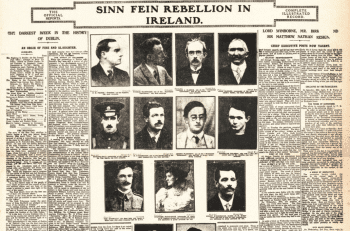
    The Irish Times has had a mixed 1916 commemoration. Even its own audiences seem hardwired to expect a certain bias from the newspaper of reference, but one particular decision – or probably a non-decision no one ever thought to check for unfortunate implications – certainly didn’t help. For its 1916 anniversary issue the paper produced a replica cover from 100 years ago, but decided to cut the original banner headline: ‘Sinn Fein Rebellion In Ireland’. The page-two explanation – that broadsheets aren’t what they used to be, and the resized 2016 dimensions (half the size of the 1916 original) meant the original would no longer t in its entirety and, although it had been shrunk somewhat, any further reduction in print size would render it unreadable, and something had to go… convinced some, but left others unimpressed. If space was the only issue, then why leave two mastheads on the front page, one modern and one vintage? Assuming the plausible explanation that it was a design decision, and nothing more, the online row it generated speaks much about the perceived trust issues the paper has with its audience. Irish Times journalists are prone to complain that their paper is often held to a higher standard than others, and that may be the case, but it is also a backhanded compliment. Its readers expect more from it, and are therefore more inclined to complain when it does not live up to expectations. The Irish imes garners complaints because what the Irish Times says matters to its in a way that most other newspapers do not. Being an opinion leader comes with a price. Twitter media accounts come in two avours. There are those that engage, joining in conversations with followers over the stories of the day, even on occasion adding their contributions to the joke of the day on the medium, and there are those that broadcast, casting their bread upon the waters for others to consume, but never acknowledging that the audience is talking back. Irish Times’ editor Kevin O’Sullivan falls into the latter category. His twitter stream is a list of links to articles he finds it worth highlighting, mostly from his own publication, occasionally from farther afield. While it is assumed that O’Sullivan curates his own Twitter account, he does not engage with his followers online, or share his thoughts on the news of the day, beyond a brief “interesting” or “scintillating” appended to a story link. And since he does not share his thoughts in detail, the only insight into the thinking of the man helming the paper of record derives from the stories he deems worthy of sharing. Irish Times 1916 coverage, as highlighted by its editor in the period from Patrick’s Day to the end of Easter Week, was colourful and varied, with thinkpieces by regular and occasional columnists (Fintan O’Toole on Shaw and Casement; Niall O’Dowd on the American input to rebellion; though oddly, no one expurgating the German contribution). Beyond this, the Irish Times chose to reproduce a letter from Francis Sheehy-Skef ngton to Thomas MacDonagh making a case for pacifism, an offbeat Q&A by cynical Frank McNally: “To question the Rising is to be found guilty of unIrish activity”, Eunan O’Halpin was mean about the Proclamation (“a speech not a Proclamation”), atheist Donald Clarke goaded that it didn’t need to be atheistic, and Miriam Lord wished fervently that we could hold an Easter party every year. Diarmuid Ferriter appeared here and there with as usual more good history than acute insight. Some ideas that sounded like cringe-inducing embarrassments, such as the new proclamations created by schoolkids, generated genuine wonder. What does it say of a modern nation if children are calling for an end to homelessness while ministers hide behind constitutional guarantees of private property? On the new-media side, a particular highlight must be the Irish Times’ Women’s Podcast on Margaret Skinnider, volunteer, sniper, school- teacher, trade unionist, and would-be hotel bomber (of the Shelbourne – the newspaper’s readers may have pondered that it might as well have been the Irish Times itself). The Irish Times has even produced a book called unexcitingly the ‘Irish Times Book of the 1916 Rising’. And then there was its own 2016 Proclamation, with dodgy prose: “First among our values is the belief that every citizen must have both [sic] the legal, civic [sic] and political rights necessary for full citizenship”, but a progressive core: “we commit our governments to a continuing process of reducing inequality”. If schoolchildren came out with a simple vision of an Ireland where no one is homeless, the Irish Times’ editorial proclamation for 2016, attempting to cherish all its children equally, had the look of a family Christmas tree, with everyone adding their favourite bauble to the decorations until it became top-heavy, over-owing with good wishes, inclusiveness, and a feelgood spirit that made it look like an out-of-shape heavyweight next to the Spartan declaration of a century ago. Perhaps a little like the Irish Times itself. Gerard Cunningham

    Loading

    Read more

  • Posted in:

    Hands off civil society

    The UN’s Secretary General, Ban Ki Moon, has called civil society “the oxygen of democracy” but its space is shrinking. This may be jargon, but it is inspired by a serious threat to democracy – the undermining of basic rights: freedom of expression, freedom of association, and the right to peaceful assembly. Civicus grandly describes itself as the ‘World Alliance for Citizen Participation’. It is more down to earth when highlighting failures to address this shrinking civil society space. In recent months environmental and land-rights activists have been assassinated in Honduras and South Africa. Civil society organisations in Egypt are being prevented from receiving funds from foreign sources. In India the police have repeatedly sought the arrest of a couple who criticised Prime Minister Narendra Modi for his role as Gujarat chief minister during the Gujarat riots in 2002 in which at least 790 muslims (and 250 Hindus) died. The police have confiscated their passports and blocked their bank accounts and their homes have been raided. A woman human-rights defender has been arbitrarily detained in Bahrain with her 15-month-old son. A new law in Jordan is imposing arbitrary conditions on the formation of civil society organisations. An activist opposing a hydropower dam in Cambodia has been given a suspended sentence. That is disturbing and unacceptable. However, some will argue that only happens elsewhere. But civil society space is shrinking in Ireland too: different means, same intent. Civil society organisations here are strangled with cuts and encumbered with ever greater levels of bureaucracy such as charity regulation, lobbying legislation and tendering demands; and are spending too high a proportion of their time reporting on endless indicators. For example our long-standing local not-for-profit development companies providing programmes to tackle unemployment and social exclusion suffered reductions in funding from €84.7m in 2008 to €48m in 2014 and have been required to submit detailed competitive tenders. Most got through the process but some didn’t. Those that did are now bogged down in an indicator-dominated programme. The environmental pillar of social partnership has been under severe pressure due to reductions in funding arising from cutbacks in the environment fund and Department of Finance obstruction. The Minister for the Environment implied he was considering removing An Taisce, the largest environmental NGO, which has been critical of him, from the list of bodies consulted over big planning applications. Organisations are bound into service-provision contracts that preclude criticism of the state. The structures for engagement with the State have been dismantled. There is an evident hostility to and a demonisation of protest and dissent. We can’t stand aloof in Ireland from this global attack on democracy and ostensibly valued freedoms. Locally, as internationally, those in power do not want these organisations giving voice to and mobilising dissent to a model of development that impoverishes, generates inequality and destroys the planet we live on. Civicus are seeking to foster greater coordination between civil society organisations to face down these threats. Civicus and Human Rights Watch hosted a meeting of regional and international civil society organisations to explore the agenda for a campaign on these issues. They identified the need to develop a new positive narrative about the contribution of civil society to national life. This seemingly basic step was prioritised in the face of what was described as ongoing stigmatisation and vilification of civil society organisations. A second step was to inform the general public about the nature, causes, and extent of restrictions on civil society activists and organisations. A third step was to broaden the debate beyond advocacy organisations and those working on civil and political rights. They noted that restrictions are increasingly applied to anti-poverty and development-focused organisations. Civicus are seeking inputs on how best to develop this global campaign. The International Civil Society Centre is the “global action platform” for international civil society organisations (ICSOs). It works to support the “world’s leading ICSOs in maximising their impact for a sustainable and more equitable world”. It is also initiating a process of consultation on a ‘Civic Charter’ which it will launch in October 2016 as a means of building international solidarity for civil society organisations. Some key directions have been suggested, including the need for new ideas for collective advocacy to reverse repressive legislation targeting civil society organisations, the adoption of progressive institutional frameworks for civil society engagement with Governments, and the recruitment of eminent persons to demand the release of unjustly imprisoned civil society activists. Civil society in Ireland should prioritise the re-appropriation of civil society space. It must participate in these global campaigns and aim to get international demands tailored to address how civil society is specifically being eroded here. As we face increasingly intractable inequalities and irreversible climate change it is a political imperative. Niall Crowley

    Loading

    Read more

  • Posted in:

    Independence in a Vassal State

    In his 1976 poem, ‘A Part of Speech’, Joseph Brodsky says Russian narratives of the future and of history are informed by language, not facts. “… and when “the future” is uttered, swarms of mice rush out of the Russian language and gnaw a piece of ripened memory which is twice as hole-ridden as real cheese”. Current events in Ireland import his observations to our own milieu. March and April mark the peak of the Centennial celebrations season in Ireland – the months of remembering, interpreting and occasionally re-writing the already troubled historical narratives of the nation to reflect the distant 1916 Easter Rising. The ripened memory is hole-ridden by interpretations and narrations, though the factual history of the event could easily be explained in simple timelines. Thus the focus of many analysts has drifted from the original Easter Rebellion to the future. The culmination of this was a rather simple, yet far-reaching, observation by President Michael D Higgins that modern Ireland is a society that has yet to achieve the core perceived objectives of the Rising: the story of Ireland is still being told. This notion of Irish sovereign incompleteness, one hundred years from the Rising, is an important and complex one. To some, extracting relevance from the Rising means projecting historical myopia into an evolving future: the ideal of national independence defined by physical boundaries. Nationalist rhetoric, historically apt, but backward-looking, has been one of the significant themes in the Centenary. For others, including myself, relevance is less about the ideals of the original Rebellion, and more about the nature of the Irish state and its elites within the context of the modern reality, framed forcefully by the memory of the Global Financial Crisis. Put simply, irrespective of the wishes of the 1916 leaders and the generations of Irish national leaders who followed them today’s Ireland is, economically-speaking, a vassal state, dependent on fortunes, choices and policies determined well beyond our shores. Perhaps the saddest part of this truth is that this state of affairs is the direct outcome of the willful co-opting of Irish elites by our external masters: the technocracies of Europe and the Multinational Corporations. As in 1916, today Ireland has little control over its own destiny. And just as in 1916, there is only a small minority of the Irish people willing to confront this reality. No matter what the Irish President declares about the ‘Irish story’ being a continuing saga, we are subjects of the world order that our leaders, aided by the silent majority of us, have not the will to alter. Still less the capacity. Over the hundred years that separate the Easter Rebellion and today, Ireland has travelled an impressive path of economic growth – a path that is still new but which is celebrated today as our major achievement. However, attributing the economic success of today to the struggle for independence in the past is a false narrative. Apart from the fact that on average Irish citizens were doing well before the Rising, asserting Ireland’s economic independence from the UK required a period of painful and exceptionally protracted misery that stretched from the Rebellion into the early 1970s. When we finally did get growth to ourish, we squandered its fruits. And though we have growth it has not yielded independence. The economic renaissance after 1973, attributed to TK Whitaker-promoted economic openness and FDI-focused development, did not mark meaningful economic sovereignty for the country. Rather it represented a shift in Irish economic dependency from reluctant participation in UK-centric trade, investment and labour markets to an enthusiastic embrace of the EU as an opportunity for the beggarthy-neighbour model of tax arbitrage policies and to comprehensive prostration to corporate markets, first represented by the ‘civilised’ foreign direct investors, lately – by the blackmail-wielding bondholders and vultures. The overall outcome was belated prosperity, but also atrophying leadership. Economic growth came with policy de a- tion through Social Partnership, the perceived and real demands of FDI, and reliance on the importation of social, cultural and economic ideas (and institutions) from the EU. A nation once subjugated to the UK found itself subjugated to a virulent blend of nationalism and religion and, finally, to yet another set of hegemonies.By the end of the 1990s, the Irish model of commerce, traditionally defined by the triumvirate of the local councilor, local priest and local bank manager presiding over economic resources gave way to the Social Partnership model where those three agents were supplemented by a motley crew of social and business groups and state bureaucrats whose sole preoccupation was to make sure that the wishes of the MNCs and Brussels were not trampled by mere local selfishness. The fruits of 100 years of striving for independence is an economic culture of dependency. Which, in cold and impersonal language of economic statistics, looks like this: In 2014, Ireland spent more than the EU and euro-area average as a percentage of GNP – 0.87-0.88% – on social housing, against the Euro area’s roughly 0.72%. In return, we got a spiralling homelessness crisis and a ratcheting length and duration of social housing queues. We posted the second highest GDP per capita figure, based on EU purchasing power parity, but only average (for the euro area) levels of actual real individual consumption. We got the fastest growing economy in the EU, with OECD-topping investment figures. But we also have average or below average growth rates in construction spending (+3.1% in the first nine months of 2015 compared to the same period of 2014) and our companies’ investments in machinery and equipment was down almost 18%. In fact, January- September 2015, total investment growth, excluding intellectual property – domain of smoke and mirrors generated by the tax-shifting MNCs – was down 9.5%, just as official total investment figures for the economy were up 26.8%. Consider the following simple exercise. We used to believe that the true state of the Irish economy was described by our Gross National Product (GNP) because, unlike GDP, it ‘accounts’ for profit

    Loading

    Read more

  • Posted in:

    Yes to history, no to commemoration

    Commemorations for the centenary of the 1916 Rising are well underway. This anniversary is being marked in a much less sanitised way than previous significant Easter Week commemorations. This is very welcome. For far too long, ceremonies celebrating the 1916 Rising were based on a highly simplified, monochrome account of history: Rebels good, Brits bad, civilians ignored. We did not see pictures of dead bodies. Few official accounts mentioned the deaths of women and children caught in the crossfire. This time around, things are different. The vital research work of many historians and others has contributed greatly to the generation of this more complex understanding of the 1916 Rising. We now know that approximately 488 people were killed during Easter Week. Of these, 40 were children, and over 200 were civilians. There were about 120 British soldiers killed, and 60 rebels. These numbers are as significant as the numbers we have traditionally associated with commemorations marking Easter Week: the seven signatories of the Proclamation, and the 16 men executed. It is timely to reflect on four key themes which should shape, and to some extent are shaping, the centenary commemoration process: de-militarisation; contextualisation; inclusivity; and humanisation. Commemorations should not be over-militaristic, nor should any death or killing be ‘celebrated’. This is even more necessary in the wake of the recent Brussels atrocity which showed the immense human tragedy of mixing religion, politics and violence. The events organised throughout Dublin for Easter Monday under the ‘Reflecting the Rising’ banner were far more in keeping with an inclusive spirit of commemoration, than the military parade that took place on Easter Sunday. In a similar spirit, commemorations should reflect the context of the time. The rise of important social movements, in particular the trade union and suffragette movements, as well the Irish cultural revival, should be marked alongside the nationalist struggle. The commemorations must be inclusive. Where official ceremonies include religious services, these must be carried out with respect for humanists, atheists and people of minority religions. Similarly, commemorations must be inclusive of both women and men. We now know, from the great work of feminist historians, that 77 women involved in the 1916 Rising were arrested along with their male colleagues at the end of Easter Week. Inclusivity also means remembering the many thousands of Irishmen who fought and died in World War I, but whose lives and deaths were not officially commemorated for many decades after independence. Commemorations must become humanised. It is welcome to see this happening in this centenary year. Many official and unofficial events have incorporated the telling of individual eye-witness accounts: some noble, some tragic, some humorous, and some poignant. These include stories like that of Catherine Byrne, who jumped through a side window of the GPO to join the male Volunteers inside. They include that of two-year old Sean Foster, who was shot dead in crossfire while being wheeled in a pram by his mother Katie on Church Street, and whose father had died on the Western Front the year before. In bringing these stories to the fore, we come closer to realising the past and to remembering the dead in a respectful and inclusive way. It is very welcome to see these four themes informing the 2016 commemoration process. Yet it appears that they are not embraced universally. The Glasnevin Cemetery Trust has carried out hugely important work in compiling accurate data on all the 488 people killed during the 1916 Rising. It is constructing a Necrology wall to mark all of their deaths in a non-judgemental fashion. It is unfortunate that some of the 1916 Relatives Association do not support this approach to commemoration. And that there was some scuffling at the recent unveiling. It seems that, for them, even 100 years on, there is still a hierarchy of grief. Those who still seek to elevate some deaths over others are themselves harking back to the old monochrome view of Easter Week. Their view should not prevail. The reality is that the concept of ‘commemoration’ is always problematic. Ultimately, we should not seek to replace ‘history’ with ‘commemoration’. Commemoration is a largely artificial concept, itself tending towards sanitisation. History is messy, complex, ambiguous and contradictory. The history of the 1916 Rising should be marked and remembered in a way that is appropriate to that reality. Accurate historical research, inclusive contextualised events, and vivid eye-witness accounts should replace empty commemorative ceremonies. Our process of marking the 1916 Rising should be de-sanitised, to reflect the real complexity of the history of the struggle for Irish independence. Ivana Bacik

    Loading

    Read more