Posted in:
Polar Czechs
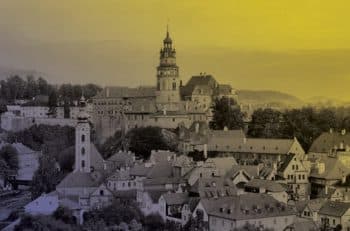
Aflons Mucha’s Slav Epic enjoys glorious pride of place in the Czech National Gallery in Prague. It is a cycle of twenty large and portentous paintings completed between 1910 and 1928 recalling the history and myths of a heterogenous people inhabiting territory from the Asian steppe to the shores of the Mediterranean. The artist imposes his peculiar predilections and aspirations in broad strokes to produce imagery simultaneously troubling and enthralling: a peaceable nature is emphasised but a belligerent Germanic ‘other’ is also apparent. The first painting has a contemporary resonance. Mucha claimed his intention was to depict the Origin, the Adam and Eve of the Slavs. The English guide says: “He portrayed them crouched down like defenceless refugees, wearing expressions of fear”. On the hill behind we see a hostile horde that has plundered and set fire to their village. Implicit is recognition that all peoples have at one time sought refuge from invasion. But that understanding is sorely lacking in the Czech Republic along with other countries across Central and Eastern Europe today. Not since the US invasion of Iraq have attitudes differed so greatly between what Donal Rumsfeld referred to in 2003 as ‘Old’ and ‘New’ Europe. Many in Western Europe are exasperated by the attitudes of their Central and Eastern European counterparts, regarding them as hypocrisy considering the number of Central and Eastern Europeans who have migrated west as both workers and political refugees. Central and Eastern Europeans appear to be from Mars and Western Europeans from Venus; but there is hardly a genetic basis for the intracontinental differences. Perhaps most surprising to Westerners are attitudes in the Czech Republic – a state, geographically and to an extent culturally, Western European: Prague’s architectural splendours are further to the west than Berlin’s and revolutions have been pacific West-friendly Velvet affairs. The State of Czechoslovakia was the only democracy in continental Europe apart from France in 1939. But successive opinion polls have shown Czechs to be overwhelmingly opposed to receiving refugees despite shocking scenes that have generated strong feelings of empathy elsewhere. Four factors ground this apparent imperviousness to the suffering of others: the first is the historical and current relationship with minorities; the second is the enduring economic fallout from the Communist era; the next factor is the malign influence of the current Czech President Miloš Zeman; finally, after a twentieth century during which the Czech people have been unwillingly controlled by three empires – the Hapsburg, Nazi and Soviet, there is a strong sense that the Czech people should be allowed to control their own affairs. The Czech Republic has produced statesmen of international renown. Former playwright President Vaclav Havel was one of the heroes of the struggle against Communist dictatorship; although his equation of the extension of US power with the expansion of liberty, culminating in support for the US invasion of Iraq in 2003, was naïve at best. Nonetheless his emphasis on individual autonomy and artistic expression was an antidote to the conformity of the dark Communist years. Looking further into Czech history we find the great Jan Masaryk the first president of Czechoslovakia whose liberal sentiments contrasted with the hateful rhetoric that pervaded the leaderships in countries surrounding an embattled state that was effectively handed over to the Nazis by the British and French in 1938. In a speech in 1928 marking the tenth anniversary of the foundation of the state he said: “I repeat and emphasise what I have said before, namely, that everything in the nature of Chauvinism must be excluded from our political life”. Arguing for a pluralist civic nationalism he said that: “the necessary State unity does not mean uniformity”. Although that state did not perfectly integrate its broad composite of minorities his benign leadership engendered tolerance, especially of religious difference. He said that Czechoslovakia should only have an army as long as other countries did. One individual who grew up in inter-war Prague recalls: “One of the pleasant aspect of living in Czechoslovakia at the time was that you never really knew what religion the other person had, child or adult, and more importantly didn’t care”. Masaryk also said that: “Politics is leadership and democracy therefore has its constant and urgent problem of leadership”. The current President Milos Zamen is offering leadership of a different character. Zamen is part of a rising phenomenon, apotheosised in Donald Trump. He speaks in foul-mouthed terms about marginalised groups. He regularly departs from political correctness, and appeals to fear and xenophobia. Thus in the wake of the New Year Cologne sex attacks he typically claimed that, “it’s practically impossible to integrate Muslims into Western Europe”. He has also previously stoked anti-German feeling, referring to his opponent in the 2013 Presidential election, Karol Schwarzenberg, as a Sudeten German and claiming that Sudeten Germans had been done a favour by their forced transfer to Germany, during which many thousands died, after World War II. The heavy-drinking President has also pursued friendly relations with Vladimir Putin and is roundly denigrated in liberal, relatively cosmopolitan Prague. But his divisive views, so out of step with the legacy of Masaryk, have proved a successful political strategy and today he is the most trusted politician in the country with a 56% approval rating according to a recent survey. A major reasons for this is the continuing discontent of the majority of the population with their economic status. Thus, in a survey conducted by the CVVM agency in October 2014, 55 percent of Czechs characterised the economic system that existed in Czechoslovakia before 1989 as “better” or “on the whole better” than the current one. This nostalgia for the Communist era may come as a surprise but it reflects the two-tier economy that has grown up. Prague now contains a substantial population that has grown wealthy in particular off the back of a booming property sector that has attracted significant foreign investment. There is also a high level of corruption that stalls development. This problem dates back to the