Posted in:
Enda Kenny
Taoiseach 2011-2016
Posted in:
by admin
Beleaguered and polarised, the future is a tolerant and civic nationalism
Posted in:
by admin
The EU and the defeasible control of Irish destinies
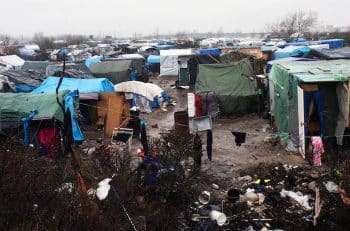
Hundreds of people line up in a queue as soon as the doors of the van open, each hoping to get a pair of warm trousers. It is a cold November day in Calais, but some of them are wearing just shorts and slippers. In the queue I recognise a Syrian man that I met in the refugee camp on the Greek island of Lesbos just three months ago. He is so thin that it is hard to find him a slim enough pair. But what strikes me even more is his eyes – their sadness and exhaustion – that seem to reflect the cumulation of hardships of the past months, starting in his home country, and now continuing in Europe. That moment of hope and relief, when the overcrowded flimsy rubber dinghy he was on reached the shores of Europe, has now turned into hopelessness at being stuck in one of the worst makeshift refugee camps in Europe, the Calais camp, also known as the Jungle. It’s not a jungle though: it’s more of a disaster zone. Shabby tents and improvised shelters made out of pallets reach as far as the eye can see. The site is far from ideal for camping, the less so during this chilly rain; the sandy ground has become just muddy. Some parts of the camp are exposed to a heavy wind, and people are looking for help to fix their collapsed shelters. There is no electricity. Sanitation is severely inadequate. No more than 40 toilets are currently serving over 6,000 inhabitants – one for every 150, while the UNHCR recommendation is one toilet per 20 users. With only three taps in the camp, there are not many opportunities to wash hands. Litter is everywhere, and some areas are covered with human extracts. At one of the two refuse points of the camp I meet representatives of the Médecins Sans Frontières, who have come to collect the rubbish. They remind me to be careful what I touch due to the threat of scabies and other infectious diseases. A recent investigation by the University of Birmingham, supported by the Médecins du Monde, further highlights detrimental health situations in the camp including the prevalence of ‘white asbestos’, sometimes used to weigh down tenting. As food in the camp cannot be stored safely, much of it carries infective amounts of pathogenic bacteria, causing diarrhoea and vomiting. Several water storage units exhibit levels of bacteria exceeding the EU safety standards, too. The lack of washing facilities prevents the effective treatment of scabies, lice and bedbugs. Many here are suffering from mental illnesses. The makeshift hospital in the camp has the capacity of treating only up to 90 patients a day and there is a constant shortage of medical supplies. It is especially hard to provide treatment for long-term medical conditions such as tuberculosis. Many patients also come in with serious injuries, often resulting from unsafe conditions in the camp, or failed attempts to cross the border. I meet a young boy who has a broken arm, after a failed attempt to jump an England-bound train – a typical case. The United Nations High Commission for Refugees (UNHCR) has continually expressed about the reception conditions for refugees and migrants in Calais, stressing that security measures alone are unlikely to be effective, and urging the French authorities to relocate the refugees to proper reception facilities in the Nord Pas de Calais region and further afield. Some relief is expected from the proposed EU- supported refugee centre, that is expected to be opened in Calais in 2016. It will reportedly be equipped to deal with 1,500 persons. Another alternative would be to involve experienced non-governmental aid organisations such as the Red Cross to act as auxiliaries for the public authorities in the humanitarian field. Charities and voluntary organisations offer an invaluable contribution to the current European challenge, but they cannot be expected to supersede the responsibilities of European governments. Of course, permanent aid mechanisms will be required for as long as the conflicts causing the crisis, sometimes exacerbated by Western military interventions, are allowed to continue. Naiim Sherzai is standing at the exit of the camp, watching the trucks headed for British ports. Sherzai, who comes from the Helmand province in Afghanistan, is a former translator for the British forces, and had to leave the country because of the threat of the Taliban. He now wants to seek asylum in the UK, and ultimately to bring his wife and two children there. He asks whether we could recommend him any legal ways to enter the UK. But in Calais, there are no such routes available for a refugee. Lack of alternatives drives many to desperate acts, trying to hide in the trucks headed for the ferries or the Eurotunnel, or cutting the fence to hide in the trains. At least 16 people have died this year trying to get across the Channel. Tear gas fills the camp regularly as the police tries to drive out refugees from the proximity of the trucks entering the port of Calais. Although the tightened security measures and border controls have decreased the numbers of those who try to leave, groups of refugees lunge for their freedom every night. The rest, like Sherzai, find themselves lost – the road ahead blocked, but with no turning back either. In the jungle. In limbo. Johanna Kaprio
Posted in:
by Lorna Gold
At the end of last September, under the shadow of the glimmering New York skyline overhead, the world celebrated the dawn of a new era. The UN Summit on the Sustainable Development Goals (SDGs) concluded with a massive party in Central Park, graced by the presence of superstars such as Ed Sheerin and Beyonce. The party was sponsored by Gucci, Citi, Unilever, Google and others. Many of their super-rich executives could well have been watching the party from their high-rise apartments in that most elegant part of the planet. Some people had paid upwards of $10,000 for VIP passes to the party. All proceeds went to charity, of course. There was no whiff of a world on the brink of collapse, threatened environmental destruction and violent extremism, the one that had been so eloquently articulated by Pope Francis in his landmark address to the UN General Assembly the previous day. The gap between the optimistic, almost euphoric atmosphere in some UN quarters and the pessimistic, almost despairing perspectives of others, including Pope Francis, was palpable at the Summit. On the one hand, famous business moguls, UN officials and many states, including Ireland, lined up to hail the goals as a new beginning. On the other hand, many wondered whether yet more goals would make any difference at all or even whether they would take us in the wrong direction altogether. Whatever your perspective, the SDGs are now a universally agreed UN document. For the most part, they set out important objectives for the world, 17 in all. They point to all the critical areas of human development that must be addressed if we are to tackle inequality, poverty and environmental destruction. They set 167 indicators of progress which are to be monitored and followed up annually. Importantly, for the first time ever, they promise to “leave no-one behind” and put a deadline of 2030 on achieving that goal. While as individual objectives the SDGs are desirable, as a global policy framework they are deeply flawed in at least four ways. Firstly, the sheer number of goals agreed and the lack of real interconnection between them has turned them into a shopping list. Everything becomes equally important. Yet the truth is that global imperatives exist. There are critical enablers which everyone needs to address alongside second-level priorities, which can be reached only on condition the first are being achieved. So the SDGs create a kind of policy fog in which it is hard to see the wood from the trees. Secondly, despite years of debate, the goals fail to resolve the decades old conundrum of sustainable development. This is the fact that ‘economic’, ‘social’ and ‘environmental’ dimensions do not really sit side by side or form interlocking circles. The ‘economic’ and the ‘social’, in reality, are dependent on the ‘environmental’. We need to move away from the inadequate cliche of interlocking circles to a ‘doughnut’ model as put forward by Oxfam. There is no overarching agreement in the SDGs that we need to move towards a world which lives within planetary boundaries. This is a real opportunity lost. Thirdly, however worthy the SDGs are, they are weak voluntary initiatives rather than an international treaty. Of course, voluntary initiatives have an important role in setting norms, but they only thrive when the environment is conducive to their realisation and are matched by strong implementation measures. The goals are debilitated by dysfunctional power structures, which render them a side-show, if not quite irrelevant to the main drivers of power. Unfortunately, important policies are being actively promoted by the same states that signed up to the SDGs and whose actions elsewhere directly contradict many of the goals. One alarming example is the emerging rules on global trade and investment, epitomised by the Transatlantic Trade and Investment Partnership (TTIP), which is being negotiated between the EU and USA. Controversial proposals within TTIP include Investor State Dispute Settlement mechanisms. These will effectively facilitate MultiNational Corporations to circumvent domestic court systems and sue sovereign states through a confidential arbitration mechanism in challenging governments for introducing regulations that in multinational businesses’ view harms their interests or profit margins. This raises concerns about the state’s right to regulate on a wide range of public policies, including extreme poverty and environmental standards. SDGs do not even enter into these negotiations. Another example is continued state subsidies and investments in fossil fuels. If remaining below the agreed 2°C-increase target for global temperatures is to be possible, a basic pre-requisite for the SDGs, 80% of known remaining fossil fuels need to remain under ground. Yet in 2014 the global economy missed the decarbonisation target needed to limit global warming to 2°C for the sixth year running. Fourthly, the respective roles of the state and the private sector in SDG development and implementation is deeply concerning. The visibility of the private sector and the pledges made in New York reflect the way that major corporations have managed to skew the agenda. One official pledge made by MasterCard at the SDG Private Sector Forum to bring 500 million people in the developing world into the credit market, thus enabling them to achieve Goal 8, is indicative of this. A pick-and-mix approach to the SDGs is already evident, facilitating corporations to use them to their marketing advantage while not addressing basic human rights and issues such as lack of accountability. The UN appears to have already relinquished control of its own message about the SDGs to the corporate sector through its ‘Global Goals’ campaign. This was launched during the Summit. In signing a licensing agreement for the Goals with key sponsors such as Gucci, Citi and others, it effectively delivered the SDGs, a key global public good, into private ownership. A clause in the campaign agreement means that those who use the goals’ branding must do so in ways which do not damage the partner brands. Technically speaking, therefore, if an NGO such as Trócaire or Christian Aid, draws attention to the systemic problems of corporate power whilst using the goals’ branding, they are in breach of the licence. Though it
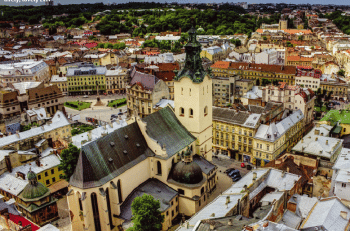
Crossing from Slovakia into Trans-Carpathian Ukraine at the Çop junction, trains from the West halt in deference to the different rail gauges used on the other side. Stalin contrived this to prevent easy entry for invading armies; or escape. Crossing the frontier into the former Soviet Union might instil a little trepidation even into a seasoned traveller. An illuminating mural in the cavernous train station depicts heroic scenes of triumphant Socialism. Trains that retain wooden benches recall another age. I knew I had left a rapidly converging Europe when the conductor smilingly declined payment after I presented too large a denomination. I was among three other visitors to Ukraine arriving by train from Slovakia, although a border guard told me frequent car trips are made to avail of cheap petrol. The frustration of waiting on a windowless, stationary carriage – akin to a panelled sardine tin – during a heatwave was offset by the friendliness of customs officials who simply checked for contraband medicines. No visa is required for EU visitors but the continued low-level warfare in the faraway east is deterring visitors despite a favourable Euro to Hryvnia exchange rate. Borders are often a legacy of ancient battles or coincide with impassable mountain ranges or rivers that deterred conquest and absorption. A change in topography often gives rise to socio-economic boundaries; shifts from upland, semi-nomadic pastoralism to settled arable land bringing larger settlements: different political regimes and ethnic compositions may arise. But twentieth-century Europe brought more artificial borders imposed by distant remote peace treaties or later omnipotent Superpowers, and saw the decline of multi-ethnic empires. Thus Hungary was reduced from one part of a dual empire (the Austro-Hungarian) to a disgruntled rump that ruefully surveys its over two million ethnic brethren in neighbouring countries. The hated Treaty of Trianon after World War I was reflected in that country’s alignment with Nazi Germany during World War II. Revanchist Hungary remains a potential source of instability. There is no obvious difference in terrain between Trans-Carpathian Ukraine and eastern Slovakia, and the region contains a sizeable Hungarian minority. Yet as one travels into the surrounding countryside a different agriculture becomes apparent from the ubiquitous cash crop of maize on the Slovak side to traditional hay stacks in Ukraine gathered as of old with scythe and pitch fork. Since the twentieth century, political frontiers have acted like natural boundaries accentuating patterns of development. In Eastern Europe north of the Balkans, the legacy of Soviet victory in World War II remains largely intact. Apart from the amicable separation of Czech Republic from Slovakia in 1993 the frontiers are unchanged. The recent land grab by Russia of Crimea and incursion of irregular troops into Donetsk may herald a more turbulent phase in European history. Borders rarely shift without an accompanying tide of blood, even more perilous in an era of mutually assured destruction. The most dramatic legacy of World War II was Poland’s westward shift, forcibly ceding significant territory to the Soviet Union in return for large swathes of eastern Germany. Millions of Poles were removed from their ancestral homes and re-located in the west. Among the territory lost was the historic city of Lviv (Lvov to Poles) to Ukraine. It contained an inter-war population two-thirds Polish. Lviv is now almost entirely Ukrainian although reminders of the Polish period include a statue to their national poet Adam Mickiewicz, who was actually born in Vilnius, the capital of Lithuania. Lvov was annexed by the Austrian Hapsburg Empire (and re-named Lemberg) in 1772, in the first Partition of Poland, becoming capital of Galicia which was the poorest province of the Empire. But this period left a remarkable architectural legacy that prompted UNESCO to designate the historic centre as “World Heritage”. Today Lvov is relatively prosperous, drawing a large number of tourists from neighbouring Poland. Predictably the old city is fringed by a swathe of functionalist Soviet-era apartment blocks, but it retains an abundance of old world charm and the hum of cafés that spill onto carless streets. There are nonetheless signs of a country at war with stands erected by the Far Right Svoboda Party supporting the war effort and offensive toilet roll featuring a picture of Vladimir Putin available in souvenir shops. I spoke to one women of student age who railed against a terrorist, separatist threat to the integrity of the state. She could have been mistaken for someone referring to the existential threat posed by ‘enemies of the people’ in Soviet times. The uncompromising language of extremism is unmistakable. The demise of the archaic, multinational Hapsburg Empire after World War I might be seen as the death knell for so-called Mitteleuropa. Most successor states that emerged in the Versailles settlement were inspired by a nationalist vision promoting a single culture, and hostile to diversity within the confines of the state. In contrast during the imperial era cities at least were a mosaic of religious and linguistic groups. The population of ethnically variegated Mitteleuropa was particularly unsuited to the identification of a nation with a single state that reached a violent apotheosis with the Nazi ideology of the master race. Transnational Jewry were the most obvious victims but anti-Semitism was not limited to the Nazis, continuing into the Cold War-era: as late as the 1960s thousands of Jews fled Poland in the wake of a number of purges. Jews had flocked to Poland in great numbers at the end of the Middle Ages due to the tolerance shown there compared with in the rest of Europe. It became known as paradisus Iudaeorum (paradise for the Jews) and contained two thirds of the continent’s Jewish population. Great centres of learning were establish in cities including Lvov, and agrarian settlements known as shtetl that contained many layers of Jewish life dotted the countryside. There Yiddish, a Germanic language written in Hebrew script, found its highest expression. The writings of Joseph Roth (1894-1939) recall the extraordinary cultural diversity of the Austro-Hungarian Hapsburg Empire. Born a Jew in