International

Random entry RSS

  • Posted in:

    Global Migration Policies, Perils, and Profits: Caroline Hurley reviews Sally Hayden’s ‘My Fourth Time We Drowned: Seeking Refuge on the World’s Deadliest Migration Route’

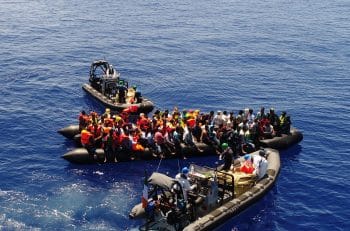
    “Whoever was tortured, stays tortured” — Auschwitz survivor Jean Amery.  In My Fourth Time We Drowned, multi-award-winning freelance journalist Sally Hayden documents the experiences of those who flee homes destroyed by conflict and oppression. Sally Rooney’s reaction is typical — “the most important work of contemporary reporting I have ever read”. Numerous boat crossings from Libya are detailed, each risking what happened off the Greek coast in mid-June when a boat with hundreds crammed aboard sank. Of an estimated 700 plus passengers, less than 100 bodies were recovered. The majority, locked in the hold, were feared dead. Rescue charities, and authorities in France, Greece and Malta, as well as European border control Frontex, had all been alerted, and monitoring the boat for 12 hours, but disagreed over words exchanged with passengers and what unfolded. Alexis Tsipras, Greece’s former left Prime Minister asked, “what sort of protocol does not call for the rescue … of an overloaded boat about to sink”? If practical assistance was not offered until it was too late, organisations failed in their sea duties under international laws. Barack Obama and others noted the contrast in media coverage of the Titanic submersible incident and called out obscene inequality and disparity in life chances. Meanwhile, Ireland is sending a Navy ship, Lé William Butler Yeats, to Libya, which may indirectly facilitate more drownings, because it is joining an EU naval operation tasked to sink or burn migrant ships encountered, often under smugglers’ control, meaning migrants must use increasingly more dangerous ships. Hayden explores similar ploys; denials of responsibility, or outsourcing it to criminal operators, passing the buck, hands-off exploitation and careerism, politicising desperate plights, whitewashing with tokenism, jargon, image branding, and more. The stricter migration control regime installed by the West since Gaddafi’s overthrow in 2011 has paved the way for ever-graver human rights catastrophes befalling those seeking sanctuary. Hayden’s use of unfiltered messages received directly from hundreds of refugees themselves illustrates how these European policies often result in cruel inhumane incarceration across North Africa, with Libyan militias and the modern slave trade being bankrolled by the EU, and with NGOs and the UN standing by, complicit and even corrupt. The opaque trail of accountability and striking under-reporting of activities and conditions suggest a collective wish to ignore and forget so many victims of the West’s neocolonial foreign policy. The EU does not count detainees, or have a process to contact families in emergencies, though the UN tracks numbers drowned at sea. At least 23,000 refugees have drowned or gone missing in the Mediterranean between 2014 and 2022. 1 in 51 attempting the crossing died in 2017 versus 1 in 21 in 2019. The number of people living as refugees rose by nearly 20 million from 2021 to nearly 110 million people by December 2022, according to a UN report. Hayden’s book is accessibly laid out, with lists of contents and key data, plus maps, notes on terminology, acronyms, acknowledgements and 65 pages of other notes and references, to end. According to the late David Graeber, co-author (with David Wengrow) of The Dawn of Everything, for the vast majority of human social experience, people enjoyed “three primordial freedoms: the freedom to move, the freedom to disobey and the freedom to create or transform social relationships”. Peaceful anarchy was the modus operandi. While inequalities in early human societies were not unknown, the structures of domination common to hierarchical government were absent. The tentacles of many institutions now creep around the planet, enforcing an imagined world of divisive identities, affecting millions of individuals in every facet of their lives.   Exploration and colonisation over centuries brought genocides, ethnic cleansing, capture of labour, and accumulation of capital and resources. The spoils are still not going to those who earn them, although the Global South is waking up to the raw deals and lies imposed for too long. As power centres shift, Naomi Klein’s words seem apt: “In the hot and stormy future we have already made inevitable through our past emissions, an unshakeable belief in the equal rights of all people and a capacity for deep compassion will be the only things standing between civilization and barbarism”. A tragic parallel can be drawn between current migration journeys and those of Irish migrants piling into the infamous filthy overcrowded unseaworthy ‘coffin ships’ often arranged by Anglo-Irish landed gentry during the Great Irish Famine halfway through the nineteenth century. Many applicants were already at death’s door, unable to bear further hardships on route to America or Canada. Drownings and sinkings were common. Over 100,000 chose this dangerous option in 1846 alone, numbers which shocked the US Congress into passing two new Passengers Acts to raise minimum voyage fares as deterrents. Unfortunately, modern Ireland mimics international shortcomings. Evidence of human trafficking of migrant fishers off the Irish coast is mounting. And the Irish Refugee Council has recently criticised the preferential treatment of people seeking protection: “While we acknowledge the pressure on homeless services in Ireland, where homeless figures are at a record high, the decision to respond to two groups of people, that are both experiencing homelessness, with different policies on the grounds of their different status and/or nationality, risks being discriminatory and is not tenable”. The 1951 U.N. Refugee Convention states, “no Contracting State shall expel or return a refugee in any manner whatsoever to the frontiers of territories where his life or freedom would be threatened on account of his race, religion, nationality, membership of a particular social group or political opinion”. In a shameful saga, Hayden can be proud of her contribution That is the obligation under international law, incorporated widely into statutory law, but rarely cited anymore. Libya was not a signatory. Still, developing countries shelter about 87 % of the world’s refugees, most of whom have clear entitlements with experiences of conflict, poverty, enforced militarisation and so on. The goal of those fleeing strife is to contact the United Nations refugee agency, UN High Commissioner for Refugees (UNHCR) and/or the International Organisation for Migration (IOM)

    Loading

    Read more

  • Posted in:

    Understanding Prigozhin

    Prigozhin is a Putin construct and illustrates underlying Russian structural deficiencies including indulgence of oligarchs and a dysfunctional relationship  between the public and private sectors that I recall from my time there.  By Conor Lenihan. The Russian government has gone to enormous lengths to maintain an illusion of business as usual on the domestic front, but Prigozhin offers a rare insight into the power struggles still raging beneath the apparently tranquil surface. Writing about the invasion of Ukraine in the early days, I predicted that one way or the other, it would unleash another power struggle within the Kremlin, however well-masked from prying western eyes. That Prigozhin would be the one to stage the uprising, coup or as he called it ‘march for justice’, was not initially obvious. There are historical and sociological reasons for the rise of Prigozhin. Before Putin came to power 23 years ago, it was never quite clear who was running the country – Boris Yeltsin, or the insiders and cronies who had taken ownership of previously publicly owned oil, gas and commodity, resource-based companies in the chaotic, crash-course transition to fledgling democracy. This situation whereby these wealthy oligarchs – often referred to as the “Yeltsn family” – effectively ran the Russian government caused much discomfort to the newly ascendant Putin. It was an early hallmark of the new regime that he set about reversing the nature of the relationship between the Russian Federation’s government and the oligarchs, many of whom either sat in the state Duma (parliament) or actually owned dozens of members – almost like proxy voters in a public company. In July 2000,  Putin brought the country’s top oligarchs into a meeting that was beamed out live on television where he formally warned them that if they interfered in politics and media via their ownerships, he – Putin – or the State would come after them.  Present at the meeting was one Mikhail Khodorkovsky owner of the one of the richest oil companies in Russia (Yukos). Khodorkovsky seemed to have ignored the warning and ended up in jail with his companies stripped and re-allocated either to the state or friends of the regime. Putin introduced his own system where the relationship between him and the Oligarchs became one of Servant-Master and he was the Master. Putin reversed the nature of the relationship between the Russian Federation’s government and these extraordinarily wealthy oligarchs many of whom either sat in the state Duma (parliament) or actually owned dozens of members almost like proxy voters in a public company. Putin introduced his own system where the relationship between him and the Oligarchs became one of Servant-Master and he was the Master. Added to his own “new money” oligarchs came a set of people largely drawn from the state sector called “ silivoki” a polite terms for middle or senior ranking state employees with an emphasis on those from the state security apparatus – the KGB, GRU and other such agencies. These “siloviki” were everywhere in the private companies and state organisations that I came into contact with, and the power they wielded was significant. Within Russian company these operators act as protectors for their patrons and in business terms have an uncanny way of both penetrating the often hazardous and slightly impenetrable Russian state bureaucracy. In 2011, after the loss of my Dáil seat, I had been invited by  Viktor Vekselberg to become a vice-president of the Skolkovo Foundation – a $10 billion innovation project which was Moscow’s effort to build its own Silicon Valley and lessen the dependence on oil, gas and commodities. Vekselberg himself has been on the US sanctions list since the annexation of Crimea in 2014. The foundation employed  dozens of siloviki, typically well-connected former intelligence agents, and at least one former KGB General. The point is that in Russia important roles at the highest levels are  filled by people who got there dysfunctionally – Yeltsin oligarchs, Putin oligarchs and silivoki. Yevgeny Prigozhin must be framed against this dysfunctionality though he is not rich enough to quality as a an oligarch in the usual sense. He is part of an elite spawned through corruption, nepotism and violence. Putin exploits this system and depends on it to consolidate his leadership and control of Russia. He is Putin’s creation. He derived his massive Wagner mercenary army, not from ownership of oil and gas resources, but from direct friendship with Putin. He rose from criminal, to hot dog seller, and eventually created a catering company that supplied not just the Kremlin, but also the Russian army. It was a small jump to supply paid mercenaries in 2014, renting them out to regimes in Africa and the Middle East who for one reason or another needed military muscle. The Wagner operation became a “discreet offering” from the Russian state to friendly allies like Assad in Syria and General Haftar in Libya. In a way, Prigozhin’s own story is emblematic of the state built by Putin. So it is a profound irony that he became a putative coup leader himself. This accounts for the clear look of fear and anger in Putin’s face during the live broadcasts in which he pledged to crack down on the coup and the coup leaders themselves. With Prigozhin speeding up the road to Moscow, Putin chose to offer him a way out – a safe haven in Belarus in a clearly staged intervention by his close ally Aleksandr Lukashenko. One member of the Russian Duma was heard to remark that Prigozhin deserved to get “a bullet in his head” rather than a comfortable exile arrangement. The Russian public will have been alarmed at the instability of those two days where the past once again seemed possible.  Still, the immediate consequence of the failed mutiny will be to strengthen Vladimir Putin and lead to a re-doubling of the Russian war effort in Ukraine. But Putin is not a young man anymore and the inherent instability of both the war in Ukraine and his own visible vulnerability

    Loading

    Read more