International

Random entry RSS

  • Posted in:

    Currency warfronts: Russia is spearheading a gold- and commodity-backed Ruble, while Central Banks accelerate digital currencies which, without protections, will give them unlimited power to monitor and control how we spend our money. By Eddie Hobbs.

    Putin’s 9 May speech in Red Square came and went, without any new theatre opening up. This may indicate a change in strategy to limit the kinetic war to Donbas but he’s made it quite clear that, in his world view, the culpable protagonist, is NATO /USA. By moving away from military rhetoric his speech, along with threats to take “retaliatory steps, both of a military-technical and other nature” against NATO-bound Finland,  shifts the focus in the conflict to the financial, economic and cyber security fields. If the West is at the end of a 50-year debt-financing bubble, the global financial system, largely of American design, is very vulnerable. That is why an interview on 26 April 26 in Rossiyskava Gazeta by one of Putin’s top strategists — the man who in 1999 replaced him as head of the FSB, Nikolai Patrushev — adds new heat to the boiling pot. Patrushev, who is Secretary to the Russian Federation’s Security Council, the inner sanctum chaired by Putin and which includes Lavrov, Medvedev and Mishustin, announced a fresh challenge to the US–dominated global financial system. Nikolai Patrushev Source; Spisok-Putina.Org The Kremlin determines the West’s weakest financial spot to be its debt bubble. In its eyes it is a West burdened by decades of debt excesses, now facing runaway inflation, supply chain disruption, and faltering consumer confidence. It sees  the West’s Central Banks, led by the Fed and Bank of England, trying to perform a miracle U-turn — jacking up interest rates in a time of war without triggering recessions. This is Russia’s opportunity, as the Kremlin sees it, to lead a coalition of economic regions that strike a blow to USA pre-eminence and births a new currency system. Patrushev outlined Russia’s plans to head a multi-currency system pegged to gold and commodities and, he couldn’t have been clearer: “For any national financial system to be made sovereign its means of payment must have intrinsic value and price stability, without being pegged to the Dollar. Now experts are working on a project proposed by the scientific community to create a two-circuit monetary and financial system. In particular, it is proposed to determine the value of the Ruble, which should be backed by both gold and a group of goods that are currency values, and to put the Ruble exchange rate in line with the real purchasing power parity”.  Patrushev’s interview was first reported in the West by Ronan Manly, a precious metals analyst and writer with Singapore-based, BullionStar. Since Nixon’s break from the gold standard, the US has built power from an endless demand for Dollars to finance trade and to attract inexpensive capital flows into US Treasuries, giving it a unique competitive advantage, one that US proponents see as open-ended, immutable, and an American birth right. But in announcing plans to head a global multi-currency system, starting in the Eurasian region and extending, through intensive co-operation to half the planet, Patrushev sees things very differently: we are clearly aware that the West allows other countries to be its partner only when it is profitable for it “The West has unilaterally appropriated an intellectual monopoly on the optimal structure of society and has been using it for decades… We are not opposed to a market economy and participation in global production chains, but we are clearly aware that the West allows other countries to be its partner only when it is profitable for it. Therefore, the most important condition for ensuring Russia’s economic security is to rely on the country’s internal potential, a structural adjustment of the national economy on a modern technological basis”. Though largely ignored in the West, Russia has pegged the Ruble to gold in trades between its Central Bank and its banking system — setting a floor at 5000 Rubles per gram. Though largely ignored in the West, Russia has pegged the Ruble to gold in trades between its Central Bank and its banking system — setting a floor at 5000 Rubles per gram. This twins the Ruble with gold, which is traded in US Dollars, while simultaneously Russia demanded Rubles for gas from opponents to its war in Ukraine. Based on Patrushev’s comments, which I believe are aimed squarely at commodity-exporting nations, the next likely step is to entice payments for Russian gas in gold, in an attempt to change the nature of international energy markets away from trading in Dollars. If successful, this could trigger a flow of gold into Russian reserves bolstering its currency-peg plans.  This has the potential to damage the highly-leveraged paper gold markets and to start a contagion. Russia’s plans would ultimately require the removal of its exchange controls, which have pushed the Ruble to a two-year high against the Dollar. It would also require a post-war international agreement for commodity-backed currencies involving all participants including China, India, Iran, Latin America and Africa, if it were ever to be successful. In doing so Russia would face the double-edged sword Nixon faced when gold was demanded as payment for national debt instead of Dollars, due to sagging confidence in the US currency after it had borne the cost of the Vietnam War. Those who blindly follow the doctrine of US pre-eminence scoff at plans to restructure the global financial system, having heard it all before. What’s different this time, is the scale of debt being carried by the US and many Western economies while Central Banks, unnerved by breakaway inflation, raise borrowing rates in a desperate attempt to counteract inflation. What’s different this time, is the scale of debt being carried by the US and many Western economies while Central Banks, unnerved by breakaway inflation, raise borrowing rates in a desperate attempt to counteract inflation. If the tightening cycle, now entered into by the Fed, hobbles the US economy this year, a flip flop by the Fed, back to easing once again to avoid recession, would hobble the Fed itself. The truth is that, it is all finely poised. The advanced sign of an

    Loading

    Read more

  • Posted in:

    Putin puts in the boot. The West and its weakest link here, Germany, face a formidable foe and test. By Eddie Hobbs.

      By Eddie Hobbs   What is Putin’s big Disruption Strategy? To find out I’ve been engaging with geopolitical experts. I don’t dwell here upon the effectiveness of the mounting responses to Putin’s aggression.  He faces a coalition of overlapping opponents: the EU, UK, NATO, USA – many countries and multinational corporations. The military strategy of the West may be to fight Russia down to the last Ukrainian, then do a deal;  but that strategy presupposes that Ukraine is his main objective.  After research, I don’t believe that is so.     Putin has been planning this meticulously for a long time, well over a decade. It is multi-faceted and, he has weaponised economics and finance as part of his plan. His objective is a multi-polar world with Russia the epicentre of the Eurasian sphere.   He seeks the diminution or disintegration of the EU. His chief target is Germany, its weakest link. His most potent weapon is energy supply.   Crippling the EU, he fractures NATO and diminishes the transatlantic alliance, disabling the USA, its economy and potentially its currency. This is a global financial and economic war, the kinetic theatre of which is Ukraine. Disruption to supplies of Russian hydrocarbons and Ukraine harvests will exacerbate inflationary forces. Both recession and stagflation are real risks. Central banks, led by the Fed raising rates to head off inflation add to the uncertainties. This is a climate of asymmetric risks, there is no safe haven.   Putin is a Christian Conservative and authoritarian, but first and foremost he is a Russian nationalist.  He despises what he determines to be fascist, but he also hates the extremes of the former USSR.   He is not irrational or insane when you examine the tensions created by the backing of liberal democracy, the EU and NATO up to his front door as he sees it.  This is not to excuse the invasion of a democratic neighbour despite its record of corruption and the prevalence of the far right.   Putin’s hero is Peter the Great – he determines Ukraine to be part of greater Russia, and an artificial creation. Ironically his invasion, faced with a skilled and determined opposition, is creating the foundation identity story for the remarkable people of Ukraine.   The truth is Putin doesn’t care whether political opposition in Europe and the USA is hard left or hard right, so long as he can foment instability by financing it.   He already has assisted in establishing what is a hard-right Tory administration in the UK which broke away from the EU.   Russian bankers have financed Marine Le Pen, Russian monies flow into far-right movements like the AfD in Germany and elsewhere including ethnic Russian populations in the Baltics.   Russian banks have financed Trump’s hard-right economic nationalism and Russian digital assets were deployed to support Trump’s candidacy.   Brexit was Putin’s greatest victory in the EU and since then he’s focused on Le Pen in France. Brexit reduced the EU to one nuclear power and isolated the other at its outer orbit.   He now hopes on foot of popular support for Le Pen and for the Left, that the French National Assembly elections in June will lead to political paralysis in France, and for the EU.   Putin is placing his chips on the inability of NATO to hold at the centre, he considers Germany Europe’s biggest and strongest economy to be weak at the centre.   Germany’s disastrous policy of reliance on Russian gas, oil and coal led by East German, Angela Merkel, and blinkered by Putin, puts Germany at the epicentre of his plans.   He expects that pragmatic Germans, faced with a horrible winter of rationing of industrial opening hours, autobahn driving, cooking and heating, will weaken in their resolve to remain in the EU and do a deal with the Russian sphere.   He is also banking on Hungary voting no in NATO, just as he banks on weakened subsidies to former East Germany to grow political extremes.  This is where the pro-Dexit (German EU Exit) and AfD (Alternative für Deutschland) have their stronghold as does Die Linke with roots through to the Marxist-Leninist ruling party of former East Germany.  Both are Russophiles but who may publicly say otherwise.  Sinn Féin and Die Linke, together with a host of communist and socialist parties form The Left grouping at the European Parliament.   He further understands the vulnerability of Target 2, (the ECB trade settlement system structured like the USSR Comecon) at the heart of the Eurozone.   Germany leaving the Euro or faced with France, Italy or Spain leaving would mirror the USSR breakup.   It would leave huge unpaid debt of over €1trillion owed by Central Banks across Europe to the Bundesbank and would leave behind inflation-ravaged replacement currencies, fertile ground to stoke old rivalries thought long dead in Europe.   In military terms Putin can move Russian assets along the Suwalki Gap, separating Poland from the Baltics in a line between Northwest Belarus and Kaliningrad, the headquarters of his Baltic Fleet, without breaking treaties.   Military exercises have ramped up in the Kaliningrad Oblast where he over twenty thousand troops and intermediate nuclear missiles.  He may be calculating that Poland wouldn’t wait for an Article 5 consensus vote or be delayed by German prevarication.   Poland would be unlikely to stand idly by and watch a repeat of Crimea in the Baltics especially when its historic links to Ukraine and its bloody history with Russia is considered.  A failure of consensus over Article 5 would end NATO as a functioning alliance. Poland, in Putin’s calculations, could be left isolated and vulnerable: a scenario in preparation for which he may be blooding his army in Ukraine.   To the Northwest of Kaliningrad lies the strategic island of Gotland part of Sweden but from which the Baltics can be dominated.   Directly north sitting at the mouth of the Gulf of Bothnia, that separates Sweden from Finland, lies

    Loading

    Read more

  • Posted in:

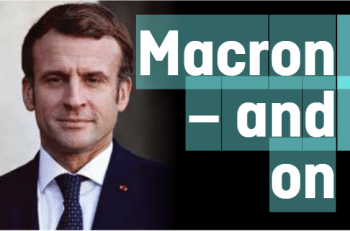
    Macron – and on

    78March/April 2022And whether or not Ireland likes it, on convergence. Two years ago this is what he told the Economistabout Europe: “So, frstly, Europe is gradually losing track of its history… Europe has forgotten that it is a community, by increasingly thinking of itself as a market, with expansion as its end purpose. This is a fundamental mistake, because it has reduced the political scope of its project, essentially since the 1990s. A market is not a community. A community is stronger: it has notions of solidarity, of convergence, which we’ve lost, and of political thought. Secondly, a change in American strategy is taking place; thirdly, the rebalancing of the world goes hand in hand with the rise—over the last 15 years—of China as a power, which creates the risk of bipolarisation and clearly marginalises Europe. And add to the risk of a United States/China “G2” the re-emergence of authoritarian powers on the fringes of Europe, which also weakens us very signifcantly. Finally, added to all this we have an internal European crisis: an economic, social, moral and political crisis that began ten years ago. Europe hasn’t re-lived civil war through armed confict, but has lived through selfsh nationalism. In Europe there has been a north-south divide on economic issues, and east-west on the migration issue, resulting in the resurgence of populism, all over Europe. These two crises—economic and migration—hit the middle classes particularly hard. By raising taxes, by making budgetary adjustments which hurt the middle classes, which I believe was a historic mistake. That’s incidentally what lies behind the rise in extremism throughout Europe. A Europe that has become much less easy to govern”.The Economist gives Macron an 80% chance of re-election. He has said and done what he thinks. It’s good to understand him. History if not ideology is on his side. these matters, has claimed that “Mr Macron has turned into something of a closet socialist”.The most visible evidence of the president channelling his inner Mitterrand is to be found in public spending. When the pandemic struck, Macron undertook to do whatever it took. Since then he spent ten times more last year to keep frms and furloughed workers going than France ever earned in a year from its wealth tax. France was already outspending all the Nordic countries on social programmes, and in indebtedness. Less noticed is a growing body of progressive rights and rules Mr Macron has also introduced: a doubling of guaranteed paternity leave to four weeks, with one week compulsory; fnes for frms that fail to close the gender pay gap.Internationally he has championed progressive multilateral causes, from a global minimum corporate-tax rate (a Macron pledge in 2017) to vaccines for Africa. France’s centre of political gravity has shifted to the right. This, not the left, is where his toughest competition will come from in April’s Presidential election. Macron’s nod to the left is studiously mild by French class-warrior standards, and in line with his intellectual roots. Not surprisingly his policy mix works quite well in practice, even if not in theory. Macron is much more philosophical than any other European leader, contrasting with a long-standing Irish weakness. His thinking, if he wins a second term, may drive the future of the EU. It centres on strength especially globally, on creating a community not a market, on tackling extremism and selfish nationalism and on indulging the disafected centrist middle classes. Four years ago I wrote early in Emmanuel Macron’s French Presidency that he had shown more leadership than the entire rest of the Western world since his election. “He claims to have found a political path between left and right, has made clear in the most elegant ways his disdain for Trump and has bowed to nobody, least of all Vladimir Putin, in sharing truths about international political thuggery”. I had a go at tracing his philosophic infuences largely through Paul Ricoeur of whom he was a protégé. Through Ricoeur essentially Macron is more likely to take an ethical approach, less likely to lie, more likely to keep promises, more likely to seek dialogue, see the other side and understand that two interpretations are possible of an act or situation, to be idealistic and secular.A good topical example is his role of interlocutor with Russia which bespeaks his willingness to see the other side and both his pragmatism and his idealism. He is touting the Russian perspective but is a friend to Ukraine and has made troops available just in case. Inevitably with that philosophical underpinning his overall record is dissonant. Macron has governed to the right of centre though he had promised to be in equal measure right and left of centre. A former investment banker, who scrapped the wealth tax and picked two centre-right prime ministers, he has moaned about the money the state spends on social welfare and does not idealise France’s comprehensivist welfare state. He has introduced looser labour laws into the rigid French system and he presided over the longest strikes since 1968 driven by his proposed pension reforms. He has been tough on security and Islamist extremism. Nevertheless the Economist magazine, not sympathetic on By Michael SmithINTERNATIONALGeneral government spending total, as % of GDP, 2020 or latest available (OECD)Macron – and on

    Loading

    Read more

  • Posted in:

    Ukraine: Ireland to Russia’s UK

    76March/April 2022Fragile, vibrant, modern Ukraine faces being overrun by 190,000 Russian troops, driven by an autocrat frustrated at the loss of Russia’s one-time sphere of infuenceBy Michael SmithINTERNATIONALUkraineUkraine may have been a backwater, romanticised originally as the land of the Cossacks, until recently though it is the second biggest country in Europe (after Russia of course), but as of now it is a thriving democracy with a free media and free speech, and a vibrant economy, culture and social life. Kyiv and OdessaI visited Kyiv, Ukraine’s capital, and Odessa, in August 2021. Both are sophisticated, afordable, modern cities with swanky bars full of beautiful people drinking cocktails, artesan IPAs and local champagne; lively parks swarming with rollerskaters; and cinemas showing Hollywood movies. Kyiv, where the average salary is €620 per month, is an IT hub, dotted with high-rise apartments under construction – their ubiquitous realtor-branded photographic hoardings in English showcase the cosmopolitan residents they seek to attract. Odessa is the best-preserved Neo-Classical city in the world with a ritzy beach resort. Odessa has the most stylish restaurants East of Paris. We stayed in the Londonskaya Hotel, a Renaissance style palace built by a French confectioner in 1828 near the steps that feature in Sergei Eisenstein’s revered 1925 movie Battleship Potemkin. He stayed there too.All changed in 2014Ukraine hit the spot after its 2014 ‘Revolution of Dignity’ when protesters at Maidan square in Kyiv ousted the democratically elected president Viktor Yanukovych a thuggish Russian-backed mafoso. By then he had purloined around $100bn, equal to more than half the annual economic output of Ukraine. Leaned on by Putin, in 2013 Yanukovych had abandoned Ukraine’s Association Agreement with the EU and moved to join its Russian-led rival. Yanukovych ordered police to shoot protesters who opposed him. When the crowds swelled, Yanukovych fed to Russia where he remains, poised, allegedly hauling $32 billion dollars in cash across the border in trucks as his power crumbled.History: shared heritageThe shared heritage of Russia and Ukraine goes back more than a thousand years to a time when Kyiv was the capital of the frst Slavic state, Kyivan Rus, the birthplace of both Ukraine and Russia as Vladimir Putin recently asserted: “Russians and Ukrainians are one people”. Ukraine has been carved up down the centuries by marauding empires. Mongols, Polish and Lithuanians in a way that Russia was not. In the 17th century, Russian tsars ruled lands to the east of the Dnieper River as "Left Bank" Ukraine while lands to the west of the Dnieper, or "Right Bank" Ukraine, were ruled by Poland, though in 1793 those lands too were annexed by Russia. A Russifcation policy banned the use of the Ukrainian language, and pressurised Ukrainians to convert to the Russian Orthodox religion. The people were Ukraine: Ireland to Russia’s UKKyiv, 2022 March/April 2022 77generally known as Rusyns or Ruthenians and the ethnonym Ukrainians came into wide use only in the 20th century after the territory of Ukraine obtained distinctive statehood in 1917. Stalin organised a famine that killed millions in the 1930s and shipped in lots of Russian speakers.Ties to RussiaBecause eastern Ukraine came under Russian rule much earlier than western Ukraine, people in the east have stronger ties to Russia, often speak Russian (Russian and Ukrainian share 60% stem words anyway) and have been more likely to support Russian-leaning leaders.Annexation of CrimeaCrimea was occupied and annexed by Russia, irritated by the defenestration of Yanukovych, in 2014, followed shortly after by a separatist uprising in the eastern Ukrainian region of Donbas that resulted in the declaration of the Russian-backed People’s Republics of Luhansk and Donetsk. Ukrainian forces have been fghting pro-Russia rebels in the east since 2014 in a confict that has killed some 14,000 people.Threat of imminent warExploiting its overwhelming military superiority, as Village went to press, Russia had amassed 190,000 troops on Ukraine’s borders and was expected to attack simultaneously on several fronts, from the north-east, the Donbas and Crimea. and Belarus, Airstrikes would underpin a lightning drive south to seize the capital, Kyiv. And encircle Ukraine’s army, neutralising the country and its leaders. The US estimates artillery, missile and bomb strikes and ground clashes could kill 50,000 civilians.WarAs Village went to print Putin had made an angry speech and moved troops into Luhansk and Donetsk which have been armed, fnanced and politically controlled by Russia since 2014. But until now were recognised as part of Ukraine.Putin has also sent his military on a “peacekeeping mission” to Ukraine, meaning that Russia will formally occupy sovereign Ukrainian territory for a second time following the 2014 annexation of Crimea. But in this case, Russia has not annexed the territories. A document signed by Putin on Monday also allows him to establish military bases or place missiles in the territories. The bourses were diving, Germany suspended its Nordstream gas-pipeline collaboration with Russia and Boris Johnson was tearing around fnding Russians to sanction.Invasion of Ukraine could destabilise former Soviet republics such as now independent Estonia, Latvia, Lithuania (EU members), as well as Belarus, Georgia and Ukraine. Irish analogies and infuenceRussia’s relationship to Ukraine is clearly analogous to that of the UK to Ireland: a bigger and far more powerful neighbour, partially shares history, culture and religion with a division on ethnic rather than racial lines. Most Ukrainians are Eastern Orthodox Christians. A significant minority of Ukraine‘s population consider themselves Russian – analogously to the North of Ireland where a majority considers itself British frst and Irish second.It would be preferable if Ukraine signalled it will never join Nato but in any event Ireland should exercise its influence to support Ukraine, a beleaguered but honourable and modern country in retaining its independence from foreign interference and indeed carnage. Such is the foundation of the United Nations. SolutionsIt is forgotten that early in his frst Presidency Putin wanted to join both Nato and the EU – bonds that could now be ofered, long-term. Beyond that, we should use our limited infuence to see that the balance between Nato and

    Loading

    Read more