International

Random entry RSS

  • Posted in:

    Ukraine

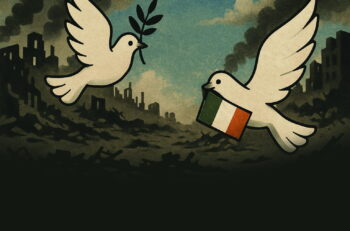
        Ukraine: Ireland to Russia’s UK Fragile, vibrant, modern Ukraine is being overrun by 190,000 Russian troops, driven by an autocrat frustrated at the loss of its one-time sphere. By Michael Smith.   Ukraine Ukraine may have been a backwater until recently but it is the second biggest country in Europe (after Russia of course). It is a thriving democracy with a free media and free speech, and a vibrant economy, culture and social life.   Kyiv and Odessa I visited Kyiv, Ukraine’s capital, and Odessa, in August 2021.  Both are sophisticated, affordable, modern cities with swanky bars full of beautiful people drinking cocktails, artesan IPAs and local champagne; lively parks swarming with rollerskaters; and cinemas showing Hollywood movies.  Kyiv, where the average salary is €620 per month, is an IT hub,  dotted with high-rise apartments under construction – their ubiquitous realtor-branded photographic hoardings in English showcase the cosmopolitan residents they seek to attract.  Odessa is the best-preserved Neo-Classical city in the world with a ritzy beach resort. Odessa has the most stylish restaurants East of Paris. We stayed in the Londonskaya Hotel, a Renaissance style palace built by a French confectioner in 1828 near the steps that feature in Sergei Eisenstein’s revered 1925 movie Battleship Potemkin. He stayed there too.   All changed in 2014 Ukraine hit the spot after its 2014 ‘Revolution of Dignity’ when protesters at Maidan square in Kyiv ousted the democratically elected president Viktor Yanukovych a thuggish Russian-backed mafioso.  By then he had purloined around $100bn, equal to more than half the annual economic output of Ukraine. Leaned on by Putin, in 2013 Yanukovych had abandoned Ukraine’s Association Agreement with the EU and moved to join its Russian-led rival.   Yanukovych ordered police to shoot protesters who opposed him. When the crowds swelled, Yanukovych fled to Russia where he remains, poised, allegedly hauling $32 billion dollars in cash across the border in trucks as his power crumbled.   History: shared heritage The shared heritage of Russia and Ukraine goes back more than a thousand years to a time when Kyiv was the capital of the first Slavic state, Kyivan Rus, the birthplace of both Ukraine and Russia as  Vladimir Putin recently asserted: “Russians and Ukrainians are one people”. Ukraine has been carved up down the centuries by marauding empires. Mongols, Polish and Lithuanians in a way that Russia was not. In the 17th century, Russian tsars ruled lands to the east of the Dnieper River as “Left Bank” Ukraine while lands to the west of the Dnieper, or “Right Bank” Ukraine, were ruled by Poland, though in 1793 those lands too were annexed by Russia. A Russification policy banned the use of the Ukrainian language, and pressurised Ukrainians to convert to the Russian Orthodox religion. The people were generally known as Rusyns or Ruthenians and the  ethnonym Ukrainians came into wide use only in the 20th century after the territory of Ukraine obtained distinctive statehood in 1917. Stalin organised a famine that killed millions in the 1930s and shipped in lots of Russian speakers.   Ties to Russia Because eastern Ukraine came under Russian rule much earlier than western Ukraine, people in the east have stronger ties to Russia, often speak Russian (Russian and Ukrainian share 60% stem words anyway) and have been more likely to support Russian-leaning leaders.   Annexation of Crimea Crimea was occupied and annexed by Russia, irritated by the defenestration of Yanukovych, in 2014, followed shortly after by a separatist uprising in the eastern Ukrainian region of Donbas that resulted in the declaration of the Russian-backed People’s Republics of Luhansk and Donetsk. Ukrainian forces have been fighting pro-Russia rebels in the east since 2014 in a conflict that has killed some 14,000 people.   Threat of imminent war Exploiting its overwhelming military superiority,Russia  amassed 190,000 troops on Ukraine’s borders heralding an attack simultaneously on several fronts, from the north-east, the Donbas and Crimea. and Belarus. Airstrikes will possibly underpin a lightning drive south to seize the capital, Kyiv. And encircle Ukraine’s army, neutralising the country and its leaders. The US estimates artillery, missile and bomb strikes and ground clashes could kill 50,000 civilians.   War After making an angry speech and berating his security council Putin moved troops into Luhansk and Donetsk which have been armed, financed and politically controlled by Russia since 2014. But until now were recognised as part of Ukraine. At 530 am on 24 February Putin launched a full-scale invasion of Ukrainian territory for a second time following the 2014 annexation of Crimea. But in this case, Russia has not annexed the territories. A document signed by Putin on Monday also allows him to establish military bases or place missiles in the territories. The bourses were diving, Germany suspended its Nordstream gas-pipeline collaboration with Russia and Boris Johnson was tearing around finding Russians to sanction. It is the most incendiary invasion of another country’s territory in Europe since the Second World War. This is modern war.

    Loading

    Read more

  • Posted in:

    Dag Hammarskjold

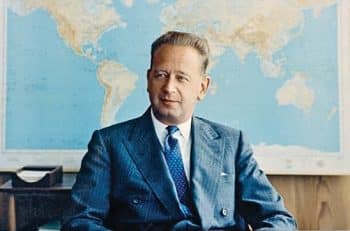
    The youngest and best UN Secretary General, 60 years after his assassination. By Chay Bowes Dag Hammarskjold was the second ever, and some say the greatest, Secretary General of the UN. When he died sixty years ago this year, President John F Kennedy suggested that Hammarskjold had been “the greatest statesman of our century”. At 47 years of age on his appointment, Hammarskjold was the youngest ever secretary-general of the United Nations and one of only two people to ever be awarded the Nobel prize posthumously. Are his life, innovations and untimely death relevant in 2021? Dag Hjalmar Agne Carl Hammarskjold was born in 1905 to a wealthy Swedish ‘noble’ family, the son of a future Swedish prime minister and politician Hjalmar Hammarskjold, who would serve during the first part of the first world war. Dag Hammarskjold had a relatively privileged early life at the family home at Uppsala castle. Despite his materially comfortable surroundings, Hammarskjold experienced much personal difficulty within his conservative and emotionally rigid family. Roger Lipsey, in his work ‘Hammarskjöld: a Life’ (2016) suggests: “There were enough confusing psychological crosscurrents to generate sterile excellence and recurrent personal misery”. Essentially Lipsey posits that Hammarskjold was given ample opportunity to achieve a life of “high-level mediocrity” but despite the restrictions and emotional limitations of his upbringing he would achieve great things. Hammarskjöld has been credited with coining the term “planned economy”. He co-drafted the legislation that opened the way to the creation of Sweden’s welfare state Hammarskjold attended the “Katedralskolan” one of the oldest educational establishments in Sweden (Est 1236 ) and went on to take law and philosophy degrees in 1930 at the University of Uppsala. He had by then already been appointed to the post of assistant secretary of the “committee on employment” in the Swedish government. Hammarskjold excelled as a civil servant and by 1936 had been appointed to the Swedish central bank serving as secretary of its general council between 1941 and 1948. Hammarskjöld has been credited with coining the term“planned economy”. He co-drafted the legislation that opened the way to the creation of Sweden’s welfare state. In 1947 Hammarskjold was made Sweden’s delegate to the organisation for European Economic Co-operation where he assisted in the implementation of the Marshall plan to resurrect Western Europe economically. Despite being appointed by a government of Social Democrats, Hammarskjold never actually joined any political party himself. The United Nations By 1951 Hammarskjold joined Sweden’s delegation to the United Nations General Assembly in Paris. Hammarskjold’s conviction that smaller, less powerful nations should be protected was central to his vision for the UN as a peacekeeping entity. He quickly became Chairman of the Swedish delegation. Hammarskjold wanted the United Nations to be a dynamic tool for its members with pragmatism at its core. The Suez Crisis, Innovation and Pragmatism Hammarskjold exercised his own personal diplomacy to get the UN to nullify the use of force by Israel, France, and Great Britain following Nasser’s commandeering of the Canal; At the outbreak of the Suez crisis in 1956, the United Nations had never deployed peacekeeping forces. rticle 43 of the UN Charter provides that All Members of the United Nations, in order to contribute to the maintenance of international peace and security, undertake to make available to the Security Council, on its call armed forces, assistance, and facilities, including rights of passage, necessary for the purpose of maintaining international peace and security. Working alongside Canada’s foreign Minister Lester Pearson who had initially sown the seeds of the concept in Hammarskjold’s mind, the concept of peacekeeping as we know it today was formulated. Hammarskjold pulled together enough support and commitment from member states to establish the United Nations Emergency Force or UNEF which stood ready for deployment in weeks. The essential tenets of that initial UNEF mission remain at the core of all UN missions to this day. The Congo, Context and Global Relevance The decolonisation of Africa had reached a pivotal moment by mid-1961. Neither the Soviets nor the Americans supported colonialism. They nevertheless saw the relinquishing of colonial possessions by Britain, Belgium, France and Portugal as an opportunity to expand their influence in newly independent states. Certainly the remaining minority-white governments of the region such as South Africa and Rhodesia had significant concerns about the decolonisation process. In 1960 the Belgian government officially relinquished its sovereignty in the Congo and a nationalist leader Patrice Lumumba was elected Prime Minister. In a vain attempt to appease his rivals and preserve unity, he appointed the opposition leader Joseph Kasavubu as president. However, days later the army mutinied. In the midst of this turmoil, large umbers of white Belgian settlers began to leave the Congo with Belgian forces intervening on the grounds of protecting its citizens. In May 1960 Moise Tshombe announced that the province of Katanga, which held most of Congo’s mineral wealth, was declaring independence. Among the valuable minerals and deposits Katanga held were uranium and cobalt. A Belgian commercial entity called the “Katanga mining union” immediately began to support the breakaway government based in Elisabethville. The immediate effect of such financial support for Katanga was that it was wealthy enough to stand alone against Congo proper, with the Belgian mining interests ensuring that their assets in the region would remain under their control. In September 1961 Hammarskjold was on a mission to facilitate an end to this evolving conflict in Katanga. Hammarskjold firmly believed that the post-colonial growth and liberty of the newly independent Congo should not be influenced or restricted by its old colonial ruler, Belgium. The defence and preservation of the infant independent Congo became a personal priority. He along with 15 others died in a plane crash on 18 September 1961 in what is now Zambia. He was on his way to negotiate a  cease-fire between UN forces and Katangese troops under Moise Tshombe. In her definitive work, which served to stimulate renewed UN investigation into Hammarskjold’s death, British academic Susan Williams, (‘Who killed Hammarskjold?’, Oxford University Press 2014) contends that

    Loading

    Read more