• Posted in:

    Unthinking self-apologists

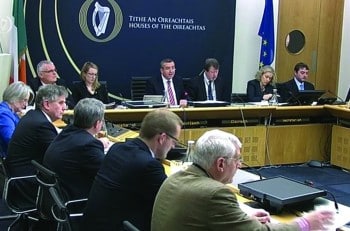
    By Gerard Cunningham If one thing was apparent from the parade of senior newspaper executives and editors before the Oireachtas banking inquiry and the subsequent opinion pieces, it is that newspaper-folk are far less upset at missing the bubble that at the idea that they did so because of anything the advertising department said. Take Geraldine Kennedy as an example. “The same editorial standards applied in the property supplements as elsewhere in the newspaper”, she told the committee. “Advertisers did not write editorial copy”, she added, addressing a strawman no one had raised. But perhaps her finest moment came when she rejected the idea that Irish Times editorial policy was subject to political pressures. “I wasn’t bullied by Charlie Haughey when in my 20s so I wasn’t going to be bullied by lesser politicians in my 50s”, she said. Whether this indicates that Charlie was a great leader, or merely that his successors are minnows will be left to the historians. In her defence Kennedy was able to point out that her paper had carried the prophetic December 2006 article by Morgan Kelly. Likewise, Irish Independent editor Ger O’Regan was able to point to his decision to hire David McWilliams as evidence of his good faith. What percentage of these prescient newspapers’ newsprint went to these sages was not revealed. McWilliams, for his part, told the inquiry a month earlier that while he was subjected to “personal and nasty attacks” and “slapped down” by fellow economists and senior bankers for his analysis, he was never “muzzled” by his editors, and was free to write what he wanted. But while editors let McWilliams get on with it, Julien Mercille, whose appearance before the inquiry set the tone for the questioning of the editors and media executives, has since been the subject of several critical articles. The most coherent of these came from Dan O’Brien, who questioned Mercille’s research methodology (and his “hard left” ideology). Others were less focused. Ger O’Regan launched a rambling broadside in the Sunday Independent, starting off by quoting Donald Rumsfeld’s “unknown unknowns” and imagining committee member Joe Higgins as an Albanian “commissar for economics”, before ending with a dismissal of the “obscure academic” Mercille as a “self-appointed guru”. Leaving aside how many pro-boom or doom-warning articles were published or broadcast, the media module did produce a few interesting statistics. At its peak, property advertising accounted for 17% of revenue at the Irish Times, 14% at the Independent, and 7% at the Irish Examiner. By contrast, property advertising accounted for a mere 0.9% of RTÉ revenues. In his research, Mercille identified three strands which compromise editorial independence and effective journalism: advertising revenues, sourcing of stories, and close ties with corporate and government interests. The low level of reliance on property advertising by RTÉ could therefore suggest that whatever the problems were, they weren’t due to advertising pressures. Mercille is as critical of RTÉ and its ‘Prime Time’ specials on the property markets as he is of the newspapers. However, while RTÉ didn’t profit directly from property advertising to the same extent as print, it did produce content which fuelled the boom, according to DIT journalism lecturer Harry Browne, who highlighted “property porn” TV programmes and print lifestyle features which “encouraged readers to constantly think about going higher and higher up the ladder. To think about how to get that bigger house; to think about how to decorate their apartment in Bulgaria, that sort of thing”. Meanwhile, uncritical reliance on sources was explicitly identified by Examiner editor Tim Vaughan. “If we were guilty of anything, and I believe we were, it is that we believed and accepted that institutions, such as the financial regulatory authorities, were doing their jobs and doing them competently with due diligence and with appropriate compliance policies, and with proper political and departmental oversight”, he said. “We are reliant on agents of the State to be competent, professional, open, honest and reliable in what they do and say, and then we report on that”. Geraldine Kennedy echoed a similar sentiment. “The media, as always, was reliant on reporting the views of the specialists, be they government, the Central Bank, the regulator, or the profession of economists”, she said. “Journalists were less well-placed than others to make an accurate assessment”. Whether such views stand up to any scrutiny in terms of the role of the media in a democracy is doubtful. Of Mercille’s three strands then, advertising might not be the villain it is often presumed. Editors do guard their independence jealously in the face of commercial pressures, after all. That leaves the interlinked issues of story-sourcing and the close ties between media, government and corporate interests. In a small country like Ireland, those may not even be compromises that editors are consciously aware of. •

    Loading

    Read more

  • Posted in:

    So-so MoJo on the go-go

    By Gerard Cunningham At one point during his workshop at MoJoCon, the mobile- journalism conference organised by RTÉ in late March, BBC reporter Nick Garnett paused during his demonstration of the audio editing software he was using to edit the sound recordings he had made earlier. Garnett’s NoJo website opens with an impressive promise. “Recording an interview used to involve carrying a tape recorder that weighed the same as a new born baby. Now we can record, edit and mix – and broadcast live radio and TV from around the world. On a phone”. Unfortunately, Garnett informed the audience, the company which made Voddio, the multi-track editing app he was demonstrating, had gone bankrupt, and the app was no longer available. In a world where Apple and Android have trained users to expect software to cost $1.99, the high-functioning audio editor wasn’t a runner. And there is a major problem faced by phone-only journalism advocates. While they might be technically capable of producing broadcast-standard audio (and video), smartphones are a consumer product, and apps are aimed at end-users, not professionals. But even allowing for the (temporary, we hope) absence of appropriate software, and settling for the moment for an inferior editor (in the hope that a new one comes along shortly) the improvement to workflow from switching to a single mobile device isn’t always that compelling. The microphone on the latest iPhone, for example, is reasonably good, but still manages to sound tinny compared to most custom recorders. Several MoJos recommended different microphones to overcome the problem, just as many had their favourite lens attachments for improved video performance, but if a journalist is going to go that far then there must come a point when she asks whether it wouldn’t just be simpler to get a “proper” camera or sound recorder. The more traditional alternative becomes even more tempting when one considers that it’s been quite some time since the typical recorder weighed “the same as a new born baby”. The Zoom H2, a handheld recorder favoured by at least one prominent RTE broadcaster, weighs a mere 110g, a quarterpounder. Smartphones certainly boast some selling points as reporting tool. The tech – camera and audio – is “good enough” but it isn’t necessarily the best. What it does have is familiarity. A microphone or camera can silence a witness, or make them self-conscious about what they say. A phone is familiar, and doesn’t spook people so much. And the phone is already wired in to the network. Sending the report to the studio is as simple as patting the button marked ‘Send’. But so what? It’s hard to shake the sense that MoJo is – so far at least – something of a gimmick for traditional broadcasters, who are simultaneously wary of and curious about broadbanders. The best thing about it may be the name. RTÉ’s Philip Bromwell noted that the Irish national broadcaster is leading the way in the field, having transmitted over 50 pieces shot on mobile devices. But it is notable how many of those pieces were features rather than hard-news reports. Examples of hard news produced on mobile tech were more like what is understood by “citizen journalism”, where people who are not professional reporters find themselves in places where conventional reporters cannot easily go – reporting a woman’s experience of life in Saudi Arabia, or a doctor’s experience in the middle of an Ebola outbreak. A modern, slimline sub-compact laptop fits easily in a kitbag. A reporter can still record on the smartphone of choice, or on a Zoom or other recorder or minicam. It is then easy to transfer that raw file to the notebook over bluetooth (or by switching an SD card) where the file can then be edited using much more powerful custom software than is available off an app store, and with the advantage of precision control rather than half-abortive editings using stubby fingers and thumbs on a 5 or 6 inch screen. At that point, the thing that matters about mobile journalism is the mobile journalist. The technology comes second. Or as RTÉ documentary producer techno-cynic Ronan Kelly put it at MoJoCon: “Often people who talk about the kit don’t have a story. In fact, the story must come first”. •

    Loading

    Read more

  • Posted in:

    Facebook and Zuckerberg expand their search for new prey

    The cost of using social networks and email services may usually come without a financial price but most of us are aware that the companies providing these services expect something else in return: our information. That these technological superpowers gather, analyse and, ultimately, monetise this data is no longer a trade secret. In recent years, with the growth of these companies and their collective user base, more details have emerged as to the extent of their data collection. In the third quarter of 2014, Facebook claimed to have 1.35 billion active users (that is, those who have used Facebook in the last 30 days) while the number of active Gmail users comes in at a more modest 500 million. Respectively, these figures make up almost 20% and 7% of the earth’s population. Relative to the number of people with access to the internet (2.7 billion), that figure comes in at 50% and 18.5%. Recent research commissioned by the Belgian data protection agency revealed additional information that indicated just how far these services reach into the lives of even the most casual internet users. The extensive report detailed how Facebook gathered information on the online activity of non-Facebook users and even those who explicitly opted-out of being monitored, with the latter having ironically had a cookie placed on their computer which allowed for their activity to be tracked for up to two years. An earlier report commissioned by the Belgian data commissioner found that the company’s privacy policy was in breach of EU privacy law which requires that prior consent be given before issuing a cookie or ‘tracking’, unless it is necessary for either the networking required to connect to the service (“criterion A”) or for delivering a service specifically requested by the user (“criterion B”). The same law requires websites to notify users on their first visit to a site that it uses cookies, requesting consent to do so. Meanwhile, the European Court of Justice is set to decide on an Irish-generated case about the legality of the ‘Safe Harbour’ treaty, which allows the US arm of big social media sites to transfer data from the stringently regulated EU to the US, where it can finish up , as Edward Snowden showed, in the dodgiest of official hands. The extent to which companies will go to gather data is reflective of its significance to them in terms of profit. More data equals more growth and so mining non-Facebook users for theirs, even given its occasional illegality, seems to be a step worth taking for Facebook. Interestingly, Facebook and its CEO, Mark Zuckerberg, are playing a major part in expanding the size of the world’s internet population through their Internet.org initiative. In the extravagantly titled “white paper” announcing Internet.org, Zuckerberg stated his belief that “connectivity is a human right” and framed the motivation for its creation as humanitarian rather than profit-seeking in nature. It’s difficult to imagine that executives at Facebook wouldn’t have drawn up plans to see how they could potentially capitalise on their company’s penetration into untapped population-rich markets. Internet.org isn’t the first multinational-driven tech effort to enable easier access to internet services or, indeed, the first by Facebook. Its Zero service allows users of specific mobile providers to access Facebook via a stripped-down version of its flagship product. Text can be downloaded free of charge but users must pay to access photos and video. It has been a highly successful initiative to the extent that a survey of online users in Africa found that a higher percentage of respondents said that they used Facebook than said they used the internet itself. The Internet.org homepage greets visitors with the tagline: “The more we connect, the better it gets”, a statement which rings true from more than one angle. In an interview with Bloomberg, Zuckerberg was reticent when the subject of advertising on Internet.org was originally brought up, replying that he “[wasn’t] sure if it’s a big part of the solution in the short-term”. Of course Zuckerberg is so aggrandised that it is not clear for whom the solution is being sought. Nevertheless when asked if that meant no advertising, he replied that “in a lot of these countries there isn’t a very big ad market yet, so it’s not that we won’t do it eventually”. Of course, once you have solid data on the market you’re selling to advertisers, those advertisers are likely to become more interested. The Internet.org initiative could therefore be seen as the firing gun to start the internet ad race in emerging markets. Ultimately, Internet.org will continue to improve the lives of millions of people by providing basic internet access but it does not take a cynic to view the altruistic language of Facebook Zero and Internet.org as being somewhat disingenuous. Companies such as Facebook and Google exist solely on the back of their users’ data and, while the trade-off may be acceptable for all concerned parties, when companies are willing to go so far as breaking the law, it’s necessary to pay attention. •

    Loading

    Read more

  • Posted in:

    Fidelma Healy-Memes

    By Gerard Cunningham If one story last month illustrated how far Irish media have to go in adapting to the speed at which stories develop online, it was the latest gaffe by Galway-based Fine Gael senator Fidelma Healy-Eames. Healy-Eames does not have a good record when it comes to the internet. So error prone has the she become, she is known online as Healy-Memes for her ability to reliably generate regular snafus. The senator, who has a doctorate and looks like a politician, joined the Reform Alliance though not its ultimate incarnation, Renua. She infamously was fined for allegedly being obstreperous  with a ticket collector on the Galway-Dublin train when she  was found without a ticket in July 2012, 10 days after her Merc was seized for failure to display a tax disc; and for refusing to pay €12,000 to a plumber for renovations to her home – something “implausible” about the jacuzzi being too big. Anyway… in January, she reacted to Leo Varadkar’s coming out interview with Miriam O’Callaghan by wishing him well, ending her tweet with a bizarre #sexualorientation hashtag. The choice was mocked for the rest of the day, with tweets such as “Just taking the bins out #sexualorientation”. On Mothers Day, Healy-Eames took to twitter to wish a “Happy Mother’s Day to all”, before continuing by noting: “Hope we can continue to celebrate it after #SSM (same-sex marriage) passed. In some US states Mothers and Fathers day banned. #pcgonemad”. Online, the tweet was quickly mocked and fact-checked, and “some US states” soon turned out to be isolated incidents in two schools, one in New York, the other in Nova Scotia, a decade apart and, in both cases, pre-dating any same-sex marriage laws. The Senator didn’t help her case during her climb-down several hours later by posting a link to one of the stories at a website with a noted anti-Semitic bent which also sells, among other things, magic pills which claim to offer protection against ocean-borne Fukushima radiation. Following the Mother’s Day faux-pas, the Journal fact-checked the claim, even as several twitter accounts did the same thing. The first fact-checked rebuttal came in their Daily Edge section, 65 minutes after Healy-Eames took to twitter. Later that afternoon, the Journal got an interview with the senator. In other words, by the time the Monday papers were being laid to bed, the story had run its course. A politician had made a wild claim, been challenged on it (and not just by “ordinary” twitter users but also by several TDs, senators, journalists and activists), and clarified her position or backed down, depending on your point of view. The tweet from the senator, on a Sunday morning, was the kind of thing an enterprising producer on one of the Sunday morning radio shows might have run with, either offering it to the roundtable panel to chew over, or even trying to get Healy-Eames on the phone to expand on her position. Granted, ‘The Marian Finucane Show’, which usually reports on Twitter and internet items with the tone of a medieval scribe confronted with a Gutenberg press, was unlikely to make that call, but neither did Newstalk or Today FM. The first Irish Times report on the story isn’t on their website until 9PM that night, compiled by Michael O’Regan. Only the first three paragraphs of the story concern the tweet-storm, and they are followed by two more on the senator’s relations with Renua, before segueing to an Atheist Ireland statement on the referendum campaign. The Healy-Eames tweet bears all the hallmarks of being shoehorned into an existing story. The Irish Examiner didn’t even bother with an update during the day. The website simply uploaded the report, with all their stories, at 1am the next morning. The first newspaper to speak to Healy-Eames, the Irish Independent, quoted her at length on her voting intentions but, while the report did state that there were two school cases, it oddly underplayed the senator’s claim that “some US states” had banned the holiday. The blatant untruth is simply skipped over. The senator was not challenged about it, or offered an opportunity to explain if, for example, it was the result of poor research or  a misunderstanding. To the Indo’s credit, however, its story was posted two hours after the event, and a full nine hours before the Irish Times’. Stories don’t happen in a vacuum. When the most engaged audience watches a story unfold online, actively investigates and debunks it, and then watches as the “mainstream” media downplays even as it plays catch-up, then old-media credibility suffers. It probably didn’t help that the Senator took to her twitter on a sleepy Sunday morning, but when statements  are treated less seriously because they were not made in the august chambers of Leinster House or on the busy plinth outside, the audience may wonder whether it’s worth bothering with the mainstream. If newspapers really want to be ‘digital first’, then they have to adapt to be ‘digital serious’ about ‘digital events’, and report them in something close to real time. •

    Loading

    Read more