• Posted in:

    Mojocon no Mojo con

    MoJoCon – the Mobile Journalism Conference which debuted in Dublin last year – has its roots almost a decade ago, when Glen Mulcahy, then working with RTE Nuacht, began experimenting with the camera on his Nokia N93 smartphone. “Video quality was atrociously bad, photographs were tiny, 1Mb was seen as huge, it was very much in its infancy”, recalls Mulcahy, now RTE’s head of innovation. “We were experimenting with that around the time Reuters had deployed the same tools to their journalists in the UK to create content for websites”. A handful of stories was produced to an acceptable broadcast quality using the mobile devices, and Mulcahy started keeping track of other broadcasters who were doing the same.“I thought, we need to bring everyone together, talk about what we’re doing, and that was the birth of MoJoCon”. From those beginnings, and networks built up through Circom, the European Association of Regional Broadcasters, MoJoCon has evolved into a “leading international media conference focusing on mobile journalism, mobile content creation, mobile photography and new technology all in one event”. Mulcahy may be an advocate for new technology, but he doesn’t expect RTÉ reporters will be carrying smartphones and selfie sticks by the end of the decade. “People still expect a particular kind of look when they turn on the television. You can’t do sports coverage on mobile, for example – you need those broadcast cameras, powerful zoom, all those expensive things. That said, there is very interesting case study, a station in Luxembourg, Léman Bleu, uses mobile to create content for their TV news. I think they are very brave to go this early”. “You will still see cameramen, you will still see satellite trucks in five years time, not journalists with selfie sticks. There are times when mobile works, but mobile is not mature enough yet to do 100% of the work”. Where he does see openings for new technology to expand are in non— broadcast media outlets, from newspapers to independent pod-and video-casts. “There are a few case studies in the Irish Times where I was absolutely blown away by some of the stuff they were able to do. They also very cleverly decided to upskill all their press photographers who were interested in doing it into shooting video with their DSLR cameras. So you have a new aesthetic. You definitely have better, although not necessarily radically more expensive, cameras and you also have some of the journalists who responded and went out shooting stuff with their phones”. “You don’t need a broadcast-quality camera to produce content that going to be delivered (back) onto mobile phones. I’m more and more coming to the opinion that there is a mobile ecosystem where we create on the mobile phone, edit on mobile phone, and deliver to mobile phones”. New technologies, and the ability to produce programming and news quickly and cheaply, also have implications for how RTÉ covers different communities, Mulcahy believes. “In the UK, there’s been a concerted effort by the BBC over the last 12 to 18 months to try and encourage hyperlocal sites. There is a UK government initiative where you can get a modest fund to basically try and get it off the ground. So there’s more that the government here could do to encourage that level of local community content”. “This is a device that most people have in their pocket. Maybe not everyone has a top-of- the-line Android or whatever, but lots of people have smartphones that can do pretty decent video, reasonably decent video”. “There is potential to give community-group newsletters, the ones that get stuffed on A4 sheets through letterboxes, a mobile angle. We could really energise community activism at grass roots level by showing them what you can do with video on mobile”. Looking to the future, as technologies (and screens) merge, Mulcahy can see a point where RTÉ produces video and audio not just for broadcast, but for the web, and for web first. As technologies mature, there is no strict reason why, for example, a new report compiled during the mid-afternoon should have to wait until the Nine news to be seen, when it can be immediately streamed to desktop computers or phones. Gerard Cunningham

    Loading

    Read more

  • Posted in:

    Less, but still, relevant

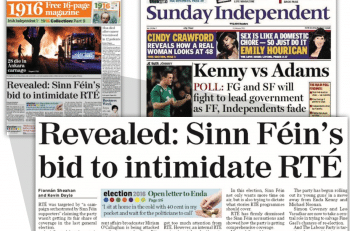
    From the point of view of the media, one of February’s biggest stories almost got lost in the election chaos. On Friday, February 19th, one week before polling day, the newspaper circulation figures for the second half of last year were published. In one sense, the story was a bit of a non-story: newspapers continue to sell fewer and fewer copies – the roughly 40 per cent collapse of sales that we’ve seen over the last decade or so was certainly accelerated by Ireland’s economic implosion; but whatever recovery somebody out there is enjoying, it’s not bringing newspapers back into our lives – they were down a few more per cent. That should be the starting point of any discussion about how newspapers covered the general election. This may indeed have been, as several commentators such as Oliver Callan have suggested, the most sensationalist, the most biased, the most trivial newspaper coverage of an election in the history of the State. Maybe. Whatever. There can be little doubt, though, that it was the most irrelevant. You can shout all you like about how much the journalism of the Irish daily press gets read online. “We’ve got more readers than ever (now if we could only get them to pay)” is a common refrain in the shrunken corridors of the press. The fact is that most of those readers are no longer committed to getting their news and views from any given paper, but rather they dip in and out, often critically. I suspect that on the day those circulation figures were published, more people saw a social-media post full of mockery, outrage or bemusement at the Irish Independent’s latest front-page denunciation of Sinn Féin than actually paid for a physical copy of that page. Since I merely saw an image on my phone, I still have no idea what Gerry Adams was planning to do with my pension. Is there a connection between the press’s hysteria this time around and the steady withering away of its relevance? I suspect as much. Like troubled children, the less attention we pay them, the louder they scream. Election seasons have always seen journalists at their most pompous and self-important: in the better class of newspaper the consequence is an obsessive-compulsive commitment to ‘fairness’. I can remember, back in the 1990s, a team in the Irish Times newsroom dedicated to measuring (literally, like with rulers) the coverage given to each party in a general election, with various formulae to adjust for the unfortunate fact that all column inches are not created equal. Other papers, of course, take a different approach. If there’s one thing we can say for certain about, say, the Indo’s notorious treatment of this election, it’s that they got us to notice how important they are. Once you understand the desperation of the press’s attention-seeking in its much-reduced state of health, it’s easier to understand why, for example, the Regency Hotel shooting managed to displace the election from page-ones for most of a week. If there’s one thing that the press does even more self-importantly than elections, it’s crime. This has little to do with the wonderful, generous resources gifted by Denis O’Brien and Rupert Murdoch to the investigation of wrong-doing and a lot to do with the impotence of convicted criminals to use the defamation laws to protect themselves. (No reputation to protect, no case, scumbag.) The hotel shootings showed definitively that crime journalism in Ireland is RELEVANT – more so even than the gardaí, who were absent while the crime-hacks and -snappers were very much on the scene. And when it came time to segue from “Hey, remember us! We’re newspapers! We cover crime!” to “Hey… elections!”, there was the lovely little link of Sinn Féin’s position on the Special Criminal Court. It seemed remarkably difficult to get anyone to recall a principled, non-Republican reason to oppose no-jury trials. So, even short of a major definitive research project, we can pretty safely say, that compared to times past, (1) newspapers are less relevant and (2) people are more inclined to see through media bias. (Check out Dr Rory Hearne’s research with water protesters to confirm the latter point.) However, this is not the same as saying (1) the media are irrelevant and (2) media bias doesn’t matter. When RTÉ – which unlike newspapers has a statutory obligation to be fair, to which it pays often hilarious lip-service – allowed crime-hack Paul Williams on the Late Late Show to use the issue of the Special Criminal Court to denounce Sinn Féin and its voters, on the very same day that he and we learned of his shrinking circulation relevance, it was not only a disgrace, it was most probably consequential for the election outcome. With the best will in the world – and even a half-decent will is a rarity – Sinn Féin and its voters remain another country for the vast majority of the established professionals in the Irish media. On his last NewsTalk broadcast before the election moratorium, George Hook recalled covering Mary-Lou McDonald on a canvas in Cabra: he scraped the phrase “work-ing-claaaass peeeople” over his tonsils as if he were describing a particularly dangerous safari. When the diverse regional accents of the various returning officers are a source of novelty and excitement on election-count days, you know the media have got a problem of uniformity. John Bowman turned up on RTE radio before the election with what academic Dr Conor McCabe described aptly as “the most Irish middle-class statement ever”. Bowman said: “I caught the election bug back in school when I was on the number 10 bus from Ballsbridge to Belvedere College, and the bus would pass by a sign outside the offices of the Irish Times…”. The problem is not Bowman personally, of course, but the fact that his background remains highly representative of the media. That ignorance partly accounts for the strange yet popular notion that the Labour Party has something to do with

    Loading

    Read more

  • Posted in:

    Election Times

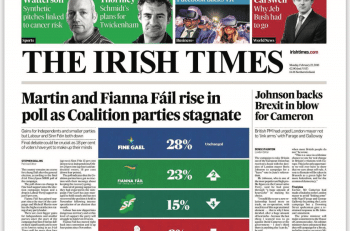
    The story of an election is much more than a few headlines, but the Irish Times front pages mercifully, if languidly, devoid of the kind of blatantly partisan positioning seen elsewhere, provide in hindsight a neat narrative of the campaign, with the slow realisation that Fine Gael was in trouble, the lack of a clear alternative emerging, and of course, “events, dear boy”. While its columnists and editorials may have declaimed preferences in the run-up to the general election, the Irish Times‘ front page generally affected a more neutral stance, certainly by comparison with the anti-Sinn Féin headlines which dominated the Irish Independent and its Sunday sister during the February campaign. The ‘newspaper of reference’ (formerly “of “record”) began the month in ‘phoney war’ mode, leading on Monday 1 February with coalition plans to “target home buyers and parents in poll pledges”. On the Tuesday, with still no election date declared, the story was “Taoiseach prepares Fine Gael ministers for election”. Perhaps ominously, on both days the below- the-fold story concerned the revelations regarding “Grace” a young woman with intellectual disabilities abused while in HSE care in a foster home. The story would feature again several times during the month and, by the end of the campaign, would threaten to inculpate Michael Noonan. Wednesday’s paper finally brought the official election notice, leading with Fine Gael ministers outlining their election promises, but the shine was short lived. Thursday, and the first election poll, brought “disappointing news for Coalition parties”. Much of the remainder of the campaign was spent trying to push back against those low poll numbers, which stubbornly refused to rise. By the first weekend, Fine Gael had announced a “tax U-turn to hit voters earning €100K” (the top 10% of all earners, though Irish Times readers would be better paid than the average). The election narrative was dominated at first by Fine Gael (at least on the front page) but it changed dramatically in the second week. The murderous Regency Hotel rampage called attention to cuts in Garda numbers and resources and Fine Gael, which prides itself as a law and order party, found itself on the back foot. At one point Sinn Féin’s Mary Lou McDonald attacked the government for being soft on crime during an RTÉ radio debate. By the end of the week, the lead story that Garda “may be issued with new weapons” helped to restore marginally Frances Fitzgerald’s battered image, but you know you (we?) are in trouble when Sinn Féin are attacking you from the right on crime. Meanwhile, bubbling below the fold, the news was no better. Lowry, Drumm and Luas strikes festered, and the Times awarded the first TV debate to Micheál Martin. Week Three began with Labour striking out to create a separate identity, promising “an abortion vote in any new deal” – definitely a plus for liberal Irish Times readers. Smaller parties got their first acknowledgement the following day, as the lead reported they did best in the previous night’s debate. For the rest of the week, it was almost as if the Irish Times tired of the “boring” election campaign, with more conventional “newsy” lead stories on an HSE inquiry into baby deaths, welfare benefits for migrants, and Brexit. Week Four began with the writing on the wall, summarised in a single Monday headline “Martin and FF rise in polls as Coalition stagnate”. Tuesday the paper reported Kenny and Martin had “equal backing in race for Taoiseach”, and the final TV debate failed to resolve anything for this hard-to-please newspaper as “leaders fail to land killer punch”, before Kenny’s “last-ditch call for vote in favour of stability.” Below the fold on the same day, the first mention of Sinn Féin in a front-page headline volunteered no favours: “Canvasser for Adams owns hay shed where ‘Slab’ Murphy cash was found”. ‘Slab’ was also the subject of one of the few passionate editorial columns (now perhaps self-deprecatingly titled “the Irish Times view”). Others quite reasonably despaired of the “short election, short of vision”. But while front pages covered national trends, debates and polls, and columnists inside the paper from Una Mullally (who, surprisingly for someone with a political agenda, gave up interest) to Breda O’Brien (vote for people of conscience, if you know what I mean) via Fintan O’Toole (who in the end detected an unlikely victory for social democracy) and Noel Whelan (who again somehow spotted the Fianna Fáil revolution implausibly early) ventilated partisan viewpoints, perhaps the most concise reportage on what happened on election day was by religious affairs correspondent Patsy McGarry, who on the day of the count reported from the north inner city, less than ten minutes from Tara St in a neighbourhood where few read the Irish Times, and fewer would share its editorial concerns: one, a hooded man, was picking up rubbish and putting it in a black plastic bag.“I didn’t vote. I don’t have a voting card. I was abroad for five years. It’s not important at all”. Gerard Cunningham

    Loading

    Read more

  • Posted in:

    Classy!

    Irish news-radio programming shows a strong anti-tabloid bias in selecting contributors, according to an examination of survey data from the three main broadcasters earlier this year. Journalists interviewed by the stations’ news programmes and participating on panels came overwhelmingly from the Irish Times and Irish Independent during the survey periods, with none at all from the Irish Daily Star, the Sunday World, or the Irish Sun. The data, originally collected by Lucy Kavanagh as part of her research into gender bias in Irish radio, highlighting the absence of women’s voices on air, show that 50% of Irish journalists on air came from just two titles, the Irish Times and the Irish Independent. Another quarter of journalists came from the remaining three broadsheet titles, the Sunday Business Post, the Irish Examiner, and the Sunday Times Irish edition. [For the purposes of this analysis, the now “compact-size” Irish Independent is defined as a broadsheet. Although its sister paper the Sunday Independent is widely regarded as a tabloid at heart, and has been for years, this did not influence the results as no Sindo journalist participated in any of the programmes in the study during the time period under review.] The analysis, by Village media correspondent Gerard Cunningham, excluded the stations’ own journalists. It means that stories and viewpoints from some of the largest selling newspapers in Ireland are excluded from the airwaves, to the detriment of public debate. And given the demographics associated with the readerships of those newspapers, it means that by proxy, working-class voices are also locked out and silenced. Curiously, despite the ownership overlap between Communicorp and Independent News and Media, both strongly identified with Denis O’Brien, Irish Times journalists were proportionately more likely than Independent journalists to appear on Newstalk programming during the period studied. The data covered Newstalk’s Breakfast Show, the Pat Kenny Programme, the Lunchtime News, the Right Hook, and TodayFM’s Last Word during the period 2-8 June 2016, Newstalk’s Sunday Show and RTE’s Marian Finucane show and This Week programmes on Sundays 3 May- 7 June, and the Late Debate (RTE) May 26-June 4. International experience shows that less than one quarter of voices heard on radio belong to women, despite making up a little over half the world’s population. These figures indicate that when other demographic factors are taken into account, the lens through which radio reflects its audience becomes even narrower. Working-class voices are, as a rule, virtually unheard on national radio, outside of occasional vox-pop and roving-reporter segments featuring Paddy O’Gorman and Henry McKean, where the tone isoften voyeuristic. Non-Irish voices are even rarer. A 2012 CSO survey showed that Britons are the second largest ethnic minority in Ireland, yet their voices are heard far more often than those of the largest, Poles. Voices from Latvia, Lithuania, Nigeria, Romania, India, and other large immigrant communities are egregiously rare. Irish radio, in other words, is overwhelmingly white, English-speaking, middle-class, and male. These findings are reinforced by other findings, such as a 2012 Freedom of Information request which showed that over half of the €120,000 RTÉ paid its top-ten external correspondents over a three-year period went to Irish Times journalists.   50% of Irish journalists on air came from just two titles, the Times and Independent. Another quarter of journalists came from the remaining three broadsheet titles   In a 2010 report on the Irish Broadcasting Landscape by Athena Media, commissioned for the Broadcasting Authority of Ireland, the authors found that: “Surprisingly, few broadcasting initiatives have been made to the changing dynamics of Irish society [sic]. There is little content available in languages other than English/Irish, and no local or community services offering specific choices to minorities, whether new communities such as the Polish, or established minorities, like the Irish Travellers. Beyond the RTÉ DAB service, Junior, there is no non-music radio service for children or young people since RTÉ 2FM now serves 25-45 year olds. There is a need to examine both the commercial and the public-service opportunities in the changed Irish social landscape. In the current model, the delivery of services is defined by providers. A more flexible approach to innovation and licensing could stimulate more targeted offerings for specific groups”. In the five years since, it would seem little is being done to redress the structural imbalances in Irish national radio. Irish radio’s definitive biases against tabloids, immigrants and alternative voices. A few years ago, as print media watched their subscription and circulation plummet, digital advocates were fond of reciting the adage of internet guru, Clay Shirky, that “no medium can survive the indifference of 25-year-olds”. The advocates had a simple solution. Readers didn’t care about paper and ink, they wanted content, so move the content to where the readers were, establish a presence online, through the web and apps, get rid of the unsustainable dead-tree costs, and pursue a combination of advertising and subscription revenues.

    Loading

    Read more

  • Posted in:

    Coming soon to your phone, and then everywhere

    A few years ago, as print media watched their subscription and circulation plummet, digital advocates were fond of reciting the adage of internet guru, Clay Shirky, that “no medium can survive the indifference of 25-year-olds”. The advocates had a simple solution. Readers didn’t care about paper and ink, they wanted content, so move the content to where the readers were, establish a presence online, through the web and apps, get rid of the unsustainable dead-tree costs, and pursue a combination of advertising and subscription revenues. A few – a very small few – have managed the transition successfully, The Times and Financial Times are bullish about their subscription-only models, the New York Times seems happy with its constantly tweaked mix of leaky paywalls and advertising, the Guardian and Mail open their content to all and bet on advertising alone. But for most newspapers and magazines, the economics of a sustainable online product are still at least one more iteration away, and readers are rebelling against the one constant of all publishers: advertising. Ad blockers in one form or another are almost as old as the internet, and over the years have ebbed and flowed in popularity. Their first appearance in the 1990s was prompted partly by the intrusive nature of early web advertising – who remembers flashing and blinking pop-ups? Their tendency to inflame became less of an issue as the growth and spread of viable broadband made loading times and worse still download times if you made the mistake of clicking on it, less of a concern. Blockers still live on some desktop computer browsers, but the numbers there stabilised a long time ago. But bandwidth issues resurfaced again in the last decade, as smartphones consumed more and more of readers’ attention. In the first five years of this decade, the number of consumers globally using ad blockers grew tenfold. The smaller screen size on even the largest phones makes advertising more noticeable – and more of a nuisance – than on a full-size computer screen, and the combined constraints of slower chips and constrained wireless speeds mean that the ad blocker’s promise to improve loading speeds by blocking useless advertising is highly appealing. The result, as outlined in the 2015 PageFair/Adobe report on The Cost of Ad Blocking, is a phenomenal growth in ad blocking, with worldwide 41% year-on-year growth since 2014. In the EU blockers grew by 35%, and are now used on 77 million devices. Notably, the report found that 93 percent of phone adblockers are installed on Chrome and Firefox browsers – that is, on Android phones. With Apple’s Autumn announcement that it will allow ad blocking on its own Safari browser, the problem seems set to increase. The global cost of ad blockers to date is estimated at $21.8bn [€20.5bn]. In the second quarter of 2015, 17.7% of monthly users in Ireland had ad blockers installed. That number is low by international standards, and that should worry Irish media outlets. The comparable US number is 47%, in the UK 39%, and where the US leads, the UK tends to go also, followed shortly afterwards by Ireland. In hard cash terms, the Irish Times expects to earn €8m from digital advertising in 2015, while INM expects digital revenues of around €12m. Circulation and print advertising revenues continue to fall at both companies. The Irish economic recovery means digital revenues are increasing for both publishers, just about offsetting print declines, but as international experience is sowing, that growth depends not only on the Irish economy prospering, but on readers continuing to accept advertising taking up their attention,bandwidth, and phone screens. The state of the Irish market can be understood by noting the Irish Times profitability increased in 2014 in part because it gained contracts to print the irish Examiner following its receivership. INM revenues in the same year were helped by a contract to distribute the Irish Times. Newspapers are consolidating their print and distribution efforts, thus shaving costs, but this activity is based on the ever-shrinking print sector. Cost savings and managed decline can only sustain the industry for so long. Advertising and editorial departments both need to adapt. User-hostile strategies, such as blocking browsers which use adblocking, seem unlikely to succeed. Those indifferent 25 year olds will simply go elsewhere, and there’s a whole wide world of web content out there. More favourable options may include increasing use of advertising formats such as sponsored content/branded journalism (the advertising formerly known as commercial features) or new forms such as sponsorship of podcasts (and perhaps vidcasts) or interstitial advertising in ‘casts.

    Loading

    Read more