Posted in:
Sophisticated but will not pay
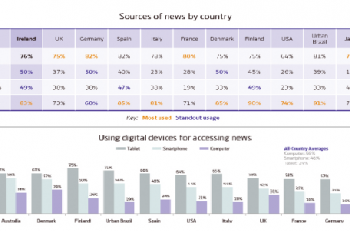
By Gerard Cunningham The Reuters Institute Digital News Report 2015 for Ireland gives an effective overview of who learns what where, here. The report describes Ireland as “a broadly engaged audience who are digitally immersed but with a substantial allegiance to traditional sources.” The report is produced in association with Dublin City University’s Institute for Future Journalism and Media (FuJo) and the Broadcasting Authority of Ireland (BAI). In a foreword, BAI chief executive Michael O’Keeffe hopes that the reports will “track key trends and identify data points that will assist the BAI in its deliberations”, something that should come in handy for the authority’s newly announced role in refereeing media mergers. Ireland is not particularly special when it comes to media consumption compared to the other 12 country Reuters studies, though we are more reluctant than average to pay for news, and more than usually likely to read foreign news. The Irish have also – so far at least – been less willing than other English-speaking audiences to abandon print, although even in Ireland circulation numbers are falling. The survey, based on a sample of 1501 adults who get news once a month or more, was conduced online in Ireland by ResearchNow, the Irish research partner of YouGov. The overall margin of error rate is 2.5%. The primary news source is online media, at 83%, with TV coming second at 76%. Radio (50%) and Print (49%) bring up the rear. It is notable that while radio and print come last, both are above average compared to international trends. The survey also reveals a glaring generation gap. Put bluntly, TV is for old people, while under-24s are abandoning it in favour of online sources. The contrast could not be more stark for RTÉ: 77% of over-55s got news from TV or radio in the past week, while the equivalent figure for 18-24 year olds is just 34%. At the same time, 21% of 18-24s checked the RTE.ie website, compared to only 0.5% of over-55s. As this is the first time that Ireland has been included in the Reuters report, it provides a baseline for future comparison, but no Irish trends are apparent yet. However, internationally, broadcast news is in decline, with print and broadcast news merging online. The survey took place in January-February, before the Irish Times introduced its paywall, so future surveys will also show the full effect that had on audience figures. Essentially, while viewers will still check in with TV and radio broadcasts at fixed hours, they are becoming more and more likely to get news, whether audio, video, or text, by phone. What’s true of entertainment, through services like Netflix, is equally true of news. TV is seen as the most accurate/reliable (37%) and trustworthy (38%) news source, but a majority (53%) believe that the best sources of analysis and comment are available online. This may reflect the wider range of opinions available in specialist blogs and news websites, the limited number of columnists in print, or a combination of both. Unsurprisingly, online is also seen as the best place for updates on breaking news. Online, just under three quarters (74%) of the population use a computer to obtain news, and the halfway tipping point has been reached on mobile, with 52% using it to check news. The generation gap is again visible here: smartphone users are younger; computer users are older. Among over-55s, 72% have used a computer to access news, but only 17% a smartphone. Gender analysis show a strong male preference for sports (52% of men, 15% of women) but it may be worth asking whether this is a chicken and egg situation. Most sports stories are about men’s sports, which may influence the audience it attracts. During June, the soccer columns were full of transfer rumours, for example, while the women’s World Cup was almost ignored. It may also be notable that while men read more about sports, only 17% said they were interested in health stories, compared to 42% of women. Some survey answers are difficult to accept at face value. The Irish claim to care deeply about international (64%) and national (59%) news stories, but not that much for celebrity (21%) or fun/weird “offbeat” news (18%): figures any journalist aware of what stories are most read and shared will question. This could be due to the nature of the online survey – those who answer are self-selecting, and may have a higher than average interest in news, or they may be giving an answer which reflects better on themselves. Another question, on what makes a story get read, provides an interesting contrast. Most (58%) said they “click on headlines that are most interesting to me”, contrasted with 32% who declared the basis was trust in the news site and 8% based on trust in the person sharing the story. This is the reverse of what is seen internationally, where trust is more highly rated. It may reflect deep cultural issues with trust in media, or a refreshing honesty about the effectiveness of clickbaiting headlines. The Irish certainly have trust issues. Only 46% trust the news in general, and 30% said they don’t trust most news. However 57% said they trust their chosen sources of news. Traditional news was seen as more accurate, reliable and trusted than online news in general, and TV news is seen to be more accurate than either print or online news, which will please RTÉ. Trust increases with age, education and income. Age makes a difference once again when it comes to preferred online news sources. The users of the traditional news brands – RTÉ, the Irish Independent, and the Irish Times – are much older than those for TheJournal.ie, which dominates among younger readers in the 18-24 and 25-34 age cohorts. RTÉ dominates the overall market. 58% watch TV news, and 33% listen to radio news. RTÉ radio and TV combined reach 65%. Online, RTÉ web offerings reach 31% of the potential audience. The Independent