• Posted in:

    We Are Totally Facebooked

    We’re enslaved by social media which will manipulate emotions for money By Mark Kernan This year Facebook filed two very interesting patents in the US. One was for emotion recognition technology; which recognises human emotions through facial expressions and can assess what mood we are in at any given time -happy or anxious for example. This can be done either by a webcam or a phonecam. The technology is relatively straightforward. Artificially intelligent driven algorithms analyse and then decipher facial expressions. They then match the duration and intensity of the expression with a corresponding emotion. Take contempt: measured from 0 to 100, an expression of contempt can be measured by a smirking smile, a furrowed brow or a wrinkled nose. An emotion can then be extrapolated from the data linking it to dominant personality traits: open, introverted, neurotic etc. The accuracy of the match may not be perfect, but AI (Artificial Intelligence) technology is getting much better; and is already much quicker than human intelligence. Recently at Columbia university a competition was set up between human lawyers and their AI counterparts. Both read a series of non-disclosure agreements with loopholes in them. AI found 95% compared to 88% for humans. The human lawyers took 90 minutes to read them; AI took 22 seconds. More remarkably still, last year Google’s AlphaZero beat Stockfish 8 in chess. Stockfish 8 is an open-sourced chess engine with access to centuries of human chess experience. Yet AlphaZero taught itself using machine learning principles, free of human instruction, beating Stockfish 8 28 times and drawing 72 out of 100. It took AlphaZero four hours to independently teach itself chess. Four hours from blank slate to genius. A common misconception about algorithms is that they can be easily controlled. In fact they can learn, change and run themselves –a process known as deep “neural” learning. In other words, they run on self-improving feedback loops. Much of this is exciting of course: unthought of solutions to collective problems like climate change may become feasible. The social payoffs could be huge too. But AI could be nefarious. Yuval Noah Hariri, author of ‘Sapiens’ speculates that AI could become just another tool to be used by elites to consolidate their power in the twenty-first century. Rapidly evolving technology ending up in the hands of just a few mega companies, unregulated and uncontrolled, should seriously concern us all. Algorithms, as Jamie Bartlett the author of ‘The People Vs Tech’ puts it, are “the keys to the magic kingdom” of understanding deep-seated human psychology: they filter, predict, correlate, target and learn. They can also manipulate – both financially and politically. In 2017 an internal Facebook report said it could detect teenagers’ moods and emotions by their entries, though it later denied it, adding it does not, “offer tools to target people based on their emotional state”. The report was written by two Australian executives, Andy Sinn and David Fernandez. The report was written for a large bank and said that, “the company has a database of its young users – 1.9 million high schoolers, 1.5 million tertiary students and 3 million young workers”. Going one better, Affectiva, a Boston company, claims to be able to detect and decode complex emotional and cognitive data from your face, voice and physiological state using emotion recognition technology (ECT) – amassing 12 billion “emotion data points” across gender, age and ethnicity. Its founder has declared that Affectiva’s ECT can read your heart rate from a webcam without you wearing any sensors, simply by using the reflection of your face which highlights blood flow, a reflection of your blood pressure. Next time you’re listening to Newstalk’s breakfast show, dwell on that. Affectiva’s ultimate goal of course, underneath all the feel-good optimistic guff about “social connectivity”, “awesome innovation”, and worst of all “empowering” is, in its own words, to “enable media creators to optimize their content”. Profiting from decoding our emotional states, in other words. Maybe Facebook (and Google) would use this technology wisely for our benefit, however, it isn’t such a stretch to imagine how it could be used unethically too. It’s already microtargetting customised ads and messages at us depending on our state of mind and it allowed Cambridge Analytica to harvest the personal data of 87 million Facebook users to subvert democracy with Brexit and Trump. Facebook claims it wasn’t aware of this though. Well, maybe, maybe not, and it remains remarkably unaccountable given its enormous cultural and social power in modern lives. The second Facebook patent is even more interesting, or dystopian. Patented this June and under the code US20180167677 (with the abstract title of Broadcast Content View Analysis Based on Ambient Audio Recording), it illustrates a process by which secret messages – ‘ambient audio fingerprints’ embedded in TV ads, would trigger viewers’ smart technology (phone or TV) to record them while the ad was playing. Presumably to gauge the reaction to the product being advertised through, perhaps, voice biometrics (i.e. the identification and recognition of the pitch and tone of the viewer’s voice). As the patent explains in near impenetrable jargon this is done by first detecting one or more broadcasting signals (the advertisement) of a content item. Second, ambient audio of the content item is recorded, and then the audio feature is extracted “from the recorded ambient audio to generate an ambient fingerprint” before finally, “ the ambient audio fingerprint, time information of the recorded ambient audio, and an identifier of an individual associated with a client device (you and your phone or smart TV) recording the ambient audio” is sent “to an online system for determining whether there was an impression of the content by the individual”. It goes on to say that “the impression of the identified content item by the identified individual” is logged in a “data store of the online system”. “Content providers”, it notes, “have a vested interest in knowing who has listened to and/or viewed their content”. The feature described in the patent is not exhaustive: “many additional features

    Loading

    Read more

  • Posted in:

    EU’re in the Line of Fire

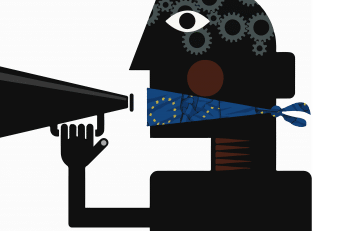
    EU Digital Copyright Directive aims to reward content providers but overreaches on ordinary web users By Laurence O’Bryan   Our world is experiencing a cathartic period of change, thanks to the internet and social media. The President of the United States uses Twitter to rally popular support among his base, including people who believe, as he does, that race and immigration issues are intertwined and that high walls are the best way to deal with neighbours. A political world away in Nicaragua, the one-time darling of the left, Daniel Ortega, has seen real challenges emerging thanks to the widespread online dissemination of videos of his police thugs beating up protesters. He’s obviously still catching up with how to use the new tools. In Venezuela, independent web sites and social media report the black-market exchange rates and murder counts. That’s anathema if you’re trying to prop up a dying regime. In Tanzania the government has introduced a US$930 fee for bloggers to create content. And in Kenya resident Uhuru Kenyatta signed a cybercrimes bill, criminalising the publication of fake news. The web, and its promotion and suppression, has enveloped our small world. Clearly many despise the transparency that independent web sites and social media bring. Attempts to stifle new media are being proposed even in Ireland. A proposed EU Digital Copyright Directive was approved by the European Parliament on 12 September 2018, and will enter formal Trilogue discussions that are expected to conclude in January 2019. If formalised, each of the EU’s member countries would then be required to enact laws to support the directive. One of the key objectionable aspects of the new copyright directive is the requirement that bloggers and social media commentators install software to preapprove content. This suggestion is buried in a section of the proposed legislation. Article 13 of the ‘Proposal for a Directive on Copyright in the Digital Single Market’ is written in the language of bureaucrats. It is intended to enable “a fair balance between the rights and interests of authors and other rights holders on the one hand, and of users on the other”. Article 11 of the same Directive provides for the so-called “link tax,” which gives publishers a right to ask for paid licences when online platforms share their stories. The obvious target is aggregators like Google News, but there are wider applications. This is EU Big Brother overreaching. The idea is that online platforms become liable for content uploaded by users that infringes copyright – to the advantage of content-makers. But it’s not that simple. Even if you are e sympathetic to the notion of barring teenagers from uploading mashup videos without paying for the music track, and of YouTube paying up when those tracks are identified, you should recoil from the thought police installing a copyright check system before you upload anything to any web site. If you decided, after Article 13, to post a “quote” from a famous writer or retweet a picture of a demonstration, you might need to apply for a licence and have your post and Tweet pre-approved first by the EU’s software as the quote and picture could be owned by someone else. And the proposal to require all internet services to create filters to prevent copyrighted material being uploaded illegally, will be a levy racket which could put many smaller websites out of business. I run a web site which lists books to help readers find new authors. Am I to pay to have a software tool assess what I may and may not put up on our web sites? And given the many failings of existing copyright-identifying software, in my personal experience of our book trailers that have been incorrectly flagged, where we have paid for the music used, it seems likely that the tool will make mistakes. Article 13 has been criticised by Sir Tim Berners-Lee, inventor of the worldwide web, and Jimmy Wales founder of Wikipedia. Both have warned that Article 13 could “damage the free and open internet”. Even the United Nation’s human rights experts oppose Article 13 on the grounds of limiting the right to free speech. And the next likely step is an attack on ‘fake news’ – a European Commission group of experts has already been established – and then that EU filter software, and the terms of your licence to use it, could be used to stop you saying anything online that could constitute fake news. But one person’s fake news is another person’s truth. I am sure some EU bureaucrats would object to ‘The Iliad’ if it was to be published on Amazon for the first time, under Article 13, for its use of epic poetry from previous sources and the one-sided nature of its reporting of the Trojan war – of who the heroes were and who ran away. If there is a line to draw beyond which the EU must not pass Articles 11 and 13 point to it.   Laurence O’Bryan is an author and founder of BooksGoSocial and the Dublin Writers Conference.

    Loading

    Read more

  • Posted in:

    BAIance under threat

    The well-worn phrase “it’s all over bar the shouting” couldn’t be more apt with regard to the Referendum which repealed the eighth amendment to the constitution (article 40.3.3). The referendum is all over, the shouting has begun and it is going to continue for some time. So far the shouting has been confined to a small number of very conservative Catholics on the one hand and people whose fury at the Catholic Church knows no bounds on the other. These relatively small numbers will grow. When clinics to provide abortion eventually open they will be picketed by conservatives and the pickets in turn will probably be picketed by left-wing groups. This has been the experience in the United States but at least in Ireland we can be reasonably confident that neither side will be armed. It is important that Ireland studies the American experience not only in order to learn from it but also because there is little doubt that US activists were involved in the referendum, largely on the NO side, but possibly in smaller numbers in supporting the winners. That the US is ultra-sensitive to foreigners intervening in its own electoral events added a touch of irony and paradox to the procedure. The decisions by Facebook to ban advertising from outside Ireland and by Google to ban all advertising highlighted the total absence of regulation not only of social media in general but also of the online activities of mainline broadcast media. Here’s an example of what is possible in a referendum or general election. The Broadcasting Authority of Ireland lays down the guidelines for election and referendum coverage and these include a moratorium on broadcasts from 2.00pm onwards on the day before the vote. So let’s take the case of a fictitious broadcaster called Radio Populism or RP for short. Its talk show is drawing a large listenership as 2.00pm approaches. One of the speakers says he is about to reveal some devastating information concerning corruption and bribery by his opponents. Just as he starts to make his statement the clock strikes 2.00pm. If the broadcast continues then RP will be in breach of the guidelines and get itself into trouble with the BAI. The presenter, however, makes an announcement saying that the discussion will be brought to an end on air but will continue as a podcast on the station’s website. RP, therefore, will move from the highly-regulated sphere of traditional broadcasting to the unregulated territory of the internet. Once that switch from one medium to another has been made the moratorium will not be broken because the BAI has no authority over internet podcasts and the only things that can deflect the speaker from accusing his opponents of bribery and corruption are the Courts of Justice and the law of the land in the form of the Defamation Act of 2009. The year 2009 was a busy one for legislation for it also saw the arrival of the Broadcasting Act under which the BAI was set up and the regulation of broadcasting in Ireland was brought up to date. Since then there has been an exponential growth in internet media, social and otherwise. What was up-to-date in 2009 is now outdated to almost prehistoric levels in 2018. One thing that has happened according to successive surveys is that a large majority o the younger cohort of the population listens to radio and watches TV over the internet rather than by traditional broadcast means. In our hypothetical case above while older listeners might have made a dash from radio to laptop to stay with the programme their younger fellow citizens would probably have used the unregulated internet to access the broadcast from the start. In years to come, therefore, the BAI could find itself with nothing to regulate. There are a number of options. The Act could be allowed to stagnate and we could be off on a Limbaugh-dance to US style Shock-Jock podcast radio where the concept of balance and impartiality of any sort would simply not apply. There are plenty of people with right-wing views who would welcome such a situation and who have enough money to exploit its political and social advantages. On the other hand a new Broadcasting Act could be introduced in an attempt to bring broadcasting regulation particularly in the area of coverage of the democratic process into line with today’s reality. The first necessity in any new legislation should be a re-organisation of the BAI itself. It is staffed by a highly professional group of public servants whose expertise made an extremely positive impression on me during my membership of the Authority’s board. Apart from the most publicised activity of dealing with complaints against broadcasters the BAI gives financial assistance to broadcasters under its Sound and Vision scheme and this has led to the production of very-high-standard programming especially from smaller independent companies with limited funds of their own. But the set-up imposed on the BAI by the 2009 Act has led to a highly-complicated situation which has been described, with reasonable accuracy, from within as a “three-headed monster”. The three heads are as follows: 1) The Authority which is essentially the board of directors of the BAI and set the strategic direction of the organisation. 2) The Contract Awards Statutory Committee that does exactly what it says on the tin. It awards licence contracts to broadcasters. 3) The Compliance Committee is another statutory body and it monitors broadcasters for compliance with broadcasting regulations such as impartiality. It also investigates complaints against broadcasters and publishes its decisions. But it’s even more complicated than that. As might be expected in any public or private company, decisions of the Contract Awards Committee are put to the board of the Authority for ratification. The Authority is, after all, the board of directors. The Compliance Committee’s decisions, on the other hand, are not ratified by the board. In effect therefore the Compliance Committee is an independent body with some membership links to the Authority itself (it includes two Authority members and two members of the

    Loading

    Read more

  • Posted in:

    Embargo

    The lacklustre prose might have tipped you off that all of the above items are from press releases, and so lack the sharpness good newspaper prose should have after subediting. But it’s not just PR-speak that distinguishes these news items. Each one was subject to a news embargo. News embargoes are not unknown in Ireland, and are usually honoured. Sometimes, they are even lifesaving. A few years ago, to pick one example, the Garda press office issued an alert to journalists about an “incident” where a man had barricaded himself inside a house. The brief notice asked journalists to respect a blackout in reporting the incident until it was resolved. Sometimes, based on their assessment of a crisis situation, Garda authorities will ask journalists to cover an event as much as possible, for example as a way of communicating directly with someone who may be listening to a radio. And sometimes, they ask for silence, to avoid inflaming a situation. The barricading incident was resolved without tragedy, and the stand-off was then reported by the press. There’s no way to tell if the embargo helped or not, but it was observed by every journalist who learned about the case. There’s no legal basis for a press-embargo system. It’s just something that evolved over the years. One of the compromises entailed is implied by press releases labelled “check against delivery”. The text of a speech, usually from a Minister or party leader, is leaked in advance to journalists to help them over the pressure of impending deadlines, but on the understanding that the journalist will listen to the speech in case the minister changes what he says at the last minute. Often of course, what the minister says in an off-the-cuff or unrehearsed remark departing from the script is the most newsworthy event of the night. Such a system made sense when print was the dominant news medium, and it took up to eight hours to get a news report from one end of the country to another. When a government or news website can upload the same speech in seconds, and then promote it through social media directly to citizens, the embargo makes less sense. On the (to be honest, not that frequent) occasions when the script contains urgent and newsworthy information, there is no reason why the planned script a Minister is going to deliver should not be reported. And if the actual delivery changes, then that too is news to report. A press embargo should be rare, and only invoked in the public interest. The barricading incident described earlier is an illustration. But instead, it is abused more often than respected. Some embargoed stories, such as an increase or reduction in homeless numbers, are of immediate interest. Many, quite frankly, are not. In addition to numerous speeches by ministers and TDs, among the recent embargo requests I’ve received were the launch of a new website and app by a government agency, tractor testing regulations, the opening of a courthouse, and a speech about the cost of Garda overtime. All worthy and worth reporting in the public interest, but few of immediate interest to the public, and certainly not meriting the spurious importance attached by the word “embargo”. Most of the embargoes in my inbox expire either at midnight, or at 4.30PM. In other words, they are blatant attempts to influence news coverage, hoping to feature prominently on morning newspaper front pages, Morning Ireland, or evening drivetime news broadcasts. What should be a rare occurrence, urging media restraint in the public interest, has instead become a way for press officers to manipulate news cycles. It is time for journalists to ignore embargoes. Gerard Cunningham

    Loading

    Read more