Posted in:
Don’t Feed The Bots
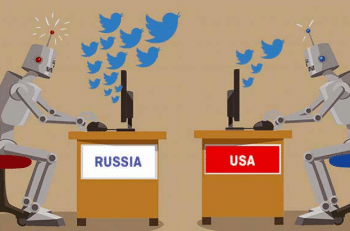
One in four Twitter followers of Philip Boucher Hayes is a fake account, the RTÉ broadcaster announced on his Twitter feed recently. Around the end of August, Boucher Hayes had noticed an uptick in new followers on Twitter, which he had monitored since. “Previously 100/150 people would follow me every week”, Boucher Hayes posted on Twitter. “Suddenly it became 800/1500 a week. Most had Irish-sounding names. None had tweeted. They were all following the same high-profile Irish accounts”. Boucher Hayes noted that many of the accounts had usernames consisting of a name followed by a series of random digits, such as @ John87654321 or @Mary12345678. This pattern, suggestive of names being mass-generated automatically, had also been seen earlier in the year among many ‘Brexit-bots’ in the UK. Although Boucher Hayes reported the increase in fake followers to Twitter, the pattern continued unchecked. “Either most of the high-profile Irish accounts have grossly inflated numbers of followers (which is admittedly a bit of a “so what?”) or someone is amassing a very large Twitter mob for some as yet unidentified purpose”, Boucher Hayes posted. “Either way it further erodes confidence in an increasingly compromised platform. Twitter doesn’t seem worried, maybe its users will be”. The same phenomenon may also account for the large numbers of fake followers identified for the @rte2fm radio account by the anonymous account of ‘Secret RTE Producer’ (@rtesecretpro), and would certainly make more sense than the national broadcaster spending licence-fee money to boost a social-media headcount. Perhaps reflecting official sensitivities, as Village was going to press, 2FM had reduced from thousands to 45 the number of accounts it was following. In recent testimony to the US congress, Twitter estimated five percent (16 million) of its accounts belong to fake users. Bots in turn can be divided into subgroupings. Spambots post URLs, hoping to encourage users to click on them, either to sell a product, or to lead users to a malicious website, which can infect their browsers and take over their laptops or phones. By contrast, influence bots seek to influence public opinion, whether by spamming hashtags, promoting artificial trends, pushing smear campaigns and death campaigns, or boosting political propaganda. “Artificial trends can bury real trends, keeping them off the public and media’s radar. Smear campaigns and death threats can both intimidate vocal opponents and dissuade would-be speakers. The link between propaganda and legitimate political speech is a fine one, of course, and in some cases is entirely in the eye of the beholder. Nevertheless, bots can be used to amplify the propagandist’s desired message”, noted Nathalie Marechal, a researcher with the University of California, writing in the International Journal of Communication in 2016. A 2016 study found that Twitter’s algorithms would eliminate a bot which tweeted spam links, but would not delete the associated accounts that retweeted the original post. This meant bot networks could all retweet a message hundreds of times, at the loss of only a handful of original tweeting accounts each time. Analysts at the University of Washington in Seattle studied a network which they named the Syrian Social Botnet, which worked not only by posting pro-Assad news and promoting astroturfing, but by flooding timelines with irrelevant news. A hashtag about the Syrian civil war would be flooded with irrelevant reports about other stories, for example from Hurricane Sandy, swamping the system with noise and making the hashtag useless for search purposes, a practice known as smokescreening. Another network – the Star Wars Botnet – discovered by researchers at University College London, numbering over 300,000 accounts, was so-called because the accounts each posted random snippets of text from Star Wars novels in the minutes after they were set up. A large number of the bots followed a handful of real users, and it seems to have been built for this purpose, and sold to users who wanted to inflate their follower counts and exaggerate their popularity. Bots can also be used to create page impressions, as Twitter and Facebook accounts are often used as logins by readers of news sites. This could exaggerate page views and ad impressions on websites seeking to defraud advertisers. A second botnet uncovered by the same London-based researchers numbered over 500,000 accounts, and was behind a large-scale spamming attack on Twitter in 2012. Gavin Sheridan, who worked as innovation director with Storyful, the News Corp-owned online news-verification company started by Mark Little in 2010, says it is not possible to determine who might be behind this nascent bot army until it is activated. (And indeed, now that it had been noticed, its usefulness may have been diminished to such an extent that it is never used). “I’ve read a lot of research, and I’ve seen the bot armies myself”, says Sheridan. “There were bot armies for California leaving the Union, for Texas leaving the union, there are pro-Erdogan ones in Turkey, one for Catalonia, one for Scotland leaving the UK: all bot armies in some shape or form”. “I started looking at [the Irish botnet] about two weeks ago. I wasn’t being followed by them but I noticed them following other people. A couple of people contacted me and said that they seemed to be being followed by strange accounts. There’s a couple of interesting things about these bots. One thing is the rapidity with which they are following certain users, the second thing is that they appear to have Irish-sounding names, not all of them, but a certain number, so if I look at, say, a prominent member of the Repeal the Eighth movement, I’ll see that of the last 50 followers, about half are newly set up – in the last few weeks. They have never tweeted and engage in no other activity. Some follow 50, some follow 80 accounts, that include people prominent in the Repeal the Eighth campaign. I’d have to analyse every single checking account to see if they follow people on the other side of the debate, but so far they’re also