


Politics

Random entry RSS

  • Posted in:

    Legal Change

    Organisations that support victims of domestic violence have been calling for many years for legal reforms to offer greater protection for victims. Victims of domestic violence who are not cohabiting, or do not have a child in common with an abusive partner, are not eligible to apply for court safety orders. Even where they are eligible for legal protection, they often endure long delays in court processes, and they suffer due to the serious lack of co-ordination between different Courts hearing separate applications relating to the same family. It is outrageous for example that issues of custody and access to children may be dealt with by a judge who is unaware of parallel domestic-violence proceedings. Given the right set of facts and a suitable litigant, I believe that there is now potential for legal action to be taken against the State for the failure to provide adequate protection against domestic violence for women and children. This is a case waiting to happen. Such a case could ensure greater awareness of the challenges faced by victims in negotiating legal processes and speedier introduction of the necessary legal reforms. Similar calls for reform of legislation on rape in the interests of victim protection are being made in the wake of the recent O’R case, where the Supreme Court rejected an appeal by a man who had been convicted of raping his mother. The court confirmed the current law that an “honest, though unreasonable, mistake that the woman was consenting is a defence to rape”. Rape crisis centres and others are calling for a statutory definition of ‘consent’ to be included in the current sex offences Bill. They have also argued that legislation on rape should be changed fundamentally, to require that a man should not have a defence to rape where he makes an unreasonable mistake about a woman’s consent. A core problem with the criminal law is that it is generally designed to deal with isolated events. It can be difficult to apply in the context of an ongoing abusive relationship. Garda statistics do not identify repeat callouts, so it is impossible to know how many recorded incidents involve the same individuals. Indeed we know that a great deal of domestic violence goes unreported. However, reporting levels have tended to rise where individual victims and survivors come forward to tell their stories and to highlight the need for action to be taken against abusers. Recent legal reforms such as the use of victim impact statements in sentencing were introduced largely because of brave individuals who spoke out about their experiences as victims and survivors, and the advocacy of others supporting them, like Women’s Aid. Their work has debunked many of the problematic myths about rape and domestic violence. We now have a better understanding of the terrible effects of such offences upon victims. We know that the majority of perpetrators are known to their victims. The sharing of experiences, and the taking of public interest litigation, are both valuable ways of achieving legal and social change. In a book that I edited with my TCD colleague Dr Mary Rogan, recently published as ‘Legal Cases that Changed Ireland’, we asked some individuals who have taken ground-breaking cases to speak about their experiences. These include Máirín de Burca, who won her case before the Supreme Court in 1975 establishing the right of women to serve on juries; and Dr Micheline Sheehy Skeffington, who in 2014 won her Equality Tribunal claim that NUI Galway had discriminated on gender grounds by denying her academic promotion. Their individual stories, based in experiences 40 years apart, are both essentially tales of courage, of brave women whose actions have made our society more equal. The book shows, however, that the law is only one part of the solution when it comes to achieving progressive change. A range of strategies is necessary, including lobbying, advocacy and campaigning work, to bring about change in attitudes and culture. With domestic violence, a whole package of other measures is necessary, beyond legal reform, including better provision of shelters for victims and their children and of adequate resources for support groups across the country. Currently services are not universally available and, in some areas, victims of gender-based violence have no access to shelters or support groups. We need a fundamental change of emphasis, to challenge a culture in which gender-based violence may sometimes be tacitly tolerated. We need to work on changing attitudes among those engaged in perpetrating abuse, in order to prevent it in the first place, rather than constantly trying to mend the damage that abusers do. As the stories told in our book show, true legal and social change can only be achieved through a combination of legal activism, sharing of experiences, advocacy and campaigning work.

    Loading

    Read more

  • Posted in:

    An Offence Against The State

    On 1 December 1972 a car bomb exploded beside Liberty Hall in Dublin. Fortunately no one died but George Bradshaw, a CIE bus driver, and Thomas Duffy, a bus conductor, perished in a second explosion at Sackville Place. No one has ever been charged with these crimes. The UVF belatedly claimed sole responsibility for them but there are legitimate doubts about the veracity of this claim. These bombings were part of four bombings in Dublin’s north city centre at the end of 1972 and beginning of 1973 and are to be distinguished from the even more horrific bombings in the same general area in 1974.   A State In Denial Margaret Urwin has just published ‘A State in Denial’ which unravels a web of intrigue connecting the British Secret State (BSS) to loyalist paramilitaries at a variety of levels. No objective reader of this impressive work could doubt that London focused the might of its counter-insurgency arsenal against Republicans while turning a knowing blind eye at loyalist wrongdoing and also arming and colluding with them. Irwin’s book is fascinating for its dissection of official papers to discern what was going on behind closed doors.   The Man with the English-Belfast Accent The publication of ‘A State in Denial’ is timely as yet another anniversary of the 1972 Dublin bombings comes around. On that fateful evening a man with a mixed English-Belfast accent parked a car bomb beside Liberty Hall. After he alighted, he asked someone who had just left the building when it was likely to empty out for the night. One of the cars used by the bombers to get to Dublin was a Ford Zephyr which had been stolen in Antrim from an Englishman called Joseph Fleming the previous August, along with Fleming’s driver’s licence. Fleming’s licence was put to use on two occasions in November 1972 by an imposter posing as Fleming, to hire cars in Belfast. The imposter was either extraordinarily reckless or had good reason to believe Fleming’s licence was not detailed on the lists circulated by the RUC to carrental companies. He obtained a number of cars over the space of a week, a timespan which underlines his confidence about the use of a stolen licence; and all this at a time when an epidemic of car bombings was bringing Belfast to a standstill. In addition, he left his fingerprints and handwriting on the forms he completed. Another significant fact was that he spoke with a mixture of a Belfast and English accent.   Kitson’s Military Reaction Force The UVF would have us believe that its volunteers: • Stole Fleming’s car in August 1972 and hid it for three months, and; • Drove it across the Border with its original registration plates on display, and; • Proceeded to Dublin at the same time – and possibly as part of a convoy of cars, parked it with explosives, and • Faced an extremely high risk of detection because the rental cars had been acquired using a stolen licence which the gang must have believed was on an RUC watchlist; • Yet all the while possessed the confidence to proceed without any high-level protection from the BSS. It is unlikely this is what happened. On the other hand, the highly secretive Military Reconnaissance Force (MRF) of the British Army had the nerve, skill and high-level protection in place to undertake just such an operation. The MRF was literally above the law. It was a sprawling organisation established by Brigadier Frank Kitson in 1971 to engage in agent-recruitment; surveillance; drive-by shootings (deploying the type of weapons the IRA were known to carry); laundry collection, to detect the residue of explosives on clothing; and even brothel management, to collect gossip and obtain blackmail material. It had access to loyalist agents recruited by the British Army and M15. Stealing vehicles and hiding them at its Palace Barracks HQ for use later was one of its known practices. The MRF could easily have arranged for the details about Fleming’s vehicle and licence to have been erased from the RUC watch lists. With this backing, the loyalist gang that bombed Dublin (or at least some of them) would have enjoyed the confidence to hire the cars and drive them to Dublin.   Albert Ginger Baker Albert Ginger Baker, an alleged British Army deserter, who joined the UDA in the early 1970, ticked all the boxes as an MRF agent. His family have claimed that he was involved in the 1972 bombings. In 1976 the Sunday World published an article exposing his links to a ‘Captain Bunty’, a mysterious figure who can only have been his handler. The pair met regularly in a Belfast coffee bar. Baker was involved in a string of gruesome sectarian murders in Belfast. During one of them, James Patrick McCartan, a 22-year-old forklifttruck driver, was stripped naked, hung up by his ankles and punched, kicked and beaten with a pickshaft, while a dagger was used to stab him in the hands and thigh over 200 times. He was threatened with castration and dropped head first from the ceiling. Eventually one of Baker’s UDA superiors gave him a pistol and told him to kill McCartan. Baker put a hood over his head, and blasted into his skull three times. A grenade Baker’s gang used in another attack was standard British Army issue, which raises questions about how they acquired it. It is doubtful the prospect of bombing Dublin could have troubled the conscience of those in the BSS who ultimately controlled men like Baker. Baker suffered some sort of a crisis in 1973, and fled to England where he confessed to a string of sectarian murders to the police in Warminster, in Wiltshire. As far as the BSS was concerned, some rather nasty cats were now peeping out of the bag. Damage limitation became the order of the day. Hence, while Baker was convicted and sent to prison in 1973, his secret link to the MRF was

    Loading

    Read more

  • Posted in:

    Poverty shapes abortion

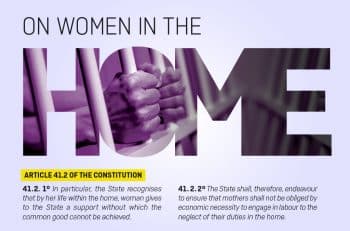
    A woman in poverty is damned from two perspectives when it comes to pregnancy. She can’t afford to continue a pregnancy but she can’t afford to stop it either. Constitutional reform; investing in women; trusting women; reversing austerity; treating all mothers equally; addressing poverty, low pay and childcare and all the other social and economic issues – are part of the politics of motherhood and choice in women’s lives. In our ‘Repeal the 8th’ debate we need to make links to a different section of the Constitution, Article 41.2. This prioritises a woman’s domestic role over her labour market participation by unambiguously implying that a woman’s place is in the home. Repeal the 8th needs to make links with the reality of a contemporary politics of motherhood based on Article 41.2. The values informing this Constitutional Article are still widely and deeply held and shape the politics of motherhood today. They are reflected in current policies on child income support, lone parents, homecare tax credit, tax individualisation and childcare. Economic independence and women’s access to, and control of, economic resources are key to understanding women’s choices and the barriers to women’s choices. Crisis Pregnancy Agency research has established that economic factors mediate a woman’s pregnancy in complex way: “the balance between the ‘value’ and the ‘cost’ of a child is important in shaping fertility decisions”. Poverty and financial dependence impede women’s ability to act on a range of choices, not least those associated with reproductive health including her right to choose to have a child. Poverty is a barrier to having children as it may make it impossible to pay for food. 10% of Irish people experience food poverty. They have problems meeting basic needs including health, housing, and children’s education. Austerity has made people more likely to experience poverty and the recently loosened purse strings have yet to dispense much to those who need resources most. Precarious jobs, bogus self-employment, if-and-when contracts, casual hours, low-hour jobs and internships all make pregnancy a non-viable option. Young people, women and migrant workers are most likely to have such jobs. Being pregnant and an employee is precarious. There has been an increase in unfair dismissals of, and discrimination against, pregnant women. Being self-employed and pregnant is often the foundation for stress and poverty. Poverty, and related lack of access to economic independence act as a constraint on a woman’s capacity or right to choose not to have a child. The Irish Human Rights and Equality Commission (IHREC) argues that the high cost of prescription and non-prescription contraceptive items interferes with the right of men and women on low incomes to obtain affordable contraception and to enjoy their right to adequate reproductive health. Cost deters young adults from using contraception. The need to get a GP for renewal of a prescription for a contraceptive pill acts as a further barrier. Once a woman living in poverty falls pregnant, accessing the finance needed for an abortion is a barrier. Borrowing from informal or formal sources, money lenders or credit unions, is rarely an option. Austerity has acutely affected the extent and depth of financial exclusion. Small-scale debt is now part of many households’ day-to-day finances. There is little capacity to absorb unexpected one-off costs. Informal sources of credit are exhausted. Money lenders (legal and illegal) and other forms of high-cost credit are used when conventional credit is no longer available. Such sources offer loans at exorbitant interest rates and often with far more serious risks. Credit Unions’ ability to make small-scale loans accessible is diminishing, due to increased regulation and a change in the Credit Union ethos. A 2016 study found 43% of women using at-home medical termination of pregnancy through online telemedicine, the abortion pill, could not afford to continue the pregnancy. Indeed 34.6% struggled to cover the £70 donation. These women were also more likely to lack emotional support. Financial control is another restraint. Some women in well-off households do not have access to their own income or control of their own time or space. To make choices to get pregnant or avoid pregnancy real, women need the practical capability to implement those choices. Debates must reflect this or lose relevance. by Mary Murphy

    Loading

    Read more

  • Posted in:

    North parties agree Brexit practicalities not strategy

    On Sunday 28th August Dublin’s Croke Park hosted the all-Ireland football semi-final between Dublin and Kerry, with Dublin emerging victorious. As celebrations were taking place around Dublin that evening another significant event was taking place in the city. Prominent representatives from Fianna Fáil, Fine Gael, Republican Sinn Féin and Sinn Féin assumed their places on the platform in the Royal College of Surgeons for a debate titled ‘Brexit-what does this mean for the North?’. The debate which was organised by the 1916 Clubs took place in a fitting venue in this the centenary year, having been one of the garrisons of Easter week in 1916 which was held by the Irish Citizen Army under Michael Mallin and Constance Markievicz. All the speakers were given ten minutes to outline their argument before the debate was opened to the floor for questions and answers. The original participants included representatives from the SDLP and Traditional Unionist Voice who failed to materialise on the night, and a representative from the UUP who withdrew hours beforehand mysteriously citing “irreconcilable differences”. The DUP had previously refused to send a speaker, leading RSF President Des Dalton to open his remarks with: “I had looked forward to engaging with them on ideas about the future direction of the Irish people as a whole… It is sad that Unionist representatives could not take their rightful place here tonight to debate issues vital to the future of all Irish people”. However, minus the SDLP and unionist parties, the debate got underway as organiser (and founder member of the 1916 Clubs) Oisín Mac Giolla Mheana outlined the governing rules of the debate stating that it would take place on the basis of ‘mutual respect’. Return of a hard border? On 23 June this year 55.8 % of voters in Northern Ireland opted for ‘Remain’ in the Brexit referendum; despite this result, come late March 2017 it is due to be led out of the European Union as Article 50 of the Lisbon Treaty is triggered by British Prime Minister Theresa May. The DUP advocated a ‘Leave’ position as did Irish Republican parties such as Republican Sinn Féin and Éirígí. A quick survey of the Falls road in Belfast will reveal worn and wind-battered ‘Vote Leave’ posters belonging to Éirígí, stating “Vote Leave for independence, for democracy, for freedom, for Europe, for Peace”. The constitutional position of the North has led to widespread speculation on the return of a ‘hard border’ with the South of Ireland. Although Sinn Féin campaigned for a Remain vote, upon the announcement of a Leave victory Sinn Féin described the result as an opportunity and immediately called for a border poll on Irish unity. During the Dublin debate Sinn Féin speaker Matt Carthy MEP argued that “constitutional change is now in the hands of the people of the North and South”. Carthy’s arguments echo those of the Sinn Féin Deputy First Minister of Northern Ireland Martin McGuinness who has asked that the views of the majority of people in the North, who voted for Remain, be respected and has argued that the North should be exempt from Brexit. The democratic will of Northern Ireland Throughout the debate speakers’ arguments were collectively couched in language of ‘democracy’, ‘sovereignty’ and ‘mandate’. Sinn Féin’s Matt Carthy argued: “I’ve spent my life hearing you must respect the democratic wishes of the people of the North. I say that right back. We must now uphold that”. Carthy proceeded to cite the Good Friday Agreement stating that it was endorsed by 71% of people in the North of Ireland. Interestingly, Carthy’s arguments appeared to suggest that Brexit is not compatible with the Good Friday Agreement of 1998. The words ‘constructive ambiguity’ are often used, particularly in academic narratives regarding the Good Friday Agreement, suggesting that it contained necessary ambiguity; however, the Agreement does not contain ambiguity. The consent principle established clearly that the North of Ireland will remain within the UK until the majority of people within Northern Ireland decide otherwise. Any ambiguity that was present existed regarding the way in which the nationalist and unionist blocs sold the agreement to their respective bases. It is therefore unsurprising that while Matt Carthy and Martin McGuinness are calling for a border poll, the DUP’s Nigel Dodds has rejected any stalling over the triggering of article 50 and has stated “on 23 June, the British people as a whole gave a clear mandate for the UK government to leave the EU”. Who holds the power? But Remain campaigners are not taking defeat quietly and recently a cross-party group (Sinn Féin, SDLP, Alliance and the Green Party) initiated a legal challenge against Brexit stating that the North of Ireland has a veto over any constitutional change; a veto which they argue emanates from the Good Friday Agreement. Brexit has arguably opened a debate on the constitutional position of the North but has simultaneously re-emphasised the supreme authority of the British government’s legislative powers in the North of Ireland, leaving political figures such as McGuinness powerless to intervene, thus resurrecting old antagonisms regarding where power really resides in relation to the North. Republican Sinn Féin President Des Dalton argued that ultimately: “the vote that counted is the one in England. Brexit demonstrates the fundamental highly undemocratic nature of the UK”. The RSF President framed Brexit around issues of sovereignty and independence and rejected Provisional Sinn Féin’s calls for a Six County border poll stating that it would “fly in the face of Republicanism”. The traditional Republican position rejects a Six County vote on unity, arguing that it is tantamount to a unionist ‘veto’ and argues instead that the unit of decision-making should be on an all-Ireland basis. The unit of determination regarding Irish unity has assumed a central point of antagonism and division in the contemporary political period. During the Hume-Adams dialogue of the late 1980s Provisional Sinn Féin rejected the SDLP leader’s argument regarding what would become the consent principle. In correspondence to Adams, Hume

    Loading

    Read more

  • Posted in:

    Small increases to Unemployment Benefits

    ‘Building a just society’ was the title for the Irish National Organisation of the Unemployed (INOU) Pre-Budget Submission. This title reflected our concern that without a strong commitment to addressing social exclusion and economic inequalities, many people will be left to observe, rather than participate in, Ireland’s economic recovery. The recent Budget provided a key chance for Government to give some practical expression to this commitment. We particularly wanted Budget 2017 to start the process of restoring working-age social-welfare rates to 2009 levels, and to end the age segregation introduced into the Jobseekers Allowance payment during the economic crisis. It is welcome that, for most social protection payments, the claimant’s rate will be increased by €5 per week. However, this increase should start from January next year, as would have been the experience when such changes were announced in the past. This is the first increase to working-age payments since Budget 2009. However, the new rate of €193 will still be €11.30 below the maximum working-age payment made in 2009 of €204.30. The supplementary Budget of 2009 was the budget that introduced a reduced Jobseekers Allowance rate for young people of €100. This was initially for those aged 18 and 19 years. It was extended out in subsequent budgets until it applied to people aged 18-24, while people aged 25 could only receive a maximum payment of €144. Jobseekers Allowance (JA) is a means-tested payment, and the €100 is the maximum payment available for people aged between 18 and 24 years of age. For someone to receive the full amount they must be a young person who personally, and whose family, has few other means. It is disappointing that nothing was done in this Budget to address this inequality. As a consequence, young Jobseekers are only to receive a proportion of the €5 increase on other payments. This amounts to€2.70for young people aged 18-24 and €3.80 for people aged 25. On a positive note, young people will receive the full JA rate if they participate in an education and training programme. In acknowledgement of their restricted income, young people who are in receipt of Rent Supplement payment will make a smaller contribution to their rent. The big challenge on housing, for anyone in receipt of Rent Supplement, continues to be finding and maintaining accommodation that is within the agreed limits. The INOU was not alone in calling for the significant scaling-up of social housing provision to address the level of demand and need. A range of measures was announced in Budget 2017, but they are still a long way off what is required to address the current dire situation. The full restoration of the Christmas Bonus and a change in eligibility criteria was another INOU demand. An 85% restoration was announced and this is a move in the right direction. However, 100% restoration would have been particularly welcome at a time of year where inequalities are most manifest. It was disappointing that the eligibility criteria for this were not changed. Currently, unemployed persons must be in receipt of a Jobseekers payment for 15 months before they can receive this additional payment. As unemployed people are deemed to be long-term unemployed at 12 months, these should have been the new qualifying criteria. Among the earliest austerity measures was a cut in the duration an unemployed person could be on the social insurance unemployment payment, ‘Jobseekers Benefit’. As a consequence of this cut, people who did not make the transition from this payment to the means-tested payment, ‘Jobseekers Allowance’ have found themselves without access to supports and services. Many people have not made the transition because of their family circumstances. Their partner, for example, may be working, not necessarily in a well paid job, and so the family find themselves down one key income. One of the motions to the INOU’s Annual Delegate Conference earlier this year called on the Government to “restore the duration of Jobseekers Benefit to 12 months and 9 months from the current levels of 9 and 6 months for people who have, respectively, at least or less than 260 paid contributions since starting insurable employment”. This change is needed to alleviate the difficulties facing these unemployed people and their families, and to facilitate their participation in education, training and employment programmes. The INOU will continue to work on these issues, as part of our commitment to an acceptable standard of living for unemployed people and their dependents. The next step in this work is addressing the forthcoming Social Welfare Bill. Brid O’Brien is Head of Policy and Media with the Irish National Organisation of the Unemployed

    Loading

    Read more