


Politics

Random entry RSS

  • Posted in:

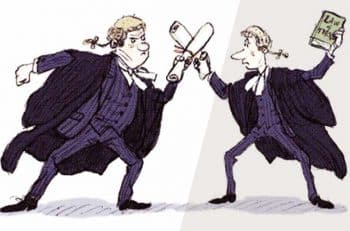
    Law is boring

    I-am-a-lawyer. I’ve said it. You may feel that positions me on the level of an amoeba or vermin but I believe I am ethical, professionally competent, creative and that I and many of my colleagues often do good things fighting on behalf of the voiceless and the victimised. But I must admit there are problems within the profession domestically and worldwide. This article intends to illustrate some of the best and worst legal practice. Show me a lawyer who is genuinely intellectually interested for example in mergers and acquisitions law, save perhaps as the by-product of a professional skill well exercised, and I will call the person to book as a boor or a charlatan: not interested in mergers and acquisitions, but in the money to be got from fabricating an interest in mergers and acquisitions. The interest is fake. In fact an interest in mergers and acquisitions or taxation law connotes a deep-seated psychological malaise. There are far more interesting things in life and indeed law. Anyone who has ever worked in a corporate sweat shop, as I have – a place called Hughes, Hubbard and Reed in No 1 Wall Street “Hughes, Cupboard and Greed” – will confirm that to acquire the lucre you so assiduously seek you are boxed in a gilded corporate cage like a puffed battery hen spending as much time calculating the billable hours as actually working. Your friends think it is glamorous but you know it is ignominious. Much more important than the quality of work produced is the amount of time spent. And quality dedicated to securities and derivatives or mergers and acquisitions Oh super. Have you ever seen this stuff? You will serve as the twentieth-person backup in a deal represented by a composite document that is laboriously copy-checked and footnoted drawn from a crucial well-tested all-important template to produce something that might end up in a short hearing which you will probably not be involved in. Anyone interested in advocacy should steer far away from corporate law. There will be no showtime or theatrics. You will have no stake. This is anally-retentive churning, soul-destroying work. Practitioners of such ephemera subject themselves to endless, pointless work and no holidays. A good friend of mine, a corporate lawyer in New York, visited me for the first time in ten years on his first holiday in that time – a five-day break in Dublin – and he had to be at the computer for a few hours every day! Further, many lawyers I met on Wall Street in particular – but elsewhere too – seemed drawn unmitigated from the novel ‘American Psycho’, dangerously psycho- or socio-pathic – overorganised and compartmentalised, rigid and fetishistic. For the sake of completeness you may care to note that sex for these forensic Gordon Gekkos was a bookable appointment, boring and consumerised, between meetings. Dirty love in the afternoon. Don’t think of the day-to-day reality of the new you: shrivelled and desexed. Commodified. Ossified. Bored. Sold-out. Ascending the corporate law ladder: a misspent youth. For those who care for more gentlemanly or ladylike times there has been a foul but gradual, insidious penetration of American work practices into Ireland, blind to our native frugality, scrupulousness and indeed noble tradition of law dating back to bardic times. The IFSC is full of the elites of South County Dublin, lucubrating over the tedious clippings of global corporate avarice. Solicitors in the ‘big five’ firms are as specialist and hungry as any attorney on the seventieth story in Manhattan. They have even affected the jargon of brash US firms: corporate responsibility, doing a meeting and a range of moronic baseball analogies: touch base, rain check, curveball. In Ireland lawyers once loved – once had to love – language. Symptomatically, this country, the land of the Book of Kells and the monkish scripts, of Beckett and Joyce, characteristically generates poorly-written mass-produced textbooks like wallpaper: heavy on the facts of the law but low on criticism or analysis. In the end, anyone can write an Irish textbook on The Law of Dogs or of Parks, with a brief introduction by judge, probably over a bottle of wine, who skim-read the effort, expressing gratitude, nay respect, for the important contribution to our law. Better rather that someone should unleash The Irish Rumpole or true crime as Stig Larsen did in Sweden or as Scott Thorow and Grisham do in the states. Let us focus on law in reality not the paper rules of mass-produced textbooks. In fairness there is some civilised life at the Irish Bar. Adrian Hardiman was a famous Joycean. Frank Callinan, a senior counsel and Brian Cregan, a High Court judge, have tried their hand at Parnell with some éclat. John O’Donnell SC writes poetry and serves on the Arts Council. Not enough. Where is the Nell McCafferty who documented the dysfunctionalities of the lower courts a generation ago? We need a Dickens to chronicle the contemporary Jarnydyce v Jarnydyce that is our banking and debt collection mess. Corporate Law My East-End client was perfectly polite until after the acquittal. Then asked to meet for a ‘sing-song’ in a seedy alehouse: “I didn’t want to say it to you but you are Irish, and if you had messed up I would not have taken it kindly. Know what I mean son?” The threat was very clear. Needless to say I did not go for the pints. In any event it needs to be be said that police officers have issued me threats even more sinister – insinuating that I was some sort of juvenile delinquent gone wrong for anti-State work or Garda criticism; bugging my phones – an occupational hazard of a human rights lawyer, expressing their closeness to lower court officials and high ranking civil servants, perhaps issuing a death threat, as if we lived in a third-world police state. Nonetheless, give me an outing in criminal law for the Kray clan any time, over corporate law. East-end gangsters

    Loading

    Read more

  • Posted in:

    Ethics cases to answer for FF in SIPO, and FG

    Long-running tensions between Fine Gael members in County Kildare are about to create difficulties for Kildare County Council and Fine Gael following the suspension of righteous Councillor Fiona McLoughlin Healy from Fine Gael for making well-founded allegations about the leader of Fianna Fáil on the Council, allegations met with a deaf ear by of cials and other councillors. This energetic councillor’s refusal to submit or be silenced raises questions about cronyism, and of a traditional old boys’ club mentality. It suggests ‘new politics’ is coming only very slowly to rural Ireland. Background Up to 2011 Fine Gael had passed two electoral terms without a TD in Kildare South. However, following 16 months of difficult campaigning and his eclipse of two strong rivals, 32-year-old golden-boy local farmer Martin Heydon brought the party a landslide victory in that years General Election. He collected a remarkable 33% of rst preference votes. Deputy Heydon built a likeable persona for himself within Fine Gael, regarded by members as a politician who, in the best Fine Gael tradition, would not rock the boat. He was also believed to have found favour with the grandees in the party. Although Enda Kenny has chastised party members for the poor optics that result from favours and jobs for family, Heydon hired his sister, Rosemary, as a parliamentary assistant and co-opted distant cousin Ivan Keatley, the best man at his wedding, to take his former council seat, all without rebuke. However, there was one aspect of Martin Heydon’s career that the Taoiseach took issue with: his association with the Dáil’s ‘five-a-side’ gang, a group of about ten right-wing male TDs who met to vent their various grievances in political life with bright-eyed South Dublin toff Eoghan Murphy TD as ringleader. Once, however, Kenny’s understandable dislike of secret groups and meetings was made clear to Heydon, he parted ways with his footie pals and the group dissolved in 2014. As another General Election loomed on the horizon, Heydon was making plans. With his impressive result from 2011 in play, the party planned on running two candidates in the Kildare South constituency. The forward-looking TD already had a partner in mind, a local solicitor who had campaigned on Heydon’s behalf in the run up to the 2011 vote. The TD was ready, and appeared well positioned, to repay the loyalty. However, the Taoiseach had other plans. Having brought in gender quotas while in government, Fine Gael was in danger of damaging itself by outing them. Reeling from a collapse in support but seeing female candidates as providing an edge over their backwoods rivals Fianna Fáil, Kenny and party strategists drew up a secret list of more than a dozen women – and a few men – to fill roles across the country. Party organisers, alongside Terry Prone’s PR firm The Communications Clinic, ran a six-week course to train eager new candidates in preparation for the election, all monitored by Fine Gael general secretary Tom Curran. Speaking at the time, Mr Curran said he didn’t expect the move would cause trouble within the party. Kenny’s secret weapon for Kildare South was a relatively new politician, Fiona McLoughlin Healy, a trained nurse who had volunteered in a Romanian orphanage before returning to NUIG where she topped her class every year in both Law and Politics, and then to Ulster University where she again obtained a distinction. A councillor in the Newbridge area since 2014, who runs a property-sales website, she was seen as bouncy if somewhat politically naive. She announced at the earliest opportunity that she believed in transparent operations and the party’s commitment to gender quotas. Her appetite for ‘new politics’, a more socially liberal Fine Gael party and willingness to break ranks, irritated old-timers and made her the target of cynical ridicule in local political circles, McLoughlin Healy addressed some of the criticism, established a formidable presence on social media and seemed to be moving towards election. Yet she faced a difficult campaign. A few older male Fine Gael members in the area took issue with the very notion of gender quotas and often were quite vocal in their opposition to a female candidate, yearning for a return to past, admittedly unrewarded, selection processes. McLoughlin Healy did little to assuage their fears, pushing herself forward on national television about sexism and her belief in gender quotas. A source working in the Council told Village that it was not just the grassroots members who felt uncomfortable over the quota issue, but that the councillor’s own colleagues expressed annoyance at the special training Fine Gael had provided her. With Martin Heydon’s running mate plans scuppered by his party leader, there was animosity towards his new female colleague. He notably showed no interest in engaging over a vote-management and boundary strategy. Heydon was also proving implausibly popular with many local Fianna Fáil supporters, which only gave traction to ongoing rumours that people from the Heydon camp were mischievously stirring confusion for voters between Ms McLoughlin Healy and the similarly named, though quite different, Fianna Fáil candidate Fiona O’Loughlin who is currently a TD and leader of Fianna Fáil on Kildare County Council. This coupled with claims that Mr Heydon’s supporters had brazenly told voters to pass on their second preference to the Fianna Fáil candidate, a claim he denied to Fine Gael insiders and called a “a dreadful slur”, stoked tensions. As polling day drew near, the pair appeared on a special election edition of ‘The People’s Debate’ with a lively Vincent Browne, with rather poor results. Ms McLoughlin Healy’s energy and eagerness were striking but she was attacked from the crowd by members of her own party over gender quotas. Luckily for her, Mr Heydon’s performance drew most of the attention, as he struggled with questions and appeared unfortunately quick-tempered when challenged. It had become apparent that this election had become more difficult than previously predicted. As McLoughlin Healy gained support outside the party base on her pro-Repeal stance on abortion, adoption of

    Loading

    Read more

  • Posted in:

    During the hearing

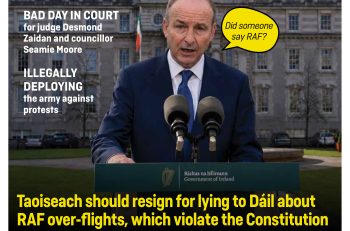
    During the hearing Mr Justice Zaidan told Clare Daly TD to “stand up straight”, perhaps a push too far under our delicate balance of power between judiciary and legislators

    Loading

    Read more

  • Posted in:

    Judging the Guards

    Judges and the Garda let our society down: make the Garda Commissioner accountable to the Ombudsman, and establish a Judicial Commission.

    Loading

    Read more

  • Posted in:

    A cross-party group

    A cross-party group (Sinn Féin, SDLP, Alliance and the Green Party) initiated a legal challenge against Brexit stating that the North of Ireland has a veto over any constitutional change, which they argue emanates from the Good Friday Agreement

    Loading

    Read more