


Politics

Random entry RSS

  • Posted in:

    Increasing housing supply won’t reduce prices

    The Construction Industry have said for years that “increasing supply (housing) will reduce prices”. The government have accepted this as fact and current policy is driven by it. The graph below is compiled from Central Statistics Office (CSO ) data for 1975-2015 and includes monthly new home completions and monthly average new house prices in that 40-year period. The information has been directly imported from the CSO website and has not been weighted or adjusted. House prices are for new homes only and 1975 is the reference starting point for both curves. It calls into question that the perceived wisdom of current government policy. The relationship of price to supply appears inelastic; in other words, increasing supply does not reduce cost and in fact the opposite appears to happen (similar to luxury goods). 40 years of CSO data suggests that increasing house prices leads to increasing completions (lead and lag noted). To an architect or builder this makes sense as developments are sales-sensitive and will only proceed if there is enough of a margin to get developers up in the morning. Similarly, phases are delayed if there is any drop in prices. The incorrect assumption, that increasing supply will reduce prices, underpins Government policy aimed at the speculative residential sector: inappropriate pro-cyclical measures (First Time Buyers grant), the reduced apartment-size standards introduced in 2015, the elimination of the local authority role in adjudicating planning applications for over 100 housing units etc. These initiatives are like a landowner’s wish list and disproportionately enhance site values, minimise public input and erode our two-tier planning system. This casts doubt over the competence of Department of Housing officials who advise the Minister and explains the disproportionate influence of vested interests on policy. The net result of current government measures will be to inflate asset prices and consequently increase supply (mid and high end)- not necessarily a bad thing. However, in the absence of any balancing measures aimed at lower-income households, affordability will remain a major problem. Longer commutes to affordable areas outside the capital may become the norm with infrastructural pressures and issues of sustainability as a result. This is happening in the rental sector already. Notable measures that have not been considered for affordable housing include government interventions such as: co-housing, state direct procurement, state financed home-ownership etc. Cost-benefit analyses of such measures are sorely absent from the discourse. Correlation does not mean causation. There are other drivers of demand not shown such as net migration, obsolescence, household formation, interest rates etc. However the graph illustrates that an increase in house supply has not been accompanied by a reduction in prices in 40 years. Unfortunately recent policies conduce to the boom-bust cycle we are supposed to abhor. Maoilíosa Reynolds is a Registered Architect and Certified Passive House Designer.

    Loading

    Read more

  • Posted in:

    Cometh the hour

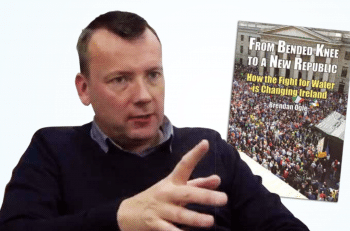
    ‘From Bended knee to a New Republic: How the fight for water is changing Ireland’ by Brendan Ogle, promises in its opening pages to take us on a journey “through the travails of a nation broken, sold and left in penury”. Ogle, unlike the many politicians and political parties he describes, fulfils this promise. The book brings you on a fascinating, inspiring, informative, and thoughtful journey through inequality in Ireland and “a nation’s fightback against it”. It should be clear from this that the book, just like the protest movement itself, is about much more than water. It comprehensively answers the question that many have asked: why was water the “issue that Irish people would take their first and biggest real stand against austerity?”. Ogle is the Education, Politics and Development organiser for the Unite trade union in Ireland and one of the founders of the Right2Water and Right2Change campaigns. The first quarter of the book provides detailed analysis of the political, economic, and social circumstances that gave rise to the Irish water protests which are “the biggest (per capita) and most peaceful protest movement for social change anywhere in the world”. These include the global water privatisation agenda, austerity, poverty and the health and housing crises. Neoliberalism is explored before an analysis of the self-evisceration of social democracy through Tony Blair’s ‘third way’ acceptance and implementation of neoliberalism, and its adoption by the Irish Labour Party. He suggests the Labour Party has become an “obstacle to progress toward a more equal Ireland, and is in fact an enabler of neoliberal inequality”. Ogle spends the rest of the book describing how the Right2Water campaign was organised and the challenges it faced in becoming a mass movement. He recounts how he and Dave Gibney, the other main organiser in Right2Water, withstood difficult negotiations with local communities who had been let down by trade unions in the past but had started this new movement in order to build trust and a strong working partnership with them. He writes about how ‘civil society’ organisations failed to offer much support to the movement. He describes the constant work required to build unity amongst the fractious left-wing parties that make up the ‘political pillar’ of the movement. We can read how he and others in the water movement which “could so easily have been just another failed campaign in a failed Republic”, actually developed the most successful mass-protest movement in modern Irish history. It is, therefore, an essential read for those looking to understand not just how and why the water movement developed in Ireland but for those seeking lessons of how to build successful social movements. A central purpose of the book is to set out the origins and purpose of the water movement, and to tell the story of the water activists, which, as Ogle rightly says, you won’t read about in the media or many other places. The book provides an important contribution to documenting Ireland’s recent socio-political history and geography, particularly the excluded voices and views in society which are too often ignored. The book documents how the movement was built from the grassroots up in working class communities like Edenmore in Coolock in Dublin and by “wonderful people” from all over Ireland “who were determined to make a difference”. It tells the inspiring story of water activists such as Karen Doyle, a “housewife and mother who also works part-time outside the home” from ‘Cobh says No’. She got involved in the water charges movement and formed one of the hundreds of ‘meter watch’ groups, which were the heart of the movement across the country, to obstruct water meters being installed. It is from such actions that a broader social movement was born. Ogle writes: “every week-day morning someone would rise about 4.00 to 5.00 am and find where the meter contractor vans were heading. Text alerts were sent so that by the time the vans arrived people like Karen were at estate entrances to protest. A caravan and trailer were procured and soup, tea and coffee produced every day for sustenance. Margaret Thatcher would have hated it. Society! People came from their homes, their individual isolated bolt holes, to start sharing stories about where it had all gone wrong, how their lives had been impacted by the breaking of a nation, which gave them the strength, the determination, to do something about it”. These groups, according to Ogle, faced problems from “some on the ultra-left” who saw the local groups “as a vehicle for advancing their own agenda, viewing people like Karen as potential recruits”. He describes how “people who got involved in a campaign out of genuine concern for their community and their country”, were hurt as they found themselves “the focal of bitter and personalised attacks”. He notes that in the past “many have walked away from the campaigns, surrendering them to the dogmatic ultra-left and the inevitable failure to deliver on their promise”. But not this time. Karen and many other community activists like her continued on and developed their own spaces and confidence to keep building a broad and inclusive movement. important in this was the support given by the Right2Water trade unions, and Unite in particular through its political economy education. It ran nine free ‘political economy’ courses for 150 ‘non-aligned’ community activists “with the objective of giving activists who were central to the growing water movement access to the type of information that would enable them to understand the political economic agenda behind water privatisation”. This was a very innovative approach which provided an important longer term empowering aspect to the movement. Ogle writes how “through the training we not only helped them connect with each other on a national level but showed how the tax and privatisation agenda are global issues…giving renewed energy as to how to challenge the neoliberal consensus”. Ogle persuasively tackles the critiques of the water movement in relation to water conservation. He highlights how people in the UK, which has

    Loading

    Read more

  • Posted in:

    Haughey cleaned up his own mess

    The author is a senior lecturer in the department of Modern History at Liverpool’s hope University. He has carefully mined the available documentary sources to produce a book that covers Haughey’s, much disputed disposition and policy instincts on Northern Ireland. Given the longevity and impact of Haughey’s career this, by definition, involves a painstaking trawl through a variety of sources. His cautious conclusion is that “Northern Ireland, it seems, was only one of a handful of issues to which Haughey left a positive legacy”. However, even this tentative conclusion is set against the view of the haughey critics who saw his actions as opportunistic and maladroit. The Arms Trial is of course the defining event in Haughey’s career. Stephen Kelly goes a great distance to establish that Haughey was, however unwittingly, the person who most facilitated the emergence of the Provisional IRA as a terrorist organisation in the years that followed from the upsurge of violence in Northern Ireland following the events of 1969. He states that Haughey’s “subversive involvement in the distribution of monies, guns and ammunitions” indirectly facilitated the yet to fully emerge Provisional IRA. The only issue I can see with this line of argument is that it suggests that Haughey was in fact subversive when in fact most of the testimony, research and evidence suggests that the arms importation was part of a fully authorised, albeit covert, operation of state. There is little or no doubt, at this remove of time, that Haughey was part of a plot to import arms for nationalists in Northern Ireland and that this operation was initiated at the highest levels of government and was supervised, quite deliberately, by army intelligence as opposed to that other security arm of the state the Special Branch. The lack of co-ordination between the two agencies meant the importation was badly managed. Kelly appears to give credence to the line, pursued by the Jack Lynch faction, in the wake of the Arms Trial, that Blaney and Haughey were in effect usurping their mandate from government and foisting their own policy on Northern Ireland. The problem in sustaining this argument is firstly the actual jury verdict in the trial which concluded that the accused persons did have a government mandate for their action. The second difficult issue is the copious evidence from military intelligence officers that the operation was run with the active involvement of a variety of ministers including the Minister for Defence. Stephen Kelly does well when covering Haughey’s subsequent efforts, when in power as Taoiseach, to develop policy on Northern Ireland and the famous early summit with Mrs Thatcher. His mishandling of Mrs Thatcher over the Falklands war and its consequences for Anglo-Irish relations is well covered. This book also gives a valuable insight into Haughey’s early approval of contact between Fianna Fáil and Sinn Fáin as well as the careful cultivation of Fr Alex Reid, the Redemptorist priest, who became a crucial interlocutor in what has become known as the peace process and the ending, by way of formal ceasefire, of the IRA’s campaign of violence. In may 1987 Haughey, who had become Taoiseach, was presented with a 15-page letter from Fr Reid. The contents of the letter were groundbreaking. Contained within were the terms of a proposed IRA ceasefire, seven years before the end of hostilities in August 1994. Apart from his secret dealings with republicans, it was also Haughey who first won concessions from John Major, Margaret Thatcher’s successor as prime minister, on Northern Ireland. In December 1991, following three years of discussions between Adams and Hume, Haughey presented Major with a draft of a model joint British-Irish government declaration, known as ‘Draft 2’ which would later become the ‘Downing street Declaration’. Stephen Kelly has set himself a hard task. John Bowman produced his definitive De Valera and the Ulster Question, 1917-1973 with the benefit of a PhD thesis and a lifetime of topical interviews with some of the key people through his work as a broadcaster before he produced his book. Kelly has produced something that will be of great value to others who may wish to write full biographies of haughey in the future. A book yet to come from Vincent Browne is much anticipated. My only other quibble with stephen Kelly is his claim in a footnote that my biography ‘Haughey – Prince of Power’ is a hagiographical work. I might humbly suggest he re-read the book. Perhaps the best part of this book is its description of the build up to and the contents of Haughey’s ground breaking summit with Mrs Thatcher in December 1980. Stephen Kelly rightly gives the credit on the British side to two senior Whitehall mandarins namely Sir Robert Armstrong and Sir Kenneth Stowe. Persuaded by Haughey’s persistence in demanding that there be an Irish or Dublin role in relation to the North, and a personal belief on Armstrong’s part that a united Ireland was inevitable, the two civil servants shifted Thatcher on this issue. This is rightly attributed to be the beginning of a series of agreements that brought both Dublin and London closer together. My father was hugely energised by the Dublin Castle meeting and told me afterwards, on the basis of conversations with Armstrong, that the British had given up the ghost on staying on in Ireland. The process begun at Dublin Castle was a move towards a joint British-Irish stewardship of the Northern Ireland issue. ‘A Failed Political entity – Charles Haughey and the Northern Ireland Question 1945-1992’ by Stephen Kelly is available from Merrion Press. Conor Lenihan

    Loading

    Read more

  • Posted in:

    Ross hits judicial soft spot

    There is this extraordinary conjunction of interest between the legal profession and parliament. Lawyers in Ireland play a very active part in the political system. In 2010 there were 16 barristers and solicitors in Dáil Eireann – ten percent of the total. There are strong historical associations between the professions of politics and the law. In Ireland’s case the association has been grandly embedded at least since the time of Daniel O’Connell, arguably the greatest Irish parliamentary figure and agitator a popular and crusading barrister whose campaign for Catholic emancipation earned him the sobriquet ‘the Liberator’, Radical nationalists following in O’Connell’s wake quite often, unfairly, depict his achievement of Catholic emancipation as being only of benefit to the Catholic middle class or the well-heeled lawyerly professionals. Wolfe tone and Padraig Pearse were also members of the legal profession. In more modern times lawyers have in many ways dominated the new state. The story of the first half of the Irish state (1916-1966) was in large part an economic failure – weak domestic industry and continued emigration. The safe and prestigious jobs were in medicine, the professions, banking, the civil service and the law. The meagreness of economic growth and wealth imbued these positions with an enviable mobility for those with social or class aspirations. A great many lawyers also gravitated towards politics. Traditionally the appointment of judges was a rather rarefied activity monopolised by the cabinet. In Ireland judges must have 12 years (10 for the District Court) experience as a barrister or solicitor. Interestingly, the US alone among common law countries has literally no requirements for appointment to its courts, though of course there is stringent scrutiny of supreme Court candidates by the legislature including a senate Judiciary Committee. Historically in Ireland, the whole thing had the feel of an insiders’ game. For example, there was a kind of informal, lawyers’ club within the cabinet when my father, the late Brian Lenihan senior, was in politics. My father, needless to add, was highly active, along with other cabinet-rank lawyers, when it came to the appointment of people as members of the judiciary. Friends and former colleagues of his in the bar library were constantly discussed as possible or actual appointments to the bench. In my father’s time Fianna Fáil and Fine Gael dominated the appointments with an occasional Labour party twist. The two big parties were careful enough to appoint supporters of the opposite political persuasion to create the impression that the process itself was fair and impartial. By the time i had been elected to the Dail in 1997 the appointment of judges had become an extraordinary example of indiscreet lobbying and jockeying for place and position. TDs were frequently canvassed to promote a particular individual. I even became involved myself and managed, along with others to get two or three lawyers appointed who I felt would be good people to be members of the judiciary. In her recent book on ‘the politics of Judicial selection in Ireland’, Jennifer Carroll MacNeill concludes of judicial appointments: “some systems are exclusively based on the preferences of the executive, some systems require approval of nominations by the legislature, some appoint judges according to a quota by different branches of the political system and some restrict the involvement of politicians to selecting among individuals who have been pre-screened by an independent body comprising judges and representatives of the legal profession”. For the last 20 years in Ireland, High Court, Court of appeal and supreme Court judges have been recommended by the Judicial appointments advisory Council and the Cabinet (ie the executive) makes the decision on advice from the minister for Justice and Attorney General and with the consent of the Taoiseach. In reality, of the ‘executive’ only the Taoiseach, minister for Justice and leaders of any coalition partner, are involved in the selection. Unlike in England and Wales (where the Prime minister selects the judge after nomination of one candidate by the Judicial appointments Commission) and unlike Israel (where the Judicial selection Committee selects the judge), the Irish government retains significant discretion to choose any person to fill a judicial vacancy. Reform has certainly been tame but efforts to curtail, control or otherwise reform the legal profession are often the subject of a cacophony of protest by the profession who are very adept at deploying well-orchestrated campaigns against hostile regulation of the profession. This is because unfortunately, according to Carroll MacNeill: “over the 20 years of its operation, the advisory board did not use the range of powers given to it to assess judicial candidates, was not provided with sufficient secretarial or professional supports and suffered from a substantial absence of process and Oireachtas oversight”. Worse, Carroll MacNeill says, the board made a “crippling“ change of strategy when it decided to change its process for recommending judges. Instead of performing a careful selection that would recommend the seven (or fewer) best candidates as provided in law, the board decided it would in the future simply approve all applicants deemed not to be explicitly “unsuitable”. The number of names recommended to government “increased substantially from about seven to roughly 20, 50 or 100 names for a High Court, Circuit Court or District Court vacancy respectively”. In Ireland this means the executive has almost free reign to appoint someone whose – real or perceived – politics they favour or, more pertinently, who favours theirs. Against this domestic background, Shane Ross is either very brave, or very foolish, to take on the task of reforming the country’s judiciary and how it regulates itself. His proposal to create a new body, composed mainly of non-lawyers, to guide the judges in their work, recruit appointees and register their financial interests is a welcome and well overdue piece of work. Ross is often accused by his opponents of coat-trailing a brand of opportunistic populism that is once off and designed to secure him maximum publicity. in the case of the judiciary however Shane Ross has been remarkably consistent.

    Loading

    Read more

  • Posted in:

    How maths will destroy capitalism

    The consumerism-generating-capitalism- it usefully loyal, generating-consumerism cycle that characterises the developed or ‘Northern’ world depends on inequality, even as it purveys certain equalities, and is the main obstacle to tackling climate change, the most serious long-term problem facing humanity. Capitalism is struggling to maintain itself. In one formal sense this is good for equality. A crucial weakness of capitalism (not sufficiently noted by the Left) is that by relentlessly pushing its ‘free’ market into every corner of life to seek profit, it puts a cash-price on everything,and it thereby becomes a great social leveller: status, is replaced by capital or money as the measure of societal eminence. As a result, other than the great inequalities of money, we now live in communities with a level of personal and legal equality that was totally unimaginable throughout human history or even 40 years ago – for gender, sexual orientation, race, ‘legitimacy’, nationality, and religion, for example. Capitalism eschews the personal inequalities which torpid caste-based civilisations emphasised. Only money matters now. But the crucial point is that the promotion of personal equality by capitalism also causes constantly growing agitation by workers for a just share of their social production as they now see themselves as equal to their bosses. In response to this growing agitation for equality, the capital-owning class must react, like any ruling-class or mafia, in two ways: one section of the exploited must violently be repressed, the other will be bribed to keep inside. England, as one of the biggest imperialist powers has done this regularly and systematically. It did it in the 1819 Peterloo massacre of demonstrating workers. It did it in the 1840s when famine starved a million people in ireland while massive amounts of food were being exported under British army guard to Liverpool. Towards 1850 when Chartist agitation for equality again became strong in england, instead of violence the Corn Laws were dropped to allow imports of cheap food as the ‘bribe’ to quieten agitation. Colonies were brutally plundered by England’s imperialism to deliver bribes to English workers. Friedrich Engels noted this in a letter from 1882 to Kautsky: “English workers gaily share the feast of England’s colonies”. Ireland at this time was used as one source of those bribes as part of the effort to maintain the English working-class comfortable enough to forgo dangerous agitation, even to join the imperial army. But the equality drive continued, Ireland demanded and won independence, and after two diverting world wars and the likes of the Jarrow march in the 1930s, in the 1970s and 1980s there again arose agitation among the English working-class against capitalism’s economic inequality – most noticeably the 1974 and 1985 miners’ strike and opposition to the poll tax from 1990, in spite of the material benefits to the working classes third world imports of cheap food and raw materials. There was also strong, often violent agitation by the colonies, following Ireland and Viet Nam‘s example, for national liberation, for the equality of races and nations. This new agitation was a dangerous crisis for capitalism, and as there were no further colonies to plunder, a new source of wealth, beyond cheap food and raw materials, had to be found. Thatcher’s capitalism achieved this: up to the 1970s colonies were generally not allowed to manufacture, this was reserved for the North so that for example India was forced to send its raw cotton to England and to buy back spun and woven goods. The new policy was that the ex-colonies and third world in general needed to get the national liberation they were increasingly demanding and could then develop manufacturing on their low wages to export the new agitation-quitening bribe of cheap manufactured goods back to England. Reagan and the North in general did the same. Ireland had become part of this group, exploiting not exploited. This new system worked well and subsists: a surfeit of cheap manufactures from the southern nations, often produced by children working in horrible conditions, as the North’s diminishing manufacturing drifts toward a financial economy where billionaires speculate to produce damaging bubbles and get bailed-out when a bubble bursts, as Thomas Piketty notes in ‘Capital in the 21st Century’. The class-struggle, previously within nations, has become global, between nations. The ‘bribes’ mentioned are not just cash incentives, there is an intrinsic turbocharge for the enthusiastic wealthy consumer. Consumerism thrives when a worker in the US or Ireland receives the equivalent of $15/hr while the worker in, for example, China producing equally-sophisticated manufactured goods is only paid $2/hour. Capitalists gloat at the classic opportunities to trade the spoils, the only issue is the ‘terms’ of trade. A worker in the US or Ireland can trade one hour’s labour, in a shopping mall, for several hours of equal-quality Chinese labour. This looks like a winning gambler cashing in the chips. The more you shop for consumer goods the more your profit grows as you indirectly exploit foreign workers. This is the economic basis of that particular ‘buzz’ element of our Consumerist consciousness. The incentive is inbuilt, the process stacked to the advantage of consumers in the North. It is the instinctive grasp of this situation by a worker who is comfortable with capitalism that matters. a worker might exchange 30 minutes labour at a routine retail job for the price of a pair of imported jeans. the cotton must be: planted-grown-harvested-spunwoven-dyed-cut-sewn,then zips-pockets-hems-buttons- belt-loops-rivets-labels applied, and the lot transported. The same is true, though it is less obvious, if both workers are on car-assembly lines in their own countries. The consumerist ‘buzz’ arises from an unequal worker-to-worker relationship, not worker-to-capitalist. In striking contrast shopping for manufactured goods before 1980 felt like the much cruder experience of being mugged by capitalists as the wages earned exchanged for a less than equal amount of labour because when a worker shopped, those workers who produced the manufactured goods were in the same economic area and so were paid the same wage rate (the missing labour-value of course expropriated as profit by capitalists). This is why shopping for the working

    Loading

    Read more

  • Posted in:

    Defang Defamation Act

    Reform the 2009 Act: recognise intention, eliminate aggravated and punitive damages and juries, cap awards, compensate oppressed journalists and elevate free speech

    Loading

    Read more