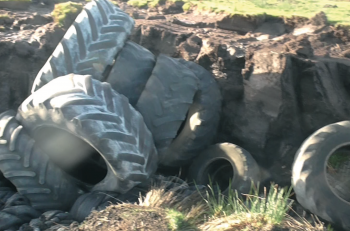
Carndonagh is an area of outstanding natural beauty that nestles in the shadow of the Grinlieve Mountain, only eight kilometres from the designated Natura 2000 sites, Trawbreaga Bay Spa and the North Innishowen Coast. Safeguarded by the 1992 Habitats Directive both these ecological wonders are home to protected animal species and diverse wetlands. Outwardly this area seems idyllic and well-protected; however, on 4 December 2011 Sunday Life newspaper exposed Meenyollan, Carndonagh, as the location of a vast illegal tyre dump fed by KF Tyres, Corody Road, Derry (top right). The landowner, Michael McLaughlin, was also claimed to be complicit in the dumping. Nearly ten million tyres had been buried, unregulated, in the period 2008-2011 alone. At least one for everyone in the audience. It has made Carndonagh Europe’s largest illegal tyre dump. Following the Sunday Life exposé in 2011, Donegal County Council promised robust enforcement including an extensive cleanup operation. KF Tyres should have been made responsible in whole or in part for the cleanup operation Donegal County Council promised. However, seven years on, there is still clear evidence of tyres being illegally buried at this location and there is little evidence of a cleanup. The pristine fields, underpinned by tyres which leach into the meandering water table, contrast starkly with the surrounding boglands and call to mind previous violations and unseen toxicity (bottom right). Although it is difficult to find out the exact composition of a tyre, and there are lots of different types most of them include synthetic carcinogens, solvents and heavy metals, for example. KF Tyres and Michael McLaughlin escaped prosecution and in fact subsequently applied for and were granted a range of permits and planning permissions by both Donegal County Council and the Northern Ireland Environment Agency (NIEA) allowing them to legally operate at the same site. These incongruous decisions, some of which were granted in breach of the legally-man-dated sequence, reduced the promised enforcement to no more than knuckle raps. After an abortive attempt by planning consultant Jim Harley to get McLaughlin’s development deemed “exempt” from planning permission, an unlikely new wheeze was to tout it as land reclamation with secondary drainage benefit. Yet still the terms of the new permits permissions have been flouted. Photographic evidence clearly shows that illegal dumping is still going on at the site. In 2018 KF Tyres and Michael McLaughlin are still controversially involved on this site, while Donegal County Council behaves as if it is unaware of this. In 2015, Planning Permission was obtained for the use of 8448 tyres in 105 bales (80 tyres per bale) over a five- year period, suggesting even what Donegal County Council considers reasonable has been overwhelmed by illegal dumping on a much greater – indeed unconscionable – scale. The photographic evidence (left) shows that neither McLaughlin nor KF Tyres appear to be compliant with the terms of the planning permission, which demands that the tyres that are used be baled, not loose (left, bottom right); nor do they seem to care. Moreover, Donegal County Council evidently does not appear to know what is going on. For example, after the Sunday Life article in 2011, Donegal County Council promised an investigation and robust enforcement. However, in January 2012, mere weeks after the article, Donegal County Council granted McLaughlin a five-year Waste Management Facility permit (WMP) (top right). Why? No planning permission had been granted though one is mandatory before a WMP can be issued. Without the requisite planning permission all tyres taken to Cardonagh around that time continued to be transported and dumped illegally. Jim Harley, formerly of Harley Planning Consultants, has figured in strong criticisms levelled against the Donegal County Council planning department when he worked there a decade ago. These are currently being reviewed by a senior counsel on behalf of the Department of Housing, Planning and Local Government. Harley acted as a planning consultant for McLaughlin when he was granted planning permission in November 2015. There was one condition: that he apply for a WMP. But there was an existing WMP that had been issued illegally. It was illegal precisely because it should not have been issued before planning permission was granted. The Sunday Life article stated in 2011 that KF Tyres had a WCP (waste carriers permit) with Donegal County Council to collect “end of life tyres” but it had no permission to bury tyres at Carndonagh. It is yet another anomaly that KF Tyres obtained a valid Waste Carriers Licence for the South in 2011 but no planning permission or commensurate licence for the site it operated from in Derry. It is strange that Donegal County Council neglected to contact the NIEA about KF Tyres in 2011. The NIEA went on to grant Ken Ferguson a WMP (bottom right) allegedly oblivious to the illegal dumping. This information would have been immeasurably beneficial in averting the current situation. Donegal County Council should have been monitoring the site, verifying the number of tyres being buried both by KF Tyres and McLaughlin. No assessment appears to have been made, north or south of the border, of how many Trans Frontier shipments (TFS) and what tonnage of tyres, KF Tyres declared to the NIEA it had transported between 2012 and 2015. It is not clear how many physical border and site inspections were made by Donegal County Council and the NIEA during this period. As stated both the WMPs (previous page) were granted under Appendix II of the EU Waste Frame Directive 2008/98EC: recovery operations. R10-Land Treatment resulting in benefit to agriculture or ecological improvement; R13 – storage of waste pending (right). Amazingly there is no reference to waste tyres or indeed anything like rubber within this directive, nor to the burial of solid waste in any form. Land reclamation using tyres is deemed dangerous and illegal in Northern Ireland , but not in the Republic – yet both countries are bound by the same European Directives. Given the toxicity of tyres and the stringent legislation on their