Posted in:
The Politics of Disillusionment.
Ronan Burtenshaw explores four of Ireland’s new anti-austerity organisations, asking where they came from and where they are going.
Posted in:
Ronan Burtenshaw explores four of Ireland’s new anti-austerity organisations, asking where they came from and where they are going.
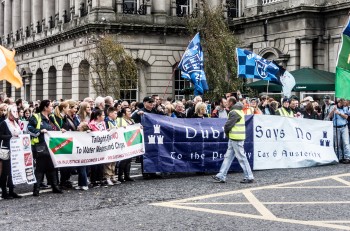
BID (Business Improvements District, now known as DublinTown) is a not-for-profit quango, funded by hundreds of retailers in an area, 2,500 of which are compelled by the City Council – acting under the Local Government BIDs Act 2006 – to pay an extra rate to it. Businesses must vote in favour of becoming a Business Improvement District in order for it to be established. BID’s role was originally to ensure that an area would be clean, green and accessible. Its chief executive is Richard Guiney formerly prominent in the Dublin City Business Association and its chairman is Ray Hernan, CEO of Arnotts. Itsboard comprises city business people and councillors including myself and Ciarán Cuffe, as well as Rose Kenny, Dublin City Council Area Manager. The problem is that its principal functions are already dealt with by the City Council. Additional tasks undertaken by BID, a US-inspired initiative much promoted by the City Business Association, include intense cleaning such as graffiti removal, managing the Christmas lights, tackling the anti-social behaviour that obsesses its members, organising festivals, collecting waste, ‘lobbying’ and ‘branding’. Ultimately it seems that BID is more concerned with employing marketing companies to gure out what consumers are buying than it is about husbanding ratepayers’ and taxpayers’ money to make the city a cleaner, safer place with. BID is attempting to run before it has shown it can walk. The problem for its beleaguered compulsory members is that its functions are ill-defined and many claim that despite its expansionary intent it is not delivering on its original functions. Business owners in Capel St recently took the BID to court and won their case, and some are now seeking to exit the BID and be free of the extra rate levy. BID has brought us branded quarters like Dame District, Talbot Area District and the Creative Quarter. It even has ambassadors directing the public to top Dublin attractions. It is improper, against a background of suspicion of local authorities and the indictment of the Temple Bar Cultural Trust for the City Council to collect over €2m as an extra rate levy forBID/Dublintown, but to have no audit control on how or where this money is spent, if only because DCC is the overriding rating authority. I have a motion before DCC calling on councillors to instruct the CEO to forensically audit this company. At its most recent EGM a strong group of members including some on the Board challenged the CEO and the chairman about a process that would give the BID company the legal right to borrow moneyand begin to acquire property, including for a €1.5m headquarters in the former TSB on Lower Abbey St. Serious questions were raised by members of the organisation about whether such functions wereultra vires the objects of the company and the terms of the 2006 Act. The meeting collapsed in acrimony over the issue of allegedly dubious proxies. Tempers were further frayed by the secrecy of BID/DublinTown’s salvo with Dublin City Council into the Christmas Market business at St Stephen’s Green in 2014, franchised to an outfit called Milestone Inventive whose shareholders include Enterprise Ireland. Due to its faux-ski-resort tackiness, over reliance on fast food and beer and close proximity to what is already a very busy commercial area, this so-called Christmas market caused great annoyance to many local rate-paying businesses, including many BID members, to the Restaurants Association of Ireland and car-drivers. Dublin City’s CEO, Owen Keegan professed himself “underwhelmed” by it, and it duly made noises about improving for next year. BID/DublinTown company is primarily interested in Dublin’s big-beast retailers: BT, Arnotts, Clearys, O’Carrolls Gift Shop, the Ilac Centre etc. It appears more concerned with employing marketing companies to gure out what consumers are buying than it is about making the environment of the city a cleaner, safer place. While some of this might be admirable in its place, it is undemocratic and perhaps even illegal to do so with rate-payers’ money that has been compulsorily extracted from hard-pressed businesses. It also gets the City Council o the hook for some of its own delinquent services. Unsurprisingly, the CEO of Dublin City Council is not impressed by BID marketing initiatives or its property adventures, but claims to be legally powerless since itis accountable only to its own shareholders. The BID/DublinTown brand with its limited remit is inconsistent with Dublin City’s own brand of promoting Dublin. The arrogance and indifference of BID’s current leadership has ensured the discontent of many BID members and will ensure their downfall or discontinuance. It is marshalling its diminishing credibility to ‘love bomb’ Sinn Féin, frantic to burnish its business credentials, the biggest group on the Council – one time bolsterers of now disgraced Temple Bar Cultural Trust. As a Board member of BID I have little confidence in the company. A Business Improvement District’s mandate is for a maximum of 5 years. A Business Improvement District wishing to continue beyond 5 years must reaffirm its mandate through another ballot, based on a further proposal. I support the bid for freedom. • Mannix Flynn
Posted in:
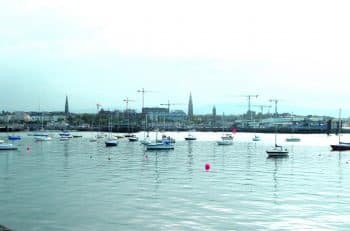
Dún Laoghaire has never quite cut the umbilical cord that connects itself to Dublin City. Although it is the County Town from Dún Laoghaire-Rathdown it has never quite come to terms with itself, and is constantly under pressure from the relentless expansion of Dublin City. This manifests itself in a frenzy of land rezoning every few years when the County Development plan comes up for renewal. The gradual expansion of the county to the south and west puts pressure on Dún Laoghaire to expand and compete with shopping centres and retail parks in Dundrum and Cherrywood. However if properly planned, Dún Laoghaire can hold its own and compete successfully as a vibrant east coast town. Dún Laoghaire has a lot going for it. It has a magical location on the edge of Dublin Bay beside one of the largest harbours in the country. From many of its streets you can look across the Bay to Howth and the Irish Sea. The Stena ferry connects Dún Laoghaire to Wales and beyond. As a planner I believe it has many of the key components that make a successful mixed-use urban neighbourhood: the People’s Park and coastline are within walking distance; good public transport exists with the DART and bus routes running through the town; a mixture of housing and shops are side-by side with schools, pubs and churches within the town. The refurbished Royal Marine Hotel and the Pavilion Theatre attract many visitors, as does the Festival of World Cultures held every August. However, the town has its fair share of challenges, and action is required to ensure it does not get left behind. At the height of the boom new residents were all but excluded from the town. High residential property prices meant that many residents’ sons and daughters had to move to Wicklow or Kildare rather than closer to home to find affordable housing. Hopefully the current slide in house prices will attract more young families to the town to sustain schools that have suffered from declining numbers over the last decade. However, Dún Laoghaire has an ageing demographic compared to the younger suburbs of Dublin, and there is an opportunity to provide more services to an active older population. More housing will support shops and other facilities, but it is crucial that such development is well planned. For instance the rezoning of the Dún Laoghaire Golf Club lands was highly controversial. People saw this as a loss of a green lung of the town and worry that the price of new homes will be unaffordable to many. People fear that the higher densities of new development will overlook and overshadow existing neighbourhoods. Better planning and architectural standards are required to overcome people’s very real concerns. The retail heart of Dún Laoghaire has been challenged in recent years by the bling of the new Dundrum Shopping Centre. Perhaps as the economy changes gear, people will better appreciate the shops and businesses in Dún Laoghaire that did not succumb to the frenzy of the boom years. Some retailers need to pull up their socks, but there’s a healthy mix of shops in Dún Laoghaire.Dún Laoghaire Shopping Centre was refurbished recently yet still presents a brutal edge to the town. I’d be happy to see a controlled explosion on the site similar to the Ballymun Towers! It should be replaced it with a state-of-the-art mixed-use development. Liverpool recently redeveloped part of its city centre with a park and pedestrian streets beside the Mersey. Dún Laoghaire could benefit from that city’s imagination. At the other end of Georges Street, removing a cluster of three buildings in front of Bloomfields Shopping Centre could create a wonderful urban square beside St Michael’s Hospital with space for outdoor cafes and a fountain. In recent months a decision was made to reopen Georges Street to car traffic. This is a backward step. Instead, a decent parking and traffic management plan would allow for a proper car-free area in the heart of the County Town. Successful businesses such as Hughes and Hughes bookshop, Alexis Restaurant and Harry’s bar and Grill have increased footfall. There are bold plans by the Council for a new Library overlooking the sea, and for covering part of the railway line with a new pedestrian promenade. Hopefully the Council will also develop the Dún Laoghaire Baths site as a modest development with a public pool, seaweed baths and a seaside café. Dún Laoghaire has a bright future if it can strike the right balance: high density not highrise; smart growth not suburban sprawl and sustainable transport instead of more car dependency. I’m cautiously optimistic that it will build on its natural strengths as a seaside town of heritage and character, and reinvent itself for the twenty-first century. Ciarán Cuffe is a town planner and Green Party TD for Dún Laoghaire.